Crypto
Amid a scam crackdown, crypto giants keep fueling bitcoin ATMs – ICIJ


Bitcoin ATMs, the now-ubiquitous machines in gas stations and smoke shops that convert physical cash to cryptocurrency, are in trouble.
Over the past few months, the Canadian government announced a proposal to ban the scam-prone machines while Tennessee, Minnesota and Indiana passed legislation to outlaw them. Just last week, the world’s largest operator of these ATMs, Bitcoin Depot, filed for bankruptcy, citing litigation and government action. Experts and authorities have for years warned about the machines’ heavy use by criminals, who rely on them as a convenient means to collect funds from scam victims.
But as the crackdown on crypto ATMs widens, one critical aspect of the scam ecosystem has escaped scrutiny: the crypto giants that have enabled these ATM operations through massive transfers of bitcoin. Because these machines often take in cash and convert that cash to bitcoin, the crypto necessary to make such conversions are essential to the ATM firms.
At ICIJ’s request, a group of cryptocurrency investigators traced billions of dollars in bitcoin transfers from brand-name crypto firms directly to the coffers of ATM companies, even as authorities issued increasingly dire warnings about potential criminal activity. ICIJ found that after attorneys general in Massachusetts, Iowa and Washington, D.C., alleged that top ATM operators were dealing heavily in scam transactions, major crypto companies continued selling them big sums of bitcoin.
This included U.S.-based exchange Kraken, which has transferred at least $1.1 billion worth of bitcoin to crypto ATM operators in recent years. ICIJ found that Kraken sent the ATM operator Athena Bitcoin at least $17 million worth of cryptocurrency after District of Columbia authorities singled out its machines last September.
“Athena’s bitcoin machines have become a tool for criminals intent on exploiting elderly and vulnerable District residents,” D.C. Attorney General Brian Schwalb said in a statement at the time. “Athena knows that its machines are being used primarily by scammers yet chooses to look the other way.”
Athena Bitcoin has rejected these allegations. In response to questions from ICIJ, Kraken said that it takes its regulatory obligations seriously and maintains robust compliance controls. In a statement, a spokesperson said its “business relationships are subject to rigorous onboarding, ongoing due diligence, and enhanced monitoring standards.”
Between May 2020 and March 2025, the crypto firm Gemini provided more than half a billion dollars in bitcoin to Bitcoin Depot. Cumberland DRW, a crypto trading firm founded by billionaire Don Wilson, has also been a major supplier of bitcoin to crypto ATM firms, including Bitcoin Depot and CoinFlip, according to blockchain researchers.
Cumberland and Gemini did not respond to requests for comment.
In some cases, big crypto players provided bitcoin to ATM operators that were later criminally charged, ICIJ found. For instance, the crypto exchange Bitstamp sent at least $7 million to a firm called Crypto Dispensers between 2018 and 2024 — which fell within a timeframe when the firm used its ATM network for money laundering, according to a federal indictment.
Bitstamp did not respond to requests for comment. Firas Isa, the founder of Crypto Dispensers, who is also under indictment for money laundering, told ICIJ in an interview that Bitstamp performed rigorous audits on his firm. Isa denies the allegations in the indictment, which states that his firm received large amounts of money derived from crimes including from scam victims.
At ICIJ’s request, a half-dozen experts who specialize in analyzing bitcoin transaction records on the public ledger known as the blockchain helped examine and confirm details of these transactions. These experts included Fredric Buret, of the crypto investigations firm Recoveris, and Joshua Cooper-Duckett of the firm Cryptoforensic Investigators.
Jason Ghetian, a former FBI agent specializing in crypto scams, told ICIJ that the providers of large amounts of bitcoin to crypto ATMs should have been wary of those business relationships, given the machines’ reputation for being heavily used by criminals. “These exchanges could shut these ATMs down if they don’t provide liquidity for them,” Ghetian said.
The companies have not, however, broken the law by providing the ATMs with bitcoin liquidity. In recent years, the crypto industry’s biggest players have vigorously sought to be accepted as part of the mainstream financial system, with Kraken just this year being the first to receive approval for a so-called master account with the Federal Reserve. Even amid this push for broader recognition, the most prominent crypto firms remain deeply entwined with a part of the industry that lawmakers around the world are scrambling to protect consumers from.
‘How can people be so cruel?’
The first bitcoin ATM went live in late 2013 in Vancouver, Canada, creating a fast bridge from cash to cryptocurrency. By combining cash and cryptocurrency — two forms of money that are difficult to trace — the machines provided a high level of anonymity for users seeking to move funds discreetly.
As the machines spread across the globe, criminals took notice. A key feature of the machines is their ability to move funds across national borders with deep anonymity and few checks. As the industry has grown rapidly, concerns about bitcoin ATMs have only mounted. In 2021, the FBI warned that criminals were increasingly relying on these services to receive funds from scam victims. Once victims deposit money into a bitcoin ATM — often at the behest of a scammer who has convinced them they are funding their own crypto accounts — the cryptocurrency is often sent overseas, where it can rarely be recovered.
Experts and local law enforcement officials have raised a steady stream of alarms about the machines. In 2024, the U.S. Federal Trade Commission called crypto ATMs “a payment portal for scammers.” Despite that, tens of thousands of the machines remain in operation around the United States.
The largest ATM operators have been voracious consumers of bitcoin, which enables cash-to-cryptocurrency conversions, according to experts. “If you’re doing hundreds of millions in volume, you need to have a place where you can quickly buy bitcoin,” said Marc Grens, whose business DigitalMint operated a nationwide network of the machines for nearly a decade. “You need a large enough source that allows you to buy enough bitcoin to replenish your inventory on demand.”
Grens said his firm exited the ATM business due to the pervasiveness of scams. “Cleaning up fraud means you’re not making revenue,” Grens said.
Prior to its bankruptcy last week, Bitcoin Depot had nearly 10,000 crypto ATMs operating around the world — from Alaska to Tasmania. In a lawsuit against Bitcoin Depot filed in early 2025, Iowa’s attorney general alleged that its analysis of the company’s machines in the state showed that between October 2021 and July 2024 more than half of the transactions involved scams.
Cleaning up fraud means you’re not making revenue — former crypto ATM operator Marc Grens
Bitcoin Depot has denied wrongdoing, saying that it “cannot be held liable for the criminal acts of third-party scammers, especially considering the robust warnings and safeguards provided” on its machines and during transactions.
The New York-based Gemini crypto exchange, owned by the billionaire Winklevoss twins, provided Bitcoin Depot with more than half a billion dollars worth of bitcoin in recent years. These transactions appear to have ended with a March 2025 bitcoin transfer of roughly a half-million dollars.
The Winklevosses have positioned Gemini at the center of a push to allow crypto firms to self-regulate via a private crypto association that would incentivize “the detection and deterrence of manipulative and fraudulent acts and practices.”

Blockchain analysts have examined money flows from crypto ATMs and found red flags that, in theory, are visible to anyone with high-quality cryptocurrency analysis tools. In 2024, the analysis firm TRM said it had found recurring patterns pointing to money laundering across hundreds of crypto ATMs. The firm said apparent financial crime risk indicators of the ATMs were “significantly higher than average risk scores for crypto exchanges,” in a review of transactions linked to machines in California.
ICIJ reviewed the activity of one high-volume cryptocurrency address — similar to a bank account — owned by Bitcoin Depot. That address used the bitcoin it had on hand to send out transactions initiated by users of Bitcoin Depot ATMs. Brad Thorne, a police detective in Boise, Idaho, who investigates crypto scams, said he had seen the same address used to transmit victims’ bitcoin in more than a hundred cases. “That address shows up consistently in my investigations,” Thorne said.
The Bitcoin Depot address also received sizable bitcoin transfers from Gemini. Between 2021 and March 2025, Gemini accounts sent tens of millions of dollars worth of cryptocurrency to the address.
Ann Tatem, a 77-year-old resident of Lake City, Florida, lost much of her life savings to a scammer relying on a Bitcoin Depot ATM using this same cryptocurrency address, according to experts who reviewed the transaction. In April 2025, Tatem, exhausted after a long night of caring for her sick husband, activated her computer to a flashing screen warning that she’d been hacked and instructing her to call a 1-800 number. When she dialed the number, she spoke with a person claiming to be with the Federal Trade Commission. That person told her authorities needed to freeze her bank accounts and, to safeguard her funds, directed her to deposit $10,000 in cash into a local Bitcoin Depot ATM.
I couldn’t eat, I could not sleep. It was like, how can people be so cruel? — crypto ATM scam victim Ann Tatem
Tatem had joined thousands of Americans who have collectively lost hundreds of millions of dollars to sophisticated scammers relying on ATMs to rapidly convert victims’ cash into cryptocurrency. In all of these crimes, law enforcement has little chance of tracing the cryptocurrency to an owner.
“That was a lot of our savings. We’re simple people,” Tatem said, adding that the crime left her traumatized. “I couldn’t eat, I could not sleep. It was like, how can people be so cruel? It’s just beyond my comprehension.”
A ‘silent partner to many scammers’
Over the past six months, the state of Connecticut suspended Bitcoin Depot’s banking license for lapses in anti-money laundering controls; Missouri’s attorney general opened an investigation into several crypto ATM operators, including Bitcoin Depot; and Nevada and Maine settled enforcement actions with the firm, requiring it to pay fines and comply with state rules. Massachusetts’ attorney general also recently sued Bitcoin Depot, alleging most of its revenue was derived from scams.
Another major sender of cryptocurrency to Bitcoin Depot was Cumberland DRW, the crypto arm of the Chicago-based trading firm DRW, founded by billionaire and famed trader Don Wilson. He made headlines last year when DRW invested $100 million into a Trump family crypto project shortly after the U.S. Securities and Exchange Commission dropped an investigation into Cumberland, according to the Financial Times. In a March filing, Bitcoin Depot named Cumberland, Gemini and other firms as its bitcoin suppliers.
Even after Gemini appeared to stop sending funds to Bitcoin Depot in March 2025, Cumberland continued to do so, according to experts who reviewed the transactions. These transactions lasted until March 30, 2026.
According to the experts ICIJ consulted, Cumberland is also a key provider of cryptocurrency to CoinFlip, which has been identified as the world’s second-largest bitcoin ATM operator behind Bitcoin Depot. Iowa’s attorney general sued CoinFlip last year, alleging that all of its top 20 crypto ATM users in Iowa, among many others, were scam victims.
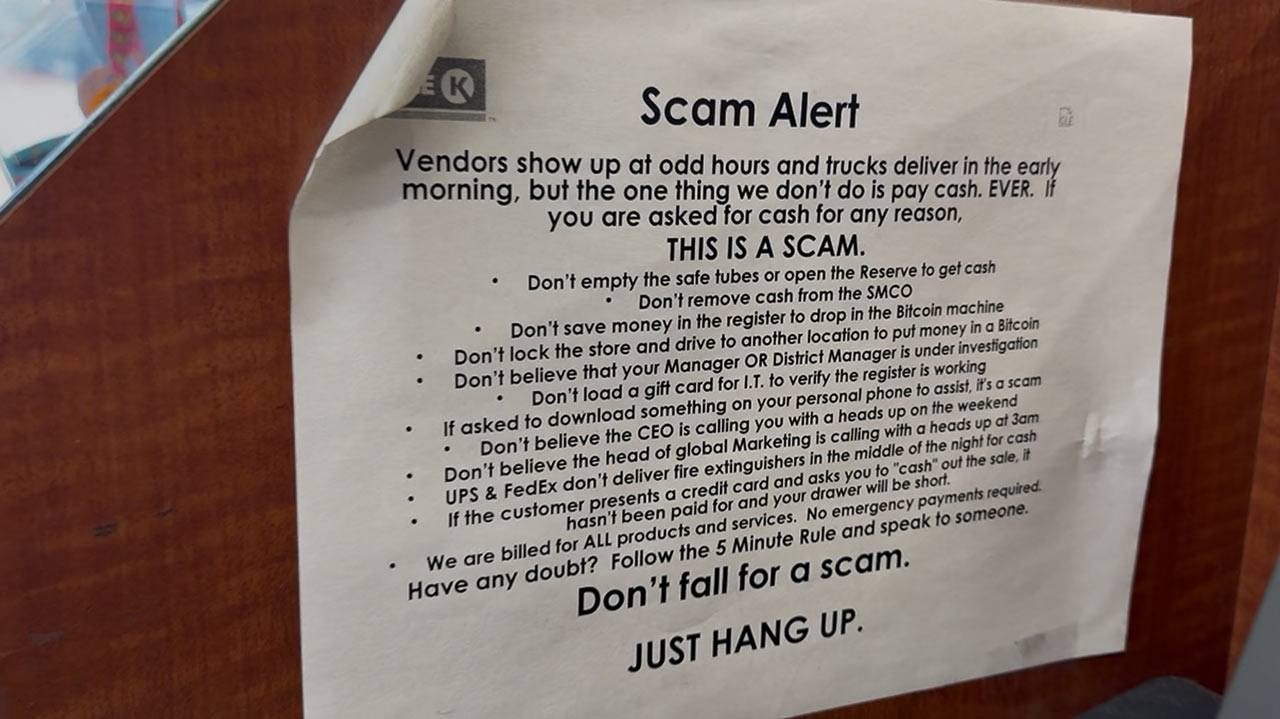
“At best, CoinFlip is a willfully blind participant in the victimization of hundreds of Iowans,” according to the state’s lawsuit. “At worst, it is a silent partner to many scammers preying on Iowans.”
CoinFlip did not provide comment for this story. In an April filing, the firm’s lawyers said Iowa authorities have deployed baseless accusations in a “smear campaign” that has damaged its standing with regulators, legislators, consumers and business partners. The firm has denied that it enables or tolerates scammers on its machines and called the Iowa suit an “unmistakable assault on the nature of cryptocurrency itself.” CoinFlip said it requires its customers to read multiple fraud-related warnings and disclaimers when using its machines.
In recent years, Cumberland has sent CoinFlip over a billion dollars worth of bitcoin, according to experts who reviewed the transactions. These transactions were as large as $5 million apiece, the experts said.
Until mid-2024, CoinFlip also received roughly $1.5 billion worth of bitcoin from London-based trader Enigma Securities, according to the experts. Enigma Securities is a subsidiary of the Makor Group. Like Cumberland, Enigma Securities labels itself as a so-called crypto liquidity provider, giving businesses fast access to wholesale portions of various cryptocurrencies. Crypto ATMs have been effectively banned from operating in the United Kingdom because authorities have not granted a licence to any of the firms.
Enigma Securities did not respond to requests to comment on this story.
The experts who reviewed data for ICIJ said that Enigma Securities was a bitcoin liquidity provider to the crypto ATM operator Bitcoin of America, which was shut down in 2023 after its founder, Sonny Meraban, was arrested in Florida for operating ATMs without proper licensing. Meraban told ICIJ that, before his arrest, his firm used multiple services, including Enigma Securities and FalconX, a crypto trading company headquartered in San Mateo, California. Meraban said he used accounts with multiple exchanges so that he could shop around for the cheapest bitcoin to improve his profit margins.
“We needed a lot of bitcoin and were linked up to exchanges to get that bitcoin every day,” said Meraban, who pleaded guilty in 2023 to charges relating to his firm’s licensing. “This is how the business model works.”
Enigma Securities did not respond to requests for comment. FalconX declined to provide comment for this story.
ICIJ found that Kraken has played a key role in supplying bitcoin to several major crypto ATM operators in recent years, including more than $700 million in bitcoin to Coinhub and at least $245 million in bitcoin to Byte Federal, according to experts who reviewed these transactions.
Coinhub did not respond to a request for comment. In an interview with ICIJ, Byte Federal’s CEO Paul Tarantino said Kraken is the firm’s sole liquidity provider. “We have a really good relationship with Kraken,” he said.
Tarantino said that Byte Federal is a leader in anti-fraud measures. In early 2024, he said, Byte Federal began rigorously vetting all customers over the age of 60, resulting in 84% of those would-be customers being blocked due to scam concerns. He added that the number of those visitors to his company’s machines has recently fallen, however. “Scammers that get ahold of these seniors are making a decision not to send them to our kiosks.”
Kraken’s relationship with Athena Bitcoin, another top crypto ATM operator, appears to have expanded in late 2023. The exchange began sending the firm more than a million dollars worth of bitcoin each week on average until mid-2025, when the pace slowed, according to the experts.
Last September, Washington D.C.’s attorney general alleged that 93% of Athena Bitcoin’s transactions involved a scam, saying the firm “fails to provide effective oversight, creating an unchecked opportunity for illicit international fraud.”

Following the legal action, Athena Bitcoin told a local news station that it “strongly disagrees with the allegations” and that it will fight the charges. The firm said it has “multiple safeguards, from prominent warnings and daily transaction limits to five separate verification screens designed to stop coerced transactions,” according to the report.
The day after the D.C. attorney general’s announcement, a Kraken account sent Athena more than $270,000 worth of bitcoin in a single transaction, according to experts ICIJ consulted. And Kraken accounts continued to send large amounts of cryptocurrency to Athena Bitcoin, amounting to about $17 million as of March 31, 2026, when the transfers appear to have stopped, the experts said.
Athena did not respond to requests to comment for this story. In a March filing, Athena Bitcoin called Kraken its “primary crypto exchange.” In a subsequent filing dated May 14, Athena did not mention Kraken.
In March, Kraken became the first crypto firm approved for a Federal Reserve master account, which allows the exchange to move traditional money directly via U.S. central banking infrastructure, a privilege never before granted to a crypto firm. Republican Sen. Cynthia Lummis of Wyoming, a proponent of the crypto industry, called the approval a “watershed moment for the digital asset industry” and a “monumental step towards making payments safer, faster, and cheaper.”
Last month, the FBI released new figures showing that crypto ATM scams had recently surged, with Americans losing $389 million relating to the machines in 2025. These scams especially targeted Americans over 60, like Ann Tatem.
Tatem told ICIJ that the loss of retirement savings forced her to cash out her life insurance plan. “I just hope something can be done about those machines,” she said.


Key Takeaways
- Blackrock’s Q2 2026 revenue hit $7.1 billion as Fink filed new SEC papers for tokenized funds.
- Ishares products crossed $6 trillion in assets while Blackrock’s digital currency and tokenized exchange-traded fund (ETF) business held near $110 billion.
- Blackrock raised its 2026 buyback plan to $2 billion as Fink pointed to accelerating momentum ahead.
The New York-based asset manager posted adjusted earnings per share of $13.91, up 15% from a year ago, and adjusted operating income of $2.9 billion, a 39% increase. On a GAAP basis, diluted earnings per share reached $12.19, up 20% year over year.
Blackrock’s assets under management (AUM) reached a whopping $15.3 trillion, driven by $868 billion in net inflows over the trailing 12 months and 10% organic base fee growth.
Record Inflows Push Assets to $15.3 Trillion
According to the firm’s second-quarter 2026 earnings, Blackrock brought in $192 billion of net inflows during the second quarter alone, contributing to the strongest first half in the firm’s history. Flows through the first six months of 2026 topped $321 billion, more than double the total from the same period last year.
During the earnings call, Chief Financial Officer Martin Small told analysts on the earnings call that the results reflect Blackrock’s position at the center of mega trends reshaping public markets, private markets, and technology. The company’s adjusted operating margin hit 45.9%, its highest level in nearly five years, expanding 260 basis points from a year earlier.
Ishares, Blackrock’s exchange-traded fund platform, crossed $6 trillion in assets under management, roughly doubling in three years. The unit pulled in $178 billion of net inflows in the quarter, led by $85 billion into core equity ETFs and $61 billion into index bond ETFs. Active ETFs added another $20 billion.
Tokenization Push Moves From Concept to Filings
Blackrock disclosed it has filed two registration statements with the Securities and Exchange Commission (SEC) for tokenized money market funds. One would create a tokenized share class on ethereum for an existing fund. The other is described as a digitally native strategy with features like daily dividend reinvestment.
Small explained that the filings are meant to connect Blackrock’s cash management products to investors who already hold assets in digital wallets. He noted the funds are expected to operate across multiple blockchains, with stablecoins supporting subscriptions and redemptions directly on chain.
“When we talk about tokenized assets, tokenized assets are the spear tip into an entirely new distribution channel,” Small explained, pointing to an estimated 5 billion digital wallets worldwide as a long-term growth opportunity for the firm.
Bitcoin, Ethereum and Stablecoin Business Expands
Blackrock now has roughly $110 billion in AUM connected to digital assets, according to Small. The firm’s Ishares Bitcoin Trust, Ethereum Trust, and its BUIDL tokenized fund remain the largest products in their respective categories. Blackrock has set an internal target of turning digital assets into a $500 million revenue business as part of its 2030 growth plan.
The company also manages $60 billion in reserves for stablecoin issuer Circle, which Small disclosed represents about a quarter of the $300 billion stablecoin market.
Despite a decline in bitcoin and ethereum prices during the quarter, Small detailed that Blackrock’s European bitcoin ETF took in more than $650 million in international demand. He attributed the flows to investors treating bitcoin as a small, diversifying allocation inside broader portfolios rather than a core holding.
Blackrock’s financial tables showed digital assets as a product category recorded $3.1 billion in net outflows for the quarter, with digital asset AUM falling to $48.8 billion from $60.7 billion in the first quarter, reflecting the price declines Small referenced.
Fink Points to Strong Market Fundamentals
Fink used much of his prepared remarks and the question and answer session to lay out his view of the broader economy. He described a market environment marked by rising corporate earnings and technology-driven productivity gains.
“Market fundamentals are strong and well supported, with higher margins and earnings momentum catalyzed by new technology,” Fink said in the earnings release.
Fink added:
“The scale and depth of our client relationships globally have never been greater.”
On the call, Fink pointed to U.S. equity markets climbing to new highs and said returns are broadening beyond American stocks. He also addressed the dollar’s role in global portfolios, noting the currency’s volatility is tied closely to Federal Reserve policy on interest rates.
Fink also highlighted Blackrock’s role supporting the U.S. Treasury Department’s newly launched Trump Accounts program, with two Ishares ETFs expected to become investment options later this year. He closed the call on an optimistic note.
“Our momentum is accelerating, and I’ve never been more optimistic about the growth ahead,” Fink stressed.
What Comes Next
Blackrock raised its planned 2026 share repurchases to $2 billion, up from prior guidance, after buying back $450 million in stock during the quarter. Executives said they expect quarterly buybacks of at least $550 million going forward, citing confidence in free cash flow growth.
The firm’s private markets business, built around its HPS and Global Infrastructure Partners acquisitions, added $15 billion in net inflows during the quarter. Executives said infrastructure and private credit deployment activity have been among the busiest periods on record for the platform, with insurance companies increasingly seeking higher yields through private market allocations. Fink remarked that the firm has closed about $10 billion in high-grade and infrastructure debt mandates for insurers so far this year, a trend he expects to keep building.

STARKVILLE, Miss. (WTVA) — A proposed cryptocurrency mining facility is under review in Starkville, with city officials and residents divided over its potential benefits and drawbacks.
Several citizens voiced concerns at a recent meeting, citing potential noise pollution, environmental impact and the volume of resources the facility would require to operate.
Starkville Mayor Lynn Spruill said the facility would benefit the community, describing it as a $10 million investment. She said the money would go to the city, the county and the school district.
Spruill said the facility is projected to use 20,000 gallons of water per day, noting the city’s splash pad uses more — at 60,000 gallons per day.
The center would draw 30 megawatts of power; the city has a 50-megawatt capacity.
Spruill said the facility would generate about $1 million for the electric department, allowing the city to offset rate increases.
Michael Frayser, owner of High Ground Coffee, said he opposes the proposal.
“What it’s really going to do is — it’s going to gobble up electricity. And all these people are up in the air about the environment and all this stuff. I don’t really want to see a cryptocurrency mining center here gobbling up even more resources, taking up space. I’m not a fan of it,” Frayser said.
Vice Mayor Roy A. Perkins said he needs to see all of the facts and has questions for the company.
“As a decision maker, if I see any type of impact, I’m not going to vote for it to locate here because I’m not willing to risk any quality-of-life issue,” Perkins said.
Spruill said the board could see plans as soon as August.
Copyright 2026 WTVA. All rights reserved.

Key Takeaways
- Interactive Brokers added 12 digital assets and enabled 24/7 stablecoin wallet transfers on July 14, 2026.
- IBKR fees starting at 0.12% undercut high-cost brokers by 85% to capture institutional crypto volume.
- Zero Hash and Paxos will drive compliance into late 2026 as UK and Irish accounts face 0% access rules.
Interactive Brokers (Nasdaq: IBKR), the automated global broker that manages approximately $930.3 billion in client equity as of mid-2026, integrated these capabilities directly into its core electronic trading architecture. Clients can now execute automatic conversions to withdraw U.S. dollars from their brokerage accounts directly into external destinations, including personal non-custodial cryptocurrency wallets, using Circle’s USDC, Paypal’s PYUSD, or Ripple’s RLUSD.
This infrastructure upgrade bridges traditional finance (TradFi) markets and digital currency networks without requiring investors to switch between separate applications. By allowing near-instantaneous transfers 24 hours a day, including weekends and holidays, the firm ensures that market participants can move capital onto the platform and begin trading across 170 global markets within minutes.
Redefining Brokerage Cost Structures
“We believe digital assets should be integrated into a client’s broader financial experience, not treated separately,” explained Milan Galik, Chief Executive Officer of Interactive Brokers. Galik emphasized that as stablecoins become a more widely used method of payment and transfer, the firm remains focused on providing seamless digital asset access alongside a diverse range of global products.
The institutional expansion addresses a critical friction point for high- volume traders who frequently contend with steep transactional overhead on specialized crypto exchanges. Interactive Brokers charges crypto commissions starting between 0.12% and 0.18% of total trade value, featuring a modest $1.75 minimum per order. Crucially, the broker imposes no added spreads, markups, or custody fees, undercutting conventional competitors by up to 85%.
Industry data reveals that recently launched crypto offerings from traditional brokerages charge client commissions as high as 0.75% per transaction. Alternative platforms often remain two to four times more expensive, with some retail applications charging up to 1.20% or more. By maintaining low overhead, IBKR leverages its $21 billion consolidated equity capital to aggressively capture market share from standard spot exchanges.
Token Expansion and Custodial Pipelines
Tuesday’s Interactive Brokers crypto expansion routes new asset classes through separate regulated pipelines to guarantee institutional-grade compliance and security. Through its partnership with Zero Hash, the broker added Aave, Aptos, Canton, Lido DAO, Monad, NEAR Protocol, Plasma, Pax Gold, and Uniswap. The addition of Pax Gold provides a digital token backed entirely by physical gold stored in professional vault facilities.
Concurrently, Paxos Trust Company will facilitate trading for three of these newly supported assets, specifically AAVE, UNI, and PAXG. These choices join an existing institutional catalog that already includes high- liquidity crypto assets such as bitcoin, ethereum, solana, bitcoin cash, litecoin, and XRP. This dual-vendor model minimizes counterparty risks for the firm’s rapidly growing base of 5.185 million client accounts.
This strategic development coincides with a period of massive operational growth, as the firm’s Daily Average Revenue Trades recently surged 53% year-over-year to 5.269 million. Margin loan balances also climbed 67% to $108.5 billion, highlighting a highly active client base that utilizes capital leverage across unified portfolios. The addition of crypto flexibility serves as an onboarding tool for sophisticated international investors.
Regulatory Guardrails and Global Availability
While the expansion enhances utility for domestic accounts, strict geographic limitations remain firmly in place due to fragmented cross-border regulatory frameworks. Bidirectional funding via stablecoin is entirely unavailable to clients registered under Interactive Brokers U.K. Limited or Interactive Brokers Ireland Limited. Furthermore, the newly introduced crypto-assets cannot be accessed by clients of the Irish affiliate.
Corporate executives maintained a realistic, risk-managed tone regarding broader market conditions, explicitly stating that digital asset trading carries exceptional financial danger. The platform noted that these specific digital products are designed exclusively for individuals with high risk tolerance and the financial capacity to sustain total capital losses. This conservative positioning aligns with the firm’s corporate credit profile and S&P rating of A- with a stable outlook.
As digital and TradFi continue to converge through tokenization and institutional investment vehicles, Interactive Brokers positions its balance sheet as a primary clearing house. The elimination of separate wallet ecosystems reduces operational friction for hedge funds and independent money managers alike. This long-term framework underpins the broker’s overarching strategy to capture institutional wallet share as the digital currency landscape matures.
-

 Michigan1 minute ago
University of Michigan’s David C. Miller chosen to succeed Jeff Balser as Vanderbilt Health’s President and CEO and Dean of Vanderbilt University School of Medicine
-

 Massachusetts7 minutes ago
Massachusetts Broadband Institute distributes devices to underserved communities
-

 Minnesota13 minutes ago
Smoke from wildfires in Minnesota and Canada exposes millions to dangerous air quality
-

 Mississippi19 minutes ago
How permanent daylight saving time would impact Mississippi
-
 Missouri25 minutes ago
Missouri reports 43 cases of parasitic infection that’s sickened thousands nationwide
-

 Montana31 minutes ago
Governor Gianforte Announces Montana Ranks as Top 10 State for Job Growth
-

 Nebraska37 minutes ago
Roanoke County teen heads to national rodeo finals in Nebraska
-

 Nevada43 minutes ago
Nevada’s modern boomtowns are these fast-growing cities, study said

