Business
Your package wasn't delivered? Try living at one of L.A.'s '½' addresses

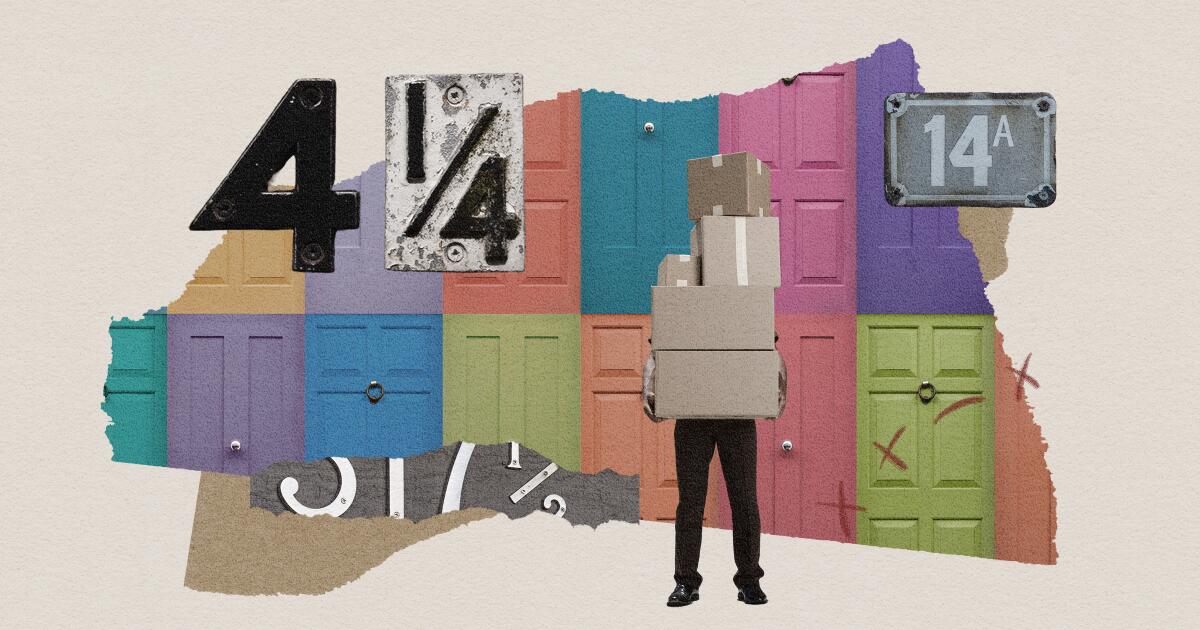
Casey Hogan had no idea her new address would be so frustrating.
But soon after moving into a granny flat in Van Nuys three years ago, she realized that the fraction in her house number — think: 101 ½ Main St. — was going to be particularly inconvenient in an era of constant deliveries.
Her packages get marked as “address not deliverable” or dropped off at the wrong door. Retail websites that are programmed to reject special characters, including the fraction’s slash, sometimes refuse her shipping address or auto-correct it to another location.
She has tried workarounds to this quirk of Los Angeles geography — most common in dense neighborhoods with duplexes or, as in Hogan’s case, at accessory dwilling units built on preexisting properties. Spelling out the fraction as “one half” has helped, but about a quarter of her packages or food deliveries arrive late or get dropped at someone else’s house.
In the case of a particularly urgent order before a flight, she had Amazon deliver a dog carrier to her mother’s home in Oceanside and drove there to pick it up instead of risking a snafu at her place.
“It’s still a nightmare,” said Hogan, 32, who works as a medical scribe. “Anything that could go wrong has gone wrong.”
In the increasingly deliverable world shaped by consumers’ skyrocketing, post-pandemic expectations that almost anything they want or need should arrive quickly and seamlessly at their doorstep, residents at more than 60,000 Los Angeles addresses like Hogan’s have been left on the sidelines. (Or really, left standing on their stoops, searching endlessly for packages.)
The shared inconvenience grew into a community on Reddit, where people swap tips, such as entering the address as a decimal — 101.5 Main Street — or spelling it out as Hogan does. One person made a more drastic suggestion: “Break down and get a P.O. box.”
Dealing with fractional addresses and other tricky deliveries, such as those behind gates, is equally frustrating — and costly — for retailers, logistics experts said, as well as for shipping companies that move more than 58 million packages a day in the United States.
The average American received about 70% more packages in 2022 than in 2017, according to a Capital One shopping research report. And a recent survey of 300 retail executives by the location data company Loqate found that almost 8% of first-time deliveries in the U.S. failed, costing about $17 per failed order — or roughly $200,000 a year.
Fractional addresses are sometimes written with slashes and other times with decimals — or, as at this home in East Hollywood, both.
(Marisa Gerber / Los Angeles Times)
“They have to deal with such a large amount of packages,” said Blake Droesch, a senior analyst at eMarketer who studies last-mile delivery. “This is not the post office of yore, where you could get an address half right, and the mailman will spend half the day trying to figure out who this letter belongs to.”
Since demand for deliveries spiked early in the pandemic, Droesch noted, there has been a significant shift in what people buy online, from items like new shoes or a laptop — things people didn’t mind waiting a few days to receive — to hygiene products and home essentials needed quickly.
“If you run out of deodorant,” he said, “you kind of need that the next day.”
Ram Bala, an associate professor of business analytics at Santa Clara University, studies the supply chain and is involved in a startup that will use generative artificial intelligence to improve shipping logistics.
Bala said it’s often odd little problems that sound simple to solve — in this case, figuring out how to accommodate fractional addresses — that end up being the trickiest.
“Anytime you try to fix that problem, there are unintended consequences somewhere else,” he said. “It’s a trade-off.”
Retailers don’t appear to be prioritizing a fix for people with fractional addresses, since doing so would require removing rigid formatting parameters built into software to ensure that normal addresses get entered correctly, Bala said.
In Los Angeles, which has about 1 million residential addresses, the roughly 60,700 fractionals are relative rarities. They’re concentrated in densely populated neighborhoods such as Boyle Heights, East Hollywood and Pico-Union, according to the city’s Bureau of Engineering, which oversees the handling of address numbers.
“The use of fractional numbers is discouraged and should only be used as a last resort,” a primer on the bureau’s website says.
A spokesperson for the city said the reticence to assign fractional addresses — which are often, but not always, ½ and never go beyond ¾ — stems from conversations with residents worried about not only confusing delivery drivers and visitors but the effect on property values. Still, it’s sometimes the best alternative when squeezing new units between existing ones.
The phenomenon isn’t unique to L.A.
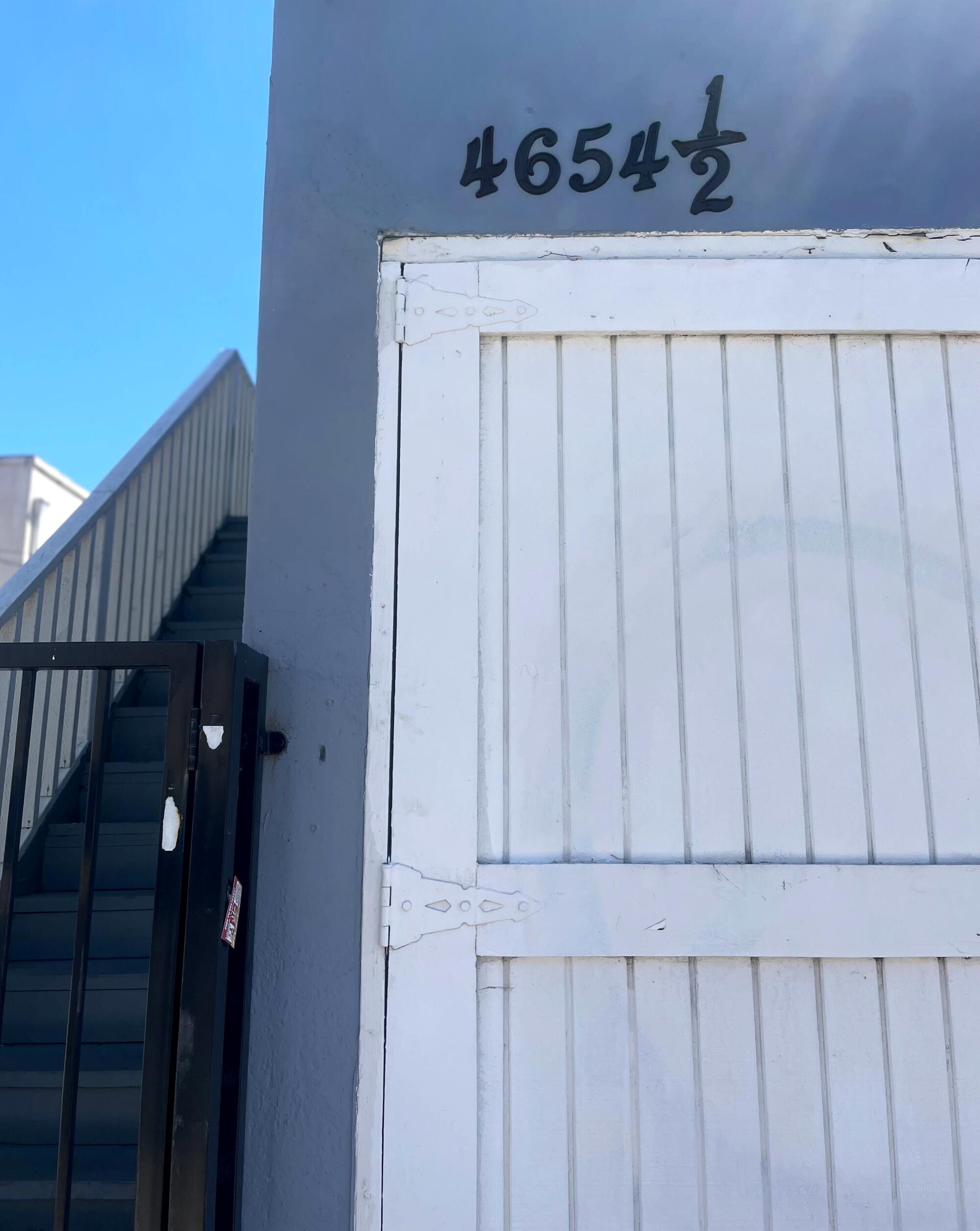
Only about 60,700 of Los Angeles’ 1 million residential addresses have fractions.
(Marisa Gerber / Los Angeles Times)
Pockets of other big cities where large, historic buildings were divided into smaller dwellings, such as New York and Philadelphia, also have fractional addresses. And in an even more complicated twist detailed in a piece by Colorado Public Radio, the city of Grand Junction, Colo., has fractions in its street names, creating perplexing intersections such as C ½ and 28 ¾ roads.
Despite the delivery headaches, fractional addresses can carry a whimsical charm, often drawing comparisons to Platform 9 ¾, the fictional London train stop where students in the Harry Potter series caught the Hogwarts Express.
But for Juan Crespo, who started the Reddit thread asking for tips about living at a fractional address, it was more annoying than alluring.
Before moving into a unit in a Highland Park quadplex in 2021, the 32-year-old research scientist tried to change his shipping address with online retailers he used frequently, including Southwest Airlines and Target, where he and his spouse had created their wedding registry.
But the sites kept rejecting the slash.
He eventually called and, after a wait, got a Target employee to manually add the “½” to his address; by then, he said, several gifts, including a $300 stand mixer, had already been sent.
When ordering from DoorDash and Uber Eats, he said, his address would often be automatically switched to a different location a few blocks up, requiring him to enter a neighbor’s address instead.
“It was just a pain,” said Crespo, who has since relocated to Michigan and settled into a home with a full address number. “I’m glad we don’t have to deal with that anymore.”
For Hogan, who lives in the ADU in Van Nuys, the annoyance remains.
A few months ago, she posted to an online help forum, asking Google to have her fractional address added to Google Maps, since many retailers use the company’s mapping software to handle shipping logistics, and a problem there can create a ripple effect of issues on other sites.
“I have to resort to entering my neighbor’s address and hoping I can intercept the delivery person,” Hogan wrote. “HELP!”
A member of Google’s Product Experts Program, a group of volunteers who answer questions in exchange for perks from the company, quickly responded to Hogan saying that only an employee can add an address with a slash to the map. A volunteer asked her to upload a photo of her driver’s license or utility bill showing her address, but Hogan felt uncomfortable doing so and abandoned the effort.
She can easily rattle off a list of packages that never arrived or were initially dropped off somewhere else: workout clothes, two pairs of shoes from Nike, a showerhead from Jolie Skin Co. And she has gotten used to filing claims with shipping companies after getting notifications with pictures showing packages left in unfamiliar doorways. She bought a Ring doorbell camera and enabled the package notification feature, so she has proof that a delivery never arrived.
So many of her food deliveries got messed up, she said, that she set up a rack outside her gate with a sign that reads, “Leave food here.”
These days, she prefers to shop in person whenever possible and thinks twice before buying anything online — a hesitance, she admits with a laugh, that comes with a silver lining.
“I guess it does save me money.”


Ethics experts sounded the alarm Wednesday after new financial disclosure reports revealed that President Trump’s income ballooned to $2.2 billion in 2025, with $1.4 billion coming from various new cryptocurrency-related businesses.
“It’s bribery. It’s graft. It’s exploitation of public power for private financial gain,” said Kathleen Clark, a law professor at Washington University and an expert in government ethics. “Trump has — with the acquiescence of a somnolent, GOP-controlled Congress and the active assistance of John Roberts’ Supreme Court — transformed the presidency into a massive corruption racket.”
Trump reported income of over $600 million in 2024. But after he entered the White House in 2025, he reported that his income had soared to more than $2.2 billion.
The 2025 annual disclosure report filed with the Office of Government Ethics shows that Trump ramped up his real estate business in countries across the globe, particularly in the Middle East, at a time when his government was negotiating over vital issues of military aid and economic tariffs. The president also expanded his dealings in the relatively new realm of cryptocurrency.
According to the 927-page report, Trump made $635 million in royalties from Celebration Coins and more than $500 million from his World Liberty Financial crypto firm. He drew in millions from a raft of Trump-branded merchandise including God Bless the USA Bibles and sneakers depicting him with his hand raised in a fist. He also brought in $10.4 million from a property in the United Arab Emirates and $9 million from a property in Saudi Arabia.
Noah Bookbinder, an ethics expert and former president of Citizens for Responsibility and Ethics, a nonprofit watchdog group in Washington, described Trump’s business dealings while in the White House as “entirely unprecedented, certainly in modern history, but I think by most ways of measuring, in all of American history.”
“This is corruption,” Bookbinder said. “You have a president who has been quite transparently using the presidency in ways that benefit his business interests and intertwining the presidency and business interests.”
But the president and the White House brushed aside ethics concerns about the money Trump is making.
Trump told reporters Wednesday that he made a lot of money before he came to the White House, he had “big institutions” run his money, and that he had benefited, like every other American, as the stock market went up.
“We’re all profiting,” he said. “I’m profiting because I have a lot of money and a lot of cash.”
In a statement, White House spokesperson Anna Kelly said: “Neither the President nor his family has ever engaged — or will ever engage — in conflicts of interest. … All actions by President Trump and his administration are taken in the best interest of the American people.”
Although the report does not show exactly how much Trump is earning — it provides details of revenue, rather than profit — the scale of the president’s cryptocurrency dealings elevated ethics watchdogs’ long-standing concerns.
Jordan Libowitz, a vice president at Citizens for Responsibility and Ethics, said the most concerning detail of the new report is the hundreds of millions of dollars coming in from various crypto ventures partnered with companies that the American public knows little about.
“At a time when his own administration itself is setting regulation for these types of companies,” Libowitz said, “there’s just this massive opportunity for corruption when foreign governments and foreign nationals can pour tens of millions of dollars into the president’s pocket.”
As a real estate mogul, Trump has long invested in hotels, condominiums and golf courses. But cryptocurrency, Libowitz said, offers vastly more potential for corruption.
“There’s only so many hotel rooms you can book, so many rounds of golf, but there’s no limit with crypto,” Libowitz said. “You can just buy his meme coin and he gets a cut, so you kind of take out the middleman, but also the cap or the amount of money you can funnel to the president.”
Libowitz said it was also problematic for Trump to expand his real estate empire in foreign countries, particularly in the Middle East.
“Now it seems that almost all his new developments are in foreign countries, and that opens up, if you’re building this giant resort, you’re going to need help from the local government, whether it’s tax breaks or utility issues, or building a road, or speeding up permits,” Libowitz said. “These are ways that foreign governments can do favors for the American president.”
In the half a century before Trump was elected, ethics experts say, presidents from Nixon to Obama publicly released their tax returns, sold properties or put the proceeds in a blind trust managed by someone they did not know.
“They weren’t doing it because they legally had to, but because they thought it was the right thing to do,” Libowitz said.
Ever since Trump was first elected in 2016 and opted to not sell his businesses or put them in blind trusts, ethics experts have urged Congress to impose more aggressive financial oversight over money in politics.
“Congress needs to update the law, and basically, mandate blind trusts and sale of assets and disclosure of tax returns,” Libowitz said.
Noting that the Constitution’s Emoluments Clause explicitly states that the president cannot accept things of value from foreign or domestic governments, ethics experts say Trump is flouting the law and Congress has chosen to not enforce it.
Richard Painter, a law professor at the University of Minnesota and former White House ethics lawyer under President George W. Bush, said Congress needed to close loopholes that exempt presidents from federal conflict of interest laws as well as enforce the Foreign Emoluments Clause.
“Nobody holding a position of trust with the United States government can accept emoluments, profits and benefits from foreign governments, and that is flatly prohibited under the United States Constitution,” Painter said. “Now, if the United Arab Emirates put money into Liberty Financial, as I understand they did … and then Trump makes money off Liberty Financial, that’s a Foreign Emoluments Clause problem.”
Congress, he said, should empower an independent prosecutor to investigate such conflicts.
“The problem with the Foreign Emoluments Clause is how do we enforce it?” Painter said. “The founders and head of the Congress enforced it by impeaching anybody who took a bunch of foreign government money, but I guess that system’s not working. That’s a serious problem.”

The race to bring air travel to the sky is heating up as Santa Cruz-based Joby Aviation and Toyota launch a joint venture to commercially produce air taxis.
The companies said in a news release Tuesday that they will work together on productivity, quality and costs and move toward mass production of Joby’s electric vertical takeoff aircraft. Joby and Toyota were first linked when Toyota made a nearly $400-million investment in the company in 2020. It has since increased its backing of the company to $900 million.
“It’s really meaningful for us to take on this challenge together with Joby, a partner that shares the same vision,” Toyota Chair Akio Toyoda said. “We believe this strengthened relationship is an important step forward in realizing the future mobility society.”
Joby‘s all-electric vertical takeoff vehicles are designed to hold four passengers and a pilot and can travel at up to 200 mph. The vehicle uses six tilting propellers to achieve vertical takeoff before switching to forward flight.
In February, Joby announced a partnership with Uber to start service in the United Arab Emirates this year, bringing on-demand air taxi rides to the country. It plans to expand to the U.S. after the completion of its final stage of Federal Aviation Administration testing.
Prior to its full FAA certification, Joby is hoping to launch early flight operations later this year as part of a White House program that will bring flights to several states, including New York, Texas and Arizona. Flights in California will not begin until after obtaining FAA certification.
Joby has been in a fierce battle to be the first with taxis in the sky with its Northern California competitor Archer Aviation. The two companies are involved in overlapping lawsuits, with Joby alleging corporate espionage against Archer, and Archer filing a suit alleging dubious ties to China that sparked an investigation into Joby by the U.S. International Trade Commission.
“Toyota has been by Joby’s side for nearly a decade, providing invaluable guidance and support as we built the foundation for manufacturing our aircraft,” JoeBen Bevirt, Joby’s chief executive and founder, said in the news release. “Together, we share a vision of making aerial mobility an everyday reality, and we look forward to delivering on that promise together.”
Joby Aviation’s shares, which have fallen more than 30% this year, climbed 3% on Tuesday to $8.92.
Disneyland Resort in Anaheim will offer $59 tickets for select evening admission to either theme park as part of a new promotion.
The one-day, one-park evening ticket offer will allow attendees to enter Disney California Adventure at 5 p.m. or Disneyland at 7 p.m. Park reservations are still required, as has been the case since the COVID-19 pandemic.
The offer only applies for admission from July 12 through Aug. 5 on Sundays to Wednesdays.
Disneyland Resort is commemorating its 70th anniversary through Aug. 9, and has introduced new shows and additions to rides as part of the occasion.
Walt Disney Co.’s theme parks and experiences business are a crucial boost to its finances, making up about 56% of the company’s operating income last fiscal year.
During the Burbank-based company’s most recent earnings call in May, Disney executives said attendance at its U.S.-based parks was down 1% compared with the prior year, a shift they attributed to “continued softness” in international visitations. However, the company said at the time that it was starting to move past those issues.
Disney’s experiences division reported $9.5 billion in revenue in that fiscal second quarter, up 7% compared with the same period a year ago, something executives said was due to higher guest spending domestically and more capacity on its cruise line.
-

 Los Angeles, Ca21 minutes ago
Family of boy, 8, killed by falling tree branch at Calabasas park to get $14.6M
-

 Detroit, MI43 minutes ago
The worst Detroit sports uniform from every pro team
-

 San Francisco, CA51 minutes ago
Discovery Bay driver arrested for San Francisco fatal vehicle collision | Contra Costa Herald
-

 Dallas, TX58 minutes ago
Erling Haaland’s Dallas Western wear purchase goes viral
-

 Miami, FL1 hour ago
Miami’s FIFA Fan Fest draws thousands to Bayfront Park to watch Team USA win World Cup match against Bosnia
-

 Boston, MA1 hour ago
2026 Yukon Denali Ultimate gets pricey, but tops the charts
-

 Denver, CO1 hour ago
Nuggets Sign Marvin Bagley to 1-Year Deal: What It Means
-

 Seattle, WA1 hour ago
FOURTH OF JULY 2026: Here’s where Seattle Parks will leave the lights on longer

