Business
With fires burning again, is California becoming uninsurable?

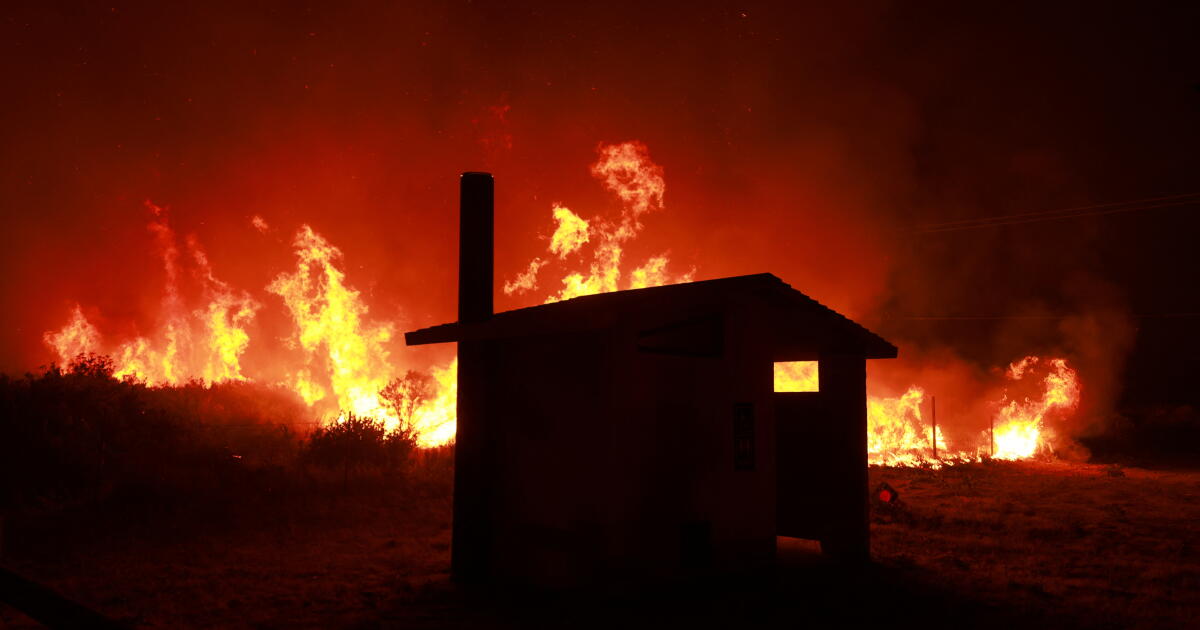
Thursday marks the beginning of summer, but early wildfires have already scorched the outskirts of L.A. and the Bay Area. Many California homeowners find themselves more vulnerable than ever as major insurers abandon areas threatened by climate change-fueled fires. Gov. Gavin Newsom and state Insurance Commissioner Ricardo Lara have responded with efforts to ease regulations and boost coverage.
Insurance industry representative Rex Frazier argues that state leaders have the right idea: Burdensome regulations are making a difficult situation worse. But consumer advocate Jamie Court contends that the state needs to take a harder line by requiring coverage of homeowners who meet fire protection standards.
California’s sclerotic insurance bureaucracy isn’t helping anyone
By Rex Frazier
As the leader of an association of homeowners’ insurers, I frequently hear from anxious Californians who are losing their coverage and wondering whether the situation will get better. My answer is that I am not one of those who believes California is facing an uninsurable future. The problems we face are difficult but solvable.
The insurance challenges the state is facing today have roots in the past. While the giant wildfires of 2017 and 2018 had a huge impact, requiring insurers to pay claims equivalent to more than 20 years of profits, the state’s insurance problems predate the fires. California’s failure to update the old rules governing insurance rates have long prevented insurers from preparing for a hotter, drier future.
California’s laws are a national outlier. The rules for projecting wildfire losses, a crucial aspect of calculating insurance rates, are a case in point. California is the only state in the country that requires property insurers to project future wildfire losses based on average wildfire losses over the last 20 years, regardless of where they plan to do business. Every other state allows insurers to base their rates on where they intend to sell insurance, taking into account the degree of fire risk to the properties they plan to insure.
California is also a national outlier on rate approval in that it’s a “prior approval” state. That means an insurer must receive approval from the California Department of Insurance before it may increase or decrease rates.
While California law promises a 60-day approval period, it often takes six months or more to get permission to change rates. At times of high inflation, slow approvals require insurers to leave the highest-risk areas or face financial ruin.
A less visible but nevertheless critical issue is the financial well-being of the FAIR Plan, a pool of insurers providing last-resort coverage. The FAIR plan is growing well beyond its ability to pay claims for large fires. And if it runs out of money, it will charge insurers, as members of the pool, a fee in addition to claims from their own customers for the same fire. If that fee gets large enough, it could devastate insurers. We must address this.
Fortunately, Insurance Commissioner Ricardo Lara has recognized the need to fix these problems. His Sustainable Insurance Strategy would update California’s rate regulations and approval process while requiring insurers to make commitments to cover high-risk areas. The proposal is far from perfect, but we look forward to working with all the interested parties to increase insurance availability and restore the health of the market.
While state regulations and processes can be changed, we remain vulnerable to forces that are beyond our control. Inflation makes repairing and rebuilding homes much more expensive, driving up rates. Longer dry seasons increase the chances of devastating fires, having the same effect in the short term. We need a system that acknowledges these realities.
But raising rates is not a long-term solution. Reducing them over time will require consensus on how to handle combustible fuels near valuable property.
That will take a lot of time and effort. California homeowners’ insurers are ready to do our part to secure an insurable future for the state.
Rex Frazier is the president of the Personal Insurance Federation of California.

Newsom needs to look out for homeowners, not insurance companies
By Jamie Court
Home insurance companies have put Californians in a bind by refusing to sell new policies or renew many customers, leaving them with few coverage options. That has driven more homeowners into the high-cost, low-benefit FAIR Plan, a pool of insurers required to provide last-resort coverage.
Gov. Gavin Newsom recently announced legislation to allow insurance companies to hike rates more quickly in an effort to woo them back to the state. While that will certainly leave Californians paying higher rates, it’s not likely to get more people covered.
Insurance companies are refusing to write new policies despite substantial recent rate hikes — an average of 20% for State Farm and 37% for Farmers, for example. What has them spooked is greater exposure through the FAIR Plan, which increasingly covers expensive homes in wildfire-prone areas. Insurers are on the hook for FAIR Plan claims, and their exposure increases with market participation, so they limit their participation.
Only freeing people from the FAIR Plan will solve this. The most practical way to do that is to require insurers to cover people who harden their homes against fire. We have mandatory health and auto insurance, so why shouldn’t we have it for homes that meet standards?
Hardening is expensive enough that most homeowners are unlikely to do it without guaranteed coverage. Mandating insurance is therefore the best way to mitigate wildfire risks.
Mitigation efforts are already working, with major claim events dwindling in recent years. Moreover, insurers recovered billions from the utilities responsible for major fire losses in 2017 and 2018.
The current crisis was precipitated not so much by wildfires as by investment losses and rising construction costs. Insurers responded by tightening underwriting and raising rates.
Insurance companies got their hikes, but they refuse to write new business here until they get more. Unfortunately, Newsom and Insurance Commissioner Ricardo Lara are ready to give them what they want.
Last week, Lara proposed regulations attempting to address the crisis. Echoing a legislative proposal that failed last year, they would allow companies to raise rates based on black-box climate models. Florida tried a similar approach, and its rates are now about double California’s. Florida’s insurer of last resort covers 20% of its homeowners, roughly five times the share in California.
The proposed regulations purport to require insurers to increase sales to homeowners in “distressed areas” by 5%. However, they would not require them to charge prices consumers can afford. The requirement to cover these areas could also be waived if an insurer shows it’s “taking reasonable steps to fulfill its insurer commitment.” And the plan gives companies two years to comply but lets them start charging all policyholders higher rates immediately.
Newsom cheered the proposal, essentially arguing that California’s insurance rates are too damn low. He didn’t mention that California insurers’ profits have generally outpaced the national average over the last 20 years.
Newsom’s latest legislative proposal would limit public participation in rate-setting by cutting out so-called intervenors such as Consumer Watchdog, which can challenge unnecessary increases and has saved consumers more than $6 billion over 22 years.
Throwing more money at insurers won’t end the crisis; requiring them to cover responsible homeowners will.
Jamie Court is the president of the nonprofit Consumer Watchdog.


Ranch dressing is having a moment thanks to the World Cup and Kraft is ready to meet it.
The company said Thursday that it is working on a “TSA Compliant Ranch” for those looking to travel with the quintessentially American condiment. The announcement follows the influx of social media videos showing international soccer fans sampling the dressing for the first time.
“Some visitors leave with souvenirs. Others leave with America’s favorite dressing,” Kraft wrote in a caption accompanying an AI image of a TSA-approved clear bag packed with ranch dressing packets posted to social media. The image showed the bag — complete with a luggage tag resembling a ranch dressing bottle — placed in an airport security screening bin along with other travel essentials.
Additional details will be announced later, the company said.
TSA has also leaned into ranch’s apparent newfound popularity among international travelers, providing some helpful tips (and warnings) on social media.
“If you’re visiting for a very large sporting event & you happen to discover RANCH while you’re here… pls pack it in your CHECKED BAG on your way home,” the agency posted on Instagram Tuesday. It also asked travelers to “avoid chugging your ranch outside security” lines.
“Who knew dip-lomacy could be achieved through addressing the obvious: ranch is the king of condiments,” TSA wrote in the caption accompanying its carousel of humorous ranch-related quips. “If you’re traveling within the U.S., make sure to keep your carry-on sauces to 3.4 oz or less and place any larger containers in your checked bags.”
“Some heroes wear capes. Others bring ranch,” it added.
According to 1987 Times reports, ranch dressing was invented by Steve Henson, who opened the Hidden Valley Guest Ranch in Santa Barbara in the mid-1950s with his wife, Gayle. The unnamed condiment originally mixed herbs and spices with buttermilk and mayonnaise and its popularity with guests led to it being jarred so they could take some home. The more travel-friendly powdered form followed.

A landmarked downtown Los Angeles apartment building designed by famed Los Angeles architect John Parkinson is on the market as its owners face foreclosure.
Residences in the Metropolitan, a 10-story tower built in 1913, are nearly filled with tenants but its ground floor retail spaces on Broadway and 5th Street are unoccupied, as are other street-level stores in downtown’s Historic Core.
The historic building was once considered one of the best in the city and is owned by the Fallas family, which operated a chain of value-priced clothing stores based in Gardena including one called Fallas Paredes in the Metropolitan.
Fallas-Paredes at 449 S. Broadway, Los Angeles, CA 90013.
(Google Maps)
Around 2011, Michael Fallas, who once worked in family’s downtown store as a stock boy, converted the upstairs floors from offices to apartments while continuing to operate Fallas Paredes. The store closed more than five years ago in the wake of a 2018 filing by its parent company for Chapter 11 bankruptcy protection.
Earlier this month in state Superior Court, a special servicer representing Fallas’ lender asked for a judicial foreclosure of the property, alleging that Fallas had stopped making payments on a $32 million loan dating to 2017. After leasing the property for years, Fallas bought the building in the 1990s.
Fallas didn’t respond to requests for comment.
The location of the Metropolitan where the buildings stands was hailed in a Times story in 1912, saying “it is regarded by many realty men as the most valuable piece of real estate in Los Angeles.”
The building today is recognized as a city historic-cultural monument because “Broadway became the commercial center of the Southland, a title it retained until well after World War II,” with its development, the city said. One of the architects who designed the Metropolitan in the Beaux-Arts style was John Parkinson, who is credited with designing such well-known local structures as City Hall, the Los Angeles Memorial Coliseum and Union Station.
Notable tenants in the Metropolitan have included the Los Angeles Public Library, Owl Drug Co., variety store J.J. Newberry and real estate company Janns Investment Co., which sold the land where UCLA is built and developed Westwood Village, among other Los Angeles neighborhoods.
In recent years, the buildings around the Metropolitan have struggled to keep retail tenants after a spurt of residential conversions of historic buildings starting in the early 2000s brought commerce to the neighborhood. Many downtown businesses have struggled since the pandemic reduced occupancy in offices downtown and reduced the flow of visitors.
“The lack of bodies on the street is generally hurting downtown, and that’s one of the reasons that has building has problems,” said downtown real estate broker Hal Bastian, who lives in the Historic Core.
There are close to 1,000 residential units in historic buildings at the intersection of Broadway and 5th Street, Bastian said, but all the ground floor stores are closed. Drug stores there suffered substantial losses from shoplifting he said, and now, “our challenge on Broadway is leasing.”
The 88 apartments in the Metropolitan are 91% rented, according to a listing for the property by the Zacuto Group, which also touts its roof deck with pool, fitness center and barbecue grills. No sale price is set.
Business
January 2025 wildfire victims seek tougher penalties against State Farm over claims handling

A fire survivors’ group announced Thursday it was seeking tougher penalties against State Farm over its handling of January 2025 wildfire claims.
The Every Fire Survivor’s Network said it was petitioning to join a state enforcement action announced this year against the company to make sure the case results in meaningful changes at California’s largest home insurer.
“We’re seeking a systematic review of all their claims and penalties calibrated to the actual scale of the harm — and we’re seeking the payouts that families are owed,” said Joy Chen, executive director of the group, at a Pacific Palisades news conference joined by victims of the fires.
The Department of Insurance in May filed an administrative action against State Farm General — the subsidiary of the giant Bloomington, Ill., insurer that handles California home insurance — after completing a “market conduct” exam.
The Jan. 7, 2025, fire damaged or destroyed more than 18,000 structures and killed 31 people.
State Farm has received more January 2025 claims than any other insurer — more than 13,700 auto and homeowners claims as of May 4, with payouts totaling $5.7 billion, according to the company.
The market conduct exam looked at 220 sample claims filed by the victims and found 398 violations of state law in about half of them.
Among other alleged violations, it found that the company failed in numerous cases to pursue a “thorough, fair and objective investigation” into claims, failed to come to “prompt, fair, and equitable settlements” and made settlement offers that were “unreasonably low.”
In announcing the action, Insurance Commissioner Ricardo Lara called the company’s claims handling “unacceptable” and said his department was taking “decisive action to hold them accountable.”
The state is seeking a “cease and desist” order to stop the insurer from engaging in unfair or deceptive practices.
It also has threatened to suspend State Farm’s license over the alleged violations, which each carry a penalty of up to $5,000 — or twice that figure if found to be willful. That could amount to a penalty of $2 million or more.
The threat to actually suspend State Farm’s license and its authority to write policies has been viewed skeptically by some, given its roughly 20% market share of the state’s home insurance market.
The company, which had an opportunity to include its responses in the exam report, denied fault in some cases and admitted fault in others. It often blamed problems on individual adjusters and denied systemic issues with its claims handling.
The petition filed by the wildfire survivor’s group criticizes the sample size of the market conduct exam as too small to capture all the alleged deficiencies in State Farm’s claims handling, which it claims are a “general business practice” of the company.
The group is seeking to conduct discovery, cross examine witnesses, present testimony from fire victims and bring more that 1,600 firsthand policyholder statements regarding State Farm’s practices into evidence, according to the petition.
It also wants State Farm to reopen cases in which claimants were paid too little, and it is seeking to participate in settlement discussions in order to increase any penalty State Farm would pay.
It calculated that a $2-million penalty would amount to a minute fraction of the assets of the State Farm Group.
“I submit to you that doesn’t defer bad conduct, it just allows you to continue to do it,” said Michelle Meyers, an attorney for Every Fire Survivor’s Network, at the news conference.
Consumer Watchdog, which has been a harsh critic of State Farm, also is providing legal support for victims’ effort.
Sevag Sarkissian, a spokesperson for State Farm, said the company was aware of the petition.
“We recognize that many wildfire survivors, including those that are State Farm General policyholders, continue to face difficult recovery challenges,” he said. “Our focus remains on helping customers recover.”
Michael Soller, a spokesperson for Lara, said the department is “acting with urgency to assist wildfire survivors in their ongoing recovery by investigating formal complaints filed by survivors and conducting the expedited market conduct exam that led to this enforcement action.”
He added that the department’s position is the state’s Administrative Procedure Act does not contemplate the commissioner or department staff authorizing intervention requests in the case.
He said that would be a hearing officer’s or administrative law judge’s decision when one is assigned to the case.
Meyers acknowledged the request was novel but said her reading of the law is that Lara can make the decision because no judge is yet assigned.
In response to the criticism, State Farm pledged earlier this year to improve its claims handling, including by providing single points of contact and improved communication so there are “fewer handoffs, fewer repeated explanations, and seamless support.”
It also named a new vice president of customer relations for State Farm General.
-

 San Diego, CA2 minutes ago
Neymar expected to return from right calf injury and play for Brazil in World Cup against Scotland
-
 Milwaukee, WI7 minutes ago
Today’s Summerfest schedule and picks: Saturday, June 20
-

 Atlanta, GA14 minutes ago
Atlanta Ballet Returns to the Fox Theatre to Present Cinderella for One Weekend Only This Fall
-

 Minneapolis, MN17 minutes ago
MERAUDER, JUDGE, ARKANGEL and many more announced for Minneapolis’ Snow and Flurry 2026
-

 Indianapolis, IN22 minutes ago
Third Public Safety Camera Added on Washington Street in Downtown Indy
-

 Pittsburg, PA29 minutes ago
Analysis: Most Pittsburgh‑area communities are losing residents — here’s why that might be OK
-

 Washington, D.C32 minutes ago
Trump’s DC makeover frenzy bewilders locals and visitors: ‘It’s like we’re under occupation’
-

 Augusta, GA32 minutes ago
Augusta Regional Airport hosts drone camp for students

