Business
'Where does it stop?' Warehouse advance in Riverside County threatens rural lifestyle

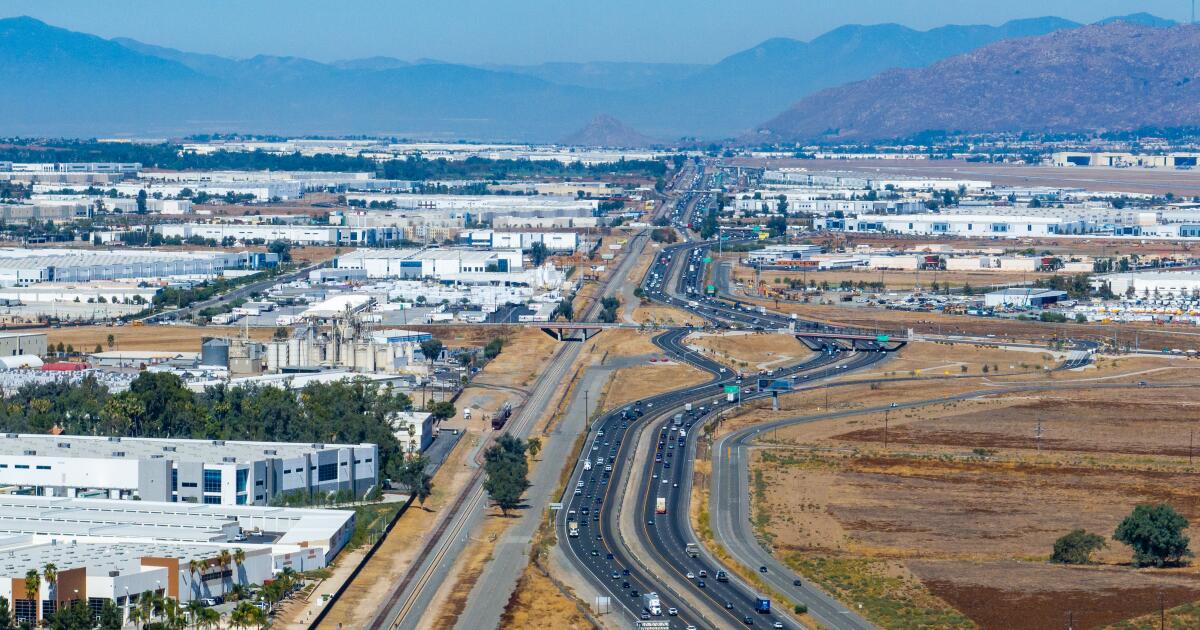
Seen from above, the industrial-scale warehouses straddling Interstate 215 where it intersects Mead Valley shimmer like a sprawling lake of white concrete boxes.
In this unincorporated Riverside County community, the big-box distribution hubs responsible for fulfilling online shopping orders have long been contained to a substantial strip west of the freeway. Burlington, Living Spaces and FedEx are among nearly 50 warehouse properties located here, capitalizing on Mead Valley’s easy access to rail and freeway corridors.
Beyond this strip, though, Mead Valley residents embrace a rural lifestyle. People here raise horses and livestock; most streets are lined with gravel trails, rather than sidewalks, to accommodate riders on horseback. Besides the new Farmer Boys restaurant near the freeway, the community has few local businesses other than gas stations, feed stores and plant nurseries.
As e-commerce exploded during the COVID pandemic, more distribution centers rose along the freeway, bringing more trucks to local roadways. Still, there was an understanding that, beyond the clearly delineated industrial zone, Mead Valley residents could maintain their solitude and sweeping views, in exchange for shouldering a disproportionate share of an industry critical to America’s online shopping habit.
But that sacred line in the dirt — where warehouse development ends and rural living begins — could soon be blurred.
Riverside County leaders are reviewing a dozen requests that would rezone portions of rural residential land in Mead Valley to create more space for industrial warehouses.
(Brian van der Brug / Los Angeles Times)
County leaders are reviewing a dozen requests that would rezone portions of rural residential land in Mead Valley to create more space for industrial use. Developers are seeking to expand warehouse development beyond the established industrial zone; at least one proposal would result in the demolition of dozens of homes as well as dedicated open space. Others would pierce the existing boundary, bringing the potential for warehouses and their 24/7 noise and exhaust to the outskirts of existing neighborhoods, fundamentally altering residents’ lifestyles.
County Supervisor Kevin Jeffries, who represents the district that includes Mead Valley, said he has “deep concerns” about the proposed changes. He described drawing a “big red rectangle” over Mead Valley’s industrial zone, indicating where he believed the boundaries of warehouse development should remain.
“All the low-hanging easy parcels for warehousing are pretty much all spoken for. And so the really big, deep-pockets developers now see opportunities to try and propose to go beyond the boundaries that have been put in place for decades,” said Jeffries, who is retiring after 12 years on the board.
“It’s going to be a challenge if they cross that line and start marching into what you might call Mead Valley proper. You start moving up that way — when or where does it stop?”
Resident Karla Cervantes expressed similar concerns. Cervantes and her husband, Franco Pacheco, raise their children and sheep on two acres in Mead Valley. She worries neighborhoods will start falling like dominoes as more rural residential land is rezoned for industrial use.
“Once one neighborhood is surrounded by warehouses, then the investors will come, buy them out, and then it creeps up more and more and more,” Cervantes said.
The county’s general plan amendment process, a largely bureaucratic zoning review the county undertakes every eight years, could prove pivotal for residents of Mead Valley this year: Will leaders green-light the proposed zoning changes, paving the way for more warehouses — and with them more jobs and revenue flowing into county coffers? Or is this the moment that the rapid-fire proliferation of distribution centers stretching for miles in each direction along the 215 corridor finally slows?
Riverside County’s unique rezoning process is the result of a more than two-decade-old settlement with the conservation group Endangered Habitats League, which sued the county in 2003 over concerns about sprawling development.
The settlement “resulted in a way to slow-roll development in the rural areas of the county,” said county planning director John Hildebrand.
Under terms of the settlement, developers who want to request zoning changes for swaths of land from one of five major uses to another — agriculture, open space, rural, rural community or community development — are able to request that change only every eight years, during the county’s Foundation General Plan Amendment cycle.
The process was designed to provide county leaders with the opportunity to take a comprehensive look at rezoning proposals, and “look at the bigger picture instead of piecemealing it,” said Dan Silver, executive director of the Endangered Habitats League.
Mead Valley, a majority Latino community of about 20,500 people, already has 2,000 square feet of warehouses per person, including existing and approved warehouses and those under environmental review, according to a data analysis by Susan Phillips, director of the Robert Redford Conservancy for Southern California Sustainability at Pitzer College, and Mike McCarthy, an adjunct professor and data scientist at the college.
That’s one of the highest warehouse-per-resident ratios in the Inland Empire, according to their analysis. And the rezoning applications that developers have submitted would add more than 1,000 additional acres of warehouse projects.
In preparation for their requests, many developers have already positioned themselves as “property owners” of large parcels by getting enough local homeowners to agree to sell their land, in exchange for sizable payouts, contingent upon the county’s approval of the zoning changes.
The Planning Commission has so far heard three zoning-change requests for District 1, which includes Mead Valley; several were continued to future meetings. If supervisors approve the requests, the developers must return to get approval for specific projects.
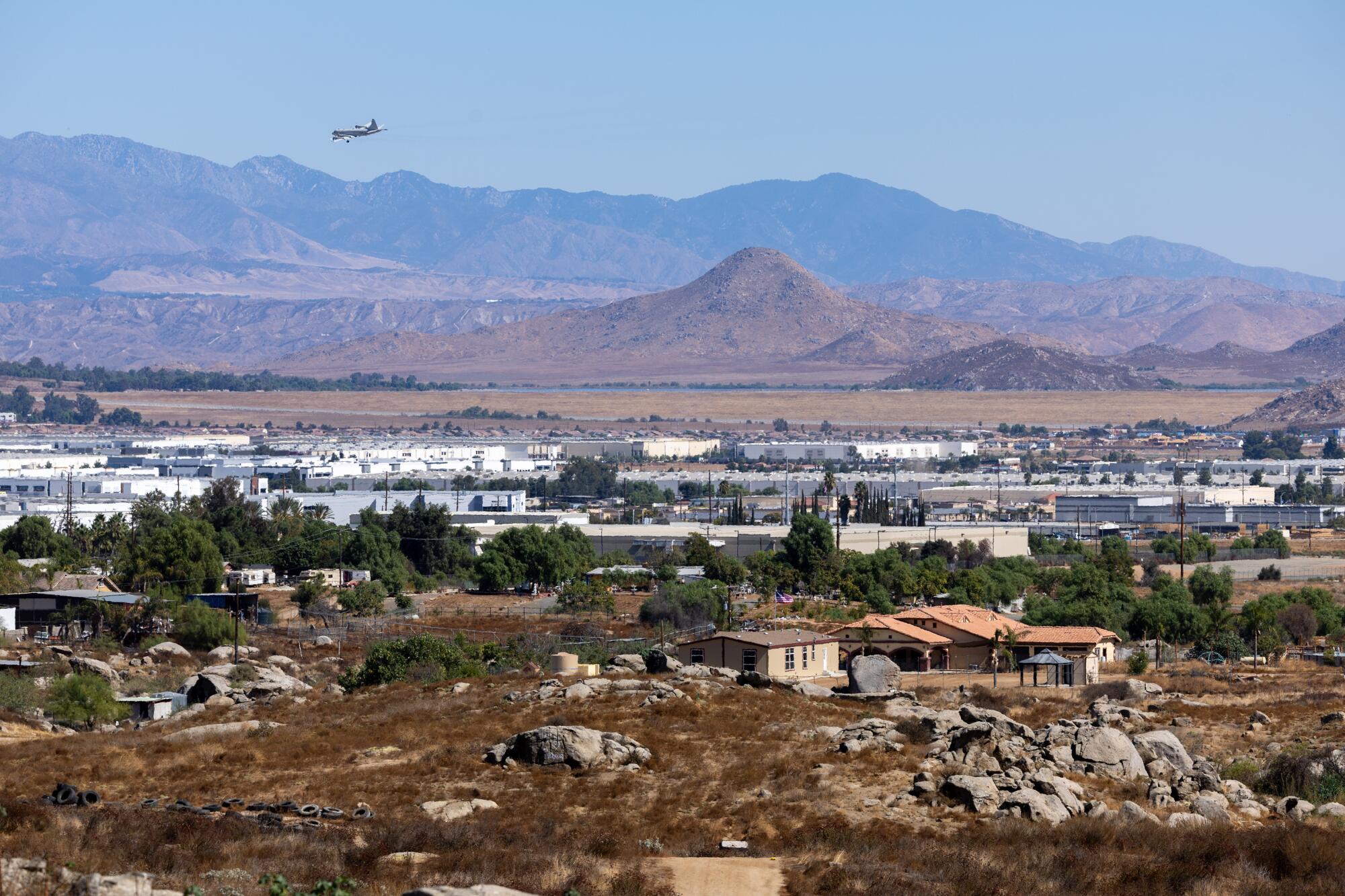
“It’s going to be a challenge if they cross that line and start marching into what you might call Mead Valley proper,” Supervisor Kevin Jeffries says of warehouse development.
(Brian van der Brug / Los Angeles Times)
One developer, Hillwood, is seeking a zoning change to build a million-square-foot warehouse, along with a public park, on about 65 acres of land just west of Mead Valley’s industrial corridor.
Currently known as the Cajalco Commerce Center, the proposed development would require the demolition of 26 homes and a commercial building. The developer has promised an estimated 974 jobs, as well as infrastructure improvements and landscaping along a main thoroughfare, according to the project’s draft environmental impact report. It would have a “significant and unavoidable” impact on air quality and transportation, the report said.
Paz Treviño lives on the outskirts of Mead Valley’s industrial corridor, on a two-acre lot where he sells heavy construction equipment. He has agreed to sell his property to Hillwood for $3 million, contingent on county approvals, he said. He has outgrown his current lot, he said, and with the money he stands to make from selling his land, he hopes to buy five or 10 acres elsewhere.
A member of Mead Valley’s Municipal Advisory Committee, he supports allowing more industrial development.
The warehouses, he said, bring jobs to a community where fewer than 8% of residents have a bachelor’s degree. He’s heard concerns about the lack of grocery stores, restaurants and healthcare facilities, and predicted those amenities would come as family incomes rise.
“We’re going to start getting the stores that people want,” he said. “But we’re not going to get those other industries — the food industries, the retail industries — without first having a stabilized middle class.”
He is frustrated with the anti-warehouse advocates trying to stand in the way of rezoning, and believes landowners such as himself should be able to profit handsomely from their investments. “It’s the landowners that have the last say, is what I say,” he said. “And if you’re not within the area, mind your damn business.”

A warehouse development under construction in Mead Valley.
Shanowa De La Cruz could end up on the losing end of that equation.
De La Cruz, her wife and their children moved to a five-bedroom house on one acre in Mead Valley not far from Treviño’s property about three years ago. It was supposed to be their forever home, where they could raise their kids — five of six still live at home — as well as chickens, goats, ducks and a pig.
“We like our solitude. That’s why most of us live over here in Mead Valley,” De La Cruz said.
Six months after buying the property, they learned about the Cajalco Commerce Center proposal — and that some neighbors had already agreed to sell their properties to Hillwood. De La Cruz said she contacted the company and got an offer that barely covered what they paid for the home, presumably because the developer doesn’t need their property for the project.
The situation has left De La Cruz between a warehouse and a hard place: The developer would need to pay a “substantial” amount of money to get her family to move, she said. But if she stays and the proposal is approved, the development would loom nearby, infringing on their privacy and tanking their home value.
“It’s going to be one of those houses that is in between a warehouse” development, she said. “We’ve all seen those houses. No one’s going to buy that. You say, ‘Aw, pobrecito, they left them there.’”
Scott Morse, executive vice president with Hillwood, declined to comment on De La Cruz’s situation. He said the proposal has public support.
“We’re bringing something to the community that is needed and wanted by the community,” he said, “so that’s our compass.”

Mead Valley resident Raymond Torres says it’s “heartbreaking” to imagine the open space near his home converted for industrial development.
Raymond Torres moved away from the “hustle and bustle” of the San Diego area more than 20 years ago and eventually built two homes on a quiet street in Mead Valley.
Standing in his driveway on a clear day, he can see the San Jacinto and San Gabriel ranges, and Big Bear and Palomar mountains. Across the street from his property is open space, where he says he regularly sees owls and kangaroo rats among the grasses and native plants. His neighbors ride horses on the land; he prefers to traverse it on wheels — by dirt bike, quad or go-kart.
The property directly across the street from him is not proposed for rezoning, but a large swath of open land surrounding it is. The real estate and investment firm Deca has proposed rezoning 648.5 gross acres from rural residential to community development, with a mix of residential, commercial and industrial components, according to Travis Duncan, Deca’s vice president of development.
“Additionally, we intend to set aside a substantial portion of the property as open space and are excited about the mix of commerce and conservation that the project offers,” Duncan said.
Torres said it’s “heartbreaking” to imagine the land being used for development.
“It’s our neighborhood,” he said. “We have pride in it.”
The Deca proposal would also bring industrial development much closer to the home of Cervantes and Pacheco. Their two-lane street already has become a truck bypass. They are concerned warehouses will beget warehouses, eventually ending up in their backyard.
Mead Valley is oversaturated with warehouses and semis, they argue, and yet the community itself remains underinvested. Mead Valley would look “amazing” if it was actually benefiting from major portions of the revenue that industrial development is generating for Riverside County, Cervantes jokes. Pacheco notes that the closest Target — on the other side of the freeway — is not a retail store but a massive distribution center.
Earlier this year, Pacheco and Cervantes launched the Mead Valley Coalition for Clean Air to oppose warehouse expansion. They see the rezoning fight as a fight for Mead Valley’s future. For the residents who stay, the question is whether county leaders will rubber-stamp continued expansion of the I-215 industrial corridor, and whether that line in the dirt — between industrial and rural residential — will survive.
But Cervantes said trying to keep Mead Valley from drowning in the shimmering sea of white warehouses often feels like an uphill battle. She worries about a future with worse air quality and decreased property values, and about the limited opportunities for young people growing up amid a mass logistics hub.
“When they look to see the sun rise,” she said, “they’re going to see the sun rise on a bunch of warehouses.”
This article is part of The Times’ equity reporting initiative, funded by the James Irvine Foundation, exploring the challenges facing low-income workers and the efforts being made to address California’s economic divide.


Residents of Monterey Park voted overwhelmingly to ban data centers on election day, making the San Gabriel Valley city the first in the nation to do so by public vote.
As of Wednesday, 86% of votes were in favor of Measure NDC, the city ban, according to the Los Angeles County registrar-recorder/county clerk.
Other cities and towns have passed moratoriums on data centers, as a wave of opposition sweeps the country. But the Monterey Park vote can only be overturned by another ballot measure, making it the most permanent data center ban in a jurisdiction.
Monterey Park’s City Council had already banned data centers by ordinance, after a proposed 247,000-square-foot data center met an outpouring of public anger and concern. The developer withdrew that plan.
That facility would have been less than 500 feet away from the nearest home, and would have used three times the electricity of the entire 60,000-person city. Residents said it would have caused noise and air pollution and driven up electricity rates.
“This ensures long-lasting protections for current and future generations,” Amy Wong, co-founder of the group San Gabriel Valley Progressive Action, said of the vote. “It means that future city councils cannot overturn a data center ban, even if data center developers wanted to spend money to fund pro-data center candidates.”
The measure had no formal opposition. The developer of the proposed facility, investment firm HMC StratCap, said it wouldn’t engage in the ballot fight when it withdrew in March.
The Data Center Coalition, an industry trade group, expressed disappointment in the vote.
“It sends a signal that the area is closed for business, both for data centers and for other significant economic development projects,” state policy director Khara Boender said.
“It deprives local residents of the opportunity to compete for jobs and investment, while also causing the area to relinquish substantial long-term economic investment, high-wage jobs, and critical tax revenue to neighboring areas or other states.”
SGV Progressive Action worked with hyperlocal groups including No Data Center Monterey Park to rally support for the measure.
The group is now focused on stopping data center proposals in the City of Industry and fighting a move by City of Industry, Santa Fe Springs, Vernon and City of Commerce to welcome data centers and other industry with fast-tracked permitting and tax incentives.
City of Industry, in the San Gabriel Valley, and Vernon, south of downtown L.A., are primarily industrial areas, each with around 300 permanent residents. They are employment centers, and tens of thousands of workers commute in daily.
There has been little vocal opposition to data centers among the few residents of these cities. Wong said the protest is primarily coming from the surrounding neighborhoods.
“If a data center gets built in City of Industry, residents across the region would bear the brunt of pollution and increased utility costs,” Wong said, noting that it is surrounded by 16 other cities and unincorporated communities.
Data center proposals have been limited in California compared to Virginia, Texas, Georgia, Illinois and Arizona, which sit at the center of a recent boom in hyperscaler facilities to power artificial intelligence.
California has the third-most data centers in the country, with 300, but high electricity rates, expensive land and regulatory hurdles mean that fewer, and smaller, facilities are currently planned than in other hotspots.
That doesn’t mean opposition hasn’t been fierce. In Coachella and Imperial County, residents are showing up in droves to protest local proposals.
In the San Gabriel Valley, Montebello, El Monte and Baldwin Park have all enacted temporary moratoriums, and Alhambra recently banned data centers as part of a zoning code update.
Wong said she hoped the ballot measure vote would galvanize the opposition. “The vote is a testament to the people power of our region,” she said. “Our region is worth protecting, and we won’t let data centers determine our future.”

A rule intended to prevent rent gouging in the wake of the Eaton and Palisades fires has lapsed in Los Angeles County, possibly exposing some renters to hikes.
The executive order that blocked rent increases was issued by Gov. Gavin Newsom amid the devastating wildfires last year. Under the order, landlords couldn’t increase rents by more than 10% above their prefire levels.
The rule, which was supposed to be temporary and was repeatedly extended, ended Friday after a vote to extend it again failed to garner enough votes. Supervisor Lindsey Horvath, whose district includes Pacific Palisades, sounded the alarm in a motion to extend price protections that failed to pass at the Board of Supervisors’ May 19 meeting.
“These price gouging protections continue to be necessary as construction and rebuilding continue, and as thousands of people remain displaced,” the motion said. “Families which signed short-term leases could face drastic price increases of 50% or more without further price gouging protection.”
Los Angeles County is home to more than 1 million rental properties, though not all of them needed protection from the new rule. There are already stricter rent increase caps for many residences, depending on the location, type and age of the building. Despite the rent control in the region, the people of Los Angeles pay among the highest rents in the country.
It is uncertain whether renters will face rapidly rising rents now that the protection has lapsed. But some real estate experts and policymakers said there was no need for the temporary rule that was part of the governor’s state of emergency.
Supervisors Kathryn Barger, Janice Hahn and Holly Mitchell abstained from voting on the motion to extend the protection, while Supervisors Hilda Solis and Horvath supported it.
“I abstained because I did not see sufficient evidence to justify extending this emergency ordinance, nor did I see evidence to eliminate it entirely,” Hahn said.
Barger’s office said she supported allowing the protections to sunset while waiting to see whether new information emerged.
“Market data already shows countywide rents are only about 2% above pre-emergency levels and rental inventory has grown,” Barger representative Helen E. Chavez Garcia said. “The Supervisor is also mindful of the burden these ongoing protections place on small property owners throughout the county.”
Mitchell did not immediately respond to a request for comment.
There haven’t been steep rent hikes in neighborhoods within three miles of the Palisades fire, according to a Times analysis of data from Zillow, the property listing company.
In ZIP Codes within three miles of the Palisades fire, rent increased 4.8% from December 2024 to April 2025. In areas around the Eaton fire, which destroyed swaths of Altadena, rent jumped 5.2% in the same period.
In L.A. County, ZIP Codes farther from the fires saw only about a 2% increase.
A landlords representative, Jesus Rojas of the Apartment Owners Assn. of Greater Los Angeles, told the supervisors during public comment at the meeting that the county’s rent-gouging rules have “long outlived the emergency they were intended to address” and are now being “wrongfully used to harm thousands of rental housing providers throughout the county.”
“There is no proof that multifamily rental housing providers are hugely increasing rents for impacted homeowners,” Rojas said.
Indeed, there are strong signs that the property market in the Los Angeles area has at last begun to cool.
L.A. metro-area rent prices recently fell to a four-year low, with the median rent slipping to $2,167 in December.
Meanwhile, condominium sales had their slowest start of the year in decades. Condo sales in Los Angeles have plummeted to a 20-year low, with fewer than 2,000 units sold in January and February — the worst start to the year since 2005.
Newsom defended the price-gouging protections shortly after they went into effect.
“In the days following the Los Angeles firestorms, we worked quickly to protect Los Angeles survivors from any form of exploitation,” he said in February 2025. “The state has the tools in place to not only block price gouging during this emergency, but also to prosecute bad actors.”
The Los Angeles County Department of Consumer and Business Affairs said it received more than 2,000 complaints after the fires, alleging that retailers and landlords were taking advantage of people put in hardship by their losses, and sent out more than 2,000 cease-and-desist letters to businesses and landlords for alleged price gouging, said Morine Merritt, who oversees department investigations into consumer and real estate fraud.
“Close to 90% of the complaints that we received involved allegations of rent increases,” Merritt said in an interview. Now that the fire-related protections have expired, existing laws and “regular market conditions determine price increases for goods and services, including rents,” she said.
Crackdowns on fire-related rent gouging have been rare, said Chelsea Kirk of the activist organization the Rent Brigade, which analyzed L.A. County’s rental market in the year after the fires. It reported 18,360 potential examples of price gouging in listings but said that few lawsuits had been filed by authorities so far.
Last week, Rent Brigade announced what it said was the first private civil lawsuit brought by a family that claimed to be rent-gouged in the aftermath of the wildfires. Plaintiffs Randall and Candy Renick, whose Altadena home was damaged, said they were charged nearly three times the maximum permitted rate for nearly 10 months. They seek restitution of $96,000 plus civil penalties and attorneys’ fees.
The rental market has probably stabilized since the fires, Kirk said, but other families may still be “locked into illegal rents” that they agreed to pay when they were in a rush to find housing after they were displaced.


Dear Mr. Pelley:
I meant what I said in my letter last week to the 60 Minutes team: joining 60 Minutes is the honor of my career and I am grateful to be working alongside the people who have contributed to the most important television journalism brand this country has ever produced. While I’m new to 60 Minutes, I’ve devoted my career to investigative journalism and storytelling. I started this job excited to collaborate and to benefit from the wisdom and experience of the 60 Minutes veterans, with you among them. For that reason, one of the first things I did in my new role was call you to talk and invite you to dinner. It is a profound disappointment that you rejected that overture and chose ambush instead. Yesterday, you hijacked my first meeting with staff to disparage me, my qualifications, and my intentions with remarkable incivility and contempt. I welcome a diversity of viewpoints and respectful debate among the team, but this was nothing of the sort. Yesterday’s performative display of hostility enacted in front of the staff instead of in a civil, private conversation-demonstrated that you have no interest in contributing to the future success of the show, or approaching my new tenure with a mind open to collaboration and progress. I am here to deliver first-in-class news programming, not to make headlines about newsroom drama. I am eager to work alongside those who share this goal.
Despite yesterday’s misconduct, I had hoped that in sitting down with you today we could find a path forward together. You made clear that you are not interested in such a path.
Your antipathy to the future of the show has come through loud and clear. And I have heard you. I therefore write on behalf of CBS News, Inc. (“CBS”) to inform you that your employment with CBS is terminated for cause effective immediately. Enclosed is your formal termination letter.
Sincerely,
Nick Bilton
Executive Producer, 60 Minutes
-

 Los Angeles, Ca49 minutes ago
Man claiming to be armed robs Culver City bank, gets away with $10,000
-

 Detroit, MI1 hour ago
Fired Detroit TV anchor Taryn Asher files sex discrimination lawsuit against old station, claims new GM protected men
-

 San Francisco, CA1 hour ago
San Francisco family devastated as they face nearly 90% rent increase
-

 Dallas, TX1 hour ago
Wings’ top pick Azzi Fudd hosts clinic as Cash App donates to Dallas nonprofit
-

 Miami, FL2 hours ago
Patients left scrambling for care after Miami-Dade woman accused of operating an unlicensed surgery recovery center
-

 Boston, MA2 hours ago
Clover plans to reopen some locations after sudden closure, thanks to an anonymous investor
-
 Denver, CO2 hours ago
New report finds Denver metro home buyers and sellers experiencing ‘unattainability fatigue’
-

 Seattle, WA2 hours ago
Seattle mayor grilled over public safety, affordability, CCTV

