Business
Waymo killed KitKat. California neighborhood mourns a corner-store cat


San Francisco has been mourning the death of KitKat, a beloved corner-store cat who died after being struck by a Waymo robotaxi last week.
KitKat graced the counters of Randa’s Market on 16th Street, near the historic Roxie Theater in the Mission District. KitKat was first introduced on the store’s Instagram page six years ago, quickly winning over the hearts of customers. He wasn’t a surly or suspicious cat — he could be seen playing with someone’s dangling hoodie drawstrings; snoozing in front of shelves with liquor bottles; inside a cardboard box marked with his name; greeting the neighborhood dogs; even dressing up as Santa Claus.
He shot to fame during the COVID-19 pandemic’s first year. Not only was he posted on the @bodegacatsofinstagram account (which now has more than 500,000 followers), but he also won a mention in a news story on beloved store cats. “The atmosphere in the store definitely changed after KitKat arrived,” Daniel Zeidan, the store owner’s son, told SFGate. Not only did he get treats from customers, but also “someone recently brought him a blanket so he would stay warm in the winter.”
More recently, he was caught curled up asleep on his own heating pad.
He even made appearances in the next-door bar, Dalva, where his arrival felt like “the president had arrived, making their rounds, shaking hands and charming everyone,” said one mourning Instagram commenter.
But he was fatally wounded around 11:40 p.m. on Oct. 27 just outside the market, Mission Local reported. Two witnesses, speaking anonymously, told the news outlet that they had just left Dalva and saw KitKat sitting in front of a stopped self-driving Waymo for about seven seconds. Then the cat walked under the vehicle, heading toward the sidewalk, as the car pulled away. The right rear tire ran over KitKat, the website said.
“It was an awful sight,” one of the witnesses told Mission Local.
Another person driving by saw the Waymo swerve and told Mission Local he thought the robotaxi was driving faster than he would expect a human would drive on a busy street. “Killed the neighborhoods baby,” a comment on the city’s 311 website said shortly after the collision.
A bartender from another nearby bar, Delirium, rushed KitKat to a veterinarian hospital, where he was pronounced dead, according to Mission Local.
The cat was 9 years old, the San Francisco Standard reported.
“We’re heartbroken,” Randa’s Market said on Instagram. “He brought warmth, smiles, and comfort to everyone who walked through our doors…. The store won’t be the same without his little paws padding around.”
KitKat was a beloved presence along 16th Street in San Francisco.
(Randa’s Market)
One mourner, responding to the post, called KitKat “the best city bodega cat anyone could ever ask for. His lil pet requests meant a lot for some of us passing through, whether we missed our own pet or just wanted to share some love with a neighbor.”
In a statement, Waymo said: “We reviewed this, and while our vehicle was stopped to pick up passengers, a nearby cat darted under our vehicle as it was pulling away.
“We send our deepest sympathies to the cat’s owner and the community who knew and loved him, and we will be making a donation to a local animal rights organization in his honor,” the statement said. “The trust and safety of the communities we serve is our highest priority.”
A Waymo has had a run-in with a pet before. News outlets in 2023 reported on a Waymo striking and killing a small off-leash dog in San Francisco’s Bayview-Hunters Point neighborhood; in that case, a test driver was in the vehicle, but the car was in self-driving mode.
In one close call, a Waymo narrowly avoided running over a runaway dog in Santa Monica in May. An 8-year-old Labrador mix, Trevor, had escaped his owner’s yard and ran into the street in front of a Waymo, which braked suddenly, KCAL-TV reported. The station broadcast video of the near-collision. The dog was uninjured, and his owner praised the car’s quick action.
The California Department of Motor Vehicles has received reports of 884 collisions involving autonomous vehicles dating to 2014.

A Waymo robotaxi in downtown Los Angeles in September.
(Gary Coronado/For The Times)
Waymo, owned by Google’s parent, Alphabet, has been expanding its footprint across California. The robotaxis — electric Jaguar I-Paces — don’t use a human driver and can be hailed on an app in San Francisco and a swath of northern San Mateo County, including Daly City, San Bruno and Burlingame. They’re also available in parts of Silicon Valley and surrounding areas, including Mountain View, Los Altos, Palo Alto and Menlo Park.
In Los Angeles County, Waymos can be hailed across a portion of central L.A., South L.A., and the Westside, including downtown L.A., Santa Monica, Beverly Hills, West Hollywood and Inglewood.
The self-driving cars are also available in Phoenix.



Oracle founder Larry Ellison was on the cusp of conquering Hollywood.
Just four months earlier, he had bankrolled his son David’s $8-billion acquisition of the storied Paramount Pictures.
Now the Ellison family had designs on scooping up Warner Bros. Discovery, too, offering to buy the entire company for at least $60 billion. The bold play had suddenly thrust this Silicon Valley titan and his son, David — chief executive of the newly-merged Paramount Skydance — into one of the most powerful positions in the film and TV industry.
By most outward appearances, Warner Bros. Discovery was theirs for the taking. Wall Street analysts, Hollywood insiders and even some of the other bidders expected Paramount to prevail. After all, it was backed by one of the world’s richest men. And it even had the blessing of President Trump, who openly expressed his preference for the Paramount bid.
But Ellison’s crowning moment was ruined when Netflix swooped in Friday announcing its own blockbuster deal.
The streamer snapped up Warner Bros. in a $82.7-billion deal for the Burbank-based film and television studios, HBO Max and HBO, delivering a massive blow to Ellison and his son, David.
In the Paramount bid, Larry Ellison was once again the primary backer. But the Warner Bros. Discovery board believed the Netflix offer of $27.75 a share, which did not include CNN or other basic cable channels, was a better deal for shareholders.
The announcement stunned many who had predicted that Paramount would prevail in the contentious auction. It also marked a rare defeat for Ellison, who was outmaneuvered by none other than Netflix’s co-Chief Executive Ted Sarandos and his team.
Analysts and multiple auction insiders told The Times several factors complicated the process, including Paramount’s low-ball offers and hubris.
“This is a bad day for for Paramount and for the Ellisons,” said Lloyd Greif, president and chief executive of Greif & Co., a Los Angeles-based investment bank. “They were overconfident because they underestimated the competition.”
Representatives of Paramount and Warner declined to comment. A representative for Ellison at Oracle did not respond to requests for comment.
Characteristically, Ellison is not backing down, say sources close to the tech mogul who were not authorized to comment. Paramount — whose chief legal counsel is the former head of the U.S. Justice Department’s antitrust division during the first Trump term — is preparing for a legal battle with Warner Bros. over the handling of the auction. They are expected to urge the Securities & Exchange Commission and the Department of Justice to investigate claims that the Netflix deal would be anticompetitive and harmful to consumers and theater owners.
Paramount’s lawyers sent Warner Bros. Discovery Chief Executive David Zaslav a blistering letter Wednesday, accusing the studio of rigging the process in favor of a “single bidder” and “abdicating its duties to stockholders.”
What went wrong
Several sources said Paramount’s first mistake was making low-ball offers.
Paramount submitted three unsolicited bids by mid-October, the first for $19 a share. Warner’s board of directors unanimously rejected all of the bids as too low.
Top Warner Bros. executives were incensed, feeling that the Ellisons had just shown up in Hollywood and now were throwing their weight around to take advantage of Warner Bros.’ struggles.
Paramount had Larry Ellison guaranteeing its Warner bid with $30 billion of his Oracle stock, according to one knowledgeable person who was not authorized to comment.
But as the price of Warner went higher, Paramount needed considerably more money. It turned to private equity firm Apollo Global Management.
In late October, Warner opened the bidding to other suitors. Netflix and Comcast jumped in. Paramount’s leaders seemed to underestimate Netflix, according to several people close to the auction. A senior Netflix executive had publicly downplayed its interest.
“Maybe Netflix was playing possum,” said Paul Hardart, a professor at New York University’s Stern School of Business.
Paramount “thought they were the only game in town,” said a person close to the auction who was not authorized to comment.
At one point, Paramount’s team seemed more concerned about the movements of Comcast Chairman Brian Roberts, who had visited Saudi Arabia, reportedly on theme park business.
David Ellison and RedBird’s Gerry Cardinale were scrambling to line up Middle Eastern sovereign wealth funds to provide more financing for their offer.
“They were going around trying to get money from elsewhere and that probably sowed some doubts among the board at Warner Bros. Discovery,” Hardart said.
Paramount’s negotiations with wealth funds for Saudi Arabia, Qatar and the United Arab Emirates were widely noted, people close to the auction said.
“It invited skepticism of the strength of the Paramount commitment,” said C. Kerry Fields, a business law professor at the USC Marshall School of Business.
When Oracle stock started dropping amid concerns of an AI bubble, it left Paramount‘s bid in a more precarious position.
Worries over Trump ties
In Hollywood, Larry Ellison’s close ties to Trump dampened enthusiasm for Paramount’s bid.
Oracle is among a group of U.S. investors expected to hold a majority stake in the U.S. business of TikTok, after the hugely popular video sharing app is spun out from Chinese parent company ByteDance — in no small part due to the influence and support from Trump.
This summer, Paramount agreed to pay $16 million to settle Trump’s lawsuit against CBS for its edits of a “60 Minutes” interview with Kamala Harris, as it was seeking to gain regulatory approval for the Ellison Skydance takeover. Days later, Paramount’s CBS announced that it was ending Stephen Colbert’s late-night talk show, citing its financial losses.
David Ellison in October made a controversial hire of the Free Press founder Bari Weiss to run CBS News — which delighted the president.
“Larry Ellison is great, and his son, David, is great,” Trump told reporters in mid-October. “They’re big supporters of mine.”
After Trump’s reported intervention, Paramount agreed in late November to distribute Brett Ratner’s “Rush Hour 4,” a project that had been shelved amid sexual assault allegations against the director highlighted in a Los Angeles Times report. Ratner has disputed all the allegations against him.
“They were in the pole position with the Trump administration, but then that [position] started to be not as appealing to people,” Hardart said.
Last month, there was a meeting at the White House to discuss Paramount’s bid and the threat of Netflix, sources said. That same week, David Ellison was among the guests at a White House dinner hosted by Trump for Mohammed bin Salman, the crown prince of Saudi Arabia.
A report in the Guardian also raised alarm bells among some foreign regulators, one knowledgeable person said. The newspaper reported, citing anonymous sources, that White House officials had informally discussed with Larry Ellison several female CNN anchors whom Trump disliked and wanted fired should Paramount succeed in buying Warner.
People close to Paramount contend that Zaslav and his mentor, John Malone, who serves as a Warner board member emeritus, were biased against Paramount and that Zaslav is angling to retain his mogul status.
Paramount ultimately submitted six offers to Warner, including a final $30 a share offer, but none were as strong as Netflix’s proposal, said two people involved with the auction.
Paramount executives knew last Monday that they had been bested, according to people close to the company. Two days later, they lobbed a missive at Warner: “WBD appears to have abandoned the semblance and reality of a fair transaction process,” Paramount’s lawyers wrote.
Netflix said Friday its deal won’t close for a year to 18 months, the anticipated time it will take to win regulatory approval. That’s far from guaranteed, however, given possible antitrust concerns over Netflix’s market dominance.
Now they’re girding for fight with Warner Bros. Discovery over its handling of the auction.
Until recently, Larry Ellison was perhaps best known in Hollywood circles for playing himself in an “Iron Man 2” cameo during which Tony Stark refers to him as the “Oracle of Oracle” — and as the father who quietly bankrolled the film business careers of his children, David and Megan.
Those who know Larry Ellison say he should not be counted out.
At 81, a determined and resolute Ellison has shown no signs of slowing down. Although he stepped down as Oracle’s CEO in 2014, he remains its executive chairman and chief technology officer — and continues to be deeply involved in the company and its growing tentacles.
Larry Ellison, third from right at the White House with President Donald Trump, SoftBank CEO Masayoshi Son and OpenAI CEO Sam Altman, appears to announce Stargate, a new AI infrastructure investment.
(Andrew Harnik / Getty Images)
“He keeps reinventing the company. Right when you think that they can’t figure it out, they figure it out and they’re pretty resilient,” said Brent Thill, a tech analyst at Jefferies.
The son of a 19-year-old unwed mother, Ellison grew up in a modest walk-up apartment on Chicago’s South Side, where he was raised by her aunt and uncle.
As he told Fox Business, “I had all the disadvantages necessary for success.”

Larry Ellison at the Oracle OpenWorld 2018 conference in San Francisco.
(Bloomberg via Getty Images)
Smart and headstrong, Ellison attended the University of Chicago, but dropped out and drove to California in a used Thunderbird. He got a job as a bank computer programmer, the first of several computer jobs at various companies.
In the early 1970s, Ellison began working on early databases for a company called Ampex. As the story goes, it became the precursor to Oracle’s systems.
By 1977, Ellison co-founded Oracle with $1,200 and ideas deeply inspired by an IBM research paper. The start-up transformed how companies and organizations stored, managed and retrieved huge volumes of data. The software company quickly became an influential tech giant. Oracle’s first contract was with the CIA.
In 1986, Oracle went public and seven years later Ellison landed for the first time on Forbes billionaire’s list, with a net worth of $1.6 billion.
Even among the ego-driven billionaire eccentrics of Silicon Valley, Ellison stood out. “The Difference Between God and Larry Ellison” is the title of a 1997 biography — one of at least 10 tomes examining the life of Larry.
Unlike many of his tech titan peers, who preferred quiet pursuits and carefully crafted public personas, Ellison reveled in his flamboyant escapades and the attention it attracted.
Ellison has flown fighter jets for fun, won the America’s Cup, twice (in 2010 and 2013), collected super yachts, mansions and samurai swords.
As both Oracle’s and Ellison’s fortunes swelled, he earned a reputation for ruthlessness. For years, his archnemesis was Microsoft founder Bill Gates. During the rival’s antitrust trial in 2000, Ellison not only admitted to hiring private investigators to go through Microsoft’s garbage but he also defended his actions, calling the move his “civic duty.”
Mike Wilson, one of Ellison’s biographers, called him “the Charles Foster Kane of the technological age.”
At Oracle, Ellison pushed to expand into cloud computing, healthcare and, more recently, artificial intelligence, forging close partnerships with AI chipmaking behemoth Nvidia, Meta and xAI.
Hollywood, however, was the domain of Ellison’s children, David and Megan, whom he had with his third wife, Barbara Boothe. They divorced shortly after Megan was born.

Larry Ellison and his children, the producers Megan Ellison and David Ellison.
(Lester Cohen / WireImage)
The Ellison scions grew up with their mother on a horse farm in Woodside, in the San Francisco Bay Area, and spent time with their father during school breaks, sailing around the world on one of his super yachts.
Early on, the tech entrepreneur set up trusts for his children with large tranches of stock in Oracle and later NetSuite, an enterprise software company he helped finance, that went public in 2007. Over time, the trusts, in addition to their independent holdings, have made David and Megan phenomenally wealthy.
With Ellison’s deep pockets, both pursued filmmaking. Megan launched Annapurna, an indie production company behind such acclaimed movies as “Zero Dark Thirty” and “Her.” David, after a brief, unsuccessful stint as an actor and producer of the 2006 flop “Flyboys,” established Skydance Media, bankrolling a slew of massive box office and television hits such as “Top Gun: Maverick,” “Star Trek” and “Grace and Frankie,” later broadening into animation, sports and gaming.
“David made money, his sister made the art,” said Stephen Galloway, dean of Chapman University’s Dodge College of Film and Media Arts.
And Larry Ellison often stepped in.
In 2018, he shepherded a major reorganization of Annapurna after the company stumbled into hundreds of millions in losses amid several box office misfires.
It was Ellison who put up the bulk of his son’s $8-billion bid to buy Paramount, the iconic studio, as well as CBS, MTV and other properties — and he holds nearly 78% of the newly formed company’s stock, making him its largest shareholder.
The Ellison family announced plans to remake the fabled Paramount studio through major investments, leveraging technology and building on popular franchises including “Top Gun,” “Star Trek” and “Yellowstone.”
And they aren’t ready to walk away from Warner Bros.
If history has proven anything, Ellison is always up for a fight.
Times staff writer Queenie Wong contributed to this report.
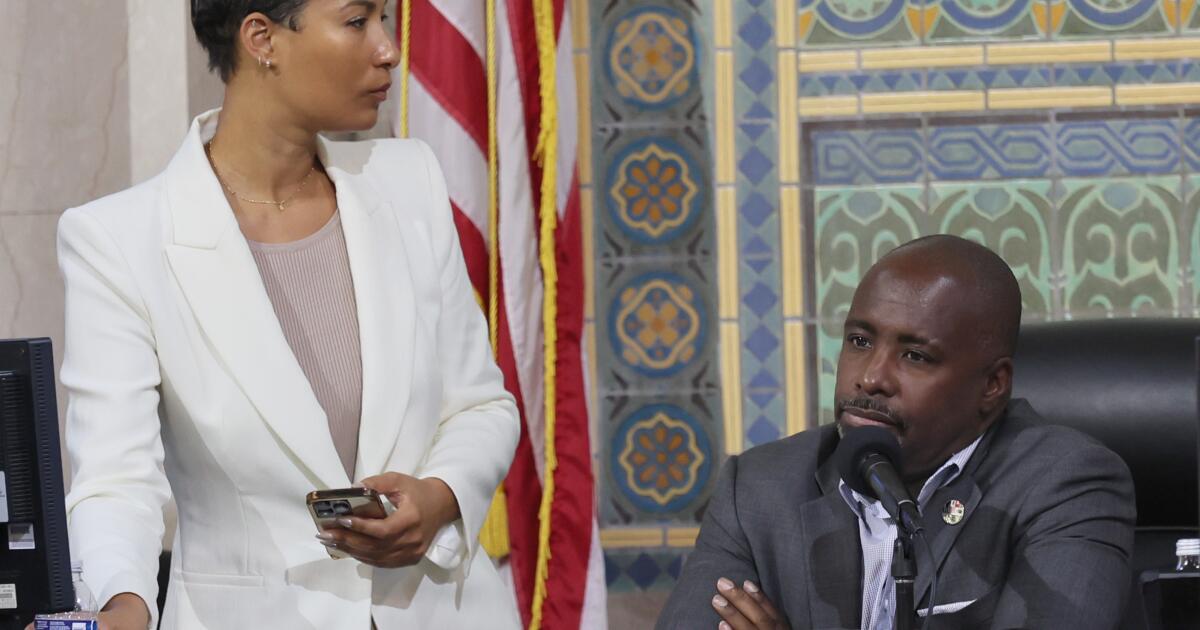
The fight over an effort to boost wages for Los Angeles tourism workers to coincide with the 2028 Olympics has taken a fresh twist, with the City Council president introducing a new motion that critics say would significantly water down the measure.
The issue ostensibly had been put to rest in September, when a business group-backed effort to repeal a $30 per hour minimum wage for Los Angeles hotel and airport workers failed to secure enough signatures to qualify for the ballot.
But now, L.A. City Council President Marqueece Harris-Dawson has introduced a motion that, if approved, would phase the increase in over a longer period of time — delaying the full $30 hourly minimum wage until 2030.
Rhonda Mitchell, a spokesperson for Harris-Dawson, said the council president “continues to work with partners around negotiations,” but did not provide other details when asked for comment by The Times on Friday.
Hospitality and service employee unions sharply criticized the proposal.
“It is a shameful day in Los Angeles when our own elected leaders decide to put forth a motion to strip hard-earned wages from some of the city’s lowest-paid workers,” Yvonne Wheeler, president of the Los Angeles County Federation of Labor, said in a statement Friday. “These workers fought for more than two years to improve their working conditions, only to have the very people who should defend them try to take it all away.”
But Rosanna Maietta — president and chief executive of the American Hotel and Lodging Assn., which had supported repealing the wage increase — said relief from higher labor costs is much-needed in an industry that has struggled to bounce back from pandemic shutdowns. The business group urges the council to “swiftly adopt” the new proposal, she said.
“Hotels are essential to the vitality of Los Angeles, supporting tens of thousands of jobs and generating critical tax revenue that funds essential services like schools, sanitation, and public safety,” Maietta said in a statement Friday. “This motion is a long-overdue step in the right direction and provides hotel owners and operators with short-term relief in the face of decreased travel demand and rising operational costs.”
The City Council originally voted in May to approve a series of yearly wage increases for hotel employees and workers at Los Angeles International Airport, following a two-year campaign by labor organizers.
The law was put on hold during the subsequent opposition ballot campaign, but recently went into effect, with workers seeing the first increments in a series of wage increases designed to boost their minimum pay to $30 per hour by 2028.
The new proposal put forth by Harris-Dawson would instead offer smaller annual wage increases, eventually boosting the workers’ wages to $30 two years later, in 2030.
Harris-Dawson backed the original proposal and helped ease it through a council vote. His spokesperson did not elaborate on why he now supports altering the timeline.
However, the motion comes after a coalition of airline and hotel businesses filed paperwork for a ballot measure to repeal the city’s business tax — a move that would strip about $740 million annually from the city’s general fund, which pays for police officers, firefighters and other services.
The business-backed referendum has been approved to circulate for signatures, and is backed by several airlines as well as the American Hotel and Lodging Assn.
David Huerta, president of SEIU-United Service Workers West, which represents airport workers, said the timing of the motion, in the middle of the holiday season, was “particularly callous.”
“We stand ready to defend the Olympic Wage,” he said in a statement.
The proposal now heads to two committees — one dealing with economic development, the other focused on tourism — for consideration.
Times staff writer David Zahniser contributed to this report.

Hollywood unions and trade groups are pushing back against the proposed $82.7-billion deal for streaming giant Netflix to acquire Warner Bros.’ film and television studios, HBO and HBO Max, citing concerns about greater industry consolidation, job losses and the potential hit to theatrical box office revenue.
Groups began voicing opposition even before the proposed tie-up was officially announced. Amid reports Thursday night that Netflix had secured exclusive rights to negotiate with Warner Bros., the Directors Guild of America said it had “significant concerns” about the development and intended to meet with Netflix for further discussion.
“We believe that a vibrant, competitive industry — one that fosters creativity and encourages genuine competition for talent — is essential to safeguarding the careers and creative rights of directors and their teams,” the DGA said in a Thursday statement.
A major point of contention is Netflix’s long-standing resistance to traditional theatrical film releases. Though the Los Gatos, Calif., streamer has released films in theaters — including about 30 this year alone — it does so typically for marketing or awards purposes and limits the amount of time those movies are available on the big screen.
That theatrical window was once at least 80 days, but has varied by studio since the pandemic. Last year, the average length of time a film was in theaters was about 32 days, according to data from the Numbers, a movie business information site.
Netflix has not been shy about its main goal of offering subscribers first-run movies on its platform, which upends the traditional strategy of having films debut in theaters for an exclusive period before being available at home.
For Netflix, having films launch on its platform allows the company to attract new users, as well as keep existing customers engaged.
But that stance has led to a testy relationship between Netflix and some exhibitors, which have pushed in general for more films to be released on the big screen. The urgency of that effort has only increased in recent years, particularly as the movie theater business continues to recover from the pandemic and dual writers’ and actors’ strikes of 2023.
Theater owner trade group Cinema United has voiced staunch opposition to the deal, saying it represented an “unprecedented threat to the global exhibition business.”
The group urged regulators to take a close look at the proposed transaction, saying in a statement that annual box office revenue in the U.S. and Canada could decrease by 25% if films that typically get a theatrical release by Warner Bros. bypass the theaters and instead are sent directly to streaming.
“The negative impact of this acquisition will impact theatres from the biggest circuits to one-screen independents in small towns in the United States and around the world,” Michael O’Leary, the group’s chief executive, said in a statement. “Netflix’s stated business model does not support theatrical exhibition. In fact, it is the opposite.”
To ease concerns about the effect on box office revenue, Netflix Co-Chief Executive Ted Sarandos told analysts in a call Friday that Warner Bros. films slated for theatrical release will still go to theaters, while Netflix films will follow the company’s existing release strategy. Future Warner Bros. films without existing exhibition commitments will also go to theaters, Netflix said.
But Netflix’s impact on Hollywood’s entire business model has been a point of contention for years, including how its streaming strategy upended existing compensation models for writers and the way shows were made — a key concern during the 2023 strike.
Hollywood unions and trade groups also noted the possibility of more job losses due to the consolidation. Already this year, Hollywood has seen scores of layoffs, some due to the recent merger between Paramount and Skydance Media.
“The world’s largest streaming company swallowing one of its biggest competitors is what antitrust laws were designed to prevent,” the Writers Guild of America West and Writers Guild of America East said in a statement calling for the deal to be blocked. “The outcome would eliminate jobs, push down wages, worsen conditions for all entertainment workers, raise prices for consumers, and reduce the volume and diversity of content for all viewers.”
The Screen Actors Guild-American Federation of Television and Radio Artists said it planned to analyze the details of the proposed deal with an eye toward jobs and production commitments.
“A deal that is in the interest of SAG-AFTRA members and all other workers in the entertainment industry must result in more creation and more production, not less,” the union said in a Friday statement.
While Netflix was once seen as simply a disrupter in the industry, it’s clear it could soon be the face of the new studio system, said former producer Travis Knox, an associate professor of creative producing at Chapman University’s Dodge College of Film and Media Arts.
“Every time a disruption hits — whether the introduction of television, the rise of cable, home video, the arrival of the internet — Hollywood always reacts like it’s an extinction-level event,” he said. “In five years, we’ll look back and realize this wasn’t the final nail in the coffin of the studio system. It was just a much-needed system update.”

New York Schools To Teach Personal Finance Starting In Fourth Grade

My Exercise Bike Cuts Me No Slack: Peloton Cross Training Bike+ Review

Movie Review – A Private Life (2025)

Video: Germany Passes Controversial Law to Boost Soldier Numbers

Map: 7.0-Magnitude Earthquake Shakes Alaska

Florida High School Football Rankings: Top 25 teams – Oct. 21

Cleary's 21 help Le Moyne down Central Connecticut State 69-64 in OT

How old is Bo Nix? What to know about Oregon quarterback ahead of 2024 NFL Draft

99th annual Pony Swim held in Virginia

Video: ‘It Didn’t Have to Happen This Way:’ U.Va. Faculty Call for Review of Police Response to Protests
Map: 7.0-Magnitude Earthquake Shakes Alaska

Hegseth hints major defense spending increase, reveals new details on Trump’s anti-narcoterrorism operations

Ukraine peace talks stall as Russia unleashes huge waves of attacks

National Park Service drops free admission on MLK Day, Juneteenth while adding Trump’s birthday

A 3-D Look at Trump’s Proposed White House Ballroom
-

 Politics4 days ago
Trump rips Somali community as federal agents reportedly eye Minnesota enforcement sweep
-

 Technology1 week ago
New scam sends fake Microsoft 365 login pages
-

 Ohio2 days ago
Who do the Ohio State Buckeyes hire as the next offensive coordinator?
-

 News4 days ago
Trump threatens strikes on any country he claims makes drugs for US
-

 World4 days ago
Honduras election council member accuses colleague of ‘intimidation’
-

 Texas11 hours ago
Texas Tech football vs BYU live updates, start time, TV channel for Big 12 title
-
 Politics1 week ago
Rep. Swalwell’s suit alleges abuse of power, adds to scrutiny of Trump official’s mortgage probes
-

 Politics5 days ago
Trump highlights comments by ‘Obama sycophant’ Eric Holder, continues pressing Senate GOP to nix filibuster