Business
Video: Why Trump’s Reversal on Greenland Still Leaves Europe on Edge


new video loaded: Why Trump’s Reversal on Greenland Still Leaves Europe on Edge

By Andrew Ross Sorkin, Rebecca Suner, Coleman Lowndes and Laura Salaberry
January 22, 2026



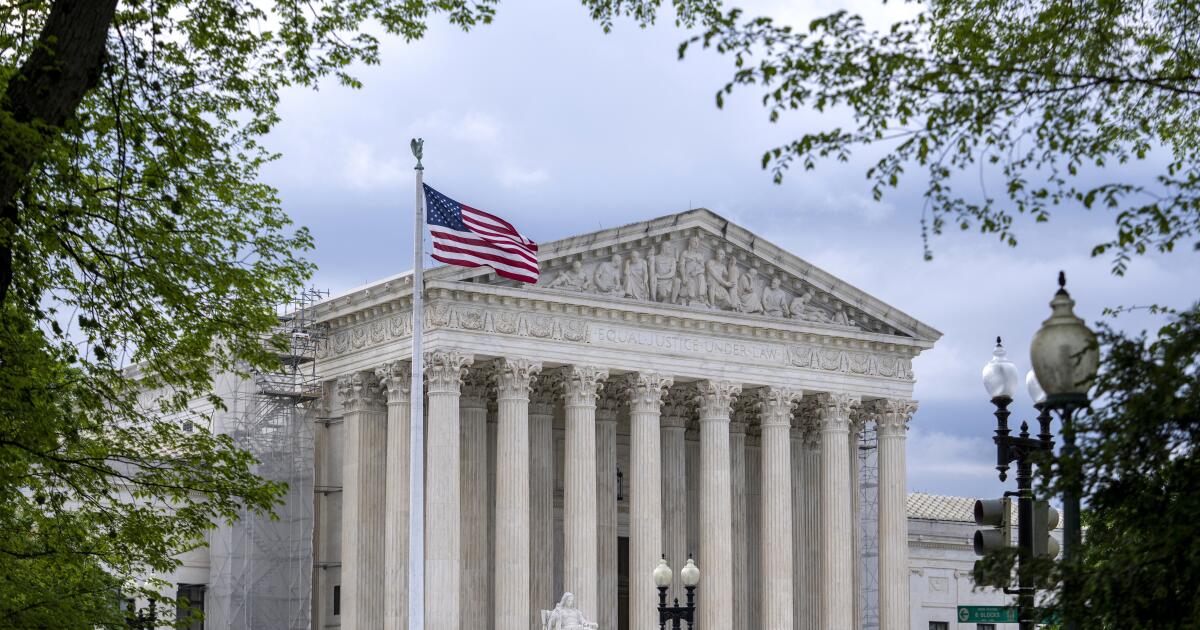
WASHINGTON — The Supreme Court on Wednesday made it harder for music and movie makers to sue for online piracy, ruling that internet providers are usually not liable for copyright infringement even if they know their users are downloading copyrighted works.
In a 9-0 decision, the justices threw out Sony’s lawsuit and a $1-billion jury verdict against Cox Communications for copyright infringement.
Lower courts upheld the lawsuit against Cox’s internet service for contributing to music piracy, which the company did little to stop.
Sony’s lawyers pointed to hundreds of thousands of instances of Cox customers sharing copyrighted works. Put on notice, Cox did little to stop it, they said.
But the high court said that is not enough to establish liability for copyright infringement, which remains a hot button issue in the music and film industries with the advent of AI tools that have spread the misuse of copyrighted content and sparked lawsuits between studios and AI companies.
“Under our precedents, a company is not liable as a copyright infringer for merely providing a service to the general public with knowledge that it will be used by some to infringe copyrights,” Justice Clarence Thomas wrote for the court.
Two decades ago, the court sided with the music and motion picture producers and ruled against Grokster and Napster on the grounds their software was intended to share copyrighted music and movies.
But on Wednesday, the court said “contributory” copyright infringement did not extend to internet service providers based on the actions of some of their users.
“Cox provided Internet service to its subscribers, but it did not intend for that service to be used to commit copyright infringement,” Thomas said. “Cox neither induced its users’ infringement nor provided a service tailored to infringement.”
Mitch Glazier, the chairman of the Recording Industry Assn. of America, said he was “disappointed” in the court’s ruling, as the case was “based on overwhelming evidence that the company knowingly facilitated theft.”
“To be effective, copyright law must protect creators and markets from harmful infringement and policymakers should look closely at the impact of this ruling,” Glazier said in a statement. “The Court’s decision is narrow, applying only to ‘contributory infringement’ cases involving defendants like Cox that do not themselves copy, host, distribute, or publish infringing material or control or induce such activity.”
Karyn Temple, senior executive vice president for the Motion Picture Assn., said in a statement that the decision “upends the critical legal doctrine of contributory infringement for copyright.” She added: “Unfortunately, the Court’s opinion today ignores this well-established rule and congressional intent, which is particularly disappointing amidst a growing consensus about the need for more accountability for facilitating harmful online conduct, not less.”
In its defense, Cox argued that internet service providers could be bankrupted by huge lawsuits for copyright infringement, which they said they did not cause and could not prevent.
“The decision means that the Supreme Court isn’t coming to the entertainment industry’s rescue,” said attorney Michael K. Friedland. “The copyright infringement problem is a technological problem. The modern internet makes infringement really easy. The decision means that the industry is going to have to solve the problem itself — by developing its own better technology to protect its intellectual property.”
Rachel Landy, who teaches copyright law at Cardozo Law School in New York, said the music industry has no good options and may need to go to Congress.
“The record industry could go after the individual users who share works online without authorization, but that led to suboptimal outcomes in the past: bad publicity and judgment-proof defendants,” Landy said. “And now, the court has narrowed the contributory liability doctrine such that they are also unlikely to get recourse from the deeper pockets. It may be that their best recourse is to go to Congress for a fix.”
The American Civil Liberties Union and the Center for Democracy and Technology joined the case in support of Cox and welcomed the decision.
It is “a win for freedom of speech,” said Samir Jain, a CDT attorney. “If the court hadn’t decided in favor of Cox, it would have turned internet service providers into censorship machines acting on behalf of powerful rights-holders.”
Times staff writer Cerys Davies in Los Angeles contributed to this report.

The strait is just 35 miles wide, but before the war began, a quarter of the world’s seaborne oil and one-fifth of its gas traversed through the waterway. The choking off of that supply is creating economic shocks around the world. Even nations not heavily dependent on Gulf oil and gas are contending with the consequences.
International oil prices are at their highest levels in years. L.N.G. prices have soared. Rising jet fuel costs are causing flight cancellations. From Tokyo to Vancouver, driving has become considerably more expensive. In Bangladesh, garment factories have begun to sit idle. In Pakistan, the government has established statewide school closures to conserve power.
The price shock is depleting foreign currency reserves and stoking inflation in nations already struggling with rising costs.
Experts have called the current situation a “systemic collapse” of the energy security era established in the 20th century.
Governments worldwide are deploying measures to combat shortages and high energy prices, including the largest-ever release of strategic oil reserves by the United States, Japan, South Korea and others.
For now, energy experts and economists say these stopgap measures are helping shield households and companies from the most acute disruptions, but they warn that the drag on global economic growth will compound if the war persists.
President Trump has pressed for an international naval coalition to break the Iranian blockade of the strait. Over the weekend, he threatened to obliterate parts of Iran if it did not reverse course. Tehran has said “non-hostile” ships can sail through the strait, but it is unclear if any vessels will try.
Methodology
The New York Times identified ports and energy installations in the Persian Gulf affected by the Strait of Hormuz and then used activity tracked by Kpler, an industry data firm, to measure the tonnage of individual shipments flowing out of the region in 2025, as well as their final destinations. The shipping analysis focused on seaborne trade and was limited to the following oil and gas products: crude oil and condensate; gasoline and naphtha; liquefied petroleum gas; gasoil and diesel; kero and jet; fuel oils; and liquefied natural gas. About half of the outgoing shipments made by Iran are estimated by Kpler using satellite imagery.

After a grueling seven weeks of court proceedings and more than 40 hours of tense deliberations across nine days in one of the country’s most closely-watched civil trials, jurors handed down a landmark decision in Los Angeles Superior Court on Wednesday, finding Instagram and YouTube responsible for the suffering of a Chico woman who charged the platforms were built to addict young users. .
Kaley G.M., the 20-year-old plaintiff, arrived in court just before 10 a.m. wearing the same rose-colored maxi dress she’d donned to testify in February. She remained stoic as the verdict, the $3 million damages award and the decision warranting punitive damages were read out. A companion fought back tears, her chin quivering. Several observers wept silently despite Judge Carolyn B. Kuhl’s repeated warning not to respond.
“We need to have no reaction to the jury’s verdict — no crying out, no reactions, no disturbance,” Kuhl warned. “If there is we will have to have you removed from the courtroom, and we sure don’t want to have to do that.”
Attorneys for Snapchat and TikTok also appeared in court Wednesday morning to hear the decision. The two platforms settled with Kaley out of court for undisclosed sums before the trial.
“We respectfully disagree with the verdict and are evaluating our legal options,” a spokesperson for Instagram’s parent company Meta said.
The verdict arrived less than 24 hours after a New Mexico jury found Meta liable for $375 million in damages related to Atty. Gen. Raúl Torres’ claim it turned Instagram into a “breeding ground” for child predators — a decision the platform has vowed to appeal.
The Los Angeles jury took much longer to deliberate. On Friday, jurors preempted their pizza lunch break to ask Kuhl whether all of them should weigh in on damages, or only those who’d agreed on liability. On Monday they told Kuhl they were struggling to agree about one of the defendants.
Kuhl told the jury to keep trying.
Kaley said she first got hooked on YouTube and Instagram in grade school. Jurors were charged with determining whether the companies acted negligently in designing their products and failed to warn her of the dangers.
Their verdict will echo through of thousands of other pending lawsuits, reshaping the legal landscape for some of the world’s most powerful companies. Experts say the payout will likely set the bar for future awards.
It comes on the heels of a Delaware court decision clearing Meta’s insurers of responsibility for damages incurred from “several thousand lawsuits regarding the harm its platforms allegedly cause children” — a ruling that could leave it and other tech titans on the hook for untold future millions.
Until this trial, which began in late January, no suit seeking to hold tech titans responsible for harms to children had ever reached a jury. Many more are now set to follow.
Amy Neville (L), who lost her son Alexander at 14 from fentanyl he purchased through social media, is hugged by attorney Laura Marquez-Garrett, as they wait for a verdict in the social media trial tasked to determine whether social media giants deliberately designed their platforms to be addictive to children, in Los Angeles, on March 20, 2026.
(PATRICK T. FALLON/AFP via Getty Images)
Kaley’s test case was chosen from among scores of suits currently consolidated in California state court. Hundreds more are moving together through the federal system, where the first trial is set for June in San Francisco.
Collectively, the suits seek to prove that harm flowed not from user content but from the design and operation of the platforms themselves.
That’s a critical legal distinction, experts say. Social media companies have so far been protected by a powerful 1996 law called Section 230, which has shielded the apps from responsibility for what happens to children who use it.
Lawyers for Meta and Google argued Kaley’s struggles were the result of her fractious home life and fallout from the COVID pandemic, not social media.

Phyllis Jones (R), attorney for Meta, leaves the Los Angeles Superior Court on March 12, 2026.
(Frederic J. Brown/AFP via Getty Images)
“I don’t think it should have ever gotten to a jury trial,” said Erwin Chemerinsky, dean of the UC Berkeley School of Law and an expert on the 1st Amendment, which also protects the platforms. “All media tries to keep people on [their platform] and coming back.”
Others say social media’s algorithmic ability to capture, cultivate and control attention makes it fundamentally different from teen-friendly romantasy novels, Marvel movies or first-person shooter games.
“These are truly hard and heart breaking cases,” said Eric J. Segall, a professor at Georgia State College of Law. “[They] represent a clash between free speech values and the real harms caused by protecting those companies that engage in free speech amplification for profit.”
“Letting jurors sort all of this out without more guidance is tempting but also risky,” he said.
As deliberations that began March 13 wore on, jurors signaled similar skepticism, asking to see internal Meta documents, and reviewing testimony from a defense expert “in regards to her professional integrity; being the only doctor stating social media was not a contributing factor to KGM’s mental health.”
They appeared to agree on Meta’s culpability by Friday, but labored through Tuesday to hash out a decision for Google, delivering their verdict just after 10 a.m. Wednesday.
“Today, a jury saw the truth and held Meta and Google accountable for designing products that addict and harm children,” said Lexi Hazam, court-appointed co-lead plaintiffs’ counsel in the related federal action. “This verdict sends an unmistakable message that no company is above accountability.”
The outcome will likely transform the already heated debate over social media addiction as a concept, what role apps may play in engineering it, and whether individuals like Kaley can prove they’re afflicted.
The platforms’ attorneys sought to cast doubt on the ailment — emphasizing that there is no formal diagnosis for social media addiction — while also arguing that Kaley had never been treated for it.
“Substitute the words ‘YouTube’ for the word methamphetamine,” attorney Luis Li urged the jury during closing arguments Thursday. “Ask yourselves with your lifetime of experience whether anybody suffering from addiction could say, ‘Yeah, I just kind of lost interest.’”
“She was sitting there for hours without being on her phone,” said Meta attorney Paul W. Schmidt.
YouTube’s team also sought to distance the video-sharing app from Instagram and other social media platforms, saying its functions are fundamentally different.
Kaley’s team called it “a gateway” to her social media addiction.
“YouTube wasn’t a gateway to anything,” Li said. “YouTube was a toy that a child liked and then put down.”
Jurors disagreed, ultimately holding the platform liable, though they split the liability 70-30, weighting heavily to Meta.
Lanier leaned on his down-home Texas folksiness throughout the trial, telling the jury what was on his heart and scribbling with grease pencil on his demonstrative aids. In his direct addresses to the jury, he used a set of wooden baby blocks, stacks of paper, even a hammer and a crate of eggs.
During the punitive phase of the trial late Wednesday morning, he brought out a glass jar filled with 415 peanut M&Ms to represent the $415 billion dollars of stockholder’s equity Google’s parent company Alphabet was valued at in December.
“What are you going to fine them for this?” he probed. “Are you going to fine them a billion?” He plucked a green M&M from the top of the pile. “Two billion?” He pulled out another. “You know a pack of M&Ms has 18 M&Ms in it? You fine them a billion, and they’re not going to notice.”
“The last thing in the world they want you to do is talk about how many M&Ms they’ve got,” the lawyer said, urging jurors to “talk to Meta in Meta money”. “The last thing in the world they want you to do is focus on what it takes to hold them accountable for what they’ve done.”
Conversely, the tech teams relied on slick digital presentations to review evidence and illustrate their arguments.
“Focus on those facts that are at issue in this case,” Schmit urged the jury during closings. “Not lawyer arguments, not props like a glass of water or a jar of M&Ms, But actual proof in evidence.”
During the punitive phase of the trial, he sought to emphasize that “there wasn’t an intention to do harm” to children, and that it had worked diligently to make its products safer.
The case was the first to get Meta CEO Mark Zuckerberg on the witness stand, where he defended Instagram’s safety record and lamented the difficulty of keeping youngsters off the app.
It also made public tens of thousands of pages of internal documents — documents Lanier argued showed the companies intentionally targeted children, and engineered their products to keep them on the platforms longer.
“These are internal documents that you’re uniquely seeing because you’re the jury that got to sit on this case,” Lanier told the jury during closing arguments on Thursday. “It’s given you exposure that the world hasn’t had.”
Those previously undisclosed materials likely proved critical to the jury’s ultimate verdict, experts said.
“Internal emails here were key — they painted a picture of indifference at Meta,” said Joseph McNally, former Acting U.S. Attorney for the Central District of California and an expert in “technology-related harm.”
The tech titans have already vowed to appeal both the California and New Mexico verdicts, all-but ensuring the issue is ultimately decided by the Supreme Court, experts said.

US troops brace for ‘hit-and-run’ guerilla attacks as 82nd Airborne deploys to Iran, military analyst warns

New Jersey Gov Sherrill signs law barring ICE agents from wearing face coverings to shield identities

Chronic back pain may have met its match with hormone treatment, scientists say

Rams star Puka Nacua sued for alleged assault and battery amid accusations he bit woman

Spring clean your digital footprint: Why retirees are scam targets

Florida High School Football Rankings: Top 25 teams – Oct. 21

How old is Bo Nix? What to know about Oregon quarterback ahead of 2024 NFL Draft

Cleary's 21 help Le Moyne down Central Connecticut State 69-64 in OT

99th annual Pony Swim held in Virginia

Indiana Members Credit Union announced as new anchor tenant at Bottleworks District
New Jersey Gov Sherrill signs law barring ICE agents from wearing face coverings to shield identities

Escalation in the Middle East – Not Europe’s war? MEPs in the Ring

War with Iran disrupts fertilizer exports as U.S. farmers prepare for planting season

White House unleashes on Raskin for clinging to ‘deranged’ Jack Smith ‘lies’ in latest Trump docs flare-up

‘Keffiyehs seized, left to die’: Inside the Palestine Action hunger strike
-

 Detroit, MI1 week ago
Drummer Brian Pastoria, longtime Detroit music advocate, dies at 68
-

 Georgia1 week ago
How ICE plans for a detention warehouse pushed a Georgia town to fight back | CNN Politics
-

 Movie Reviews1 week ago
‘Youth’ Twitter review: Ken Karunaas impresses audiences; Suraj Venjaramoodu adds charm; music wins praise | – The Times of India
-
 Science1 week ago
Industrial chemicals have reached the middle of the oceans, new study shows
-

 Science1 week ago
How a Melting Glacier in Antarctica Could Affect Tens of Millions Around the Globe
-

 Culture1 week ago
Test Your Memory of Great Lines From Classic Irish Poems
-

 Sports5 days ago
IOC addresses execution of 19-year-old Iranian wrestler Saleh Mohammadi
-

 New Mexico3 days ago
Clovis shooting leaves one dead, four injured