Business
The Geography of Unequal Recovery


The U.S. economy has added some 19 million jobs in the past four years — all the jobs lost in the pandemic plus millions more. The comeback has been faster and more complete than any in recent decades, or maybe ever.
But it has also been uneven.
In some parts of the country, jobs came back quickly once vaccines were available, if not earlier. In many of those places, more people are working, and earning more money, than ever before.
In other places, the rebound has been much slower. As of 2023, more than two in five U.S. counties — 43 percent — still hadn’t regained all the jobs they lost in the early months of the pandemic, according to annual data from the Bureau of Labor Statistics. Some of those places were struggling long before 2020. Others had been thriving economically and were knocked off course by an airborne shock few saw coming.
The geography of that unequal recovery helps reveal how the pandemic — and the policies adopted in response to it — reshaped the U.S. economy, changing the kind of work Americans do and where they do it.
The patterns could have electoral implications: The battleground states that will help decide November’s presidential election include some of the biggest winners in the recovery — but also several of the losers.
The winners have some things in common. They are concentrated in the South and the Mountain West, particularly in suburban counties, which have done well in an era of remote and hybrid work.
They tend to be places where job losses were comparatively mild in the first place, often because their major employers were in industries that were less affected by — or that even benefited from — the disruptions of the pandemic. They are, on average, richer and better educated than counties that have been slower to rebound. They voted disproportionately for Donald J. Trump in the 2020 presidential election.
The losers, by contrast, tend to be concentrated both in big cities, which were hit particularly hard by the pandemic, and in rural areas, which were struggling long before the virus struck. They are relatively poor, on average, but with notable exceptions: San Francisco and several of its wealthy neighbors, for example, have yet to regain all the jobs they lost in the pandemic.
Leisure and hospitality jobs did not return in many places
Percentage change in leisure and hospitality jobs from 2019 to 2023. Battleground states are in bold.
Utah
Idaho
Mont.
Texas
Ariz.
Ark.
Tenn.
S.D.
Okla.
Neb.
Wyo.
N.C.
S.C.
Fla.
Colo.
Kan.
Ga.
Ky.
N.J.
N.H.
N.M.
Va.
Mo.
Ind.
Ohio
N.D.
Del.
Wash.
Wis.
Miss.
R.I.
Ala.
Alaska
Calif.
Maine
Iowa
Conn.
Pa.
Minn.
Mich.
Nev.
Ore.
W.Va.
Ill.
Mass.
N.Y.
Vt.
Md.
La.
D.C.
Hawaii
–8
–4
0
+4
+8
+12%
The pandemic also changed the types of jobs that Americans hold. Restaurants, hotels, movie theaters and other in-person businesses laid off millions of workers, while warehouses and trucking companies went on a hiring spree to meet the surge in demand.
Those shifts have reversed, but gradually and incompletely: The United States has more truck drivers and fewer waiters, as a share of the work force, than it did in 2019.
The economic changes that started in the early days of the pandemic have played out differently in different parts of the country — including the states most likely to decide the election. Nevada, which depends more heavily on tourism jobs than any other state, was hit especially hard in the pandemic, and while Las Vegas is booming again, not all the jobs have returned. That may help explain why both major presidential candidates have sought to woo casino workers there by promising to eliminate taxes on their tips.
Hospitality jobs have also been slower to return in the Northern swing states like Michigan and Pennsylvania than in Sun Belt states like Georgia and Arizona, where pandemic restrictions were lifted earlier.
Percentage change in construction jobs from 2019 to 2023. Battleground states are in bold. Idaho
Ariz.
Mont.
Utah
Ark. Tenn.
S.D.
Nev.
Neb.
Mo. Maine
N.C.
N.H.
Ky.
Fla. Ind.
Wis.
Mich.
Miss.
Ala. R.I.
Ore.
Ga.
Minn.
Iowa Kan.
Wash.
Texas
Mass.
N.M. Va.
Ohio
S.C.
Del.
Colo. Alaska
Vt.
Ill.
Conn.
N.J. Calif.
D.C.
Hawaii
Okla.
Pa. Wyo.
N.D.
Md.
N.Y.
W.Va. La.
–5
0
+5
+10 +15
+20
+25
+30%
There’s been a construction boom
Government policies have also helped shape the rebound in the job market. Big federal investments in infrastructure, green energy and high-tech manufacturing under President Biden helped fuel rapid hiring in manufacturing and heavy construction.
In Nevada, new factory jobs — and jobs building those factories — helped offset the slow rebound in tourism. Arizona has enjoyed one of the biggest construction booms of any state thanks partly to giant new chip manufacturing plants whose funding includes federal grants.
Percentage change in jobs from 2019 to 2023, by county
Suburban and urban counties
Sun Belt states thrived
Nevada
Partly because of these patterns, battleground states in the Sun Belt have thrived in recent years, at least in job growth. Maricopa County, Ariz., which includes Phoenix and is the site of the chip plants, is one of the fastest-growing big counties (those with at least one million residents) in terms of employment. Jackson County, Ga., is one of the fastest growing of any size — up more than 60 percent since 2019, partly because of a major new plant that manufactures batteries for electric vehicles.
That rapid growth has brought opportunities, but also challenges, particularly a critical shortage of affordable housing. It is no coincidence that the presidential campaigns of Mr. Trump and Vice President Kamala Harris have put housing at the center of their economic messages.
Percentage change in jobs from 2019 to 2023, by county
Suburban and urban counties
“Blue Wall” states fared relatively poorly
Wisconsin
The Northern “Blue Wall” states face a different set of challenges. They struggled economically before the pandemic and have been laggards in the recovery.
Pennsylvania, for example, largely missed out on the construction and manufacturing booms. Allegheny County, which includes Pittsburgh, is the only big county in the country where total employment has fallen more than 5 percent since 2019. But the losses have been widespread: Of the state’s 67 counties, 51 lost jobs from 2019 to 2023.
How, exactly, these trends will play out on Election Day is unclear. Polls show that voters are worried about the economy across the country, not just in the places where the recovery has been weakest. That may be because, at least until recently, many Americans have been worried less about finding a job than about the rising cost of living.
That could be changing now, as rising unemployment and slowing job growth have begun to expose cracks in the labor market’s foundation. That is especially true in states like Pennsylvania, where hiring has lagged, but even fast-growing states have areas where the labor market is struggling.
While the election will probably be decided by voters in a handful of battleground states, nearly every place looks different than it did four years ago.
In Lee County, Fla., a wave of construction helped offset a big decline in hotel and restaurant jobs. Portsmouth, Va., bucked the national trend and added hospitality jobs due mostly to the opening of the state’s first permanent casino. McLean County, Ill., has gained thousands of manufacturing jobs in recent years, many of them at the electric vehicle maker Rivian.
See what has changed in your county:
In
, there is not enough data available.
Cumulative percentage change in jobs from 2019
All industries
Insufficient data
2019
2023
Construction
Insufficient data
Manufacturing
Insufficient data
Trade, transportation and utilities
Insufficient data
Information
Insufficient data
Finance
Insufficient data
2019
2023
Business services
Insufficient data
Education and health
Insufficient data
Leisure and hospitality
Insufficient data
Other services
Insufficient data
Methodology
Jobs data are average annual employment levels from the Quarterly Census of Employment and Wages, published by the Bureau of Labor Statistics. Totals are for all covered employment, public and private. Industry breakdowns are private sector only.
Population, demographic and socioeconomic data is from the American Community Survey five-year sample for the years 2016 to 2020. Election results are from Dave Leip’s Atlas of U.S. Presidential Elections.
The Bureau of Labor Statistics withholds some data to protect the confidentiality of individual businesses. Data for a small number of counties is not shown because of changes in county definitions from 2019 to 2023. Maps do not show change in employment for counties with populations under 500.



The race to bring air travel to the sky is heating up as Santa Cruz-based Joby Aviation and Toyota launch a joint venture to commercially produce air taxis.
The companies said in a news release Tuesday that they will work together on productivity, quality and costs and move toward mass production of Joby’s electric vertical takeoff aircraft. Joby and Toyota were first linked when Toyota made a nearly $400-million investment in the company in 2020. It has since increased its backing of the company to $900 million.
“It’s really meaningful for us to take on this challenge together with Joby, a partner that shares the same vision,” Toyota Chair Akio Toyoda said. “We believe this strengthened relationship is an important step forward in realizing the future mobility society.”
Joby‘s all-electric vertical takeoff vehicles are designed to hold four passengers and a pilot and can travel at up to 200 mph. The vehicle uses six tilting propellers to achieve vertical takeoff before switching to forward flight.
In February, Joby announced a partnership with Uber to start service in the United Arab Emirates this year, bringing on-demand air taxi rides to the country. It plans to expand to the U.S. after the completion of its final stage of Federal Aviation Administration testing.
Prior to its full FAA certification, Joby is hoping to launch early flight operations later this year as part of a White House program that will bring flights to several states, including New York, Texas and Arizona. Flights in California will not begin until after obtaining FAA certification.
Joby has been in a fierce battle to be the first with taxis in the sky with its Northern California competitor Archer Aviation. The two companies are involved in overlapping lawsuits, with Joby alleging corporate espionage against Archer, and Archer filing a suit alleging dubious ties to China that sparked an investigation into Joby by the U.S. International Trade Commission.
“Toyota has been by Joby’s side for nearly a decade, providing invaluable guidance and support as we built the foundation for manufacturing our aircraft,” JoeBen Bevirt, Joby’s chief executive and founder, said in the news release. “Together, we share a vision of making aerial mobility an everyday reality, and we look forward to delivering on that promise together.”
Joby Aviation’s shares, which have fallen more than 30% this year, climbed 3% on Tuesday to $8.92.
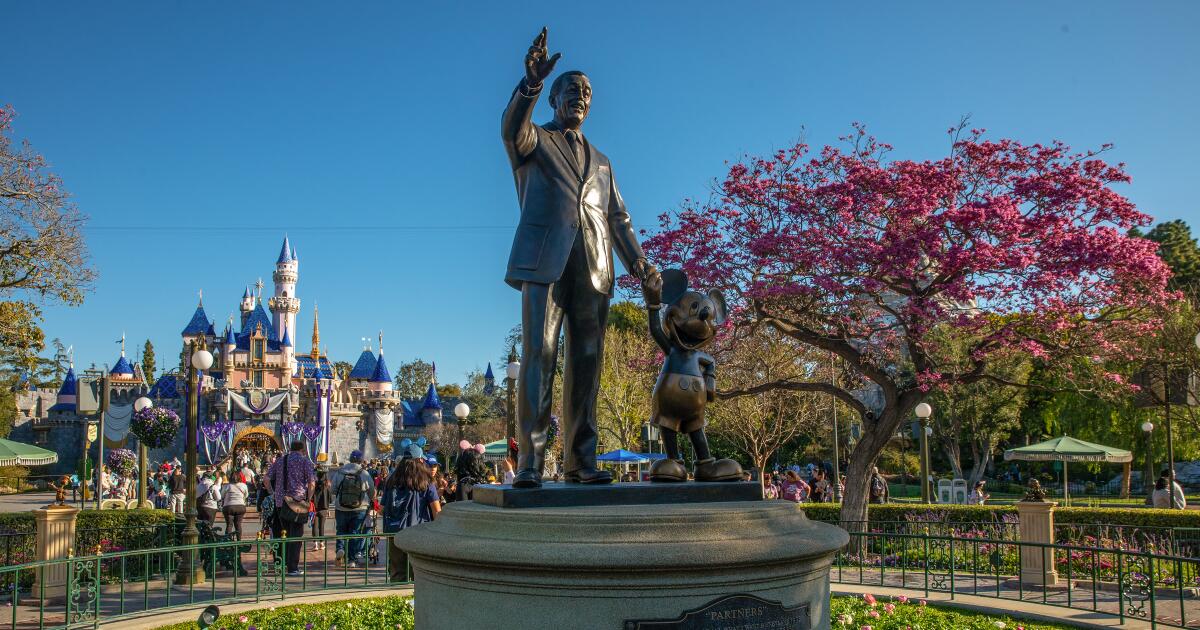
Disneyland Resort in Anaheim will offer $59 tickets for select evening admission to either theme park as part of a new promotion.
The one-day, one-park evening ticket offer will allow attendees to enter Disney California Adventure at 5 p.m. or Disneyland at 7 p.m. Park reservations are still required, as has been the case since the COVID-19 pandemic.
The offer only applies for admission from July 12 through Aug. 5 on Sundays to Wednesdays.
Disneyland Resort is commemorating its 70th anniversary through Aug. 9, and has introduced new shows and additions to rides as part of the occasion.
Walt Disney Co.’s theme parks and experiences business are a crucial boost to its finances, making up about 56% of the company’s operating income last fiscal year.
During the Burbank-based company’s most recent earnings call in May, Disney executives said attendance at its U.S.-based parks was down 1% compared with the prior year, a shift they attributed to “continued softness” in international visitations. However, the company said at the time that it was starting to move past those issues.
Disney’s experiences division reported $9.5 billion in revenue in that fiscal second quarter, up 7% compared with the same period a year ago, something executives said was due to higher guest spending domestically and more capacity on its cruise line.

An aging downtown office complex will be converted into apartments as part of an ambitious plan by local real estate companies to create 4,000 affordable housing units in Los Angeles.
The first project will be a $200-million makeover of the L.A. World Trade Center, a sprawling white elephant of an office complex on Figueroa Street built in the 1970s that will be turned into 512 apartments in one of the largest affordable housing conversions to date downtown.
Future projects being planned in the central city for delivery over the next five years will include other office-to-apartment conversions and new housing built from the ground up.
The 10-story World Trade Center, right, at Figueroa and Fourth streets in downtown Los Angeles, was built in the mid-1970s.
(Myung J. Chun / Los Angeles Times)
Behind the building campaign unveiled Monday are two of the region’s largest real estate companies, Jamison and Kennedy Wilson. Jamison is the city’s most prolific converter of offices to market-rate apartments and currently has a major makeover of a downtown office skyscraper underway for tenants who can pay top rents.
Kennedy Wilson, a real estate investment company based in Beverly Hills, owns Vintage Housing, which builds and operates affordable housing using tax credits and other state and federal financing to help fund it.
Vintage Housing and Jamison’s new affordable housing division, Arden Residential, will take on the campaign to build the housing where qualified tenants will pay rents below market rates.
Rents in the World Trade Center — which will be renamed Sky Castle when it opens in early 2028 — are expected to start at $937 for a one-bedroom unit. Some two- and three-bedroom units would rent for $1,100 and $1,300 per month, respectively, developers said.
Sky Castle will have shared amenities found in more expensive modern apartments, the developers said, such as a fitness center, resident lounge and co-working space. It already has six tennis courts on the roof, which may be converted to pickleball courts, Jamison Chief Executive Garrett Lee said.
The goal is to build higher quality affordable housing by using efficient construction methods Jamison has learned through building more than 8,000 market-rate apartments in the past, Lee said. The makeover of the World Trade Center will mark Jamison’s 15th conversion of an office building to housing.
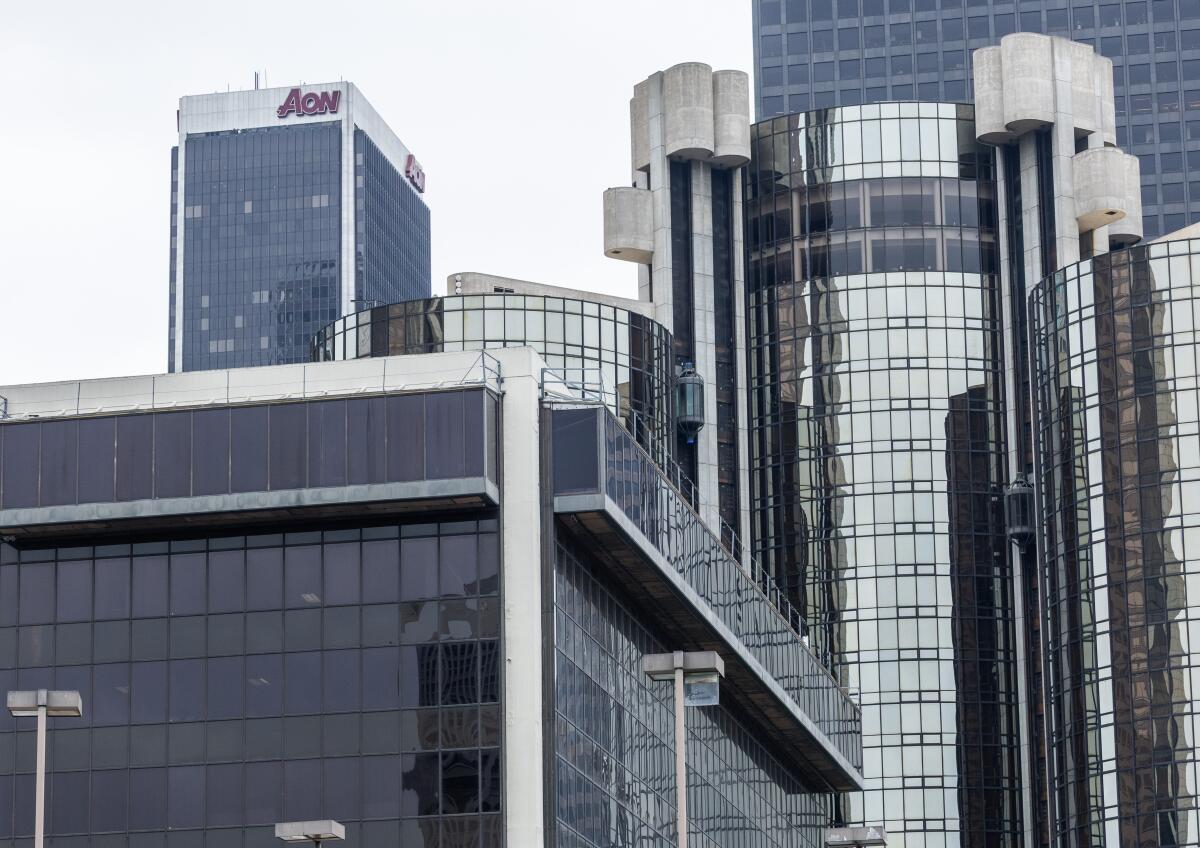
The plan to redevelop the L.A. World Trade Center, bottom left, is one of the largest affordable housing conversions to date downtown.
(Myung J. Chun / Los Angeles Times)
The 10-story World Trade Center was built in the mid-1970s to fanfare saying it would be home to international companies. In 1976, The Times described the center as a place to prepare for an overseas trip where visitors could get passports and visas, as well as exchange dollars for francs, marks, rubles and other currency. There was a language school and branches of U.S., Swiss and Japanese banks.
By the mid-1980s, the 400,000-square-foot office complex covering a city block at Figueroa and Fourth streets had lost its international flavor and was falling out of favor with corporate tenants who were moving into glossy new skyscrapers on Bunker Hill and in other locations.
The building has been cleared of remaining office tenants to allow work to begin in August, Lee said.
Kennedy Wilson is a nationwide operator of market-rate apartments that has also moved into building affordable housing in the last decade, said Nicholas Bridges, global head of capital markets at the company.
Building affordable, workforce housing “in almost all cases requires public subsidies,” Bridges said, and Kennedy Wilson has developed expertise in assembling “a cocktail of public financing sources” that includes low-income housing tax credits and tax-exempt bonds.
In the past, many housing developers have shied away from building affordable housing because assembling the subsidies needed to make construction profitable is challenging.

An artist’s rendering shows what the L.A. World Trade Center could look like after being redeveloped into affordable housing. The new complex is to be called Sky Castle.
(Ian Camarillo)
“It’s complicated,” Bridges said, “and not for the faint of heart.”
Eligible tenants must earn between 30% and 80% of the median income in the area where the housing is built.
Jamison and Kennedy Wilson will develop about 15 affordable housing projects between downtown and the 405 Freeway, Bridges said, many of them in aging office buildings such as the World Trade Center that are already owned by Jamison and are close to public transit.
Substantial potential for affordable housing lies in L.A.’s underused office buildings, he said.
“In this post-COVID world, the way people are utilizing office buildings, particularly older office buildings, has just fundamentally changed,” he said.
It makes sense for developers of conventional multifamily housing to move to building affordable housing, Lee said, because the government supports it through subsidies, zoning reform and the fast-tracking of construction permits. The city of Los Angeles also recently streamlined its adaptive reuse rules to make it easier to convert office buildings to housing.
“There are a lot of incentives pushing us in this direction,” Lee said.
-

 Sports4 minutes ago
Ex-NFL reporter Dianna Russini interaction with police officer to dodge traffic ticket comes to light
-
Business12 minutes ago
Joby Aviation creates a joint venture with Toyota to build air taxis
-
 Entertainment19 minutes ago
Inside Eddie Huang’s sadboi era and turning a new page with his novel
-
 Lifestyle22 minutes ago
Wait, it’s a candle? Her beeswax fruit and veggie ones look so real, you’ll want to take a bite
-
 Politics27 minutes ago
Commentary: The sad inevitability of Justice Alito’s birthright citizenship dissent
-
Sports37 minutes ago
2026 World Cup knockout round TV schedule, game previews and results
-

 World49 minutes ago
Russian gas imports rise despite EU phase-out
-

 News1 hour ago
Woman survives falling 1,500 feet down Mount Shasta

