Business
The Fed Isn’t Rushing to Save the Markets This Time


The notion that the Federal Reserve will rush in to rescue investors in a crisis has comforted investors for decades. But in the big market downturn induced by President Trump’s tariffs, no Fed rescue is in sight.
Jerome H. Powell, the Federal Reserve chair, made that clear on Friday. The tariffs are much “larger than expected,” he said, and their immense scale makes it especially important for the central bank to understand their economic effects before taking action.
“It is too soon to say what will be the appropriate path for monetary policy,” he said at a conference in Virginia.
In fact, I’d say, the likelihood of further market declines is much greater than the chance that the Fed will turn the markets around in the immediate future.
What U.S. stock investors have experienced until now is what’s known on Wall Street as a correction — a decline of 10 percent or more from a market peak. The correction doesn’t end, by this common definition, until the markets have turned around and that peak has been surpassed. For days, though, the market momentum has been almost entirely downward. So another dubious distinction is in sight: a bear market, which is a decline of at least 20 percent from a market top. For the S&P 500, which closed at 5,074.08 on Friday, down from its peak of 6,144.15 on Feb. 19, a bear market is already within shouting distance, a scant 2.6 percentage points away.
It would be lovely to be able to say that the stock market bottom is near, or that it has already been reached, Edward Yardeni, a veteran market watcher, said in a conversation on Friday.
“I’ve been pretty good at picking market bottoms, and I’m not shy about calling one when I see one,” he said. “But that usually has happened when the Fed has taken action. And right now, its pretty clear that Powell won’t be doing that.”
The Fed is holding back this time for good reasons. The impact of the sudden new range of tariffs imposed by the president — and the tit-for-tat tariffs announced on Friday by China that are likely to be followed by similar moves from a host of other countries — is far from clear.
But this much is certain. Tariffs are a tax, one that is likely to slow economic growth as well as raise prices. Those effects complicate the task of the Fed, which has a dual mandate: promoting full employment (and economic growth) and holding the rate of inflation down to a reasonable level.
With the Fed still battling inflation after the runaway surge in prices of 2022 and 2023, it is reluctant to lower interest rates when price increases in a range of goods could be just around the corner. And on Friday, the latest jobs report from the government showed that the economy in March remained reasonably strong. Employers added 228,000 jobs for the month, far more than anticipated, and while the unemployment rate rose slightly, to 4.2 percent from 4.1 percent, there were few signs of substantial weakness.
Given that backdrop, Mr. Powell seemed to be signaling that it would take an actual slowdown, with substantial job declines, to justify rate cuts under current circumstances. Consumer confidence has declined, and an Economic Policy Uncertainty Index that is closely watched by economists and business executives has soared. But concrete data isn’t here yet. If they’re not rolled back, the tariffs are likely to take a while to result in widespread layoffs — and without strong evidence of a slowdown, the Fed may be reluctant to act.
Yet the Fed has already come under pressure from President Trump to lower interest rates. This is the “PERFECT time” for a Fed rate cut, he said on the Truth Social media platform on Friday, shortly before Mr. Powell’s speech. Maintaining Fed independence is important in the markets, and there was no indication that this overt presidential pressure had any effect on Mr. Powell’s staunch resolve to bide his time, and to lower interest rates only when and if the Fed decided it was time to do so.
So investors may need to be very patient, and to hope that changes in tariff policy occur rapidly enough in Washington to turn the markets around and, more important, avert a recession. Recessions are typically associated with wide-ranging job losses, and they cause immense hardship in the real world as well as in financial markets.
Recessions usually make bear markets much worse, Ned Davis Research, an independent financial research firm, has found. Bear markets accompanied by recessions had a median duration of 528 calendar days and a market decline of 32.8 percent, the firm has found, using Dow Jones industrial average data since 1900. Bear markets that occurred without recessions had a median duration of 224 days and a decline of 23.3 percent.
“Bear markets are unfortunate whenever they occur, but they tend to be much worse if there’s also a recession,” Ed Clissold, chief U.S. strategist at Ned Davis Research, said in an interview.
Yet the Trump tariffs, which would be the steepest in a century if fully carried out, have already set off a global trade war. The president could reverse himself, remove most of the tariffs and try to undo some of the damage, but there are no signs that he’s planning to do so. In the meantime, the chances of a recession and of further market declines have been growing.
Mr. Yardeni said that while he remained optimistic about the long-term prospects for the United States, fear, confusion and uncertainty over President Trump’s tariff policy make him less positive about the next year. The chances of “stagflation” — a dreaded combination of high inflation and a slowing economy — are now 45 percent in the next 12 months, up from 35 percent one month ago, he said, and that wouldn’t help the stock market.
Goldman Sachs says there’s now a 35 percent chance of a recession in the next year, and late in March it ratcheted down its estimate for the S&P 500, projecting a 5 percent price decline over the next three months. At the start of the year, Goldman was rampantly bullish, forecasting a 16 percent increase in the S&P 500 over the course of 2025. If the market falls much further, Goldman and other market strategists are likely to revise their estimates still lower. JPMorgan has already raised the odds of a global recession this year to 60 percent.
As I’ve pointed out in recent columns, though, bonds have been performing well this year, easing some of the pain for investors, and international stock markets have done better than the U.S. ones, although they, too, have been battered as the reality of a new world of higher tariffs has sunk in. Old-fashioned low-cost diversified investing — I practice it using index funds that track virtually all tradable global markets — has eased some of the pain this year.
But in a full-blown recession and a bear market, few people will be entirely spared. Eventually, markets rebound, and those with long horizons are likely to prosper, regardless of what happens in the next few weeks.
Some market declines are blessedly brief. But in the bear market that started in October 2007, during the great recession of that period, it took more than four years, including dividends, for investors in the S&P 500 to climb back to the peak of their holdings in that index.
Even so, it was worth hanging on, for those who were able to do so.
Since the 2007 market peak, the S&P 500 has had a total return of more than 356 percent, even including the latest market declines. Staying in the market has paid off over the long run, and it’s likely to do so again. But sticking with it, even in times like these, can be tough. You need strength and plenty of patience to be a long-term investor.



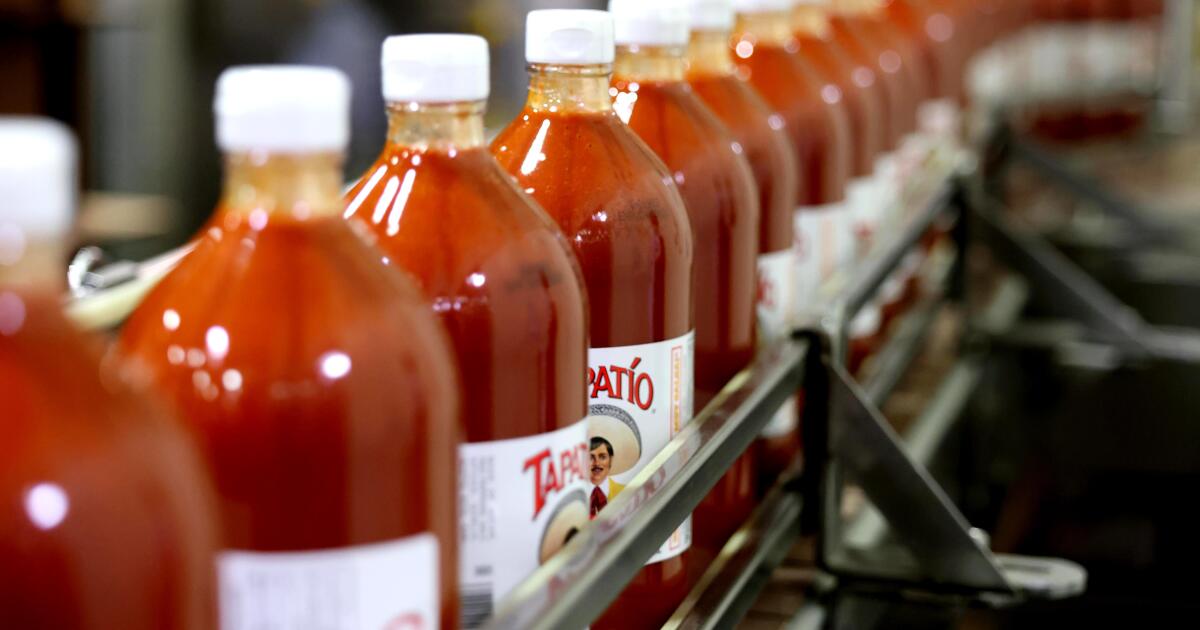
For 55 years, the family behind Tapatío has refused to even write down the recipe for Los Angeles’ iconic hot sauce, passing its secret formula for success only from lip to ear in closed rooms.
The Saavedra family put the ingredients on paper for the first time earlier this year as they sold the beloved brand to backers who plan to make their salsa picante even bigger beyond California’s borders. It is a weight off the shoulders of Luis Saavedra, the founder’s son and one of the few people who knew the recipe.
“We didn’t want anyone to know what we were using,” he told The Times in an interview at Tapatío’s factory in Vernon. “That always scared my sisters, because what if something happens?”
Demand for hot sauces had taken off for unexpected reasons just as the Saavedras were looking to sell. The millions of people on Ozempic and other powerful weight-loss drugs often have cravings for more flavor. The values of some sauce companies have skyrocketed. Bachan’s, a Japanese barbecue sauce brand, was acquired in February for $400 million.
While the Dallas private investment firm that bought Tapatío, Highlander Partners, wouldn’t share the terms of the deal, the company’s new chairman, Jeff Partridge, said it hopes to capitalize on the growing appetite for more heat to splash on proteins.
“Whether it’s GLP-1 or desire for proteins, Tapatío and hot sauces enhance that experience,” he said. “Consumers are increasingly seeking flavors.”
Red peppers drive Tapatío’s taste, though the company won’t share which exact peppers are used. The thin sauce uses garlic, salt and other spices for a tangy, peppery punch. It has a mild heat that doesn’t linger.
Luis Saavedra, right, former chief executive officer of Tapatío Foods and son of company founder Jose-Luis Saavedra, speaks with Eric Beatty, the current chief executive, at the company’s manufacturing facility on Wednesday.
(Genaro Molina / Los Angeles Times)
The big acquisition is a long way from the brand’s birth in founder Jose-Luis Saavedra’s kitchen more than 50 years ago.
Saavedra, originally from Mexico City, long dreamed of making his way north. He landed in Chicago in his late 20s, working as a Spanish translator. He met his wife and moved to Southern California.
He worked at an aerospace parts manufacturer in Los Angeles. The homemade hot sauce he brought for lunch was a hit with co-workers who asked for more. When he was laid off in the late ’60s during an oil recession, he started selling bottles.
As sales rose, he rented a small space for production in Maywood and it officially became a business in 1971. The whole family pitched in. His son, Luis, remembers twisting on caps and attaching labels to bottles when he was 13.

Bottles are filled with Tapatío hot sauce before being labeled at the Tapatío manufacturing facility on Wednesday. The hot sauce company was recently acquired by Dallas-based private investment firm Highlander Partners.
(Genaro Molina / Los Angeles Times)
Saavedra and his son would drive a van up and down Los Angeles, manually packing and unloading the product to local corner stores. Many of the first bottles were stocked in East Los Angeles stores.
About five years in, the company made enough for Saavedra to quit the two part-time jobs he had picked up to keep the business afloat. Operations remained in Maywood for 14 years before they expanded to a 7,000-square-foot building in Vernon.
In 1996, the company made its boldest bet, splurging on a 30,000-square-foot building.
In the same facility today, the strong aroma of spices tickles visitors’ noses. The precise portioning of the secret ingredients, matching the ratios of the founder’s original formula, happens in a room locked off from employees. The magic mix is then rapidly poured into a long line of empty bottles that march along a conveyor belt like soldiers.
It’s the legacy of the founder, who refused to be deterred by naysayers or obstacles to growth, said Saavedra’s son.
“Let’s go around it,” the younger Saavedra said, quoting his father’s mantra in the face of problems. “Let’s go under. Let’s go above it.”
His father’s stubbornness paid off in court as the company was sued for its name. It was once called Cuervo — his wife’s original last name — and tequila giant Jose Cuervo came after it. Saavedra had already trademarked the name in California, so it got a big payout to give up the name.
Saavedra briefly entertained the name “Charro,” a reference to Mexican cowboys, before landing on Tapatío, a nickname used for people born in Guadalajara, Jalisco, where all three of his children were born. Its logo evolved into a beaming cowboy with bright blue eyes in a wide-brimmed hat.
The Tapatío name was also challenged. Del Monte Foods sued Saavedra in the ’80s, claiming the name was too similar to its brand “Patio.” Saavedra won that case.
The founding father’s hardheadedness could also sometimes cause trouble.

Luis Saavedra, son of company founder Jose-Luis Saavedra, shows the original Tapatío label, left, compared to the current version.
(Genaro Molina / Los Angeles Times)
The younger Saavedra battled with his father in the late ’90s about changing the brand’s label to help it stand out on crowded shelves. The old bottles were largely black and white and looked a little outdated. Eventually, the senior Saavedra gave in. Sales skyrocketed.
Today, Tapatío is shaken over meals around the globe, though its dominance is strongest in California. It has been used in collaborations with other companies to spike mashed potatoes, protein powder, pickles and ramen.
Tacked to a wall at the Vernon factory is an old photo of the dozen people who were there to launch the brand’s new facility 30 years ago. Some of the employees still work there, including Jorge Cuervo, the production supervisor, and Fabian Diaz, who mans the forklift.
Diaz, who moves countless pallets of product, jokes he was born at the factory, having spent almost his entire adult life working for the company.
Under the new ownership, all 25 current employees were retained, and the firm has committed to hiring more.
“They’ve been doing this for a long time,” Luis Saavedra said. “They have a passion for it.”
The family began exploring options for a sale in late 2024, right after the founder, now 97, suffered a stroke.
Jose-Luis Saavedra had remained closely involved in day-to-day operations despite his age, often spending from sun-up to sun-down at the factory.
As he took on all his father used to do as well as his own workload, the younger Saavedra was getting burnt out and started to worry that keeping the company family-owned could be hurting the brand.
“Work was really devouring me,” Luis Saavedra said. “It was a tough decision, very difficult. We cried together as a family, then we said, ‘In the long run, it’s better.’”

“It was a tough decision, very difficult. We cried together as a family, then we said, ‘In the long run, it’s better,’” Luis Saavedra said of the decision to sell the company.
(Genaro Molina / Los Angeles Times)
Once it let potential suitors know the company was in play, the offers poured in. The family considered offers from around 40 companies before choosing Highlander Partners.
In a few years, the company’s new leaders hope to use the growing demand for flavor triggered by weight-loss drugs to bring California’s top sauce to many more markets east of the Rockies, said Eric Beatty, the company’s current chief executive.
“We believe that we’ve got these sector tailwinds behind us,” Beatty said. “It’s going to be a really good story.”

Eric Beatty, current chief executive officer of Tapatío Foods LLC, stands next to boxes of the hot sauce that are ready for shipping at the Tapatío manufacturing facility on Wednesday.
(Genaro Molina / Los Angeles Times)
New leadership has grand plans for the brand, hoping to build more facilities and add new products.
“We’ll always be a California company,” Beatty said. “This will always be the center of the Tapatío universe.”
Meanwhile, the Saavedra family still has a minority stake in the company and will continue to help manage it.
“They are the essence of the brand, and really understand the heartbeat of the brand,” said Partridge, Tapatío’s new chairman. “We certainly want to make sure that they always have a voice.”

new video loaded: How the Iran War Is Affecting Inflation

By Ben Casselman, Nour Idriss, Stephanie Swart and Sutton Raphael
April 11, 2026

A man was arrested Friday morning after he set multiple fires inside stores at the Ontario Mills mall, officials said.
Ontario police said they responded to the mall at about 10:30 a.m. after callers reported that a man with a lighter and a backpack was intentionally setting fires.
Officers found the suspect, who they identified as 28-year-old Luis Javier Gallegos Jr. of Rancho Cucamonga.
The police said in a statement that Gallegos did not comply with their requests, and they used force to arrest him.
Both Gallegos and an officer suffered non-life-threatening injuries during the arrest, the police said.
After being treated at a hospital, Gallegos was booked into the West Valley Detention Center and charged with felony arson, the police said.
Police said they are working to identify a motive for the crime and whether there is any connection to the April 7 arson at the Kimberly-Clark warehouse in Ontario.
Prosecutors say the inferno destroyed the 1.2 million square-foot warehouse and the paper products inside, resulting in $500 million in damages.
Chamel Abdulkarim, a Highland resident who worked at the warehouse, is facing both state and federal arson charges for setting the fire.
Abdulkarim, 29, filmed himself setting fire to multiple pallets of paper goods, according to the U.S. attorney’s office for the Central District of California.
In the video, he says, “If you’re not going to pay us enough to [expletive] live or afford to live, at least pay us enough not to do this [expletive].”
Anyone with information about the fires Friday at Ontario Mills Mall is asked to contact the city’s police department at (909) 986-6711.

Lawmakers close door on Massachusetts online casino legalization

Minnesota’s Pohlkamp helps Denver beat Wisconsin 2-1 for 11th national hockey title, 3rd in 5 years

Mississippi reveals its full history for America’s anniversary year, a contrast to federal efforts
KCPD investigating after 1 man hurt in Saturday shooting

The ugly truth behind ‘restoring Montana values’ • Daily Montanan

Florida High School Football Rankings: Top 25 teams – Oct. 21

How old is Bo Nix? What to know about Oregon quarterback ahead of 2024 NFL Draft

Cleary's 21 help Le Moyne down Central Connecticut State 69-64 in OT

99th annual Pony Swim held in Virginia

Indiana Members Credit Union announced as new anchor tenant at Bottleworks District

Carney casts himself as NATO defender amid Trump beef, despite Canada missing key benchmark for decades

‘Enough of war!’ says Pope Leo XIV who grows increasingly frustrated

Artemis II splashdown captures nationwide attention

Video: Police Fatally Shoot Man After Stabbings at Grand Central Subway Station

Trump blasts Spanberger ahead of Virginia meetings, says state faces tax base exodus like New York, California
-

 Atlanta, GA1 week ago
1 teenage girl killed, another injured in shooting at Piedmont Park, police say
-

 Georgia5 days ago
Georgia House Special Runoff Election 2026 Live Results
-

 Pennsylvania6 days ago
Parents charged after toddler injured by wolf at Pennsylvania zoo
-

 Arkansas2 days ago
Arkansas TV meteorologist Melinda Mayo retires after nearly four decades on air
-
 Milwaukee, WI6 days ago
Potawatomi Casino Hotel evacuated after fire breaks out in rooftop HVAC system
-

 Indianapolis, IN1 week ago
Fighting Illini begin Final Four preparations in Indianapolis
-

 Technology1 week ago
Anthropic essentially bans OpenClaw from Claude by making subscribers pay extra
-

 Detroit, MI1 week ago
Puppy rescued after getting stuck on chimney in Detroit