Business
The Big Number: $76,535


Her starting pay for the Fever — the Women’s National Basketball Association team that selected her as the No. 1 draft pick on Monday — is part of a four-year contract that will total $338,056.
But to some fans, it still seemed startling low for someone with her star power — especially compared with what her male counterparts in the National Basketball Association make.
Bryan Anselm for The New York Times



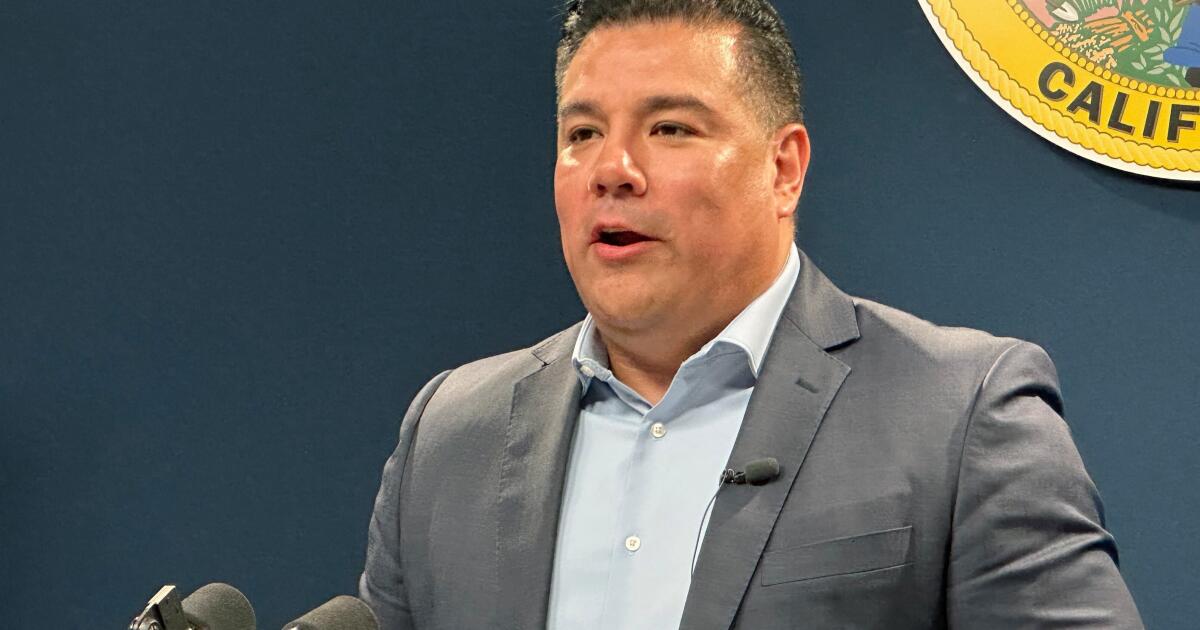
In a typical election year, the interest in the down-ballot race for California insurance commissioner musters modest interest at best.
That all changed on Jan. 7, 2025, when wildfires swept through L.A. County, damaging or destroying more than 18,000 homes and killing at least 31 people.
The resulting anger directed at the insurance industry over how it has handled claims has helped draw four Democrats into the race, who will be vying this weekend for a critical endorsement at the party’s annual convention in San Francisco ahead of the June 2 primary election.
“We haven’t seen this level of competition and, frankly, choice on the Democratic side since it first became an elected office in 1990,” said Jamie Court, president of Consumer Watchdog, a Los Angeles insurance advocacy group. “They represent wide-ranging views and a broad diversity of candidates.”
Up for endorsement are state Sen. Benjamin Allen (D-Santa Monica), whose district includes the Palisades fire zone; former San Francisco Supervisor Jane Kim; former state Sen. Steven Bradford; and San Francisco businessman Patrick Wolff, who has not held elective office.
Three Republicans have declared their candidacies, but that party’s convention isn’t until April. The filing deadline to file for the race is March 6.
The GOP field includes businessman Robert Howell, who lost by 20 points in the 2022 general election to current Insurance Commissioner Ricardo Lara. Also running are insurance agent Stacy Korsgaden from Grover Beach, and attorney Merritt Farren, whose Pacific Palisades home burned down.
Peace and Freedom Party candidate Eduardo Vargas, a Los Angeles school teacher, is on the ballot too.
The race also follows Lara’s two troubled terms in office, during which he has been accused of cozying up to and receiving money from the insurance industry for his first campaign and conferences abroad.
Lara has denied any wrongdoing, and all the Democratic candidates have vowed not to accept insurance industry donations.
“For me and maybe for many survivors, it’s not a position that we ever thought much about, but now with many of our lives devastated by our dealings with insurers I think many survivors will be watching much more closely this time around,” said Joy Chen, executive director of the Eaton Fire Survivors Network, a community group that has accused Lara of being soft on insurers and has called for his resignation.
Allen was perceived by some as the leading candidate for the party’s nomination when he announced his candidacy in September. He has held his seat for more than a decade and is the only sitting legislator in the race. He said he would not be running if not for the wildfire that struck his district.
“The fire certainly was a searing experience, helping hundreds of people get their claims paid right, but it kind of begs the question of why should you have to call your state senator to get treated right,” he said.
Allen’s platform includes a number of ideas to ensure policyholders are treated better, including requiring insurers to clearly explain claim denials. But also key to his campaign is stabilizing an insurance market that over the last several years has seen insurers drop policyholders by the hundreds of thousands, especially in fire-prone neighborhoods.
That forced them onto the California FAIR Plan, the insurer of last resort. It’s rolls grew even more since the January fires and the insurer has been sued by fire victims over its claims practices. Allen wants to build insurer confidence in the market by having insurer requests for rate hikes reviewed in months, rather than the year or more they can drag out now.
He also points to his legislative record, especially his authorship of Proposition 4, which was approved by voters in 2024 and set aside $10 billion in general obligation bonds to fund climate resiliency and environmental protection projects — an important part, he said, of lowering insurance risks.
Allen has drawn a key endorsement from California Sen. Adam Schiff and as of Dec. 31 had about $1 million in the bank, more than any other candidate. But the race was shook up last month when progressive politician Kim declared her candidacy. She boasted an endorsement from U.S. Sen. Bernie Sanders (I-Vt.), for whom she worked as his California political director during the 2020 presidential campaign.
She also has drawn attention for a plan to create a state-run disaster insurance policy for Californians.
Residents would continue to buy regular home insurance from the commercial market but would buy coverage for wildfires and other disasters from the state, similar to plans in some other countries.
The idea has come under sharp criticism from Court, who said it will shift the risk of costly disasters to taxpayers while allowing insurers to make profits from the more predictable end of the home insurance market.
“We have to explore some different models, because the current system is not working. It’s too expensive and a market failure,” said Kim, adding that the plan could evolve.
Bradford, who represented communities in south L.A County and the South Bay in the Legislature, has been endorsed by L.A. Mayor Karen Bass. He said he’s running as a pragmatist and unifier.
“What we’ve been doing for far too long has been a whole lot of finger pointing and doing the blame game,” he said.
Bradford wants insurers to open their pricing books and give homeowners “real, guaranteed” premium discounts for upgrading their property.
He also is proposing a public–private partnership that shares the risk for insurers who write policies in fire-prone neighborhoods.
Wolff, a political newcomer, is a Chartered Financial Analyst, real estate investor and former hedge manager who cites his experience building a home and auto insurance brokerage for financial services firm Capital One.
“I spent the first half of 2025 really deeply studying the commissioner’s role and the history, and the race — the politics of everything. And after really doing that deep dive, I decided to step forward,” said Wolff, who wrote his campaign a $500,000 check and loaned it another $100,000.
He also thinks rate hikes sought by insurers need to be reviewed more quickly but wants the insurance department to publish annual reports on how specific companies handled claims.
“The insurance industry has basically lobbied to keep that data anonymous at the company level, and I think it’s really important to make that information public,” Wolff said.
Under California’s open primary system, the top two candidates will move on to the Nov. 3 general election, which means two Democrats could run up against each other if a Republican isn’t able to consolidate the GOP vote.
Steve Maviglio, a longtime political consultant currently working for State Treasure Fiona Ma, who is seeking the office of lieutenant governor, said that the race is wide open.
“This is a statewide election with millions of people with candidates they’ve never heard of,” he said.
With multiple candidates seeking the endorsement, it may be hard for any single one to reach the 60% threshold of delegate votes needed.
“If no one is endorsed, somebody is going to have to be the breakout candidate, and the way you do that is with money or organization,” Maviglio said. “Until I see that happen, it’s totally up in the air.”
Business
What the Supreme Court’s decision to strike down tariffs means for L.A.’s trade-dependent economy

The Supreme Court’s decision Friday to strike down the majority of tariffs imposed by President Trump could provide some relief to L.A.’s trade-reliant economy — but only if they are not reimposed again through other means.
The court’s 6-3 ruling that Trump didn’t have the authority to impose tariffs under the International Emergency Economic Powers Act rolled back levies that have upended international trade.
“We’ve seen that the tariffs have a significant impact on our supply chain, on our manufacturers and especially on our port logistics and trade sector,” said Stephen Cheung, chief executive of the nonprofit Los Angeles County Economic Development Corp.
“I think this decision will have a significant impact on the Los Angeles economy. However, it’s going to take a long time to unravel, so we’ll see specifically how everything is going to pan out,” he said.
The tariffs dealt a blow to a large swath of businesses in Southern California and across the state, including farmers, automakers, home builders, tech companies and apparel retailers.
MGA Entertainment, the Chatsworth maker of Bratz dolls, said a little more than half of its products are made in China, while hardware and lumber seller Anawalt in Malibu said the majority of its lumber comes from Canada and nearly all of its steel products are made in China.
During a news conference Friday following the decision, Trump said that under other legal authorities he would impose a 10% global tariff and pursue additional levies, including a possible 30% tariff on foreign cars. Later in the day he signed an order imposing the 10% tax, which takes effect Feb. 24.
“The Supreme Court’s ruling on tariffs is deeply disappointing, and I’m ashamed of certain members of the court — absolutely ashamed,” Trump said. “They’re very unpatriotic and disloyal to our Constitution.”
Friday’s high-court decision affects up to $170 billion in tariffs collected under the International Emergency Economic Powers Act of 1977, including 10% to 50% duties and penalties on China, Canada and Mexico.
Whether importers who paid the tax can seek refunds was left to a lower court to decide. It’s estimated some $100 billion in tariffs were not affected by the decision.
The ports of Los Angeles and Long Beach — which handle nearly a third of the nation’s containerized cargo and are the primary trade gateway to Asia — saw a surge of traffic the first half of last year as importers sought to get ahead of the tariffs, largely imposed in April.
However, traffic tailed off the second half of the year, with the L.A. port expecting a single-digit decline in volume this year before Friday’s decision.
The twin facilities form the largest ports complex in North America, supporting more than 200,000 jobs and contributing $28 billion to the regional economy in 2022, according to a California Center for Jobs & the Economy report.
The uncertainty surrounding the tariffs derives from the complexity of the tariffs themselves — as well as the other legal options Trump has to impose them again.
Mike Jacob, president of the Pacific Merchant Shipping Assn., which represents ocean carriers, marine terminal operators and others in the industry, said the tendency is to think of the tariffs as uniform.
“It was different rates for different countries. That was compounded by different rates for different commodities. And there’s a lot of changes that have occurred with specific commodities,” he said. “So it’s almost impossible to take a broad brush and say, here’s what we expect to happen — except to say that it’s still a pretty unsettled space.”
In imposing a 10% global tariff, Trump would be relying on a provision of the Trade Act of 1974, while his ability to pursue additional levies would rely on other law.
Economist Jock O’Connell, international trade advisor at L.A.’s Beacon Economics, said that Trump may have authority to impose the 10% global tariffs, but additional levies would involve trade authorities.
“That would be a cumbersome process. The tariffs have to be more specifically framed and the subject of an investigation,” he said.
Also complicating the process are trade deals the U.S. has been negotiating with foreign countries based on the tariffs. O’Connell expects they will seek to renegotiate them.
“They’re likely to come back to the table and say, ‘Well, you don’t have the authority to impose these,’” he said.
Gene Seroka, executive director of the Port of Los Angeles, said importers are facing tough decisions right now, given that any ocean carrier leaving an Asian port today would not be subject to the tariffs that were struck down.
“That executive is asking: ‘Are my commodities now exempt from this tariff?’ If the answer is yes, ‘Can I buy more of that product and get it shipped while there are no tariffs?’” he said.
Those decisions would revolve around such factors as the availability of space on the vessel and local warehouses, as well as trucking services, he said.
Mark Zandi, chief economist at Moody’s Analytics, said the decision should be good news for the larger U.S. economy and businesses on the “front line” of the trade wars, such as transportation, distribution, agriculture and retail.
“If the president lets the Supreme Court decision stand and doesn’t try to replace the tariffs, that’s a plus for the economy — but that’s not what’s going to happen,” he said.

California wine giant Gallo is laying off more than 90 employees and closing a major Napa Valley wine-making facility.
The Modesto company said Thursday the cuts are necessary to adapt to market dynamics and changing customer demands.
In total, 93 employees across five sites will lose their jobs, according to a Worker Adjustment and Retraining Notice the company filed with the state last week.
The “operational adjustments” will not “materially impact” the company’s tasting rooms in Napa, Sonoma and Paso Robles, a spokesperson for the company said in a statement.
Gallo plans to permanently close its Ranch Winery in St. Helena. In 2015, the company bought the “custom crush winery” capable of crushing 30,000 tons of grapes, hoping to bolster its presence in the super-premium and luxury wine segment. That investment has not panned out.
The closure means 56 employees — including more than three dozen wine technicians — will lose their jobs between April 15 and the end of January 2027, according to the notice.
Layoffs are also planned at Louis M. Martini Winery and Orin Swift Tasting Room in St. Helena and J Vineyards & Winery and Frei Ranch in Healdsburg.
In 2025, Gallo closed its Courtside Cellars winery in San Miguel and laid off 47 workers, according to the San Luis Obispo Tribune.
The layoffs are indicative of the U.S. wine industry’s broader struggles amid shifting tastes.
Customers are choosing quality, not quantity: they would rather buy fewer bottles and invest in a premium product, said Rob McMillan, Silicon Valley Bank’s executive vice president and wine expert.
Many of Gallo’s wines fall into the sub-$12 category, which has performed poorly for the last decade, McMillan said.
With younger generations drinking less, and the baby boomer generation — the industry’s core base — aging out of the wine market, it’s been a challenging few years for the industry, which has also had to fend off competition from makers of premium beers and spirits, McMillan said.
Wine shops and importers have also been caught in the crossfire of President Trump’s trade war.
Founded in 1933 as E. & J. Gallo Winery, the company in 2024 renamed itself to reflect its portfolio, which by then had grown beyond wine to include distilled spirits, malt beverages and ready-to-drink cocktails.
The privately held company is the largest supplier of wine in the U.S. by volume, according to the wine trade publication WineBusiness Monthly, which estimated that it sold 90 million cases of wine in 2025.
Gallo owns more than 100 brands — including the popular Barefoot and Apothic labels — and had more than 7,000 employees worldwide, according to a 2023 company statement.

Cooler, breezy weather returns to North Texas; expect chilly mornings Sunday and Monday

Utah Mammoth open Sandy Ice Center for public skating and training – KSLTV.com
VT Lottery Mega Millions, Gimme 5 results for Feb. 20, 2026

Preview and Final Score Prediction For No. 14 Virginia and Miami

School debt repayment should be a priority, not deferred | Opinion

Florida High School Football Rankings: Top 25 teams – Oct. 21

Cleary's 21 help Le Moyne down Central Connecticut State 69-64 in OT

How old is Bo Nix? What to know about Oregon quarterback ahead of 2024 NFL Draft

99th annual Pony Swim held in Virginia

Indiana Members Credit Union announced as new anchor tenant at Bottleworks District

OpenAI didn’t contact police despite employees flagging mass shooter’s concerning chatbot interactions: REPORT

Iran demands ‘evidence’ as Trump, UN experts highlight protest killings

World reacts as US top court limits Trump’s tariff powers

Campus Radicals Newsletter: Teacher who lost job over 2-word post breaks silence, Chicago ‘racial segregation’

EU Commission targets WTO’s key rule in push to rebalance China trade
-

 Oklahoma4 days ago
Wildfires rage in Oklahoma as thousands urged to evacuate a small city
-

 Technology1 week ago
HP ZBook Ultra G1a review: a business-class workstation that’s got game
-

 Health1 week ago
James Van Der Beek shared colorectal cancer warning sign months before his death
-

 Culture1 week ago
Romance Glossary: An A-Z Guide of Tropes and Themes to Find Your Next Book
-
![“Redux Redux”: A Mind-Blowing Multiverse Movie That Will Make You Believe in Cinema Again [Review]](https://i1.wp.com/www.thathashtagshow.com/wp-content/uploads/2026/02/Redux-Redux-Review.png?w=400&resize=400,240&ssl=1 "“Redux Redux”: A Mind-Blowing Multiverse Movie That Will Make You Believe in Cinema Again [Review]")
![“Redux Redux”: A Mind-Blowing Multiverse Movie That Will Make You Believe in Cinema Again [Review]](https://i1.wp.com/www.thathashtagshow.com/wp-content/uploads/2026/02/Redux-Redux-Review.png?w=80&resize=80,80&ssl=1 "“Redux Redux”: A Mind-Blowing Multiverse Movie That Will Make You Believe in Cinema Again [Review]") Movie Reviews1 week ago
Movie Reviews1 week ago“Redux Redux”: A Mind-Blowing Multiverse Movie That Will Make You Believe in Cinema Again [Review]
-
 Science1 week ago
Contributor: Is there a duty to save wild animals from natural suffering?
-

 Politics1 week ago
Tim Walz demands federal government ‘pay for what they broke’ after Homan announces Minnesota drawdown
-
News1 week ago
Second US aircraft carrier is being sent to the Middle East, AP source says, as Iran tensions high

