Politics
Trump calls justices ‘fools,’ announces new 10% global tariff after Supreme Court setback

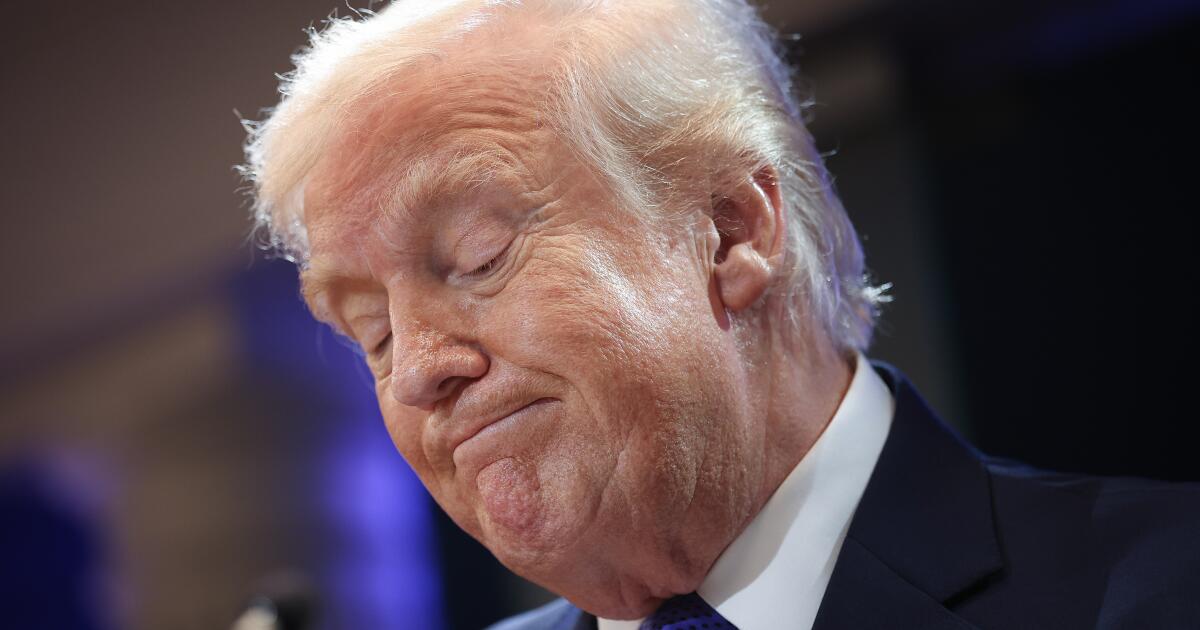
WASHINGTON — President Trump on Friday lashed out at Supreme Court justices who struck down a key part of his tariffs agenda, calling them “fools” who made a “terrible, defective decision” that he plans to circumvent by imposing new levies in a different way.
In a defiant appearance at the White House, Trump told reporters that his administration will impose new tariffs by using alternative legal means. He cast the ruling as a technical, not permanent, setback for his trade policy, insisting that the “end result is going to get us more money.”
The president late Friday signed an executive order imposing a new 10% tariff, citing a 1974 law. Under that law, the tariffs can last for only 150 days. An extension would require congressional approval.
Asked by a reporter whether he planned to issue the 10% global tariffs for 150 days or indefinitely, Trump said: “We have a right to do pretty much what we want to do.”
The sharp response underscores how central tariffs have been to Trump’s economic and political identity. He portrayed the ruling as another example of institutional resistance to his “America First” agenda and pledged to continue fighting to hold on to his trade authority despite the ruling from the nation’s highest court.
Trump said the ruling was “deeply disappointing” and called the justices who voted against his policy — including Justices Neil M. Gorsuch and Amy Coney Barrett, whom he nominated to the court — “fools,” “lapdogs” and a “disgrace to our nation.”
“I am ashamed of certain members of the court,” Trump told reporters. “Absolutely ashamed for not having the courage to do what’s right for our country.”
In a social media post, the president wrote that he believed the court opinion has been “swayed by Foreign Interests and a Political Movement,” though he did not provide any evidence for those claims.
“This was an important case to me, more as a symbol of Economic and National Security, than anything else,” Trump lamented in the post.
For years, Trump has insisted his tariffs policy is making the United States wealthier and giving his administration leverage to force better trade deals, even though the economic burden has mostly fallen on U.S. companies and consumers. On the campaign trail, he has turned to them again and again, casting sweeping levies as the economic engine for his administration’s second-term agenda.
Now, in the heat of an election year, the court’s decision scrambles that message.
The ruling from the nation’s highest court is a rude awakening for Trump at a time when his trade policies have already caused fractures among some Republicans and public polling shows a majority of Americans are increasingly concerned with the state of the economy.
But some of his top advisors maintain that his trade agenda, as promised, will continue in a different iteration.
“Despite the misplaced gloating from Democrats, ill-informed media outlets, and the very people who gutted our industrial base, the court did not rule against President Trump’s tariffs,” Treasury Secretary Scott Bessent said in a speech in Texas shortly after the ruling was issued.
Bessent said the court has simply ruled he could not impose levies on imports under the International Emergency Economic Powers Act, or IEEPA.
Ahead of the November elections, Republicans have urged Trump to stay focused on an economic message to help them keep control of Congress. The president tried to do that on Thursday, telling a crowd in northwest Georgia that “without tariffs, this country would be in so much trouble.”
As Trump attacked the court, Democrats across the country celebrated the ruling — with some arguing there should be a mechanism in place to allow Americans to recoup money lost through the president’s trade policy.
“No Supreme Court decision can undo the massive damage that Trump’s chaotic tariffs have caused,” Sen. Elizabeth Warren (D-Mass.) wrote in a post on X. “The American people paid for these tariffs and the American people should get their money back.”
California Gov. Gavin Newsom called the tariffs an illegal tax on consumers, ranchers and farmers and businesses, and said Trump is obligated to refund the $1,750 per family to make up for the cost increases driven by the tariffs.
“The rule of law won out,” Newsom said. “And what did Donald Trump do? He had a tantrum today, and he decided to tax you all again, across the board, 10% across the board, under some new authority. He’s unhinged.”
California Atty. General Rob Bonta said the ruling ends “months of chaos” that hurt farmers, manufacturers and other businesses in California.
While the Supreme Court ruling Friday centered on a lawsuit brought by a private party, Bonta and Newsom brought a separate lawsuit last year challenging the tariffs.
California’s large economy meant that the state bore the brunt of the unlawful tariffs, Bonta said, adding that it faced projected losses of more than $25 billion.
The president’s signature economic policy has long languished in the polls, and by a wide margin. Six in 10 Americans surveyed in a Pew Research poll this month said they do not support the tariff increases. Of that group, about 40% strongly disapproved. Just 37% surveyed said they supported the measures — 13% of whom expressed strong approval.
A majority of voters have opposed the policy since April, when Trump unveiled the far-reaching trade agenda, according to Pew.
The court decision lands as more than a policy setback to Trump’ s economic agenda.
It is also a rebuke of the governing style embraced by the president that has often treated Congress less as a partner and more as a body that can be bypassed by executive authority.
Trump has long tested the bounds of his executive authority, particularly on foreign policy, where he has heavily leaned on emergency and national security powers to impose tariffs and acts of war without congressional approval. In the court ruling, even some of his allies drew a bright line through that approach.
Gorsuch sided with the court’s liberals in striking down the tariffs policy. He wrote that while “it can be tempting to bypass Congress when some pressing problems arise,” the legislative branch should be taken into account with major policies, particularly those involving taxes and tariffs.
Despite the court ruling, Trump remained adamant that his trade policies will remain in effect. But now he is pivoting to plan B.
The strategy would allow the White House to impose tariffs up to 15% for 150 days on countries with a trade deficit with the U.S., according to legal analysts. He also invoked a section of the Trade Act of 1930, which could allow for additional levies of up to 50% with no time limit on countries that Trump deems has discriminated against U.S. trade or commerce.
“This means that Trump’s tariffs will continue to burden the U.S. economy, even if alternative instruments are not as agile or broad as the IEEPA tariffs,” UCLA economist Kimberly Clausing said in a statement.
The president argued that the court ruling will make his trade policies stronger.
“Now the court has given me the unquestioned right to ban all sort of things from coming into our country, to destroy foreign countries,” Trump said, as he lamented the court constraining his ability to “charge a fee.”
“How crazy is that?” Trump said.
Times staff writers Dakota Smith and Phil Willon contributed to this report.


California’s effort to restrict sales of handguns that can be converted into fully-automatic machine guns drew an immediate federal challenge Wednesday, with the Trump administration suing the state over its new “Glock ban” law just hours after it took effect.
The U.S. Department of Justice is seeking a court order to block the controversial state law that limits where most Glock and Glock-style pistols can be sold. The lawsuit, filed in U.S. District Court for the Central District of California, also aims to invalidate key parts of the state’s handgun roster — a list that dictates the types of firearms that Californians may legally purchase. In a statement Wednesday, acting Atty. Gen. Todd Blanche said that both policies “trample” the rights of law-abiding Californians.
“The Second Amendment is a sacred right belonging to all Americans, even those in California,” Blanche said. “California cannot ban the most popular type of handgun in America.”
California’s Assembly Bill 1127 does not explicitly name the Glock brand, but instead targets any handgun with a specific mechanism that can easily be converted by a black market device. These simple “Glock switches” convert semiautomatic handguns into a weapon capable of firing 20 rounds per second with a single squeeze of the trigger.
Advances in 3D printing have made the conversion devices widely available and cheap to produce. Federal authorities reported recovering 11,088 of them from crime scenes between 2019 and 2023. Switches have been used in several mass shootings, including one in Sacramento that resulted in six deaths and 12 injuries in 2022.
The new law does not prohibit the possession of affected handguns already owned by Californians, and includes exemptions for gun dealers, as well as law enforcement and military agencies.
Gov. Gavin Newsom signed the bill in October, and has maintained that firearm laws are responsible for California’s declining crime rates and gun deaths.
“The Trump administration is once again trying to dismantle California’s commonsense gun safety laws,” Diana Crofts-Pelayo, a spokesperson for the governor, said in a statement. “Our response is simple — these laws save lives.”
The federal government argues in its complaint that California can’t ban legal semiautomatic handguns simply because they could be illegally altered, adding that state and federal law already prohibit such pistol converters. The U.S. compared California’s approach to banning ordinary shotguns because they can be illegally shortened.
The lawsuit also challenges California’s decades-old handgun roster, which requires new handgun models to pass certain safety tests before they can be approved for retail sale. A federal judge tentatively blocked portions of the roster requirements in a separate 2023 case, which is being appealed before the 9th Circuit. That lawsuit was filed by the California Rifle & Pistol Assn. and other gun rights supporters following a landmark 2022 decision by the U.S. Supreme Court that set new standards for evaluating firearm restrictions.
Under those new guidelines, the Trump administration wants a judge to find that California’s gun restrictions violate the 2nd Amendment, and is seeking an order to bar the state from enforcing them.
The Trump administration is relying on a federal civil rights law typically used against police departments accused of repeated constitutional violations, arguing that California Atty. Gen. Rob Bonta and state Justice Department agents qualify as peace officers and therefore violate gun owners’ rights whenever they enforce handgun restrictions.
Bonta, who is named in the suit, has a winning court record over the Trump administration, and has secured at least 12 final court rulings and more than 35 preliminary injunctions or emergency orders.
“California’s gun safety laws helped drive firearm death rates to record lows in our state and are a blueprint for reducing gun violence nationwide,” Bonta’s office said in a statement. “We will review the complaint and respond as appropriate in court.”
Politics
Mamdani blasts ICE agents, Elon Musk and ‘supremacy’ in America 250 speech ahead of July 4 weekend

NEWYou can now listen to Fox News articles!
New York City Mayor Zohran Mamdani took aim at U.S. Immigration and Customs Enforcement (ICE) agents, Elon Musk and what he described as the “arena of supremacy” in the United States during an immigration-themed America 250 speech on Friday ahead of Fourth of July weekend.
Flanked by eight recently naturalized U.S. citizens, Mamdani invoked the Statue of Liberty, Ellis Island and America’s history of immigration before turning his rhetoric on elements of today’s U.S. Mamdani also blasted the “world’s first trillionaire” — a milestone Musk achieved with the long-awaited Initial Public Offering (IPO) of SpaceX last month.
“We see the wealthiest country in the history of the world, one where children go to sleep hungry while the world’s first trillionaire hungers for more,” Mamdani said, without naming Musk. “We see monopolies that dominate every industry, and oligarchs who buy elections. We see masked agents terrorizing our streets, eating food cooked by our undocumented neighbors before spiriting them away in unmarked vans.”
“We see a nation whose immense wealth has been built by those with calloused, dirt-streaked hands, those who toil on factory floors and chisel into stone. And we see a nation that has allowed so much of that wealth to be held instead in the soft hands of a precious few,” he added.
Mamdani, who was sitting at George Washington’s desk during the remarks, also praised the legacy of immigrants, claiming that they have overcome riots “aimed at their very existence,” to create lives in New York.
FETTERMAN WARNS MAMDANI RISKS ‘CONSTITUTIONAL CRISIS’ BY VOWING TO DEFY SCOTUS IMMIGRATION RULING
New York City Mayor Zohran Mamdani delivers a speech to mark the 250th anniversary of the United States of America at City Hall on July 3, 2026. (Anna Connors/Pool via REUTERS)
“Over the years that followed, despite laws enacted by the federal government to bar their entry, despite sweatshop fires that killed hundreds of women, despite riots aimed at their very existence, immigrants made homes here in New York City, and they helped to make New York City,” the mayor said.
“That legacy of every generation of Americans insisting that the right to life, liberty and the pursuit of happiness extends to them, too, is no relic of the past. It carried millions of Black Americans north during the Great Migration. It drew hundreds of thousands of Puerto Ricans to New York City after the Second World War. It invited countless others from the West Indies and South Asia and West Africa and across the world. And it is what brought my family to this city when I was seven years old,” he continued.
ZOHRAN MAMDANI PRAISED FOR ‘FANTASTIC’ QUESTION-DODGING ON PRESIDENTIAL ELIGIBILITY
Mamdani did not mention his own family’s wealth in the speech. His father was an elite Harvard academic, and his mother and acclaimed film director.
“My family did not arrive by boat, although we saw the Statue of Liberty from the window of the plane. Even from the air, we could make out the promise of America, the promise of the beautiful patriotic work of rendering America, year after year, a little more faithful to its founding ideals,” he said.
The Statue of Liberty stands in the foreground as Lower Manhattan is viewed at dusk, Sept. 8, 2016, in New York City. (Drew Angerer/Getty Images)
In his speech, Mamdani blasted those with “power and influence,” who he lamented have written American history.
“There is a term so often used to describe our nation and those who have shaped it. American exceptionalism. American exceptionalism, the conventional wisdom tells us, makes our freedom a little more free. It is how we dug the Erie Canal and irrigated the West. Is why children in faraway lands grow up dreaming of one day moving here. And yet, the irony is that the story of America has so often been written by those who were told by others with power and influence and wealth, that they were anything but exceptional,” Mamdani said. “For generation after generation, we have been told that when the world has sent its people to our shores, it has not sent its best.”
“It sent Puritans and Sikhs and Quakers and Muslims and Jewish people who were banished for praying the wrong way, worshiping the wrong gods, angering the wrong people. It sent peasants and serfs from slums and shuttles, who were treated as less because they hardly owned clothes, let alone land. It sent immigrants from whom power was something someone else had,” he continued. “We are told that America is exceptional because we are richer, stronger, more powerful than everyone else. The truth, my friends, is that America is exceptional because here nothing is fixed into place.”
New York City Mayor Zohran Mamdani delivers a speech to mark the 250th anniversary of the United States of America at City Hall on July 3, 2026. (Anna Connors/Pool via REUTERS)
Mamdani referenced how he became a naturalized U.S. citizen in 2018. Mamdani was born in Uganda in 1991 and moved to New York when he was 7. The mayor is a dual U.S.-Ugandan citizen.
“Nearly a decade ago, I too felt what you feel the joy of no longer being just a New Yorker, but an American too. You each hold a special power. The power to determine what America means,” the mayor said, speaking to the recently naturalized citizens by his side.
“The powerful have always known their answer. America, in their view, is an arena of supremacy where only a select few are allowed freedom,” Mamdani said. “Where not all are created equal. America, if you ask them, becomes less the more people it welcomes. America, they will tell you, belongs only to those with the right accent or the right shade of skin. The rest of us, they insist, should be grateful for merely being allowed to visit. How small they are, how weak, how unoriginal. At every moment in our past, those who led through exclusion and isolation have tried to win power and enrich themselves by turning us against one another.”
New York City Mayor Zohran Mamdani delivers a speech to mark the 250th anniversary of the United States of America at City Hall in New York on July 3, 2026. (Anna Connors/Pool via REUTERS)
CLICK HERE TO DOWNLOAD THE FOX NEWS APP
Mamdani also claimed ICE were invading New York neighborhoods.
“We see America each time neighbors link arms with neighbors without asking how long they have lived here or what papers they have as ICE invades our neighborhoods,” he added. “We see America each time those young and old stand in the beating rain or the stifling heat to cast their ballots. We see America each time working people demand more not just for themselves, but for their fellow Americans.”
“There are some who respond to those who ask for more from America with a simple refrain. ‘Love it or leave it,’ they say. But patriotism has never been about pretending our nation is without flaws. Patriotism is every act of righteous dissent,” Mamdani said. “It is every March led under the heavy sun. It is every protest held a decade before its time. It is precisely because we love this nation that we will not leave it.”
Mamdani ended his speech with a rousing call to America’s greatness.
“What power each of us holds to bring America ever closer to the greatness so many have seen when they looked upon these shores. The greatness that for 250 years has been America. Thank you. God bless America. God bless New York City. And happy Fourth of July,” he concluded.
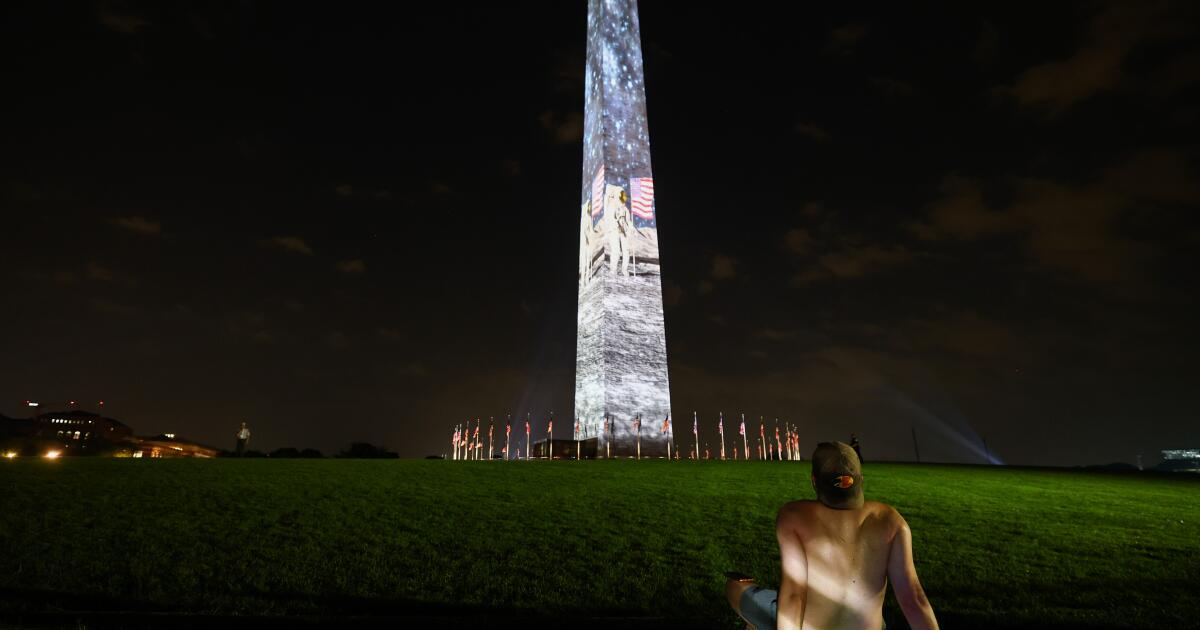
WASHINGTON — Small towns across America had big plans to celebrate the nation’s semiquincentennial this weekend. Local historical societies scheduled town square readings of the Declaration of Independence, hired bands to play patriotic tunes, organized parades and set up themed baking contests.
But many of their most ambitious plans were scrapped after the Trump administration cut $100 million in federal funding for humanities nonprofits and state councils at the start of its term. The decision severely hampered local planning for America’s 250th anniversary, disrupting history projects, museums and educational programs nationwide.
Instead, the Trump administration funneled tens of millions in federal dollars to Event Strategies, the firm behind Trump’s infamous rally at the Ellipse on Jan. 6, 2021, to organize anniversary events throughout the nation’s capital centered on President Trump.
The result, historians say, has become a centralized, more politicized spectacle, marking the national milestone as a celebration of an imperial presidency rather than a revolution from kingly rule.
The spectacular show that Americans will see features Trump at its center, culminating a year of concerted efforts by the president to put his face on passports and currency, national park passes and government buildings.
Members of the Dance4Life studio in Claymont, Del., prepares to march ahead of the Red, White, & Blue To-Do Pomp & Parade on July 2, 2026, in Philadelphia.
(Al Drago / Getty Images)
Yet, beyond the noise of the nation’s capital, historians and teachers, docents and curators, archivists, tour guides and reenactors have sustained the messy, organic discourse of the American story, less funded but no less vocal in their patriotism.
“The way history has been argued since Trump returned to office has been a reminder that governments and political figures have remarkable power to shape a society’s historical memory,” said David Ekbladh, a history professor at Tufts University and author of “Look at the World: The Rise of an American Globalism in the 1930s.”
Trump’s effort to control the anniversary narrative has reminded Ekbladh of one of George Orwell’s most famous quotes: “Who controls the past controls the future. Who controls the present controls the past.”
“The administration’s clear signals that it can and will restrict funding to institutions seems to have muted the way many institutions, like museums and universities, have approached the anniversary,” Ekbladh added. “With this said, Trump’s own direct, personal use of the 250th has been less about articulating a clear view of the nation’s history than using the moment itself to keep attention on him.”
The White House has taken a more active role in the festivities than initially planned, setting up its own Freedom 250 project to supplement America250, a bipartisan congressional effort to celebrate the occasion.
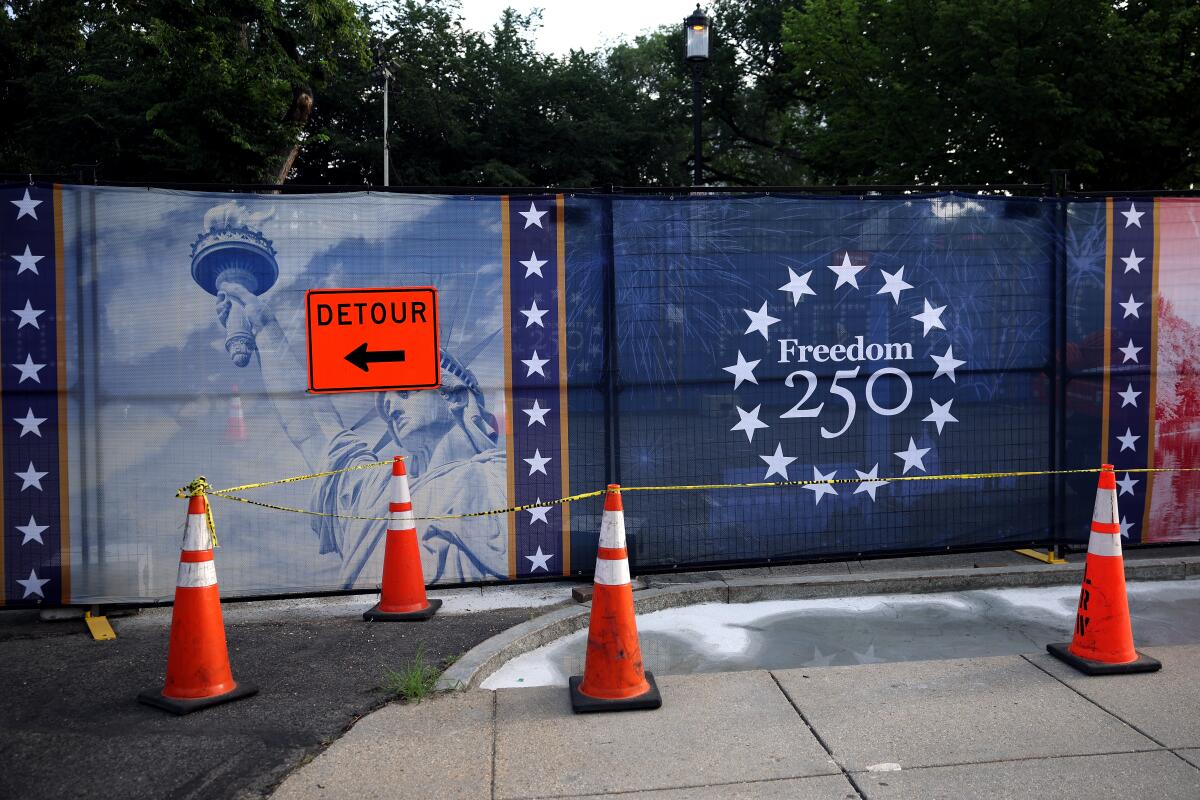
Fencing is seen around the Great American State Fair on the National Mall on Thursday.
(Kevin Dietsch / Getty Images)
The Trump administration has directed funding to events centered on the president’s attendance, primarily around Washington, and partnered with conservative organizations such as PragerU and Hillsdale College to present the country’s founding story through a conservative Christian lens.
Historians are in broad agreement that this year’s celebration has garnered far less attention than the bicentennial, marked in 1976, which generated blanket media coverage and widespread national excitement.
Andrew Rudalevige, a professor of government at Bowdoin College and author of “The New Imperial Presidency,” attributed the lack of enthusiasm this time in part due to a more fragmented media landscape than existed 50 years ago, denying the country a “core curriculum” and a shared story.
“I don’t think it’s a lack of patriotism, so much as a determination that no presidential administration should be able to center itself as the focus of that patriotism,” Rudalevige said.
“There’s a lot to celebrate in the text of the declaration. But that’s not where the focus of the Freedom 250 efforts has been,” Rudalevige said. “It would have been interesting to see what the bipartisan America250 initiative could have come up with if its funding and energies had not been diverted.”
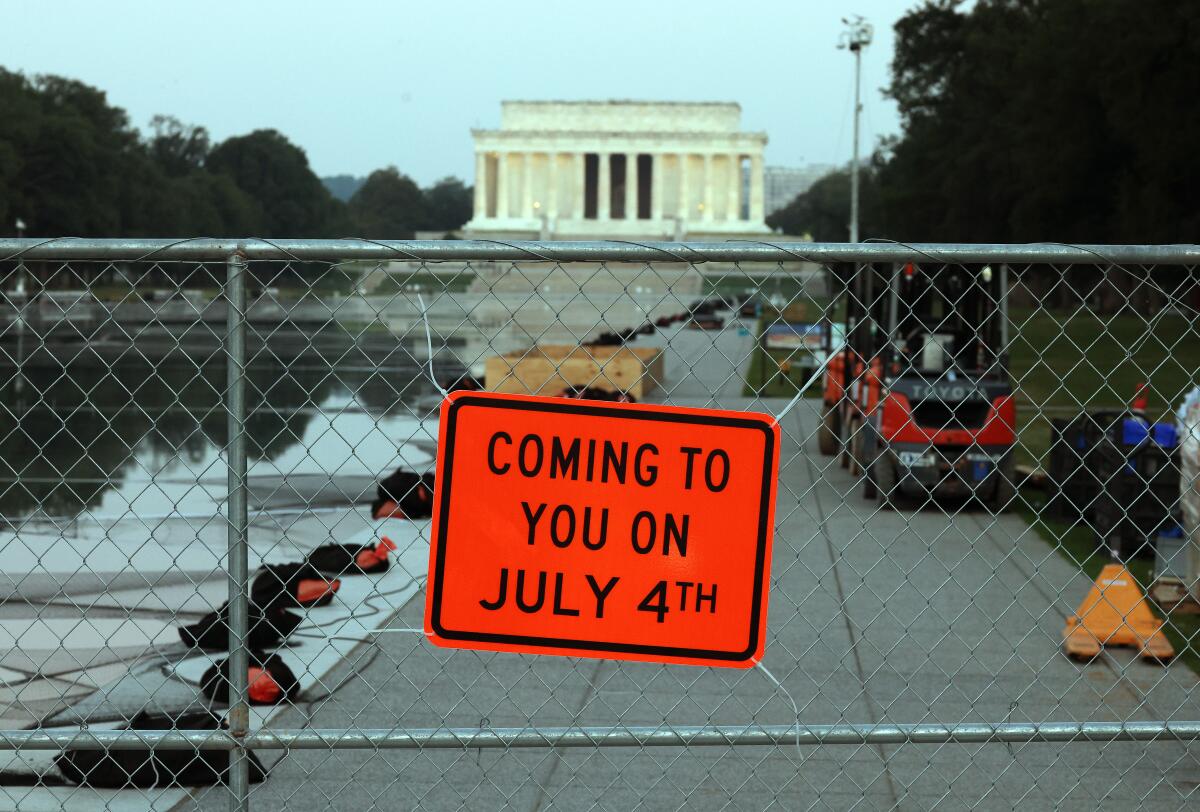
The Lincoln Memorial Reflecting Pool is fenced off in preparation for Fourth of July fireworks.
(Kevin Dietsch / Getty Images)
Trump has scheduled little national travel around the anniversary, visiting North Dakota this week for an event that allowed him to debut a new version of Air Force One, donated by Qatar and outfitted to the president’s tastes. Trump intends to keep the plane after leaving office for his personal use.
The jet will fly over the National Mall alongside the Defense Department’s most impressive equipment on Saturday, before the president delivers a speech in what is forecast to be a blistering heat wave. The evening will end, according to administration officials, with the largest fireworks display in U.S. history.
“The fundamental challenge that we face now is the fight between the historians — people who have been studying the past and who have been thinking about how to tell that story to the public — and government leaders over who gets to control that story,” said Peter Kastor, chair of the history department at Washington University in St. Louis.
“The people who are really on the front lines are museum professionals, the operators of historic sites and schoolteachers,” he said. “They face the responsibility for explaining the past to a general audience on a day-to-day basis, and they are the ones who most often face the backlash from people who want the story to be told differently.”
-

 Technology2 minutes ago
Zoox robotaxi redesign brings big rider upgrades
-
 Business7 minutes ago
Commentary: It’s not just vaccines — from infancy to adolescence, Republicans are waging war on children’s health
-
 Entertainment14 minutes ago
Taylor Swift, Travis Kelce married at lavish Madison Square Garden wedding
-
 Lifestyle17 minutes ago
How to have the best Sunday in L.A., according to Ken Marino
-
Politics22 minutes ago
Trump administration sues California over ‘Glock ban’ law targeting machine gun pistols
-
 Sports32 minutes ago
Folarin Balogun urges U.S. to focus on beating Belgium despite red card he calls unjust
-

 World44 minutes ago
Belgian diamond group that won tariff relief gifts Trump ring
-

 News1 hour ago
Family-owned company prepares to put on the largest fireworks display in history: “It is the biggest show that we’ve ever done”

