Business
The Big Number: 0%


Craving a spritz? There’s a nonalcoholic aperitif for that. Missing your “Sunday Night Football” pint? Even stalwart brewers like Heineken offer 0 percent beers. Looking to shake, or stir, an elaborate mocktail? Nonalcoholic gin, tequila and whiskey are probably available at your local grocery — or even liquor — store.
Natalie Keyssar for The New York Times



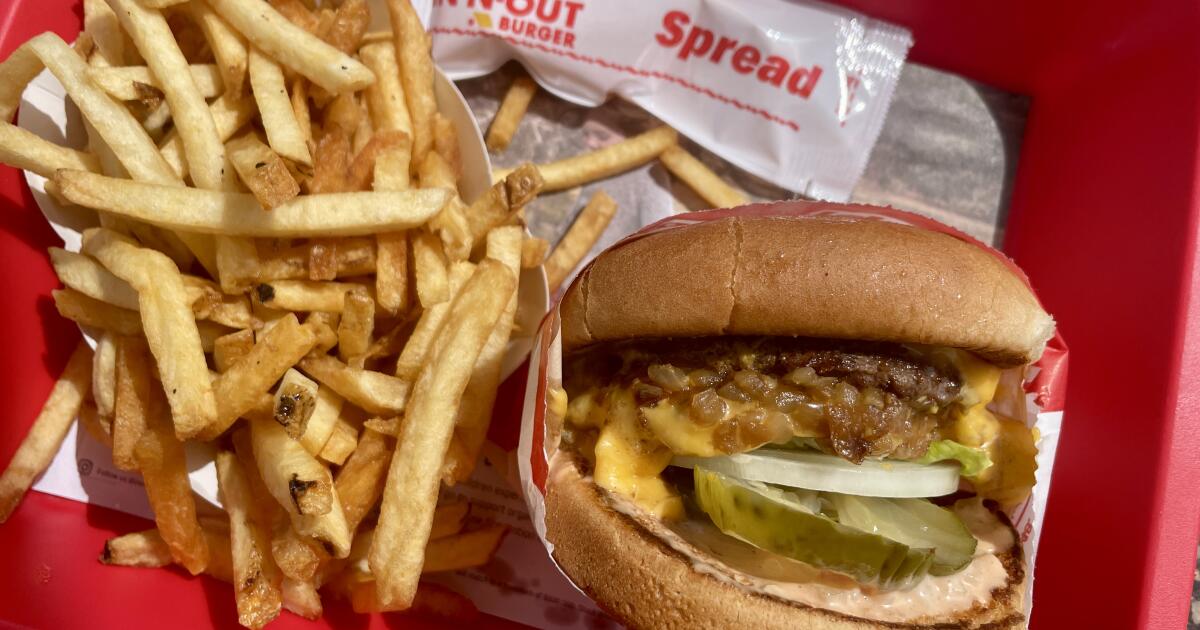
In-N-Out is known for hewing to convention.
So don’t expect the popular burger chain to embrace mobile ordering anytime soon.
That was a message Lynsi Snyder-Ellingson, owner of the family-run chain, delivered in a speech posted this week on YouTube.
Snyder expressed concern that such automation would taint the company’s efforts to sustain its in-person customer service and fresh food.
“What makes In-N-Out and the experience so special is the interaction and the customer service that we’re able to give, the smile, the greeting. Just that warmth and feeling, the culture,” Snyder-Ellingson said. “The mobile ordering will definitely take a piece of that away.”
The owner spoke and took audience questions during an event at Pepperdine University.
Snyder-Ellingson intends to keep operations as close to how it was when her grandparents, the founders, were at the helm, she said.
Snyder-Ellingson, who took charge of the family-run chain in 2010, spoke about her 2023 book, “The Ins-N-Outs of In-N-Out Burger,” and opened up during the talk about her journey reconnecting with God, the struggles she faced with drinking, as well as her divorce.
The beloved burger chain, whose long lines often wrap around the block, has stood out against fast food competitors in its resistance to automated ordering.
The company was born in 1948, when Harry and Esther Snyder opened a small food stand in Baldwin Park. For decades, the burgers could only be found in Southern California, until the chain eventually expanded, mostly to nearby states.
The original location gave birth to drive-thru ordering, and revolutionized fast food culture in the state.
To this day, all orders are custom-made and nothing is frozen, a practice that stays true to the founding couple’s promise of “Quality, Cleanliness and Service.” The menu is simple, and has remained mostly the same.
“My passion in leading is making sure that I’m preserving um the legacy of my grandparents and my family,” Snyder-Ellingson said. “I want to make them proud. I want to champion everything that they would want, especially in today’s world.”
The company’s future in Southern California has been shaky since Snyder-Ellingson announced she was moving to Tennessee, where the company plans to open a second headquarters. The company has scaled back in the Golden State, consolidating its corporate operations to Baldwin Park.
“There’s a lot of great things about California, but raising a family is not easy here. Doing business is not easy here,” Snyder said on a podcast in July. Her comments come amid a broader corporate exodus from California, with businesses like Tesla and Chevron jumping ship.
Today, there are locations in 10 states across the country, mostly in the west coast and as far east as Tennessee. The company recently announced five new locations set to open soon outside California.

In late March, Iran circulated a shaky video supposedly showing an American F/A-18 under attack. Iranian officials claimed they had destroyed the jet, though the Pentagon denied that. The video quickly earned millions of views online, demonstrating how Iran has exploited the global media ecosystem to propagate an image of military prowess.
The New York Times reconstructed how Iran was able to use overt and covert global networks alongside unwitting participants to spread its message through social media, state-affiliated news organizations and American influencers.
Here is how the claim went from a single post to a global audience of millions in 69 minutes.
1:04 p.m.
An obscure account on X, linked to Iran, posted the video first, in English, at 1:04 Eastern, followed a minute later by a post on Telegram by Iran’s Islamic Revolutionary Guards Corps. The posts received little attention at first, according to an analysis based on data from Alethea, Graphika and Cyabra, three companies monitoring online activity during the war.
1:04 p.m.
Almost simultaneously, official accounts of Iranian embassies and consulates repeated the claim on X, giving the narrative an imprimatur of legitimacy.
1:06 p.m.
An Iranian state television network then shared the video on X. Within a minute, RT, Russia’s international network, reposted the video with its own logo. The timing suggested coordinated coverage of the war from Iran and Russia.
1:14 p.m.
One of the most popular posts about the attack, from a pro-Russian influencer account known as Megatron, amassed nearly two million views, according to Graphika. At that point, there was no confirmation of an attack from any other sources.
1:21 p.m.
Sixteen minutes after its first post on Telegram, the Revolutionary Guards posted an update, claiming that the jet had been “precisely hit” and “fell into the Indian Ocean,” a detail that may have been intended to explain why there was no evidence of wreckage on the ground.
1:25 p.m.
The conversation surrounding these posts included suspected bot accounts mingled with authentic profiles, according to an analysis by Cyabra, suggesting some of the engagement was manufactured. Replies to RT’s post, for instance, often featured “short, affirmative comments” with celebratory emojis to show support for Iran, Cyabra’s analysis said.
1:32 p.m.
As the video spread, prominent influencers began posting about it, giving a boost to Iran’s narrative whether they intended to or not. Sulaiman Ahmed, an anti-Israeli activist with more than 800,000 followers on X, shared RT’s video about 10 minutes later.
1:33 p.m.
Ed Krassenstein, an American influencer, shared the claim to his more than one million followers on X. While his post made it clear that the attack was not confirmed by any other sources, influence campaigns benefit from the attention of prominent voices to amplify their narratives to broader audiences.
“I am always as careful as I can be to note where the information is coming from if it’s from a foreign government,” Mr. Krassenstein said in response to questions.
The number of posts mentioning the F-18 or similar terms began to surge, generating more than 35 million views on X alone that day, according to data from Tweet Binder by Audiense. Some users doubted the claim, but many pro-Iranian accounts celebrated the attack as a military triumph.
2:00 p.m.
Barely an hour had gone by, and the narrative had reached millions of views on social media, amplified by authentic and fake accounts based in dozens of countries, from Afghanistan to Yemen. The video appeared not only on X and Telegram but also on TikTok, Facebook and Instagram.
2:01 p.m.
Mario Nawfal, an influencer who has spread right-wing talking points and misinformation in the past, also shared RT’s post and video to his more than 3.2 million followers, noting the historical significance of an attack — “if true.”
“Our approach is to present claims transparently while clearly signaling their verification status, allowing our audience to assess credibility in real time,” Mr. Nawfal wrote in a statement.
2:05 p.m.
Prominent news organizations around the world began reporting on the claim. They included Pravda, Al Jazeera, the India Economic Times and official state media in China. Many repeated Iran’s claim that it had shot down the jet.
2:13 p.m.
An hour and nine minutes after the claim, the United States Central Command posted a denial on X, saying no American aircraft had been shot down. Its post created a new flurry of debate. Some users wrestled with the language, asking whether the plane had in fact been hit but not “shot down.” It declined to comment further.
Despite the statement from Central Command, Iranian, Chinese and Russian state broadcasters continued to feature the video over the next 24 hours, and to post about it across social media. An anchor on Russia 24 reported on “the destruction of yet another U.S. Air Force aircraft,” citing Iranian sources along with the denial from Central Command.
Since the video appeared, no evidence has emerged that Iran shot down an American F/A-18 jet. (This month, Iran successfully downed an F-15E Strike Eagle and an A-10 Warthog.) Still, millions consumed the narrative, spread by witting and unwitting actors.
“By the time an official denial lands,” the monitoring company Alethea wrote in an analysis, “audiences in multiple countries have already processed the story as confirmed.”

Tech behemoths, including Oracle and Meta Platforms, are laying off hundreds of California workers as they invest heavily in artificial intelligence.
Some of the top companies in tech that already had announced big plans to lay off thousands have revealed more details about where they are cutting in recent government filings.
Software giant Oracle has shed more than 700 workers in Santa Monica, Redwood City, Pleasanton and Santa Clara, filings to the California Employment Development Department show. The company, which was founded in California before moving its headquarters to Texas, started notifying employees of mass layoffs in late March.
Oracle declined to comment. The company hasn’t said publicly how many workers it has laid off. Several news outlets, citing people familiar with the matter, reported that the company laid off thousands of employees across multiple divisions.
As of May 2025, Oracle had 162,000 workers.
Software developers, analysts, sales representatives and product managers were among California Oracle workers who lost their jobs. Laid-off employees will officially separate from the company June 1.
California is home to some of the world’s most powerful and largest tech companies. But as they race ahead to advance AI-powered tools that can generate text, images and code, workers are anxious that businesses will automate tasks and shrink their workforce workforces. Tech companies also are more wary about their expenses, even as they spend billions of dollars on data centers and developing new products.
In March, Meta began laying off employees who worked on its virtual reality efforts.
The company laid off roughly 200 employees at its offices in Burlingame and Sunnyvale. They’re expected to leave the company May 29. Meta laid off engineers, recruiters, product managers and other workers.
“Teams across Meta regularly restructure or implement changes to ensure they’re in the best position to achieve their goals. Where possible, we are finding other opportunities for employees whose positions may be impacted,” a Meta spokesperson said in a statement.
Meta has been doubling down on its efforts to sell AI-powered smart glasses and is working on more powerful AI that surpasses human intelligence. The company, which debuted a new AI model Wednesday, is building a personal “superintelligence” to help people achieve their goals, create and be more productive.
Meta had 78,865 workers as of December 2025.
Chipmaker Qualcomm recently laid off more than 60 workers. The cuts hit employees across various offices in San Diego. Laid-off employees are anticipated to leave the company May 26. Various information technology and cybersecurity jobs were among the roles slashed as part of the layoffs.
Qualcomm didn’t immediately respond to a request for comment.

Mamdani’s First 100 Days as NYC Mayor: A Timeline

WNBA formally approves Detroit franchise. Where will they play, and when?

My thoughts on the San Francisco dance party scene

Welcome to Y’all Street: bullish Dallas aims to steal New York’s financial crown

Police investigate 2 Miami scenes after a shooting that left a man hospitalized

Florida High School Football Rankings: Top 25 teams – Oct. 21

How old is Bo Nix? What to know about Oregon quarterback ahead of 2024 NFL Draft

Cleary's 21 help Le Moyne down Central Connecticut State 69-64 in OT

99th annual Pony Swim held in Virginia

Indiana Members Credit Union announced as new anchor tenant at Bottleworks District

Video: How Trump’s Advisers Felt About Going to War With Iran

Unearthed clip exposes shocking claim by Newsom’s wife about inmates at violent California prison

Gaza journalists mourn Al Jazeera’s Wishah, killed by Israel

Exclusive: Trump weighs pulling some US troops from Europe amid NATO strains, official says

Video: The Fragile Cease-Fire in Iran
-

 Atlanta, GA5 days ago
1 teenage girl killed, another injured in shooting at Piedmont Park, police say
-

 Education1 week ago
Video: We Put Dyson’s $600 Vacuum to the Test
-

 Movie Reviews1 week ago
Vaazha 2 first half review: Hashir anchors a lively, chaos-filled teen tale
-

 Georgia3 days ago
Georgia House Special Runoff Election 2026 Live Results
-

 Pennsylvania3 days ago
Parents charged after toddler injured by wolf at Pennsylvania zoo
-

 Education1 week ago
Video: YouTube’s C.E.O. on the Rise of Video and the Decline of Reading
-
 Milwaukee, WI4 days ago
Potawatomi Casino Hotel evacuated after fire breaks out in rooftop HVAC system
-

 Education1 week ago
Video: Toy Testing with a Discerning Bodega Cat