Business
South Korea struggles with uncertainty over U.S. trade negotiations


SEOUL — As the Trump administration has been churning out trade threats this week, South Korea, a crucial trading partner and military ally, has been struggling — like many — to navigate the uncertainty that looms over trade negotiations with Washington.
On Monday, Trump sent a letter dictating new tariff rates to 14 countries including South Korea, which was hit with a 25% tax. The levies were set to kick in Tuesday, but were postponed to Aug. 1. Trump left the door open for another extension, telling reporters the new deadline was “firm but not 100% firm,” depending on what trade partners could offer.
But it’s unclear whether the additional three weeks will be enough to resolve the longstanding disagreements between Washington and Seoul. One of the biggest points of contention is South Korea’s auto industry, which was the third biggest exporter of automobiles to the U.S. last year.
Although White House Press Secretary Karoline Leavitt said Monday that Trump’s phone was ringing “off the hook from world leaders all the time who are begging him to come to a deal,” the tone in Seoul has been reserved.
Commerce Secretary Howard Lutnick, left, walks across the tarmac on Sunday as President Trump boards Air Force One. On Monday, Trump dictated new tariff rates to 14 countries, including a 25% tax on South Korea.
(Jacquelyn Martin / Associated Press)
Last week, ahead of the initial July 8 deadline, South Korean President Lee Jae Myung, who took office last month, said “it’s difficult to say for certain that we can finish [the trade talks] by July 8.”
“Both sides are doing their best and we need to come up with an outcome that can be mutually beneficial to both parties, but we still have not yet been able to clearly establish what each party wants,” he added.
Since then, senior South Korean trade officials have been dispatched to Washington with the hopes of bringing a deal within striking distance.
“It’s time to speed up the negotiations and find a landing zone,” Trade Minister Yeo Han-koo said after meeting with U.S. Commerce Secretary Howard Lutnick on Monday.
So far, the only two countries that have struck new trade deals with the Trump administration are the U.K. and Vietnam.
But the Lee administration has maintained a note of caution. At a high-level meeting held Tuesday to discuss the current state of the negotiations, Lee’s presidential chief of staff for policy, Kim Yong-beom, reportedly emphasized the “national interest” over speedy dealmaking, instructing officials to support tariff-affected industries and “diversify” South Korea’s export markets.
Under a decades-long free trade agreement, South Korean tariffs on most U.S. goods are already zero, meaning there are fewer concessions Seoul can offer, analysts say. And on the key points of contention such as automobiles, there is little daylight to be found.
“This announcement will send a chilling message to others,” Wendy Cutler, vice president of the Washington-based Asia Society Policy Institute and former deputy U.S. trade negotiator, said in a post on X.
Trump’s letter also suggested that the U.S. will “not be open to reprieves” from sectoral tariffs, including those on automobiles, Cutler added.
South Korean trade officials have stressed that removing or significantly reducing the 25% tariffs on cars is a top priority.

White House Press Secretary Karoline Leavitt holds a trade letter sent by the White House to South Korea during a news conference on Monday.
(Al Drago / Bloomberg via Getty Images)
But South Korean cars from Hyundai and Kia factor significantly into the $66-billion trade deficit that Trump has decried as unfair. Last year, South Korea was the third biggest exporter of automobiles to the United States, to the tune of $34.7 billion. It bought $2.1 billion worth of cars from the U.S.
Until now, the country’s flagship automakers Hyundai and Kia have been able to sidestep any major tariff shocks, achieving instead record sales in the first half of the year by selling existing inventory in the U.S.
But many believe it is only a matter of time until they will have to raise vehicle sticker prices, as some competitors have done. Both companies’ operating profits are now forecasted to hit double-digit declines compared with the previous year.
The U.S. has also reportedly demanded concessions that touch on sensitive issues of food or national security in South Korea — a far harder sell to the public than the expanded manufacturing cooperation that South Korea has sought to center in the trade talks.
Among these are opening up South Korea’s rice market to U.S. imports and allowing Google to export high-precision geographic data to its servers outside of South Korea.
As an essential crop that represents a significant portion of farmers’ incomes, rice is one of the few heavily protected goods in South Korea’s trade relationships. Under its free trade agreement with the United States, Seoul imposes a 5% tariff on U.S. rice up to 132,304 tons, and 513% for anything after that.

U.S. Army soldiers attend a ceremony last month in Dongducheon, South Korea. A 2021 report from the U.S. Government Accountability Office found that it cost $19.2 billion to maintain American troops in South Korea from 2016 through 2019.
(Kim Jae-Hwan / SOPA Images via Getty Images)
The South Korean government has long denied Google’s requests to export high-precision geographic data — which is used for the company’s map services — on the grounds that it could reveal sensitive military sites that are essential for defense against North Korea. Last year, Ukraine accused Google of exposing the locations of some of its military systems to Russia.
Equally vexing are Trump’s long-running demands that Seoul should pay more to host the some 28,500 U.S. troops stationed in South Korea.
“South Korea is making a lot of money, and they’re very good. They’re very good, but, you know, they should be paying for their own military,” Trump said at a White House Cabinet meeting on Tuesday, adding that he told South Korea it should pay $10 billion a year.
Over a four-year period from 2016 through 2019, the total cost of maintaining U.S. troops in South Korea was $19.2 billion, or around $4.8 billion a year, according to a 2021 report from the U.S. Government Accountability Office. Over that period, South Korea footed about 30% of the total annual costs, in addition to providing indirect financial support such as waived taxes or foregone rents.
Under the Special Measures Agreement, the joint framework that governs this arrangement, Seoul’s payments have grown over time. Under the latest version, which covers 2026 to 2030, Seoul’s annual contribution beginning next year will be $1.19 billion, an 8.3% increase from 2025, and will increase yearly thereafter.
Trump’s demand for nearly 10 times that — along with the threats that the U.S. might pull its troops from the country — has previously drawn widespread outrage in the country, spurring calls by some for the development of South Korea’s own nuclear arsenal.
“The Special Measures Agreement (SMA) guarantees stable conditions for U.S. troops stationed in Korea and strengthens the joint South Korea – U.S. defense posture,” a spokesperson for South Korea’s Ministry of Foreign Affairs said in response to Trump’s comments.
“Our stance is that the South Korean government will adhere to the 12th SMA, which was agreed upon and implemented in a legitimate manner.”


The Minions took over theaters this weekend as Universal Pictures and Illumination’s “Minions & Monsters” won the top spot at the box office, though with a lower-than-expected domestic haul.
The animated movie, which follows the Minions’ takeover of Hollywood, took in $61.4 million in the U.S. and Canada for the five-day Fourth of July holiday weekend, according to studio estimates. That haul was lower than analysts’ expectations for a domestic opening of about $68 million. The movie’s three-day total was $36.4 million.
But the Minions performed well internationally, bringing in about $85 million. In total, “Minions & Monsters” made $159.9 million worldwide on a production budget of about $85 million.
The film is the latest in the powerhouse franchise that began with “Despicable Me” in 2010. Across its previous six installments, the “Despicable Me” and “Minions” franchise has made more than $5.6 billion at the global box office. The last movie, 2022’s “Minions: The Rise of Gru,” made more than $940 million worldwide.
“Minions & Monsters” marks the lowest opening for the franchise. Part of the issue could be timing — the box office can be negatively affected when the Fourth of July lands on a Saturday, said Paul Dergarabedian, head of marketplace trends at Rentrak.
Walt Disney Co. and Pixar’s “Toy Story 5” came in second at the box office this weekend with a domestic three-day gross of $31 million. Angel Studios’ biopic “Young Washington” ($20.8 million), Warner Bros. and DC Studios’ “Supergirl” ($9.6 million) and Universal’s “Disclosure Day” ($6 million) rounded out the top five, according to Rentrak.
The haul for “Minions & Monsters,” coupled with the strong holdover performance of “Toy Story 5,” proved again that family films are making a dent in the summer box office.
“Toy Story 5” has now brought in a total of $764.3 million worldwide, and last month, Universal, Illumination and Nintendo’s “The Super Mario Galaxy Movie” crossed $1 billion at the global box office, becoming the first film of any kind to do so this year.
The rest of the summer theatrical lineup is also expected to bring in audiences and push domestic box office totals closer to pre-pandemic figures. Next week, Disney will release its live-action “Moana,” followed by Christopher Nolan’s “The Odyssey” and Sony Pictures’ “Spider-Man: Brand New Day.”
To date, the summer box office is now about $2.3 billion, a nearly 12% increase compared with the same period a year ago, according to Rentrak data. Compared with pre-pandemic 2019’s numbers, however, it is still down about 7%.
Earlier this year, a widely circulated 15-second AI-generated video of Brad Pitt fighting Tom Cruise on a rooftop sparked outrage across Hollywood. One screenwriter called the cinematic clip “terrifying.” The Motion Picture Assn. demanded the company behind the artificial intelligence tool — Chinese tech giant ByteDance — halt its “infringing activity.”
Despite the uproar, the former majority owner of TikTok has quietly continued to court filmmakers, independent artists and executives who are eager to adopt the AI video generation model called Seedance.
Seedance was launched in the U.S. this spring at a Santa Monica event hosted by a group linked to the Chinese government.
ByteDance began hiring for 100 open roles, signed multiple independent filmmakers and artists and held private conversations about financing AI films. The company threw a lavish caviar party at Cannes and in May hosted panels promoting its cinematic tool at Amazon’s AI on the Lot event in Culver City.
“Like any new technology, Hollywood ultimately has no choice but to react to market realities. And that reality is that the new crop of AI-empowered Hollywood creatives see Seedance as having the most powerful video generator in the market right now,” said Peter Csathy of Creative Media, an entertainment and AI business advisory firm.
Joel Kuwahara, the animation producer on early seasons of “The Simpsons,” echoed Hollywood’s quiet embrace.
“Within the industry, I know that a lot of studios haven’t approved Seedance, but yet with a wink and a nod, they’re allowing Seedance to be used. … It’s kind of like a ‘don’t ask, don’t tell’ kind of a thing,’” Kuwahara told The Times.
ByteDance declined to comment on its U.S. expansion.
The race to build the dominant AI video model has created a fierce rivalry, pitting U.S. companies against the fast-closing Chinese competitors. On the American side, there are Google Veo and startups such as Runway and Luma. OpenAI’s Sora has discontinued its video tool.
The Chinese challengers Seedance, Kling and Alibaba’s HappyHorse have rapidly closed the gap on cinematic realism and have upstaged their American rivals by undercutting them on cost.
According to Artificial Analysis, a company that tracks cost and performances of different AI models, China’s Seedance is currently the most cost-effective and high-quality option compared with U.S. competitors. Seedance costs $9 per minute for video with audio generation, significantly lower than the $24 per minute required by Google’s Veo model.
That makes it an attractive tool for independent filmmakers like Rupert Wainwright, who recently met with Seedance executives at AI on the Lot.
He wants to use the the tool to help make his feature-length film called “Sebastian,” about a Christian saint set in 3rd century Rome. The hybrid AI film will be shot partly on location in Europe and partly generated with artificial intelligence.
“It’s the equivalent to when streaming a movie over the internet onto your TV finally became possible,” Wainwright said.
Kavan Cardoza.
(Kayla Bartkowski/Los Angeles Times)

A scene from “The Chronicles of Bone.”
(Kayla Bartkowski/Los Angeles Times)
In May, Steven Schneider, the producer of “Paranormal Activity,” famous for its handheld grainy footage-style filmmaking, announced “Terrarium,” his first hybrid AI horror production. The film’s director, Jason Zada, said it will be entirely generated using Seedance’s model.
Zada’s filmmaking workflow involves writing, casting, prompting and editing all simultaneously, allowing him to rewrite scripts based on “dailies” generated by AI that day.
He estimates that generating 15 seconds of high-definition video costs only $5.
“We could go from a very detailed outline, very detailed characters and have it be a bit more fluid, because we could regen[erate] as much as we want,” Zada said.
Zada plans to shoot the movie first on a soundstage with real actors and will decide later which parts work better traditionally and what should be done synthetically. He’s a member of the Directors Guild of America and said he will be employing union actors for his hybrid AI film.
Seedance also has continued building ties by offering indie creators, AI-native studios and filmmakers free monthly credits and access to unreleased features. These “tastemakers” beta test its models, offer feedback on what works, and use it for their personal filmmaking projects — which creates corporate brand awareness.
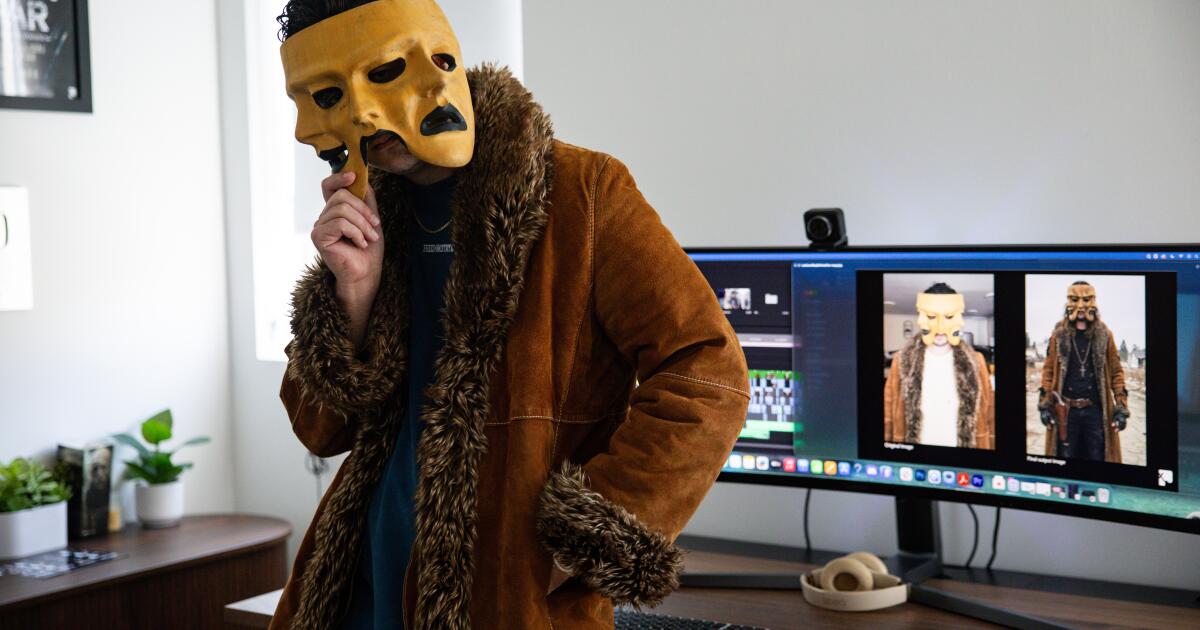
Kavan Cardoza is one such breakout filmmaker. His AI fantasy series, “The Chronicle of Bones,” which uses Seedance, features half a dozen distinct storylines and an ensemble of characters. New episodes, each not more than 30 minutes, are released on YouTube once a month. The solo filmmaker averages 3 million views per episode and has cultivated a YouTube audience of 500,000.
Most filmmakers are tool agnostic, but lately Cardoza has become completely dependent on Seedance, he said, because it solves a persistent problem: maintaining character consistency between shots.

Kavan Cardoza unmasked.
(Kayla Bartkowski/Los Angeles Times)
To create one of his characters, “the last lost boy,” Cardoza took self-portraits wearing a three-faced mask and a tattered brown jacket. He used those reference images for the AI character and transforms them into a stylized person, with a personality, backstory and visual details. He fed those images back to Seedance to get consistent characters — repeating the process for each member of the cast.
“I can’t go get Brad Pitt because he costs like $5, 10, 20 million to be in my film,” Cardoza said. “I can probably get a synthetic actor that will act just as good as Brad Pitt in the future. That’s crazy to me.”
Cardoza has copyrighted his script and characters, and aims to eventually attract major studio interest to turn his intellectual property into a film which comes with a built-in fan base.
Such plans are likely to face resistance from the performers union SAG-AFTRA, which has decried the use of synthetic actors such as Tilly Norwood.
“The rise of Seedance comes down to [its] focus on pleasing filmmakers and making things that look filmic,” said Stephan Vladimir Bugaj, senior vice president of JioStar, a joint venture between Disney and India’s Reliance Industries.
ByteDance introduced timeline-based prompting so filmmakers can actually pick specific moments and tweak them, and improved the understanding of camera direction, physics, lighting and fluidity of action. All of this, Bugaj said, “unlocked a kind of spectacle filmmaking that the other models are not delivering quite as well.”
The company’s tool has been in such high demand, Zada said, that Seedance has been quoting some major Hollywood studios $2 million for unrestricted special access.
While acknowledging Seedance’s popularity and its U.S. expansion, Amit Jain, chief executive of Luma, said its ceiling in Hollywood is severely limited. Traditional studios might adopt Chinese models for some preproduction tasks such as concepting, but the geopolitical and intellectual property risks for commercial generations are too prohibitive.
“Can you imagine Disney using the ByteDance model for the next ‘Snow White’? No way,” Jain said. “This is not even a technical argument, really. That’s the reality.”
Luma has been making inroads into Hollywood selling its software but has separately funded a production service company to teach filmmakers to make hybrid AI films using its tools.
Despite conservative production budgets, AI spending by media companies is projected to grow from $2.6 billion to $12.5 billion from 2024 to 2029, according to a State of Generative AI Media report.

Kavan Cardoza flips through pages of his fine-art photography book.
(Kayla Bartkowski/Los Angeles Times)
Bugaj warned that the quality and competitive price of Chinese models should be a “wake-up call” for American players fighting for market share.
“We’re not loyal,” said Zada, the filmmaker. “Whatever is the best, we’re going to use it.”
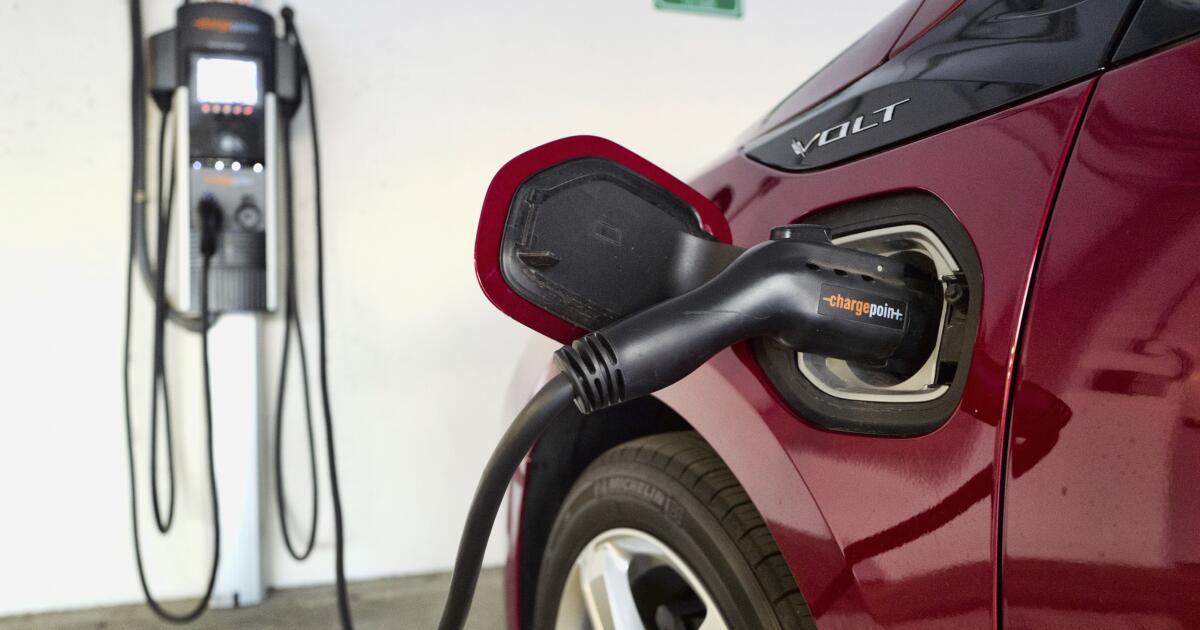
Nearly a year after the expiration of a $7,500 federal tax incentive for new electric vehicles, California is stepping in to try to motivate buyers to go electric.
Gov. Gavin Newsom allocated $135 million in his new state budget to provide incentives for new and used EVs. Participating automakers will match the funds.
California leads the nation in EV adoption, though the market has taken a hit under the Trump administration.
The state budget — a more than $350-billion spending plan — went into effect Wednesday. The EV incentives will take effect in the coming weeks as the California Air Resources Board irons out agreements with dealerships.
Here’s what you need to know.
What are the incentives worth?
Senate Bill 168 tasked the California Air Resources Board with setting incentive amounts for new and used electric vehicles sold in California.
Eligible buyers will receive $3,500 off for new EVs and $1,750 off for used ones. Unlike the federal tax credits that expired in September, these incentives offer an instant discount and don’t require buyers to apply for credit later.
State funds will cover half of the incentive amount, and auto manufacturers will cover the other half.
The rebates will mean that most eligible buyers will effectively get between 4% and 7% of their money back.
For used EVs, “this incentive helps what’s already a good deal become an even better deal,” said auto analyst Brian Moody. “I think that’s the perfect use of these kinds of dollars.”
What are the rules and exceptions?
The new incentives can’t be used on all electric vehicles — they apply only to new EVs with a manufacturer’s suggested retail price of $50,000 or less, and used EVs with a sale price of $25,000 or less.
The $50,000 maximum rules out many options on the market, but legislation outlining the incentive program makes a special exception for California-based companies. Buyers purchasing a new or used EV from a company with headquarters in California can claim the discount regardless of the vehicle price.
That’s good news for Lucid, with headquarters in Newark, Calif., and for Irvine-based Rivian. Neither company currently offers new vehicles for less than $50,000. Rivian said it plans to launch a $44,990 SUV in 2027.
Who is eligible?
California’s new EV discounts are available only to first-time EV buyers, according to the legislation.
SB 168 says the buyer’s eligibility will be “confirmed by a buyer attestation” that they have not previously owned a zero-emission vehicle.
The new EV incentive is less than half of the federal incentive that expired nine months ago. Whereas the federal incentive may have been enough to spark interest in a range of buyers, Moody said the lesser amount will probably appeal mainly to people who already have their eye on an EV.
“I think you have to already be considering it, or in the market,” Moody said. “I think that the amount is just right for that.”
What are California’s clean car goals?
The incentives are intended to help California reach its electric vehicle and air quality goals as those targets have been under fire from President Trump.
Shortly after taking office, Trump signed an executive order that revoked California’s authority to set its own EV regulations, which included a goal of having 100% of new vehicle sales in the state be zero-emission by 2035.
California sued the administration in response. The state also has goals, including some that have been in place since 2012, that set declining limits on smog-causing pollutants and required automakers to sell increasing percentages of electric and hybrid vehicles through 2025.
In March, the administration filed a new lawsuit again trying to block California’s ability to set stricter-than-federal emissions standards for cars.
Early this year, California announced that more than 2.5 million zero-emission vehicles had been sold in the state since 2010, surpassing a target to put 1.5 million zero-emission vehicles on the road by 2025.
-

 New York5 minutes ago
10-Minute Challenge: The Ceiling at Grand Central
-

 Los Angeles, Ca12 minutes ago
1 killed, multiple people injured in Tarzana 4-car crash
-

 Detroit, MI30 minutes ago
Power outage forces flaring at Marathon’s Detroit refinery; portion of Schaefer Road closed
-

 San Francisco, CA42 minutes ago
San Francisco’s fireworks show ends in hours of gridlock involving Waymo cars
-

 Dallas, TX45 minutes ago
FIFA Fan Fest in Dallas paused due to lighting in the area Sunday evening
-

 Miami, FL50 minutes ago
Venezuelan Independence Day: Aid efforts continue after devastating earthquake
-

 Boston, MA57 minutes ago
Timeline: Looking back on Jaylen Brown’s Celtics career – The Boston Globe
-

 Denver, CO1 hour ago
Denver police arrest suspect in fatal July 4 triple stabbing

