Business
Sell-off on Wall Street: Why it is happening and what it says about the economy

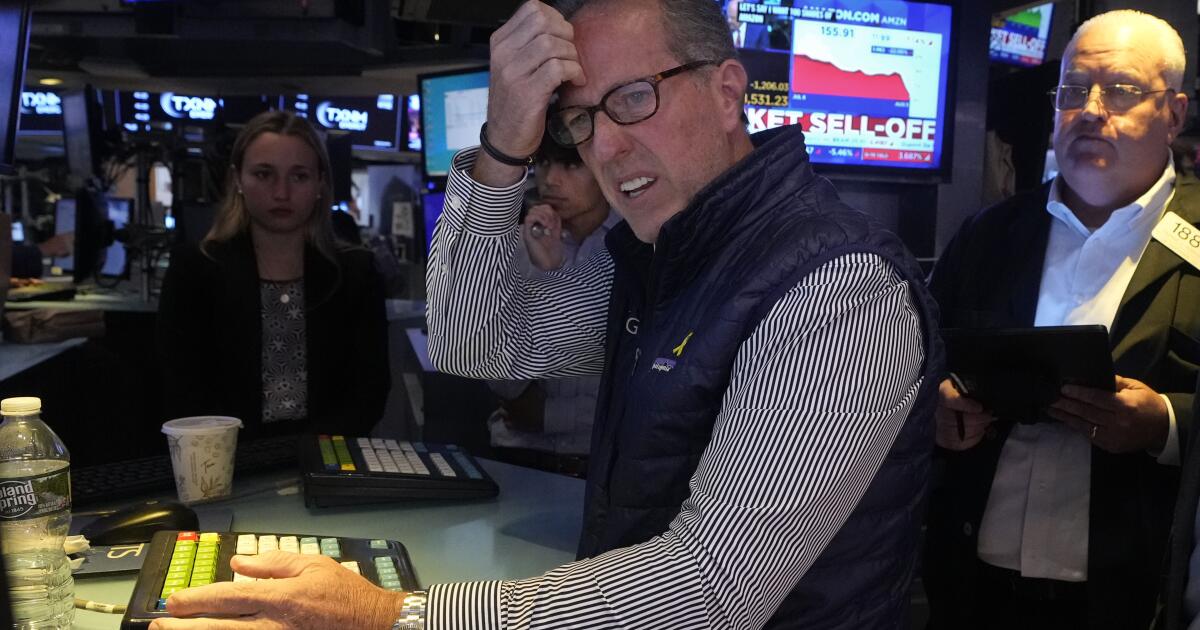
It’s nail-biting time on Wall Street.
Stocks had been dropping at worrisome rates for several days, but on Monday things went from concerning to panicky. At one point, the Dow Jones industrial average plunged more than 1,200 points, on a day when equity markets tumbled across the globe. It closed down 1,034 points, or 2.6%.
Technology stocks have been hit particularly hard lately: The Nasdaq composite was, for a moment on Monday, down more than 10% since the middle of last week, entering into what economists euphemistically call “correction” territory.
The sudden pullback has jolted investors and raised questions that go beyond financial markets to questions about the underlying health of the economy.
And even when things level out, the window-rattling downturn threatened to kill the political euphoria that has swept over Democrats since President Biden withdrew and Vice President Kamala Harris emerged as the party’s standard-bearer.
So what’s happened and what may be next? Here are first-draft-of-history answers to some of the crucial questions:
What’s causing the current plunge in U.S. stock markets?
Economists point to several factors behind the sell-off. To begin with, tech stocks were overdone, pushed beyond their underlying value by the artificial intelligence craze. Hence the Nasdaq correction. Nvidia, Apple and Intel were among big losers Monday.
And Friday’s jobs report, which showed a sharp slowdown in hiring and unemployment in July, set investors — even those not deep into tech — on edge. That came on the heels of news that jobless claims, a proxy for layoffs, increased significantly in the waning days of July.
It hasn’t helped that the Federal Reserve has been reluctant to start cutting interest rates, which have throttled inflation as intended, but also weighed down businesses and consumers.
Then there’s the reverberation from global markets. On Monday, Japan’s once-high-flying stocks took their worst drubbing since Black Monday in 1987. The huge losses were seen, in part, as being a reaction to market declines and growing concerns in the U.S.
“It’s an unfortunate sequence of events that causes selling, selling, selling,” said Christopher Rupkey, chief economist at Fwdbonds, a research house in New York.
How have stock markets in the U.S. performed overall this year?
Even with Monday’s panic-selling, stocks generally are up for the year, many way up.
Both the broader Standard & Poor’s 500 and Nasdaq are still more than 9% higher compared with the start of the year. The Dow is the laggard, up only 2.6% since Jan. 2.
Stocks have benefited from strong corporate earnings; investor excitement over AI’s growth and potential; and the expectation of Fed interest rate cuts, said Mark Zandi, chief economist at Moody’s Analytics.
“This is still, at this point, a garden-variety correction,” Zandi said of the current turmoil, though he added that the situation warrants careful watching. “Things can take on a life of their own.”
Should I be worried about a recession?
Not yet, maybe never.
The classical definition of a recession is two straight quarters of declining gross domestic product. The latest, second-quarter GDP, after adjusting for inflation, was a strong 2.8%.
Almost every economist agrees that you can’t have a recession without job growth turning negative for some extended period. And the U.S. economy hasn’t come close to that point.
Employers have added jobs every month since January 2021, when the economy began to recover from the pandemic. Most recently, in July, job growth came in below expectations, but at 114,000 new payroll hires, that was still solidly positive.
“I don’t see the underpinnings of an economic downturn,” said Jack Ablin, chief investment officer and founding partner at Cresset Capital.
Can anything be done to arrest the decline in stocks?
To quell the sell-off, some investors have urged the Fed to cut interest rates now, in a kind of emergency move ahead of the central bank’s next scheduled meeting in mid-September.
Fed officials have taken such steps before, during the pandemic and the Great Recession, for example. But analysts doubt that the policymakers will intervene unless markets keep faltering badly; making an emergency cut could make things worse by frightening people and causing a market meltdown.
“It’s certainly not a hair-on-fire moment,” Zandi said.
What are the risks going forward?
With more people on edge about the economy, further declines in the stock market could erode confidence among businesses and consumers, leading to a pullback in hiring and spending. That would be a psychological development, but economies are not immune to the fears or the hopes of their human components.
Consumer spending, which drives the U.S. economy, has held up very well in recent years, thanks to steady job and wage growth. But there are indications from companies such as McDonald’s and Starbucks that consumers are becoming more cautious.
Higher-income households account for a disproportionately big share of spending, which has been supported by rising gains in home and stock prices. A sharp drop in stocks would have the reverse impact, a so-called negative wealth effect, making richer households more averse to spending, which could lead to a recession.


Sony Pictures will invest $100 million and take a minority stake in virtual reality venue operator Cosm, as the studio continues to build a business in communal experiences.
As part of the investment, Sony Pictures Chief Executive Ravi Ahuja will also join Cosm’s board of directors, the studio said Wednesday. The size of Sony’s minority stake was not disclosed.
The El Segundo-based Cosm currently operates three venues — one at Hollywood Park in Inglewood, and the others in Dallas and Atlanta. The company plans to open additional venues in Detroit and Cleveland.
Cosm bills itself as a “shared reality venue,” and its facilities center around a massive, wraparound screen that is intended to envelop viewers with additional digital effects. The company has largely focused on sports, though it has also shown Cirque du Soleil shows and done several collaborations with Warner Bros., including recent screenings of 2001’s “Harry Potter and the Sorcerer’s Stone” in honor of the film’s 25th anniversary.
“Cosm sits at the intersection of several trends shaping the future of entertainment,” Ahuja said in a statement. “We’ve followed Cosm since before launch and have been impressed with the quality of the experience and the enthusiasm it’s generating with audiences.”
The investment is Sony’s latest venture into experiential entertainment. In 2024, the Culver City-based studio acquired dine-in theater chain Alamo Drafthouse Cinema.

The Los Angeles City Council on Tuesday unanimously advanced an ordinance to halt new oil and gas drilling and phase out all existing production over the next 20 years. L.A. is home to more than 2,000 active oil wells.
The measure revives a similar ban passed in 2022, which was struck down by a judge following legal challenges from the oil and gas industry.
It must pass a second vote before final adoption later this summer, and would make L.A. the largest city in the United States to phase out existing oil wells.
“Today, Los Angeles is making a decision that aligns with our need to turn the page on urban oil drilling,” Councilmember Katy Yaroslavsky said during Tuesday’s council meeting. “The absence of an enforceable oil ordinance has had real consequences for our communities.”
The ban in 2022 was seen as a historic move for a region built on the petroleum industry.
But in 2024, a Los Angeles County Superior Court judge invalidated the law, ruling that the state, not the city, has jurisdiction over petroleum production. The legal challenge was brought by oil companies including Warren Resources, which operates a large oil field in Wilmington. Much of the field is beneath the city of Long Beach, but it also extends under Los Angeles.
Shortly after that, state legislators advanced Assembly Bill 3233, which reaffirmed city and county authority to regulate oil and gas activity. It was largely seen as the missing piece that made the original ordinance vulnerable.
“It’s now unequivocal that cities have the authority to regulate, limit and prohibit oil and gas operations within our jurisdiction,” Yaroslavsky said.
The new ordinance, written by the Department of City Planning, prohibits new oil and gas extraction, including drilling, redrilling or deepening existing oil wells for the purposes of production. It also designates all existing and active idle wells as “nonconforming uses,” meaning they may only operate during the phaseout period and are no longer compliant with current zoning.
Warren Resources, which led the lawsuit against the previous ban, did not immediately respond to a request for comment. The company previously argued that the 2022 ban was rushed and would lead to more oil imports to the area, causing increased emissions from tankers and trucks and other environmental consequences.
Many wells in the city operate near schools, homes and parks. Most are concentrated in low-income areas and communities of color, such as Wilmington and the harbor district, West L.A. and South L.A., where residents have long reported respiratory issues, headaches, throat irritation and other health problems. Studies have found oil wells can emit carcinogens and are linked to adverse health effects.
“This ordinance is such an important step toward giving every frontline community in Los Angeles access to clean air,” Silvia Esparza, a South L.A. resident and member of environmental justice group Stand-L.A., said in a news conference ahead of Tuesday’s vote.
Ashley Hernandez, a Wilmington resident and organizer with the nonprofit Communities for a Better Environment, said bloody noses and noxious fumes were a regular part of life in the neighborhood growing up.
She noted that in addition to oil drilling, L.A. residents continue to face other environmental hazards, such as the recent oil pipeline rupture that sent crude into the L.A. River or the ongoing cold storage warehouse fire in Boyle Heights that is spewing toxic smoke.
“I’m here to remind L.A. city and these toxic neighbors that Wilmington residents are more important than any ‘black gold’ under their homes,” Hernandez said. “We need our city to protect our families now and to stop the oil industry’s reign of power in our city. A passage of the oil phaseout ordinance today gives the city a chance to correct this wrong.”
Times staff writer Dakota Smith contributed to this report.

Shares in Elon Musk’s rocket company SpaceX halted their three-day slide that had erased roughly $600 billion off its market value.
SpaceX shares closed at $156.11 with a nearly 1% gain on Tuesday, a slight recovery from a 16% fall on Monday.
That loss dropped the stock below $160.95, where it ended the day June 12 after a 19% surge during its record initial public offering. The IPO gave it a market cap of $2.2 trillion, making SpaceX one of the world’s most valuable public companies.
It also turned Musk into the world’s first trillionaire, a status he retains despite the sell-off.
The downturn probably reflects investor unease over the company’s spending plans and potential debt load, analysts say.
SpaceX raised a total of $86 billion after underwriters exercised their right to sell additional shares, on top of the $75 billion initially raised. It was the largest IPO in history.
A little more than half a billion shares were distributed to institutional and retail investors at a price of $135, with the stock opening at $150 as some holders immediately flipped shares for a profit.
Shares rose as high as $176.52 during the IPO before settling at the $160.95 price. In the weeks since, shares reached a high of $225.64, meaning that some investors lost money or are underwater with paper losses.
Since the IPO, SpaceX has dropped some big bucks.
It announced last week that it was acquiring AI coding startup Cursor for $60 billion in a deal expected to close in the third quarter. The San Francisco company, founded in 2022, enables engineers to instruct software in English to run coding tasks autonomously.
It also sold $25 billion in bonds on Tuesday , unusual for a company that just went public, much less for one that just raised a record sum.
The IPO surpassed the 2019 offering by Saudi Aramco, Saudi Arabia’s state-owned oil giant, which raised $29.4 billion, the prior record holder.
S&P Global issued a report last week that assigned SpaceX a “BBB” credit rating, the lowest possible rating to qualify as an investment grade credit risk. It noted the company will have “elevated capital expenditure” through 2029.
SpaceX rivals OpenAi and Anthropic filed this month for initial public offerings that, while not expected to be as large as Musk’s company, will be large in their own right.
Wedbush analyst Dan Ives, who has been bullish on SpaceX stock, said the market is digesting “massive debt and equity raises from Big Tech players” in the coming years.
“This is part of an industry wave of debt offerings on Wall Street, like Alphabet and SpaceX among others,” he wrote in an email.
With the stock already giving up gains since the IPO, it will be further tested when tranches of locked-up shares held by current and former employees are released.
At least 20% of the shares will be released after second-quarter results are disclosed sometime in the coming months, with all the lockups expiring in December.
SpaceX, based in Texas, is the leading launch services company in the world, with its Falcon 9 rocket accounting last year for the vast majority of satellites sent into space.
It is also the leading satellite-based broadband provider with its Starlink service. But the extraordinary interest in the IPO was driven by Musk’s plans to make the company an AI leader — including plans to launch orbiting satellite data centers powered by the sun that crunch AI data.
He merged his xAI artificial intelligence company into SpaceX this year, with the combined entity recently announcing it was leasing computer power to rivals Anthropic and Google at two terrestrial data centers it has constructed.
Musk moved the company’s headquarters from Hawthorne to Texas in 2024, but it retains large operations in the South Bay city and blasts off regularly from Vandenberg Space Force Base in Santa Barbara County.
Investment research firm Morningstar placed a $780-billion valuation on SpaceX, focusing on its core rocket and Starlink broadband satellite businesses. It suggested investors wait a few months for the stock to settle before buying in.
“I think the day-to-day stock price movements are usually based on market sentiment,” said report co-author Nicolas Owens, an equity analyst at Morningstar. “So I was not surprised when it went way up right after the IPO — and I’m not surprised it [came down]. Not much has really changed in the fundamentals.”
Mike Alves, founder of Pasadena’s Vida Vision Fund, has a stake in SpaceX that accounts for 46% of his AI and robotics fund.
He said he was not perturbed by the stock drop, noting that Facebook fell under $18 a share just months after its May 2012 IPO closed at $38 a share. It has since risen more than 1,000% above its offering price.
“The volatility doesn’t really matter because you’re going to multiply your best investment many times, so I’m not so worried about it,” he said, adding that investors seeking shares could now “scoop them up at a good deal.”
-
 Montana18 seconds ago
Update: Missing family found safe north of Butte
-

 Nebraska7 minutes ago
Tour de Nebraska bicycle ride begins five-day route in Hartington
-

 Nevada10 minutes ago
NV Energy issues PSOM watch for northern, eastern Nevada amid elevated fire weather
-

 New Hampshire15 minutes ago
Charlevoix County farm arson suspect arrested in New Hampshire after January blaze
-

 New Jersey22 minutes ago
Minnesota woman struck by worker while protesting outside of New Jersey ICE facility
-

 New Mexico25 minutes ago
Canyon Venado Fire near Clines Corners grows to 852 acres, I-40 reopened
-

 North Carolina37 minutes ago
Great horned owl kills 1 of NC Wildlife’s famous barn owlets: officials
-

 North Dakota40 minutes ago
NCAA Set to Change Unpopular Football Rule Just in Time for North Dakota State’s FBS Jump

