Business
Rivian cuts production forecast, citing supply chain issue; its stock dips

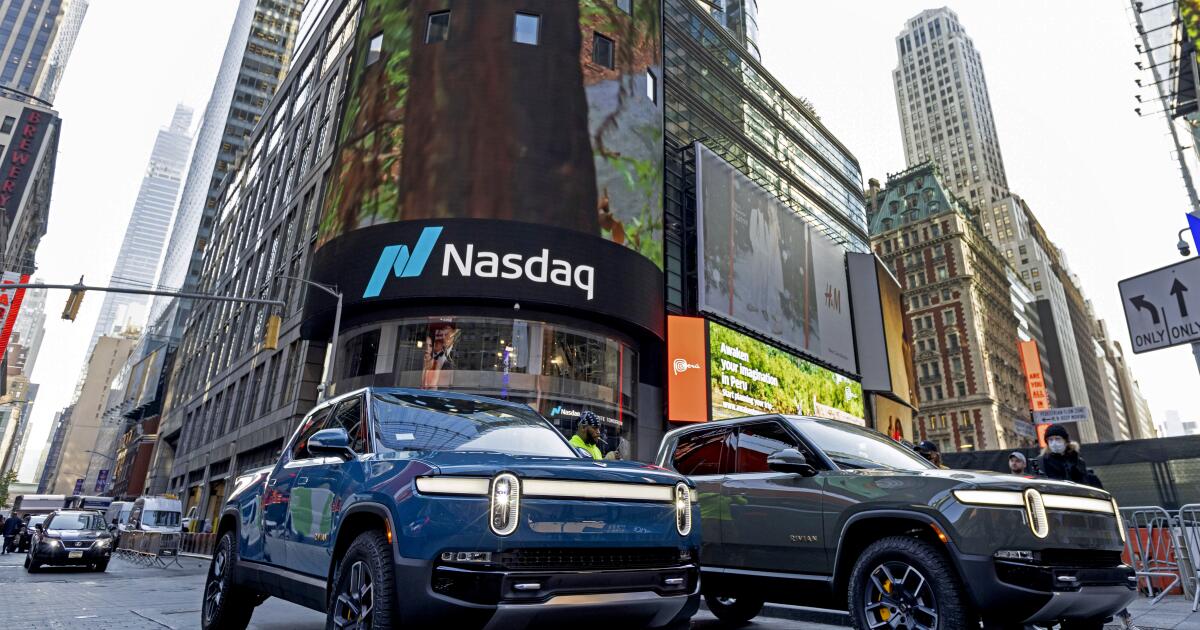
Electric vehicle maker Rivian saw its shares dip Friday after the Irvine-based company cut its production targets amid ongoing supply issues.
Citing a shortage of a component used to build its electric pickups, sport utility vehicles and vans, Rivian said production could drop as much as 18% this year at its lone U.S. assembly plant.
Rivian did not specify the part that is in low supply but noted that the shortage has become more acute in recent weeks.
The company now forecasts its full-year production will be between 47,000 and 49,000 vehicles, down from an earlier estimate of 57,000. During the most recent quarter, Rivian produced 13,157 vehicles and delivered 10,018, falling short of analysts’ expectations.
Shares of Rivian ended the day at $10.44, down 3.2%. The company’s stock has been battered since the start of the year, falling by more than 50% amid underwhelming financial reports. In the second quarter this year, Rivian posted a net loss of $1.46 billion compared with a loss of about $1.12 billion during the same period a year earlier. The company is scheduled to announce its third-quarter earnings next month.
Rivian received a lifeline in June when Volkswagen agreed to a massive investment in the company that is expected to total $5 billion. Rivan has nonetheless continued to struggle in the face of dropping demand for electric vehicles and other supply chain issues that forced the company to pause its production of commercial vans for Amazon.com in August.
Early this year, the automaker announced a 10% cut in its workforce that sent stocks plummeting 25% in one day. The pool of interested wealthy buyers who don’t already own an electric vehicle is shrinking, analysts said, while the broader market weighs the advantages and feasibility of switching to electric.
The average car buyer is not likely to be able to afford a Rivian vehicle, and concerns remain about charging infrastructure and the distance vehicles can drive on a single charge. Rivian’s R1T electric pickup truck starts at around $70,000; its R1S SUV starts at nearly $75,000.
With sleek design and outdoorsy features, Rivian’s vehicles garnered much attention from analysts and attracted investors such as Amazon and Volkswagen. The company exceeded expectations during its initial public offering of stock in 2021, ending its first day of trading valued at nearly $88 billion.
The production issues announced this week could get in the way of Rivian’s goal of achieving positive gross profits by the fourth quarter of this year. According to analysts, the company’s gross margins are expected to remain in negative territory in the final three months of 2024.




Walt Disney Co. and Pixar’s “Hoppers” took the box office crown this weekend in an encouraging sign for the company’s original animated films.
The film generated $46 million in ticket sales in the U.S. and Canada, marking the highest domestic opening for an original animated movie since 2017’s “Coco,” according to studio estimates. The global box office total for “Hoppers” was $88 million.
The zany movie features a young environmental advocate who “hops” her consciousness into a robotic beaver and bands together with other woodland creatures to stop a planned freeway expansion through a glade.
The film is directed by Daniel Chong, who created the Cartoon Network animated series “We Bare Bears.”
The muscular debut for “Hoppers,” as well as the strong performance from Sony Pictures Animation’s “Goat” last month, has been a positive sign for audience interest in original animated films.
Since the pandemic, theatrical returns for animated sequels have far surpassed that of original films. Disney’s “Zootopia 2,” for instance, has grossed more than $1.8 billion in global box office revenue, with more than $426 million domestically. Disney and Pixar’s 2024 hit “Inside Out 2” also crossed more than $1.6 billion globally.
By contrast, Disney and Pixar’s 2025 original film “Elio” brought in about $154 million in worldwide box office revenue.
Original films are vital to Pixar’s future, as the Emeryville, Calif.-based studio built its reputation on its string of nearly uninterrupted original blockbuster hits, including 1995’s “Toy Story” and 2004’s “The Incredibles.”
Paramount Pictures and Spyglass Media Group’s “Scream 7” came in second at the box office with $17.3 million in its second weekend in theaters. Warner Bros. Pictures’ “The Bride!,” Sony’s “Goat” and Warner Bros.’ “Wuthering Heights” rounded out the top five at the box office, according to data from Comscore.
With several strong releases, as well as popular holdover films from 2025 that continue to bring in revenue, the first few months at the box office have been a notable improvement over last year’s dismal first quarter.
Domestic box office revenue so far is up more than 12% compared with the same time period in 2025, according to Comscore.
Business
Hundreds of applications, no jobs and AI competition: California’s brutal tech work landscape

Laid-off tech worker Joseph Tinner has spent almost a year hunting for a job. It has been a depressing crash course on the sea change in Silicon Valley.
The former product instructor from the San Francisco Bay Area has ridden the tech wave throughout his career, easily jumping from Verizon to Fitbit to Workday. Since losing his job early last year, the 59-year-old has hit a wall.
He applied for hundreds of roles — sometimes going through multiple rounds of consideration — only to get rejected again and again.
“It’s been a roller coaster,” he said. “It just takes a lot of resilience, honestly, to be in this job market.”
He isn’t alone.
Tech companies that aggressively hired during the COVID-19 pandemic have been slashing tens of thousands of jobs. For workers like Tinner, it has been a rough realization that the Silicon Valley shakeout is stretching into another year.
Just last week, Block — the financial tech company that owns payment services Square, Cash App and Afterpay — said it is laying off 4,000 people, or half of its workforce.
Many other tech companies outside the hot artificial intelligence sector are slashing staff. Block blamed AI, saying the powerful technology means it no longer needs as many people.
“The intelligence tools we’re creating and using, paired with smaller and flatter teams, are enabling a new way of working which fundamentally changes what it means to build and run a company,” Jack Dorsey, the co-founder of Block and a founder of Twitter, said in a post on X.
U.S.-based tech employers announced more than 33,000 job cuts from January to February, up 51% compared with the same period last year, the outplacement firm Challenger, Gray & Christmas said Thursday.
Andy Challenger, workplace expert and chief revenue officer for the firm, said he used to be skeptical that companies could replace workers with AI, but he’s starting to become convinced.
“Artificial intelligence has overtaken the attention of these companies in such a dramatic way,” he said.
Mass layoffs in the tech industry started in 2022, after a hiring surge during the pandemic, when demand for online services increased as people were stuck at home.
But many of the world’s most powerful tech companies have continued cutting, even as their profits have grown. They’ve cited various reasons for layoffs, from strategic shifts and restructuring to pivoting to smaller teams and fewer managers.
An advertisement promoting an AI-powered company is seen downtown on Thursday, Oct. 16, 2025 in San Francisco, CA.
(Manuel Orbegozo/For The Times)
Tech companies such as EBay, Meta, Google, Autodesk, Pinterest, Salesforce and others have been shrinking their workforces. Layoffs have also hit the media and entertainment companies, including Los Angeles video game developer Riot Games.
On LinkedIn, laid-off workers who have been out of work — some for more than two years — have been asking for help finding a job. They’ve been sharing stories about their financial and emotional struggles, including losing their confidence, homes and savings as they search for work.
Tech workers who have seen their employers grow over the last decade have noticed a shift in corporate culture. Workers who have been laid off before said it has been tougher and taken longer to land a new job than in previous years.
A longtime Salesforce employee, who was recently laid off and asked to remain anonymous, concerned that speaking to the media could affect their severance, said the sales software company used to be more focused on helping its employees. Salesforce broadcast this value by highlighting its “ohana,” culture, using the Hawaiian word for family.
“I was just incredibly grateful every day to be able to wake up and make a positive change in the world,” the worker said. “I thought that the company was devoted to the same thing.”
But the tone at Salesforce shifted in 2023 as the company faced pressure to cut costs and increase profits. New leaders came in, and the focus changed.
“The company is trying to erase any semblance of the way that it used to be,” the worker said.
Salesforce has said AI is helping it squeeze more profit from fewer people.
“AI is doing 30% to 50% of the work at Salesforce now,” the company’s co-founder and Chief Executive Marc Benioff told Bloomberg.
Salesforce didn’t respond to a request for comment.

Marc Benioff, CEO of Salesforce Inc., during a Bloomberg Television interview at the World Economic Forum in Davos,
(Bloomberg/Bloomberg via Getty Images)
Although technology is changing the way people work, experts and even some AI executives think companies sometime use AI as an excuse to cut workers in what’s referred to as “AI washing.”
Enrico Moretti, a professor of economics at UC Berkeley, said other factors besides AI are fueling layoffs. As a company grows larger and matures, it doesn’t hire as much as before.
“It’s a shift in their position and the maturing of their product, and therefore the technologies and their employment needs,” he said.
Roger Lee, an entrepreneur who created a website to track layoffs, Layoffs.fyi, in 2020, said in an email that tech companies are pouring billions of dollars into AI investments, and cutting headcount helps offset those costs.
When he started tracking layoffs six years ago, Lee wanted to create awareness around tech layoffs and help laid-off workers find their next job. He never anticipated the layoffs would continue today.
“I do think 6 years of persistent layoffs have led many tech workers to re-evaluate the perceived ‘safety’ of tech jobs and their relationship with the industry overall,” he said in an email.
According to Layoffs.fyi’s latest count, there have been more than 35,000 layoffs in the tech sector worldwide so far this year.
Close to half of that total is from Amazon alone.
Unemployed tech worker Tinner was laid off from Workday, a Pleasanton company that provides a platform to businesses, universities and organizations to manage payroll, benefits, finances and other tasks.
In 2025, Workday slashed roughly 1,750 jobs, or 8.5% of its global workforce, citing a prioritization of investments in artificial intelligence and platform development. Then in February, the company said it plans to cut 2% of its workforce, or roughly 400 employees.
As job cuts pile up, Tinner is up against intense competition in a job market flooded with talent from the top companies in tech.
As he ponders his next career steps, he’s also redefining his identity and relationship with work.
He’s even tried pouring beer for fun or thought about doing more artwork.
“Maybe what I need to do is just celebrate all I’ve done instead of getting back into this rat race, on this treadmill, and look for something totally different,” he said.

A brokered deal with regulators and consumer advocates will allow State Farm General to keep controversial increases in home insurance rates that took effect last year in the wake of the devastating Los Angeles wildfires.
The agreement sent to a judge late Friday cements a $530-million emergency hike in home insurance rates Insurance Commissioner Ricardo Lara negotiated with the insurer last summer.
“The agreement will provide financial relief to many policyholders while ensuring continued coverage for State Farm policyholders while California’s insurance market stabilizes,” the insurance department said in a news release.
State Farm argued the emergency hike was necessary because catastrophic fire losses jeopardized its financial ratings.
The company has reported that it paid out $6.2 billion in claims last year, largely from the wildfires, with most of the costs covered through reinsurance payments. The company has told regulators it anticipates to pay an additional $1 billion in claims.
The deal allows the insurer to keep an average 17% increase in homeowner rates. Local rates for many of the company’s 1 million home customers were much higher.
However, consumer advocates argued the agreement held the line on even higher increases and halted further policy cancellations that have deepened a crisis in the state’s insurance industry.
State Farm, California’s largest home insurer, froze new business in 2023, announced 72,000 mass non-renewals, and sought a series of rate hikes. Its average homeowners premium in California doubled from 2020 to 2024.
Under Friday’s agreement, State Farm agrees to forgo mass non-renewals in 2026 and undergo further review of its rates by 2027.
Additionally, State Farm will be required to return nearly two-thirds of its 15% increase to condominium owners, deliver a small refund to rental property owners and be able to raise premiums for renters a half a percent.
“This rate enables State Farm General to continue serving existing California customers,” the company said in a statement. “We will continue to monitor our capacity to support the risks we insure and maintain the financial strength needed to pay claims and support customers and communities when it matters most.”
If approved by an administrative law judge, the settlement will be forwarded to Lara, who is expected to back it.
The arrangement sidesteps efforts to tie State Farm’s rates to its handling of disaster claims.
Under pressure from community advocates and lawmakers, Lara in May had said he wanted the two issues evaluated together.
In June, Lara announced his department would conduct an “expedited” examination into State Farm’s market conduct. In rate hearing proceedings, agency staff sought to block discussion of State Farm’s claims handling in relation to its quest for premium hikes.
The pact does not directly address complaints of unhappy policyholders who say Lara’s administration has failed to hold State Farm accountable, which the insurance department has disputed.
A department spokesman said Lara would not comment on the matter while the rate settlement is before an administrative judge.
The Jan. 7, 2025, firestorm destroyed at least 16,000 homes, triggering more than 42,000 insurance claims. State Farm has said it has 13,500 fire and auto claims related to the fires.
The insurer has come under heavy criticism from fire victims over its handling of claims, including complaints of low payout offers, denials for toxin testing and delays in payments for living expenses. The company has declined to comment on the complaints.
Some 51,000 State Farm homeowners live in disaster areas struggling to recover from the L.A. firestorm. Regulatory filings show those areas among the hardest hit by the current hikes.
Malibu resident Chad Peters said his bill from State Farm increased 140% in the last year, from $3,500 to $8,400.
Peters said he has battled State Farm for 14 months over smoke and fire damage to his home from the Palisades fire, and that the insurer at one point attempted to cancel his coverage because the house remained unrepaired.
He called rate increases in such circumstances “ludicrous, while they’re giving everyone such a hard time with their insurance … I mean, mine has been a steep uphill battle all year long.”
Sen. Sasha Renée Pérez (D-Alhambra) had urged Lara to delay hikes until after the investigation into State Farm’s conduct.
“The fact that I have so many individuals who have not received any of their claims, that are still navigating denials and delays, who are actively running out of [living expense payments] and … facing housing insecurity — it makes me deeply concerned,” Pérez said.
Pérez, along with Sens. Ben Allen (D-Pacific Palisades) and Sade Elhawary (D-Los Angeles), in April pressed Lara to defer rate hikes until State Farm General’s claims practices could be investigated. “This was a big priority for us.”
Pérez said she would seek answers to the market conduct exam as part of a Senate inquiry into the insurance department’s handling of those complaints, along with scrutiny of the department’s discipline of a compliance officer who criticized State Farm’s handling of claims.
State Farm General, an offshoot of national insurance giant State Farm Mutual, contends it has been financially sinking as seasonal wildfires morph into catastrophic urban conflagrations that destroy towns.
In mid-2024, the company asked to raise home premiums by nearly $1 billion. Lara secured an agreement that State Farm Mutual lend its California affiliate $400 million, but the insurer would not agree to cancel plans for dropping 11,000 more policyholders.
The settlement allows State Farm to avoid a public hearing that would have forced the disclosure of solvency records, mass non-renewals and other information it said would help competitors.

Our leaders look to the past, but it's not a pretty picture

How should cities use AI? This Atlanta suburb may hold the answer.

Hawaii Keeps Adding Fees And Rules. This Park Is Still Free.

Big Ten tournament preview: An Illinois-Michigan rematch Saturday at the UC would be huge

Looking ahead: Five takeaways on high school basketball regional matchups

Florida High School Football Rankings: Top 25 teams – Oct. 21

How old is Bo Nix? What to know about Oregon quarterback ahead of 2024 NFL Draft

Cleary's 21 help Le Moyne down Central Connecticut State 69-64 in OT

99th annual Pony Swim held in Virginia

Indiana Members Credit Union announced as new anchor tenant at Bottleworks District

Video: Airports Struggle to Staff T.S.A. During Partial Government Shutdown

Before-and-after satellite imagery offers a rare look at damage inside Iran
Hungary's opposition leader Péter Magyar calls on Russia to refrain from election interference

Video appears to show U.S. cruise missile striking Iranian school compound

Trump vows block on signing new laws until SAVE America Act passes Senate
-

 Wisconsin1 week ago
Setting sail on iceboats across a frozen lake in Wisconsin
-

 Massachusetts6 days ago
Massachusetts man awaits word from family in Iran after attacks
-

 Maryland1 week ago
AM showers Sunday in Maryland
-

 Florida1 week ago
Florida man rescued after being stuck in shoulder-deep mud for days
-

 Pennsylvania4 days ago
Pa. man found guilty of raping teen girl who he took to Mexico
-

 Oregon1 week ago
2026 OSAA Oregon Wrestling State Championship Results And Brackets – FloWrestling
-

 News1 week ago
2 Survivors Describe the Terror and Tragedy of the Tahoe Avalanche
-

 Sports4 days ago
Keith Olbermann under fire for calling Lou Holtz a ‘scumbag’ after legendary coach’s death