Business
Restaurant workers wanted to unionize at this L.A. hotel. Now the restaurants are closing

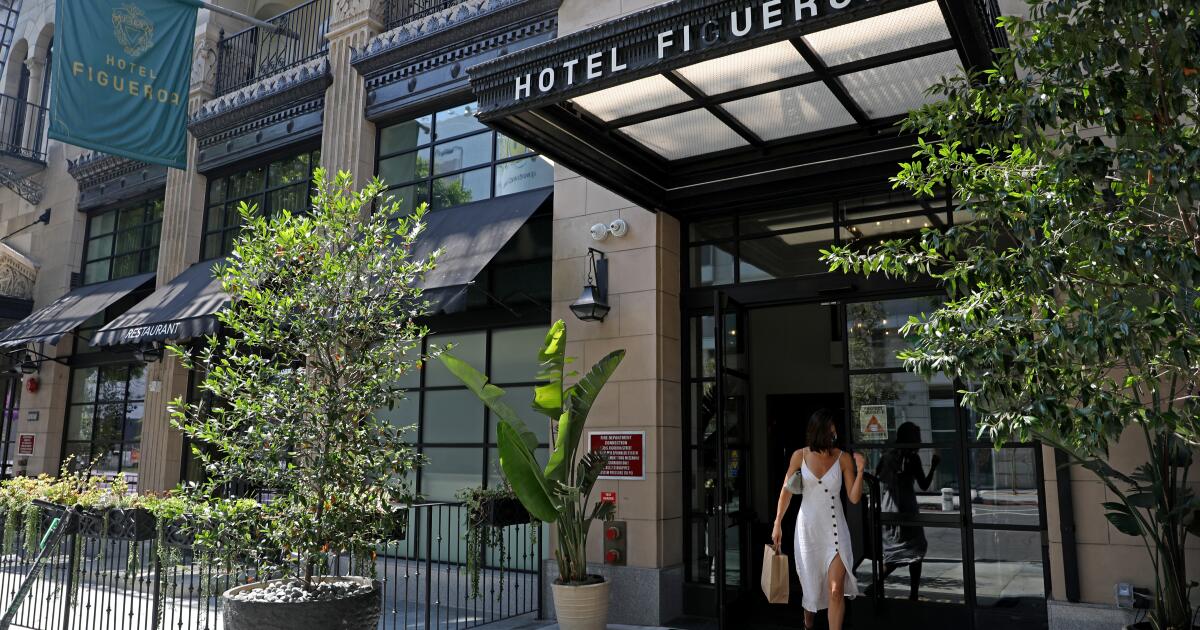
Eight days after restaurant workers at a hip downtown hotel filed cards to organize a union, the hotel’s food operator declared it would shutter the dining establishments that employed them, the latest in a string of showdowns and confrontations between workers and employers in L.A. area restaurants.
The case is playing out at the Hotel Figueroa in downtown, home of Sparrow Italia, Cafe Fig, Bar Magnolia, the Cafeteria and La Casita at Driftwood. The historic building has for the last two decades built a following for its Mediterranean-inspired space and stylish dining rooms, but behind closed doors, tension has loomed between the third-party management company behind the restaurants, called Noble 33, and the estimated 100 food and beverage workers who run them.
Discontent between Noble 33 and its employees at Hotel Figueroa started soon after the hospitality group took over food and beverage operations for the hotel in 2021, according to workers and union organizers who spoke with The Times.
Workers said they were forced to take on multiple tasks without more pay as their colleagues left and management failed to back-fill positions.
Some food and beverage workers, many who worked alongside the unionized hospitality workers employed by Hotel Figueroa, started to agitate to also form a union and gain similar rights.
On Dec. 8, food and beverage workers who worked for Noble 33 notified their management that they intended to form a union, and submitted cards to do so.
Six days later, Noble 33 emailed its food workers, announcing that it would permanently shutter the restaurants by mid-February and lay off its food and beverage staff before then, according to a letter sent to employees on Dec. 14.
In response, restaurant and bar workers employed by Noble 33 at Hotel Figueroa filed a complaint in January with federal labor regulators, accusing hotel management of trying to suppress labor organizing among its food and beverage staff.
Unite Here Local 11, which represents the hotel workers at Hotel Figueroa, filed the complaint with the National Labor Relations Board on behalf of the food workers at Sparrow Italia, Cafe Fig, Bar Magnolia, the Cafeteria and La Casita at Driftwood.
Management company Noble 33 said it would close all the restaurants adjoining the lobby, seen above, at the Hotel Figueroa.
(Gary Coronado / Los Angeles Times)
The closing of the restaurants would leave large wells of unused space on the hotel’s ground floor.
Restaurants and two bars take up most of Hotel Figueroa’s bottom floor. The hotel’s front patio serves as outdoor dining space for Cafe Fig, a popular all-day Mediterranean restaurant featuring dishes like cauliflower bites, tuna tartar tostadas and truffle fries. Hanging vine chandeliers decorate the indoor dining room, which is attached to Bar Magnolia, a well-stocked watering hole for hotel guests and diners who want to sip on a libation.
Walk a few steps toward the the courtyard, past an arched entryway and there’s Sparrow Italia, which serves coastal Italian dishes and cocktails in an indoor-meets-outdoor dining room and bar that opens up to the hotel’s iconic coffin-shaped pool. La Casita at Driftwood offers food and drink service poolside when open for the summer season.
It’s unclear what operations if any would replace the dining spaces at the Hotel Figueroa, a Spanish Colonial hotel at Figueroa and 9th streets in downtown L.A.
“We are still evaluating all options concerning future food and beverage offerings at Hotel Figueroa,” a spokeswoman said Monday in a prepared statement.
Some of the workers said they were devastated by the move, which came right before the Christmas holiday.
Leobardo Perez, a 45-year-old dishwasher at Cafe Fig, said he decided to organize after two other dishwashers left and management made him take on their work instead of hiring new dishwashers. Perez, who has worked at the restaurant for two years, said he was also forced to do other jobs, such as prep or pastry work without additional pay.
“All we want is for our rights to be respected in the workplace,” Perez said. “It’s unjust for them to close down the restaurants because we just want to organize.”
The towering building of Hotel Figueroa. A spokeswoman for the hotel said that the notice to terminate food staff did not come from hotel management or ownership.
(Ricardo DeAratanha / Los Angeles Times)
Third-party manager disputes hotel’s claim
A spokesperson for Noble 33 said the third-party vendor had no option but to close.
Noble 33 contends that its contract with Hotel Figueroa stipulates that the unionization of food and beverage employees would trigger a kill clause between both parties. “It would be a breach of the hotel’s current unionization agreement with the union,” a Noble 33 spokesperson said in a written statement.
Hotel Figueroa and Unite Here Local 11 deny this claim.
A spokeswoman with Hotel Figueroa said notice to terminate the food staff “was not prompted by hotel management nor hotel ownership.”
She said the layoffs were initiated by Noble 33, which issued the notices without first discussing it with hotel ownership, management or employees.
“It is also important to note that our agreement specifically stipulates that Noble 33 will never be requested or authorized to engage in unfair labor practices,” Hotel Figueroa said in a written statement.
Unite Here Local 11 called Noble 33’s claim “absurd.”
“It is absolutely disgusting that a company would sign a contract promising to kill its operations simply because its employees exercise their federal right to organize a union,” said Kurt Petersen, co-president of Unite Here Local 11.
Food workers across the region have been struggling with owners and employers in an industry shaken last year by brutal financial realities and allegations of mismanagement and abuse. At least 65 notable closures of restaurants affected the dining scene in 2023.
The closures continued into the new year. On Jan 1, Sweet Lady Jane — famous for its triple berry cake — announced it had shuttered all six of its Los Angeles locations.
At the same time, discontent between food and beverage workers and employers continues to grow.
In June, former servers at Jon & Vinny’s, a hip Italian American restaurant, filed a class-action lawsuit in Los Angeles Superior Court against the restaurants’ owners, Jon Shook and Vinny Dotolo. The lawsuit against Joint Venture Restaurant Group Inc., which owns Jon & Vinny’s, claimed that the company denied servers tips, resulting in a reduction of take-home pay due to diner confusion regarding an 18% service fee.
In September, hostesses at Nobu in Malibu filed separate lawsuits against the popular restaurant, alleging sexual assault, sexual harassment and discrimination.
In December, the National Labor Relations Board announced that it was looking to force Starbucks to immediately reopen 23 stores that workers allege were shut two years ago in a move that was allegedly done to suppress union organizing. Six of those locations were closed in the Los Angeles area.
Edith Reyes, a line cook at Cafe Fig, said she felt compelled to organize because of what she described as unfair treatment on the part of managers.
Reyes, a single mom who has worked at the restaurant for about three years, said managers ignored multiple requests for a few weekends off to spend with her daughters.
At the same time, she said newer workers were granted weekends off.
“It’s unfair. I’m the only parent my daughters have,” she said of her teenage daughters. “They depend on me. I need to be there for them and I need to provide for them.”
She was given a few hours short of full-time and didn’t qualify for vacation or sick time off, she said.
On Jan. 20, Hotel Figueroa hotel workers took to the picket line for a few days for the first time this year. The move was the latest in a series of intermittent strikes and a larger summer strike that launched in July when hundreds of hospitality workers at hotels across Southern California took to the streets in protest.
Unite Here Local 11 represents the hospitality workers and reached tentative agreements with about two dozen hotels, out of some 60 properties in Los Angeles and Orange counties initially targeted by strikes that started last summer.



Dear Mr. Pelley:
I meant what I said in my letter last week to the 60 Minutes team: joining 60 Minutes is the honor of my career and I am grateful to be working alongside the people who have contributed to the most important television journalism brand this country has ever produced. While I’m new to 60 Minutes, I’ve devoted my career to investigative journalism and storytelling. I started this job excited to collaborate and to benefit from the wisdom and experience of the 60 Minutes veterans, with you among them. For that reason, one of the first things I did in my new role was call you to talk and invite you to dinner. It is a profound disappointment that you rejected that overture and chose ambush instead. Yesterday, you hijacked my first meeting with staff to disparage me, my qualifications, and my intentions with remarkable incivility and contempt. I welcome a diversity of viewpoints and respectful debate among the team, but this was nothing of the sort. Yesterday’s performative display of hostility enacted in front of the staff instead of in a civil, private conversation-demonstrated that you have no interest in contributing to the future success of the show, or approaching my new tenure with a mind open to collaboration and progress. I am here to deliver first-in-class news programming, not to make headlines about newsroom drama. I am eager to work alongside those who share this goal.
Despite yesterday’s misconduct, I had hoped that in sitting down with you today we could find a path forward together. You made clear that you are not interested in such a path.
Your antipathy to the future of the show has come through loud and clear. And I have heard you. I therefore write on behalf of CBS News, Inc. (“CBS”) to inform you that your employment with CBS is terminated for cause effective immediately. Enclosed is your formal termination letter.
Sincerely,
Nick Bilton
Executive Producer, 60 Minutes

The co-founder of Aspiration, Joseph Sanberg, was sentenced to 14 years in prison on Monday after defrauding investors and lenders of over $248 million.
The startup, an eco-friendly digital banking company boasting fossil fuel-free investments, carbon offsets for gas purchases, and a debit card with cash-back benefits for shopping at clean companies, was founded by Sanberg and Andrei Cherny. Cherny left the company in 2022 and has not been charged.
Sanberg, an Orange County native, pleaded guilty to wire fraud in October after being arrested in March last year. Aspiration subsequently filed for bankruptcy and liquidated all of its assets by July.
Sanberg and venture capitalist Ibrahim AlHusseini, who also faces charges, together forged a series of bank statements in order to obtain loans. From 2020 to 2021, the pair forged AlHusseini’s bank statements to show millions of dollars in assets in order to obtain millions of dollars from lenders.
Additionally, they forged a letter from their audit committee stating that $250 million in funds were available, when in reality Aspiration had less than $1 million. The amount of loans defrauded exceeded $248 million.
In 2021, Sanberg artificially inflated Aspiration’s 2021 revenue by $44 million by recruiting 27 fake customers to sign letters of intent pledging tens of thousands of dollars per month for tree planting services. Sanberg himself funded the contracts and used the inflated revenue numbers to obtain more loans.
The charges sparked an NBA investigation into salary cap allegations due to Aspiration’s connections with Clippers owner Steve Ballmer.
Ballmer personally invested $60 million in Aspiration, all of which was lost. He is now the target of a civil lawsuit alleging his participation in the scheme. Ballmer denies the allegations.
The team announced a $300-million sponsorship deal with Aspiration, and Clippers player Kawhi Leonard signed a four-year, $28-million marketing contract with the company, which reportedly performed no duties. The issue has raised concerns about how players are circumventing the NBA’s salary cap.
The team lost the $300-million sponsorship deal and an additional $20 million paid for carbon offset purchases.
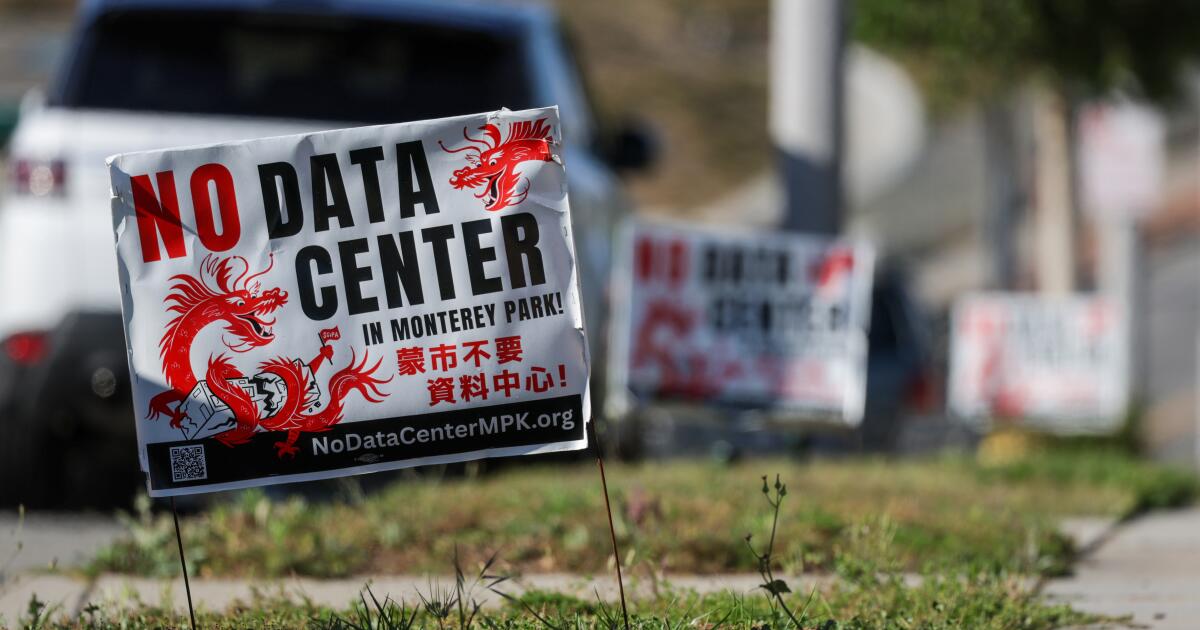
Residents in the city of Monterey Park will be the first in the nation to vote on a permanent ban on data centers Tuesday.
If approved, Measure NDC would prohibit data centers within the city limits and could only be overturned by another vote.
Yard signs saying “No Data Center” in English and Chinese with images of dragons line sidewalks in the San Gabriel Valley city.
As a wave of data center opposition sweeps the country, numerous towns and counties across the U.S. have instituted temporary moratoria and other restrictions on the facilities. But only a handful have instituted indefinite bans, and just four other towns have sent related matters to the ballot.
Supporters are hoping the vote will set a precedent for the rest of the region, where residents are fighting proposals in Vernon and City of Industry.
“This is about as permanent a ban as we can get,” said Steven Kung, co-founder of the group No Data Center Monterey Park. “Winning Measure NDC would send a huge message to the rest of the San Gabriel Valley about how residents don’t want data centers.”
The ballot measure emerged from the fight against a 247,000-square-foot center proposed in 2024 by the Australian-owned investment firm HMC StratCap for a residential area in Monterey Park.
The facility would have sat less than 500 feet away from the nearest home and used three times the electricity of the 60,000-person, predominantly Asian American city.
While the developer touted the potential for jobs and tax revenue, residents expressed concerns about noise and air pollution, rising electricity rates and a potential to lower property values.
The company pulled its plans in late March following public outcry and a March 4 city council vote to extend a temporary data center moratorium and place a ban on Tuesday’s ballot.
In a letter to the city council, HMC StratCap said it would pursue a different use for the land and would not engage in a ballot measure fight.
The city council later banned data centers indefinitely, the first in California to do so, said Mayor Elizabeth Yang. But she’s still been out campaigning for the measure with all four other council members.
“If a council puts in an ordinance, a future council can reverse it too,” said Yang. “With the ballot measure, unbanning it is a lot harder because you need the entire city to vote on it.”
The measure proposes the ban “to protect air quality, drinking water resources, and public health” and “prevent impacts to electricity and water rates.”
While California places third in the country for existing data centers with about 300 facilities, it hasn’t been a hot spot in the recent AI-driven data center boom. High electricity rates, expensive land and regulatory hurdles mean that fewer, and smaller, facilities are currently planned than in Virginia, Texas, Georgia, Illinois or Arizona.
“Most of California’s data centers are small by today’s standards,” said Shaolei Ren, an engineering professor at UC Riverside who studies how to reduce the environmental impacts of data centers. “Ten years ago, they would be medium-sized, but the power demand for new AI data centers has increased a lot.”
The average operating data center demands 45 megawatts, according to the Washington Post, while the average planned one would draw 430 MW. The one proposed for Monterey Park would have required about 50 MW at peak demand.
As proposals crop up in SoCal, they’re met with fierce opposition. Montebello, El Monte and Baldwin Park have all enacted temporary moratoria, and Alhambra recently banned data centers as part of a zoning code update. City of Industry, Vernon, City of Commerce and Santa Fe Springs are moving in the other direction, trying to court developers and streamline data center approvals. Community groups are fighting that.
Outside the San Gabriel Valley, residents of Coachella and Imperial County are showing up in droves to protest local proposals.
Matthew Shaw, a volunteer with the Coalition for Responsible Data Center Development, who recently published a report on opposition to AI data centers, said a vote to ban them in Monterey Park “would lead to copycats, partially because so many groups are just opposed to any data center development at all.”
While there is no formal opposition to Measure NDC, some building trades like Ironworker Local 433 supported the Monterey Park data center when it was still live before city council. Those in the data center industry are lamenting the state of public opinion.
“These are multi-billion-dollar assets that are built by multi-trillion-dollar companies. These things will get done,” said Mehdi Paryavi, chairman of the International Data Center Authority. “My biggest problem is that our industry does not invest enough in community engagement.”
Paryavi said towns that seek to limit data centers are missing out on thousands of jobs generated by data center construction, operations and customers, as well as faster artificial intelligence speeds and better performance.
Kung said local community organizers are “looking at the empirical evidence” and seeing a ban as a win.
“We’ve never seen a city that embraces a data center and is like, ‘Look how our quality of life has increased, look how all the revenue has gone into citywide improvements,’” he said. “That just doesn’t exist.”
-

 Arkansas5 minutes ago
Arkansas driver’s licenses and state IDs now available in Apple Wallet
-

 California12 minutes ago
California’s race for governor and other key primaries remain unsettled as vote count continues
-

 Colorado15 minutes ago
Colorado community reels after police say driver with revoked license hits three pedestrians, killing one
-

 Connecticut19 minutes ago
Night forecast for June 2
-

 Delaware27 minutes ago
Thomas Jefferson University to run Delaware’s first medical school
-

 Florida30 minutes ago
Man accused of kidnapping woman at Wawa in Central Florida
-

 Georgia35 minutes ago
5 things to know about Georgia mosquito problem amid heat, drought
-

 Hawaii42 minutes ago
Hawaii weather: USGS revised 4.6 magnitude earthquake off Kona coast, south swell, passing showers

