Business
Now bankrupt, MedMen owes millions to other companies. Meet the cannabis CEO who called them out

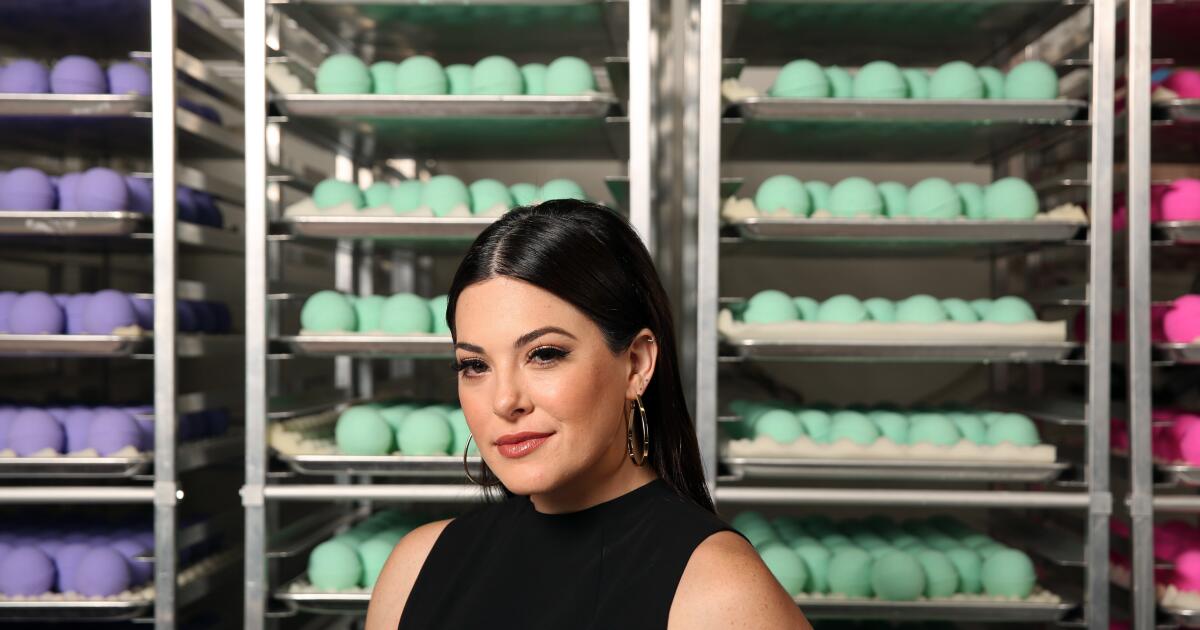
For a long time, Olivia Alexander defended MedMen.
Despite the pushback she got for partnering with the cannabis chain that some worried would box out smaller brands, Alexander — who founded Kush Queen, which sells cannabis-infused bath bombs and personal lubricant — valued the retailer’s dedication to stocking shelves with products from small, women-owned lines.
“Even though they’re a big company, they support small brands,” she recalled telling people. “They’re good for our industry.”
Now she thinks the opposite.
In March, the retailer that had been valued at more than $1.5 billion when it went public on the Canadian stock exchange six years ago was deep into a cataclysmic downfall. A few weeks later, the company filed for bankruptcy protection in Canada, disclosing it had more than $400 million in liabilities. In Los Angeles County, meanwhile, a Superior Court judge has appointed an attorney to oversee the liquidation of the company’s California subsidiary.
MedMen owes money to not only big legal, accounting and real estate firms, but also vendors such as Alexander who supplied the retailer with products that filled its shelves.
Fed up with what she said had become an open secret in the industry, Alexander fired off a LinkedIn post at the end of last year accusing MedMen of failing to pay a $1,560 invoice for merchandise she’d delivered to them. More than a 100 people commented, including several other entrepreneurs, who said the retail chain owed them money too — often thousands of dollars.
MedMen’s fall has highlighted larger systemic struggles producers such as Alexander face as they try to operate in California’s legal cannabis marketplace. The Times spoke with Alexander about MedMen and the cannabis industry at large. The interview has been edited for brevity and clarity.
Tell me a bit about your company. And how did you start working with MedMen?
I started Kush Queen in 2015. We make a little bit of everything, and we have been working with MedMen almost since the beginning. I really believed, along the way, that we were all part of what I wanted the industry to be, which is diverse and equitable and vibrant.
When did things start to go sour?
I moved to a new distribution company and they were like, “We can’t sell to MedMen. Everyone says they’re going under any minute now.” This was the summer of 2023. But I really thought what everyone else thought, which was that they were too big to fail. So I fought with my distribution partner to deliver these orders and then, of course, they stopped paying.
I went on LinkedIn and wrote the post. And I was inundated — and this is the part that breaks my heart — with messages from tons of brands saying, “Oh yeah, they owe me money.” My LinkedIn DMs are a graveyard of people owed money by MedMen.
MedMen was so afraid of me and the pettiness and my vitriol that they overnighted us a check. They did close out their measly $1,500 invoice with us and I truly believe I was the last person to get paid by them.
How long after your post did they send you a check?
Within two weeks. I posted a follow-up that said, “Look, I’ve been paid, but all these people haven’t.”
What can unpaid invoices mean, especially for smaller companies?
It means they go under or they have to lay people off. If people think it’s bad now, it’s just going to get worse. Everyone is surviving on debt. MedMen was paying a ton of freelance writers to turn out blogs and articles. These are the people that are the most tragic collateral damage of what’s happening.
Can you speak more broadly about the challenges of running a legal cannabis company in California right now?
Like, “How do I do it without crying?” Yeah, it’s tragic. It’s impossible for anyone to make enough money on legal cannabis right now. If I was operating only in the California market, I wouldn’t have enough money to pay my own bills. It’s a loser’s game. The taxes are insane, which is then causing everyone to go to the underground market. The state of California has failed us.
How would you sum up the current state of the industry in one word?
Apocalyptic.
Last month, the Department of Justice formally moved to reclassify marijuana into a category of less regulated substances, a step many in the industry hope could eventually make it easier for cannabis retailers.
Will rescheduling positively affect our industry? Maybe, we don’t know yet. But cannabis and California — there are no two things that go together better. This is our thing and we should be leaps and bounds ahead of every other market. But it’s just been decimated.


Netflix is going bite-sized. In a pivot toward the short-form content dominating TikTok and YouTube, the streaming giant announced it will start hosting three- to 20-minute videos from top digital publishers right on its homepage starting Aug. 3.
The streamer said U.S. customers will see “fan-favorite videos” from brands run by digital publishers, including BuzzFeed Studios, Condé Nast, Hearst Magazines, PMX (a subdivision of Penske Media), People Inc. and Tastemade. The videos will cover a variety of topics, including gardening tips, travel and celebrity profiles.
The rollout comes as Netflix competes for audience time from YouTube and social media platforms such as TikTok that have viral videos that can occupy users for hours. By bringing series such as BuzzFeed Celeb’s “30 Questions,” on which celebrities provide answers, or Vanity Fair’s “Lie Detector,” on which celebrities are hooked up to polygraph machines, Netflix users can learn more information about the people they already watch on the streamer, but in shorter videos.
“Members don’t just want to watch a show or film and move on. They want to keep exploring the stories and personalities they love long after the final credits roll,” said John Derderian, a Netflix vice president overseeing the initiative. “These partnerships help us deepen fandom and create more ways for members to carry those stories with them throughout their day.”
Netflix said it will offer licensed archival and ongoing series, including Harper’s Bazaar’s “Burning Questions,” Billboard’s “24 Hrs With” and People’s “My Life in Pictures” that provide an inside look at celebrities.
The videos from digital publishers will also be available to Netflix customers in Canada, the United Kingdom, Ireland, Australia and New Zealand on Aug. 3.
The Los Gatos, Calif., streamer over time has been expanding its library of content, adding games, live programming such as boxing matches and football games, alongside movies and TV shows.
Business
Commentary: While Trump declares that U.S. is enjoying ‘best economy ever,’ manufacturing jobs have been disappearing
Based on the words of President Trump, America is well on the way to becoming a “global superpower in manufacturing” — indeed, as he declared in a Father’s Day social media post, we are already experiencing the “BEST ECONOMY EVER.” (Capitalization’s his.)
Here’s what the government’s own statistics tell us: Manufacturing investment has crashed during his watch, with construction spending in the manufacturing sector down 26.4% from Trump’s inauguration through May, to $174.8 billion. That’s the lowest figure since February 2023, when the economy was in the midst of a post-pandemic recovery.
White House spokesman Kush Desai told me by email that “the last two jobs reports” showed manufacturing job growth. The Bureau of Labor Statistics reported a seasonally-adjusted decline of 2,000 manufacturing workers in May and a gain of 3,000 in June. But the June 2026 figure was 38,000 jobs, or about 0.3% below the level in June 2025, and 75,000 or about 0.6% below the level in January 2025, when Trump took office.
Desai said that “thanks to President Trump’s proven agenda of tariffs, deregulation, and tax cuts, American manufacturing will continue to rebound.”
There’s little mystery about what has come between Trump’s ambition and the real world. To a large extent it’s Trump’s economic program, particularly his tariff policies and, more recently, his war with Iran. Those have injected a level of uncertainty for corporate managements pondering whether to spend money on expansion that they haven’t had to confront in years.
From where we’re standing, we are not seeing signs of a manufacturing renaissance in the U.S.
— Didi Caldwell, Global Location Strategies
The tariffs and the war have driven up manufacturers’ costs for raw materials and overseas shipping. The general economic atmosphere doesn’t help. U.S. gross domestic product growth came in at a 2.1% annualized rate in the first quarter of this year, but the Federal Reserve Bank of Atlanta expects it to have fallen to 1.3% in the second quarter ended June 30.
Meanwhile, the University of Michigan consumer confidence index reached 44.8 in May, its lowest level ever (though it improved to 49.5 in June). Wages have been rising modestly, according to the Bureau of Labor Statistics, but those gains have been eaten up by higher prices, especially for gasoline and food.
To put things another way, the actual figures show the U.S. economy to be sputtering, and the “vibe economy” as measured by consumer confidence is doing even worse.
Now that Trump’s second term is about to reach its 18-month mark, let’s unpack the factors causing the discrepancy between his ambitions and claims, and the reality.
Trump declared economic victory just as his term was starting. On March 20, 2025, he proclaimed a “manufacturing renaissance” in the U.S. That was based on what he said were “trillions of dollars in new investments” he had “already secured in tech-based manufacturing.”
A White House statement said “the list of manufacturing wins is endless.” The provided list was a roster of announcements, not groundbreakings, much less completed ventures.
Business executives quite properly have taken these pledges with mounds of salt. “Announcements are what people say they’re going to do, but dollars spent is what’s actually happening,” Didi Caldwell, chief executive of a firm that helps companies find factory sites, told the Financial Times. “From where we’re standing, we are not seeing signs of a manufacturing renaissance in the U.S.”
Indeed, at least some of these announcements have had the flavor of performative efforts to satisfy Trump’s amour propre and extract government concessions.
For example, Apple Chief Executive Tim Cook appeared with Trump at the White House in August to announce a $600-billion U.S. spending plan to take place over four years. That was a $100-billion increase over its previously-announced program.
More to the point, however, it incorporated spending with suppliers that Apple had been working with for years. Mentioned in the news announcement was a commitment to buy cover glass for iPhones from Corning. But Corning has been supplying that glass since the first iPhone appeared in 2007. In any case, the announcement appeared to secure a commitment from Trump to exempt Apple from tariffs imposed on imported chips.
Apple’s announcement Wednesday that it will spend $30 billion to buy chips from Broadcom was similarly ambiguous. The announcement didn’t provide details about the terms of the commitment or the timing of its expenditures. I asked Apple for details and whether the deal was related to a desire to remain in Trump’s favor, but didn’t hear back.
A similar phenomenon occurred during Trump’s first term; Trump had built much of his 2016 presidential campaign on a promise to increase manufacturing jobs in the United States. He blamed shrinkage in the manufacturing sector on trade agreements such as NAFTA and the policies of the Chinese, and took credit when an American manufacturer agreed to create or save jobs in the United States.
As I reported in 2019, many of those arrangements turned out to be exaggerated or bogus, or predated Trump’s claim. Some disappeared as soon as public attention turned elsewhere, or were outweighed by job cuts made elsewhere by the same companies.
Trump’s tariffs appear to have had a direct effect on manufacturing employment in the U.S. Since Trump’s inauguration, the manufacturing sector has shed about 75,000 jobs, or 0.6%. After April 2, 2025, when he announced global “liberation day” tariffs supposedly as a response to years of unfair treatment of American exports, the decline picked up pace, with a shrinkage of 68,000 manufacturing jobs.
The Supreme Court invalidated those tariffs in February, but others are still in place, including tariffs on imported steel and aluminum and on goods from China. Nor has he ceased threatening partners with trade wars. As recently as Tuesday, he said he would cut off all trade with Spain because of that country’s disagreement with him over its defense spending and its criticism of his Iran war.
As it happens, Spain is one of the few countries with which the U.S. has a trade surplus. That means that any cutoff, which trade experts think will be unlikely, would come at a cost to the U.S.
One might have hoped that Trump had learned a lesson from his first-term trade war with China. That conflict provoked a sharp contraction in the manufacturing economy, with the Institute for Supply Management’s purchasing managers index falling to 49.1 by mid-2019. (A reading below 50 signifies contraction.)
The ISM index began to recover toward the end of Trump’s term but fell again during the pandemic. Lately it has been falling again, to 53.3 in June from 54 in May.
The Iran war is another deadweight on domestic manufacturing. That’s partially the consequence of blockages of the Strait of Hormuz, the crucial thoroughfare not only for middle eastern oil, but also for such industrial inputs as fertilizer and aluminum. Cement, concrete, olive oil and spices are also among commodities produced in the region that use the strait as an outlet to reach the outside world.
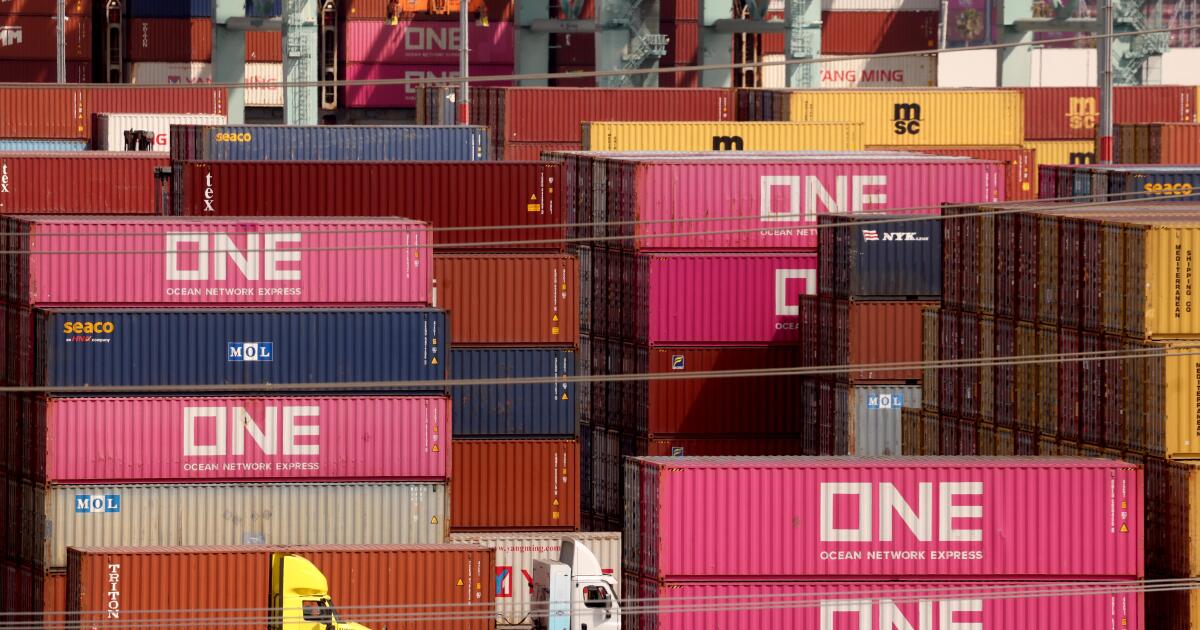
Uncertainties in the region, tensions between the U.S. and China, and heightened concerns over the safety of shipping overall have driven up shipping costs between the far east and the U.S. The price of shipping a benchmark 40-foot container from China to the West Coast has nearly quadrupled to $6,687 now from about $1,700 just before the Iran war began, according to an index maintained by the cargo firm Freightos — even though shipping prices typically decline during this time of year.
There can be little doubt that the U.S. would benefit from an industrial policy — if it’s coherent. China supplanted America as the world’s leading exporter of manufactured goods in 2010, and the gap has only widened since then. China’s dominance may be hard to reverse, as it’s built on lower labor costs and transport infrastructure that enjoys focused government investment.
Tariffs could be a component of a new industrial policy, but Trump’s tariffs aren’t rationally geared to protecting domestic industries that need protection. They’re expressions of his whims, and as such they’re totally ineffective. If there are government investment policies targeting industries that need assistance, they’re not apparent to economists or industrialists.
Trump can talk as much as he likes about a golden age for U.S. manufacturing, but from his first term through this one, it’s nothing but talk. And talk, of course, is cheap.

Walt Disney Co.’s “Moana” lost its way at the box office this weekend as the company’s latest live-action remake opened to a sluggish $43 million in the U.S. and Canada.
The domestic haul for “Moana” underperformed studio expectations, which ranged from $60 million to $65 million. Globally, the film brought in a total of $95 million on a production budget of about $250 million.
Despite its lackluster debut, the film still came in first at the box office during a weekend where it had few new competitors in the family film space.
The “Moana” franchise has been a box-office and streaming juggernaut. The original 2016 animated movie brought in more than $643 million worldwide and is the most-watched movie on Disney+, while a 2024 sequel grossed more than $1 billion at the global box office. On the merchandise side, more than 22 million “Moana”-themed toys have been sold. “Moana” also appears in the Disney theme parks.
But the theatrical reception for the live-action film may signal that audiences think there’s been too much “Moana” in just 10 years. (The 2024 film sequel was originally set to be a streaming series before it was moved to Disney’s theatrical calendar.)
Most of Disney’s previous live-action remakes have come decades after the original animated movie, such as 2025’s “Lilo & Stitch,” which arrived 23 years after its animated predecessor and grossed more than $1 billion in worldwide box office receipts.
The theatrical haul for the latest “Moana” may also have suffered from poor reviews — the film got a 34% on aggregator Rotten Tomatoes, with several critics highlighting its nearly frame-by-frame similarity to the original film. The audience score on Rotten Tomatoes, however, was 90%.
Still, as the last of this summer’s major family films, “Moana” could see a longer tail in theaters, particularly with many children still on break from school. Disney’s live-action “Mufasa: The Lion King” opened in 2024 to a middling $35 million, but ended up grossing more than $722 million globally through the holiday season.
Universal Pictures and Illumination’s “Minions & Monsters” came in second at the domestic box office this weekend with $20.5 million. Disney and Pixar’s “Toy Story 5” continued its strong run with an $18.5-million haul, enough for third place and contributing to a total global gross of $879.1 million.
Warner Bros.’ “Evil Dead Burn” ($13.7 million) and Angel Studios’ “Young Washington” ($6.4 million) rounded out the top five.
Also notable this weekend: Lionsgate’s musical biopic “Michael” crossed $1 billion in worldwide box office revenue, the first time that the studio has reached that milestone and the second film this year after “The Super Mario Galaxy Movie” to hit that mark.
-

 Hawaii2 minutes ago
Hilo woman killed in Kona traffic crash – West Hawaii Today
-

 Idaho8 minutes ago
Idaho Falls City Council delays vote on proposed alcohol ordinance – Local News 8
-

 Illinois14 minutes ago
2 teens arrested after 5 family members killed in Illinois shooting
-

 Indiana20 minutes ago
Indiana sets standards for schools to request four day week waivers
-

 Iowa26 minutes ago
Some Iowa originals to get the spotlight in RAGBRAI overnight town
-

 Kansas32 minutes ago
Newly released song depicts world visiting Kansas City for historic summer
-

 Kentucky38 minutes ago
Kentucky health officials investigating 100 reported cases of cyclosporiasis outbreak
-

 Louisiana44 minutes ago
Louisiana pastor Tony Spell ordered to stay 50 yards from alleged assault victim’s home as bodycam appears to shows him using slur

