Business
My Red Carpet Quest: A Two-Year Search for Steve


Times Insider explains who we are and what we do and delivers behind-the-scenes insights into how our journalism comes together.
Steve Olive was my white whale.
I had been trying for two years to write a profile of Mr. Olive, the co-founder of Event Carpet Pros, the California-based company responsible for custom-making the colorful, though not always red, carpets for thousands of movie premieres, the Golden Globes, the Grammy Awards, the Super Bowl and, since 1997, the Academy Awards.
I learned about Mr. Olive in 2023, while reporting an article about why the organizers of the Oscars were rolling out a champagne-colored carpet that year. My editor, Katie Van Syckle, and I had found the Event Carpet Pros website and we took turns calling the listed number in an effort to reach someone. Finally, Katie connected with Mr. Olive, and briefly interviewed him.
But this mysterious, matter-of-fact, low-key man at the heart of the glitz and glamour of awards season stuck in my mind. I wanted to know more about him. How does one become a rug guy? What had he wanted to be when he grew up? Had he ever attended an award show himself?
Last year, when the Oscars returned to a classic red carpet, Katie and I again agreed that I should pursue a story on Mr. Olive, but he was hesitant. But this year, with the encouragement of the Academy of Motion Picture Arts and Sciences, he agreed. It was three weeks before the ceremony.
Mission: Steve, as I termed it, had officially begun.
I sent a barrage of frantic texts and placed several calls to Brooke Blumberg, a publicist for the academy, trying to nail down when the carpet, which was manufactured at a mill in Dalton, Ga., would arrive at the company’s warehouse in La Mirada, Calif., a city in Los Angeles County.
My goal was to be there when the approximately 30 rolls, each weighing 630 pounds, were unloaded in the Event Carpet Pros parking lot, from a truck that had been driven about 35 hours, from Dalton. The scene, I imagined, would be akin to the arrival of the Rockefeller Center Christmas tree in New York City.
Despite my persistent overtures, Ms. Blumberg informed me that I had missed my chance. The truck had arrived at the warehouse the afternoon before I was planning to fly to Los Angeles.
“Oh darn!” I texted her. “We can hopefully get the install, though!” (The week before the ceremony, the 50,000-square-foot carpet is rolled into place by a crew of 20-some workers on Hollywood Boulevard.)
My next priority was meeting Mr. Olive at his office. But he had the flu, so I was told the interview might need to happen over a video call. Still, Katie and I thought I should go to California to capture the scene. And I wanted to meet his co-workers, as well as talk to the person who orders the red carpet for the Oscars from Mr. Olive each year.
When I finally made the decision to get on a plane, there was a chance that I might have neither the opportunity to talk to Mr. Olive in person nor to see the red carpet. But I bought a seat on a Wednesday afternoon flight and hoped for the best.
On my first day in La Mirada, I scouted out the Event Carpet Pros warehouse, a 36,000-square-foot white structure tucked among palm trees. Then, on Thursday night, I interviewed Joe Lewis, a producer for the Oscars who has ordered the awards show’s red carpet from Mr. Olive for the past 16 years.
On Friday morning, face mask on as a precaution, I visited Mr. Olive — now energetic, his bout with the flu evidently a distant memory — at his office inside the warehouse.
I’d had an idea of him in my head for two years, and I was curious to see if it matched the man. At 6-foot-2, bald and dressed entirely in black, he was somehow exactly as I’d imagined. He was, I learned, a former bodyguard for Mötley Crüe.
He had gotten into the red carpet business in 1992, with his brother-in-law, who installed tents around the country. I met Mr. Olive’s 26-year-old son, Nick, and his co-workers, all of whom told me the same thing: This is a man who doesn’t want, or need, the spotlight; he’s just happy making other people happy.
“I’m not good at this,” said Mr. Olive, as he awkwardly tried to follow the instructions of our photographer, Jennelle Fong, at what must have been his first-ever photo shoot, while standing on the Oscars red carpet.
A bit media shy, it took him some time to open up. And he was never really keen to discuss himself or his days as a bodyguard, for some of the hottest ’80s bands. “I’m not interesting,” he told me.
But I observed him becoming more comfortable as the talk turned to his lifeblood: carpets. He loved talking about his favorite collaborations over the years — all meticulously documented on the company’s Instagram account, which he created in 2013 — and sharing photos of his dog, Olive.
“You’ll make me look good, right?” he asked an hour and a half later, as we parted ways. I promised to send him a copy of the article after it was published.
Over the weekend, it was a frantic scramble to write my article. I wanted to capture not just Mr. Olive’s personality, but also the scope and scale of the modern “red carpet,” not just as a platform for fashion, but as a personal branding opportunity for celebrities. I wanted people to understand why what Mr. Olive was doing mattered.
I submitted my article on Monday morning; Ms. Fong photographed the installation of the red carpet on Hollywood Boulevard on Tuesday; and we had the story ready to go for Wednesday afternoon, when the carpet would be rolled out.
I didn’t get my Rockefeller Center Christmas tree arrival moment. But I witnessed something even better: One unassuming man, who neither wanted nor needed recognition, sharing his joy over his decades-long passion.



A landmarked downtown Los Angeles apartment building designed by famed Los Angeles architect John Parkinson is on the market as its owners face foreclosure.
Residences in the Metropolitan, a 10-story tower built in 1913, are nearly filled with tenants but its ground floor retail spaces on Broadway and 5th Street are unoccupied, as are other street-level stores in downtown’s Historic Core.
The historic building was once considered one of the best in the city and is owned by the Fallas family, which operated a chain of value-priced clothing stores based in Gardena including one called Fallas Paredes in the Metropolitan.
Fallas-Paredes at 449 S. Broadway, Los Angeles, CA 90013.
(Google Maps)
Around 2011, Michael Fallas, who once worked in family’s downtown store as a stock boy, converted the upstairs floors from offices to apartments while continuing to operate Fallas Paredes. The store closed more than five years ago in the wake of a 2018 filing by its parent company for Chapter 11 bankruptcy protection.
Earlier this month in state Superior Court, a special servicer representing Fallas’ lender asked for a judicial foreclosure of the property, alleging that Fallas had stopped making payments on a $32 million loan dating to 2017. After leasing the property for years, Fallas bought the building in the 1990s.
Fallas didn’t respond to requests for comment.
The location of the Metropolitan where the buildings stands was hailed in a Times story in 1912, saying “it is regarded by many realty men as the most valuable piece of real estate in Los Angeles.”
The building today is recognized as a city historic-cultural monument because “Broadway became the commercial center of the Southland, a title it retained until well after World War II,” with its development, the city said. One of the architects who designed the Metropolitan in the Beaux-Arts style was John Parkinson, who is credited with designing such well-known local structures as City Hall, the Los Angeles Memorial Coliseum and Union Station.
Notable tenants in the Metropolitan have included the Los Angeles Public Library, Owl Drug Co., variety store J.J. Newberry and real estate company Janns Investment Co., which sold the land where UCLA is built and developed Westwood Village, among other Los Angeles neighborhoods.
In recent years, the buildings around the Metropolitan have struggled to keep retail tenants after a spurt of residential conversions of historic buildings starting in the early 2000s brought commerce to the neighborhood. Many downtown businesses have struggled since the pandemic reduced occupancy in offices downtown and reduced the flow of visitors.
“The lack of bodies on the street is generally hurting downtown, and that’s one of the reasons that has building has problems,” said downtown real estate broker Hal Bastian, who lives in the Historic Core.
There are close to 1,000 residential units in historic buildings at the intersection of Broadway and 5th Street, Bastian said, but all the ground floor stores are closed. Drug stores there suffered substantial losses from shoplifting he said, and now, “our challenge on Broadway is leasing.”
The 88 apartments in the Metropolitan are 91% rented, according to a listing for the property by the Zacuto Group, which also touts its roof deck with pool, fitness center and barbecue grills. No sale price is set.
Business
January 2025 wildfire victims seek tougher penalties against State Farm over claims handling
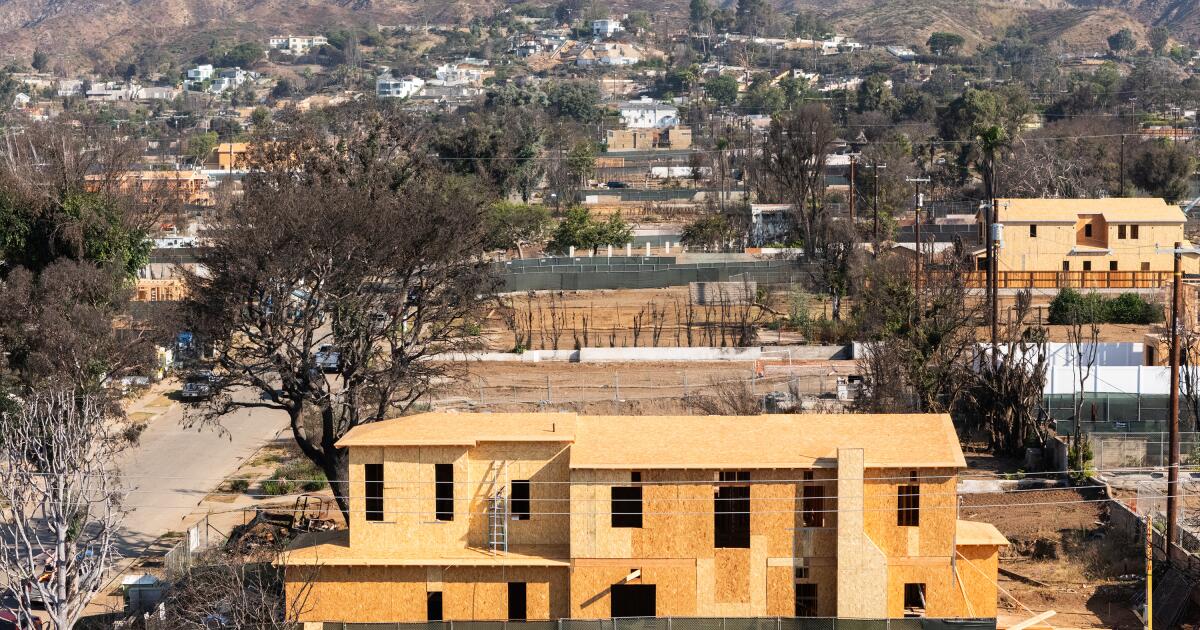
A fire survivors’ group announced Thursday it was seeking tougher penalties against State Farm over its handling of January 2025 wildfire claims.
The Every Fire Survivor’s Network said it was petitioning to join a state enforcement action announced this year against the company to make sure the case results in meaningful changes at California’s largest home insurer.
“We’re seeking a systematic review of all their claims and penalties calibrated to the actual scale of the harm — and we’re seeking the payouts that families are owed,” said Joy Chen, executive director of the group, at a Pacific Palisades news conference joined by victims of the fires.
The Department of Insurance in May filed an administrative action against State Farm General — the subsidiary of the giant Bloomington, Ill., insurer that handles California home insurance — after completing a “market conduct” exam.
The Jan. 7, 2025, fire damaged or destroyed more than 18,000 structures and killed 31 people.
State Farm has received more January 2025 claims than any other insurer — more than 13,700 auto and homeowners claims as of May 4, with payouts totaling $5.7 billion, according to the company.
The market conduct exam looked at 220 sample claims filed by the victims and found 398 violations of state law in about half of them.
Among other alleged violations, it found that the company failed in numerous cases to pursue a “thorough, fair and objective investigation” into claims, failed to come to “prompt, fair, and equitable settlements” and made settlement offers that were “unreasonably low.”
In announcing the action, Insurance Commissioner Ricardo Lara called the company’s claims handling “unacceptable” and said his department was taking “decisive action to hold them accountable.”
The state is seeking a “cease and desist” order to stop the insurer from engaging in unfair or deceptive practices.
It also has threatened to suspend State Farm’s license over the alleged violations, which each carry a penalty of up to $5,000 — or twice that figure if found to be willful. That could amount to a penalty of $2 million or more.
The threat to actually suspend State Farm’s license and its authority to write policies has been viewed skeptically by some, given its roughly 20% market share of the state’s home insurance market.
The company, which had an opportunity to include its responses in the exam report, denied fault in some cases and admitted fault in others. It often blamed problems on individual adjusters and denied systemic issues with its claims handling.
The petition filed by the wildfire survivor’s group criticizes the sample size of the market conduct exam as too small to capture all the alleged deficiencies in State Farm’s claims handling, which it claims are a “general business practice” of the company.
The group is seeking to conduct discovery, cross examine witnesses, present testimony from fire victims and bring more that 1,600 firsthand policyholder statements regarding State Farm’s practices into evidence, according to the petition.
It also wants State Farm to reopen cases in which claimants were paid too little, and it is seeking to participate in settlement discussions in order to increase any penalty State Farm would pay.
It calculated that a $2-million penalty would amount to a minute fraction of the assets of the State Farm Group.
“I submit to you that doesn’t defer bad conduct, it just allows you to continue to do it,” said Michelle Meyers, an attorney for Every Fire Survivor’s Network, at the news conference.
Consumer Watchdog, which has been a harsh critic of State Farm, also is providing legal support for victims’ effort.
Sevag Sarkissian, a spokesperson for State Farm, said the company was aware of the petition.
“We recognize that many wildfire survivors, including those that are State Farm General policyholders, continue to face difficult recovery challenges,” he said. “Our focus remains on helping customers recover.”
Michael Soller, a spokesperson for Lara, said the department is “acting with urgency to assist wildfire survivors in their ongoing recovery by investigating formal complaints filed by survivors and conducting the expedited market conduct exam that led to this enforcement action.”
He added that the department’s position is the state’s Administrative Procedure Act does not contemplate the commissioner or department staff authorizing intervention requests in the case.
He said that would be a hearing officer’s or administrative law judge’s decision when one is assigned to the case.
Meyers acknowledged the request was novel but said her reading of the law is that Lara can make the decision because no judge is yet assigned.
In response to the criticism, State Farm pledged earlier this year to improve its claims handling, including by providing single points of contact and improved communication so there are “fewer handoffs, fewer repeated explanations, and seamless support.”
It also named a new vice president of customer relations for State Farm General.

The state’s trial attorneys and Uber say they have reached a last-minute deal to scrap their dueling ballot measures and avert what was gearing up to be one of most expensive battles of the November election.
The deal, which comes a day after both measures qualified for the November ballot, has Uber agreeing to bulk up safety measures, while the trial attorneys will limit how much they can claim for lien-based medical treatment of victims who get in Uber or Lyft accidents, according to spokespeople for both sides of the campaign.
“Both sides agree: Californians deserve a system that’s safe, fair, and accountable,” read a joint statement from Uber and the Consumer Attorneys of California, a powerful attorney trade group. “This agreement protects patients from unnecessary treatment or getting overcharged, ensures access to medical care and legal representation, and strengthens safety measures.”
The agreement, finalized Thursday, means the ride-share giant will kill its ballot measure to cap how much attorneys can earn in vehicle collision cases and limit medical damages to rates based on insurance. Uber has argued that the costs for medical treatment done on a lien, which allows doctors to get paid from a cut of the plaintiff’s payout, far exceed what it would cost if the victim had used their own insurance.
In return, the Consumer Attorneys of California will cancel its competing ballot measure that sought to increase legal liability for ride-share companies if a passenger is sexually assaulted by a driver. The measure followed an investigation by the New York Times into sexual assault by drivers.
Both sides had poured tens of millions into the campaigns, plastering billboards across Los Angeles.
Lawyers claimed the fight had turned existential with the measure threatening to decimate the profit margin of many personal injury cases and leave drivers with small or thorny cases unable to find an attorney willing to take their case.
Spokespeople say the deal is predicated on their agreement being codified into a bill within the next week. Otherwise, they said, each side will move forward with its ballot measure.
-

 Los Angeles, Ca6 minutes ago
Victims sought after man allegedly points gun at passing cars in Santa Clarita Valley
-

 Detroit, MI30 minutes ago
Best barbershop in Metro Detroit: Finalists for this year’s Vote 4 The Best
-

 San Francisco, CA39 minutes ago
How to watch San Francisco Giants vs. Miami Marlins
-

 Dallas, TX45 minutes ago
Drivers in North Texas struggle with Friday floods
-

 Miami, FL52 minutes ago
Three wildfires burn more than 20,000 acres in Miami-Dade, force road closures
-

 Boston, MA54 minutes ago
MBTA, state transportation chief apologizes for ‘insensitive’ employee hair-pulling incident
-

 Denver, CO59 minutes ago
Man arrested on suspicion of murder in Denver shooting near South Park Hill, Hale
-

 Seattle, WA1 hour ago
Seattle fans pack waterfront hours early as USA defeats Australia, advances in World Cup

