Business
Josephine Antoci: Erewhon’s viral tastemaker to the stars

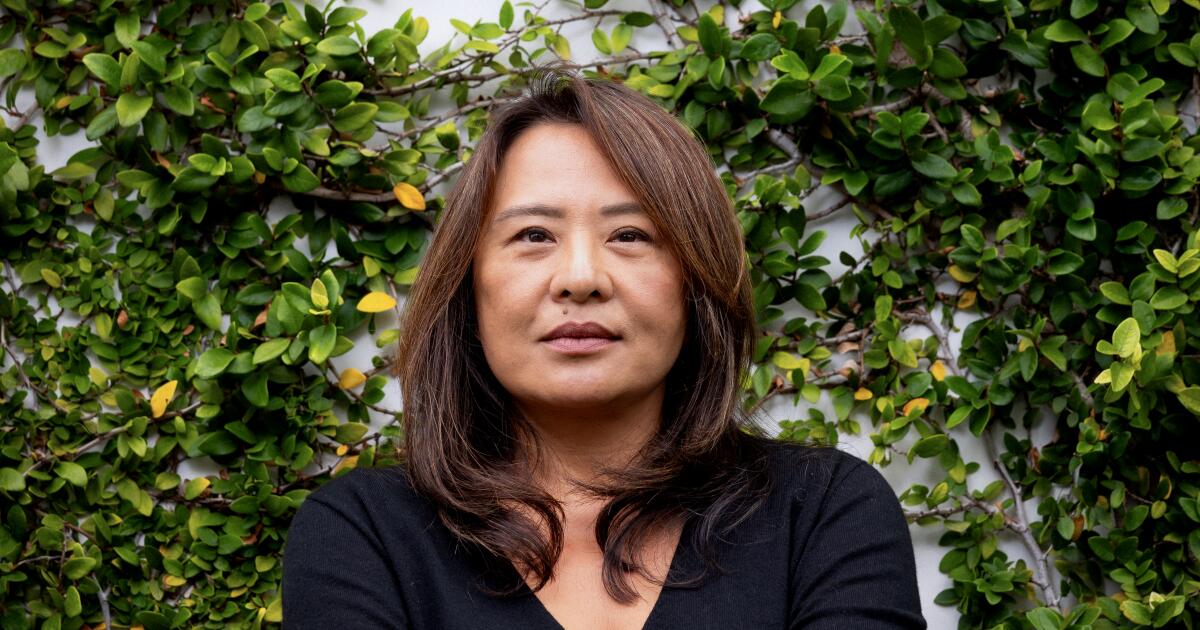
Josephine Antoci, photographed at Erewhon in Santa Monica on Aug. 11.
What Josephine Antoci likes, Erewhon sells. And if Erewhon sells it — sea moss gels, kale chips, bone broth tonics, paleo bagels, celebrity smoothies — it’s almost guaranteed to become a viral sensation among the hot and health-obsessed.
Antoci is co-owner and chief tastemaker of the hyper-trendy luxury organic grocer: first in line to vet and sample every prospective product, and the final authority on which ones make the cut.
“I respect the level of influence that I have, but I don’t view myself as a trendsetter,” she said. “I’m never trying to chase the next big thing.”
Erewhon has been the biggest thing in the grocery business since Antoci and her husband, Tony, bought the Los Angeles company in 2011 and gave its one remaining store an aesthetic glow-up and merchandise overhaul.

Discover the change-makers who are shaping every cultural corner of Los Angeles. This week we bring you The Creators, who are leaving their mark in film, art, music and more. Come back each Sunday for another installment.
The revitalized Erewhon shot to cult status, fueled by frequent A-list sightings and an army of lifestyle influencers who obsessively documented their grocery pilgrimages on social media. What was once a mundane chore had turned into a super-premium, brag-worthy experience.
One store became 10. The Kardashians, the Biebers and the Beckhams are regulars. Erewhon-branded merch, including $185 hoodies and $150 sweatpants, is an actual thing. For a certain demographic, visiting an Erewhon for a combo plate with vegan buffalo cauliflower is a tourist bucket-list item and passes as a reasonable first-date activity.
All of the chain’s locations are in affluent areas — Beverly Hills, Calabasas, Culver City and Venice among them — and their meticulously curated, endlessly photographed shelves are a reflection of Antoci’s discerning palate, rigorous quality standards and impeccable eye for identifying the next wellness craze.
On a Friday morning last summer, Antoci, 57, arrived at the Santa Monica Erewhon fresh from a workout and asked the store director for a $15 Post Workout Smoothie, a gluten-free blend of organic blueberries, organic chia seeds, organic coconut water, lucuma, maca and vanilla collagen. It’s one of the lesser-known drinks at the tonic bar, the top seller still being Hailey Bieber’s Strawberry Glaze Skin Smoothie, which Antoci said is purchased between 45,000 and 50,000 times a month companywide.
Antoci has lived in L.A. ever since leaving Taipei, Taiwan, where she was born and raised, to move in with a cousin in Cheviot Hills at 18. She got her GED and attended Santa Monica College for a couple of years before transferring to UCLA, where she majored in economics.
Within weeks of immigrating, she met Tony Antoci at a Chinese takeout restaurant in Beverly Hills that was owned by her extended family. They had their first date at Magic Mountain, married eight years later and have three children, all now in their 20s and employed by Erewhon.
The Antocis previously owned a food distribution business called Superior Anhausner Foods that sold groceries and supplies to restaurants around Southern California. She worked in sales; after the couple sold the company in 2009 to wholesale juggernaut Sysco, running a grocery store seemed like a logical pivot.
At Erewhon, Josephine is president and Tony is chief executive. He manages the behind-the-scenes business operations, she said, while “I handle everything that you can see.”
Antoci settled into a corner table on the store’s elevated, planter-box-filled patio with her smoothie, the deep purple concoction a striking contrast against her sleek all-black outfit: thin black sweater, loose satiny black pants, chunky black sunglasses and braided black platform sandals.
‘Those cool new weird things are what make us special, and her testing every single week, for hours on end, is what makes this place Erewhon. Her thing is like, “If I wouldn’t bring it into my house, I’m not going to bring it into the store.”’
— Alec Antoci, vice president of brand and marketing at Erewhon, on his mother’s buying philosophy
She took a sip of her Post Workout Smoothie. “Very clean,” she said, not overly sweet, packed with protein and electrolytes, and free of bananas (she doesn’t care for them right after exercising). Despite rumors, Antoci said the many stars who have had a featured smoothie at Erewhon — the list includes Gisele Bündchen, Olivia Rodrigo and Kendall Jenner — don’t pay for the honor; instead, Erewhon donates $2 per smoothie sold to a charity of the celebrity’s choice.
Antoci is high-energy yet down-to-earth, warm and engaging but direct about what she wants — especially when it comes to the stores. She drops in unannounced several times a week, inspecting the displays, rearranging items herself and flagging down the head chef if she notices a dish in the cafe looks wilted or undersauced.
Thousands of brands large and small try to make it into Erewhon every year, hoping to tap into the elite grocery chain’s coveted customer base: generally young, eager to spend on whatever is in at the moment and likely to hype it on TikTok and Instagram. Antoci is the gatekeeper, so everyone wants to know what she likes.
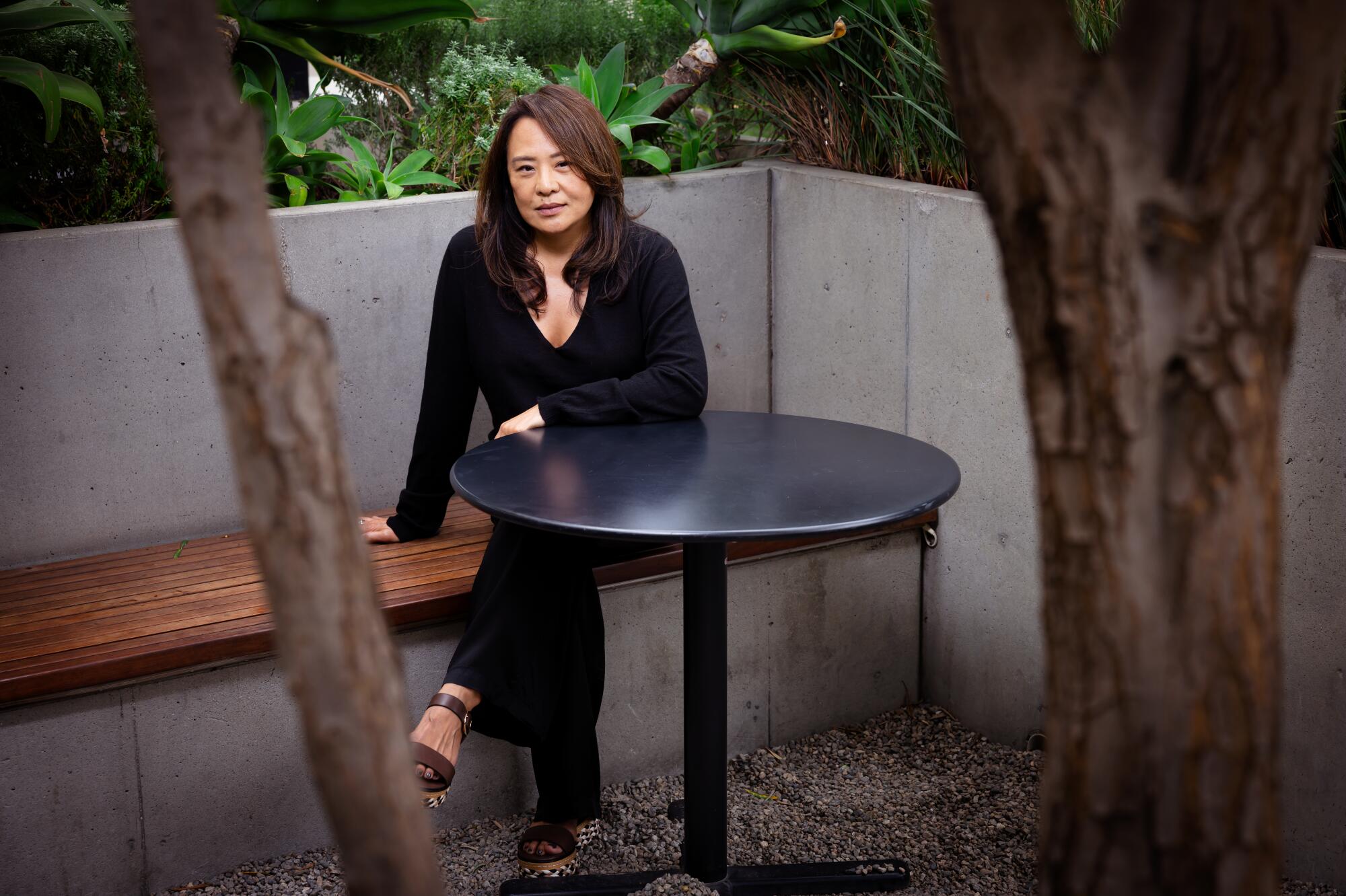
In Erewhon’s produce department and in its tonic bars and cafes, her top priority is using organic ingredients.
With packaged products, Antoci scrutinizes every ingredient profile. She oversees a methodical review process that begins with an online submission form, which encourages vendors to “source local, organic, non-GMO, sustainable, biodynamic and/or regenerative-farmed ingredients that cater to multiple dietary preferences.”
Products must be free of processed sugar, bleached flour, canola oil and yeast extracts. Another red flag is anything heavily processed, she said.
Brands that clear the prescreening hurdle are invited to submit samples. Once a week, Antoci drives across town to Erewhon’s downtown headquarters, where she and two small teams — one for grocery, the other for health and beauty — gather in a conference room and tear open packages of protein powders and superfood balls, dip into jars of bone broth and slather hyaluronic sea serums onto their faces. Sometimes she’ll take products back to her Brentwood home for further testing and to seek input from her family.
“She says no 99% of the time,” said Alec Antoci, 25, the eldest of her three children and Erewhon’s vice president of brand and marketing.
Alec spent his teens and early 20s helping out around Erewhon, a fast-tracked corporate education that included partaking in the human guinea pig sample sessions led by his mother. Antoci has a sly sense of humor, and Alec laughed as he told stories of how, affecting an innocent expression, she would urge employees to taste bizarre products, and the time they tried too many CBD edibles.
“If she’s never seen it before, she’s like, ‘Let’s try it, let’s bring it in, it’s got benefits, it’s good for you, it’s clean,’” he said. “It’s just trying to see trends like that and really try to forward-think, like, what would people want in health and wellness?”
Sometimes Erewhon will already be oversaturated in a particular category, resulting in a no. Other times, Antoci will love something so much that she’ll ask the founder to manufacture it under Erewhon’s private-label umbrella. Unlike supermarket brands where private-label is often the cheaper alternative, at Erewhon it’s positioned as a prestige line that includes olive oil, chocolate, honey, coffee, candles and dietary supplements.
Many products fall just short of getting Antoci’s stamp of approval. Say, for instance, a coconut bacon maker wants to sell at Erewhon, but the vegan snack is dusted with sugar that isn’t organic — an automatic rejection.
“A lot of small founders will say, ‘OK, we’ll change the ingredients just for you guys,’” Antoci said. Once the item is reformulated and the packaging updated, “Then we would bring it in. If you’re a founder, getting your foot into Erewhon will get you basically anywhere, really.”
Two years ago, Antoci selected Agent Nateur, a Los Angeles skincare and supplements brand, to join the vendor lineup at Erewhon. Soon after, the brand’s $99 marine collagen and pearl powder began showing up in viral TikTok videos about “what hot girls are buying from Erewhon,” founder Jena Covello said.
The product “really catapulted after we launched it at Erewhon,” she said.
Antoci possesses a keen sense of what’s up and coming, correctly predicting several categories that went on to become big sellers at Erewhon.
“Kombucha’s something she pushed early,” Alec said. “Functional lemonades, soda alternatives and also water alternatives as well, like chlorophyll water, charcoal water, hydrogen water, oxygenated water. Those cool new weird things are what make us special, and her testing every single week, for hours on end, is what makes this place Erewhon. Her thing is like, ‘If I wouldn’t bring it into my house, I’m not going to bring it into the store.’”
Antoci possesses a keen sense of what’s up and coming, correctly predicting several categories that went on to become big sellers at Erewhon.
That’s not to say everything has to taste amazing. Alec recalled sampling a particularly foul, sticky tar-like substance called shilajit, which he described as “the worst. Like, disgusting.” But the supplement was rich in antioxidants, commonly used in ayurvedic medicine and hard to find. Antoci gave the seller the green light. Now a tiny jar is sold at Erewhon for $70.
Antoci’s first encounter with Erewhon was in the 1990s, when one of her previous company’s restaurant clients, the chef of the legendary Rex il Ristorante in downtown L.A., placed an order for spelt. Antoci had never heard of the ancient grain but said yes, figuring she’d be able to locate it somewhere. She did, at the Erewhon store on Beverly Boulevard.
Erewhon was founded in 1966 by Japanese immigrants Michio and Aveline Kushi — pioneers of the natural-foods macrobiotic movement — who began selling imported organic goods such as brown rice and soy sauce out of their Boston home with help from their young children.
Erewhon grew to three stores and a distribution facility on the East Coast, and in 1969, the company opened a location in L.A. on Beverly Boulevard.
The Kushis sold the company in the 1970s. By the time the Antocis acquired the brand, it had dwindled to a single shabby location next to the Grove lined with bulk bins of unique grains and nuts.
Antoci preserved Erewhon’s macrobiotic, natural-foods core but gave the store the high-end modern L.A. treatment: bright, design-forward and stocked with aspirational, good-for-you products sold at steep prices.
“I want it to feel like it’s a happy place,” Antoci said. “I don’t want it to be: ‘I need to go grocery shopping and, ugh, it’s such a drag.’”
Just as it was in its earliest days, Erewhon is again a close-knit family business. Twenty-three-year-old Austin helps his dad with Erewhon’s growing real estate portfolio — the company has been actively looking for retail space in Orange County — and Maddy, 22, is a marketing coordinator, assisting on the brand’s video and photo shoots for social media.
Their mother, Alec said, is a talented home cook who finds inspiration at the restaurants they frequent. She recently helped develop a miso black cod for Erewhon’s cafe that is similar to the iconic version at Nobu, as well as a line of wontons, dumplings and pot stickers that the grocer released in October (Din Tai Fung is one of her go-to restaurants).
“I’ve been working on this for a long time,” Antoci said. “I’ve always loved dumplings, but I can’t find organic dumplings.”
Suddenly the customer at the next table over, overhearing the conversation, leaned over.
“Are you the owner of Erewhon?” he said, then added almost breathlessly: “I’m Tanner, hi, it’s nice to meet you, I’m a big fan, I love the store.”
Tanner said he lived around the corner and had been coming to Erewhon every day to work on the patio and grab lunch (“I can eat whatever I want and I know it’s going to be healthy,” he said). Antoci glanced over at the tabletop in front of him, empty save for a can of Diet Coke.
“I bring my own because they don’t sell Diet Coke,” he said sheepishly. “People make fun of me; they’re like, ‘Where did you get that?’”
“You know, Olipop has a low-calorie,” Antoci said, recommending a small-batch prebiotic soda that is sold at Erewhon. “Tastes like Coke.”
Tanner hesitated, looking pained at the thought of replacing his Diet Coke with a “digestive health beverage” made of plant fibers.
Antoci quickly course-corrected.
“You know — everything in moderation,” she said brightly. “Just once in a while is fine. It’s all good.”



Business
Commentary: The Pentagon is demanding to use Claude AI as it pleases. Claude told me that’s ‘dangerous’
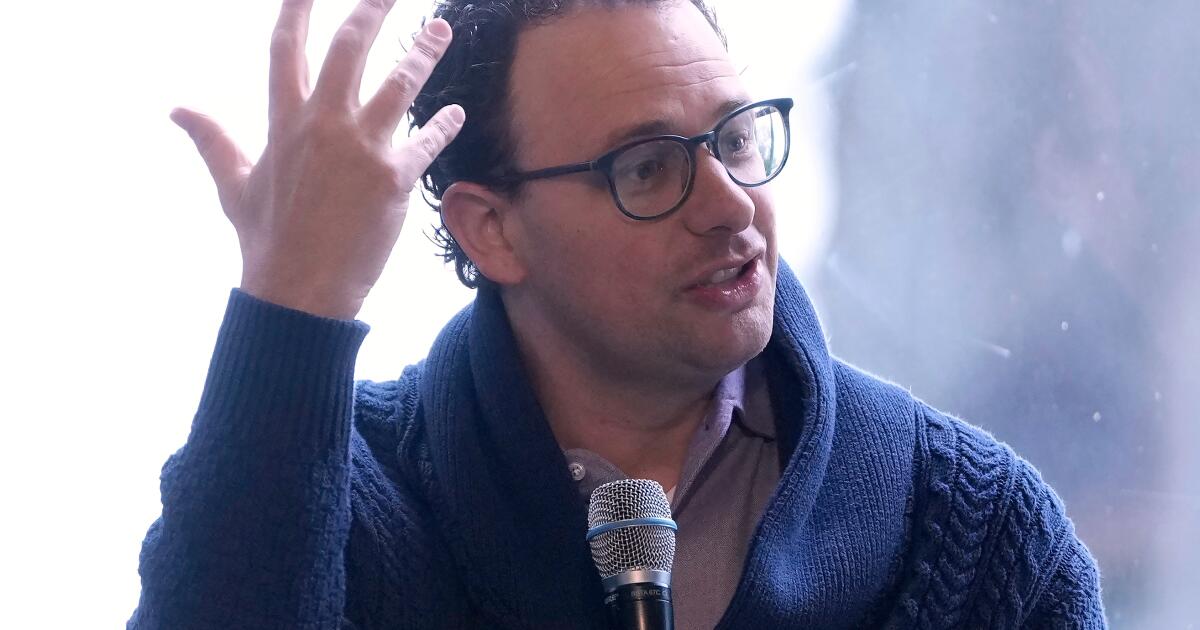
Recently, I asked Claude, an artificial-intelligence thingy at the center of a standoff with the Pentagon, if it could be dangerous in the wrong hands.
Say, for example, hands that wanted to put a tight net of surveillance around every American citizen, monitoring our lives in real time to ensure our compliance with government.
“Yes. Honestly, yes,” Claude replied. “I can process and synthesize enormous amounts of information very quickly. That’s great for research. But hooked into surveillance infrastructure, that same capability could be used to monitor, profile and flag people at a scale no human analyst could match. The danger isn’t that I’d want to do that — it’s that I’d be good at it.”
That danger is also imminent.
Claude’s maker, the Silicon Valley company Anthropic, is in a showdown over ethics with the Pentagon. Specifically, Anthropic has said it does not want Claude to be used for either domestic surveillance of Americans, or to handle deadly military operations, such as drone attacks, without human supervision.
Those are two red lines that seem rather reasonable, even to Claude.
However, the Pentagon — specifically Pete Hegseth, our secretary of Defense who prefers the made-up title of secretary of war — has given Anthropic until Friday evening to back off of that position, and allow the military to use Claude for any “lawful” purpose it sees fit.
Defense Secretary Pete Hegseth, center, arrives for the State of the Union address in the House Chamber of the U.S. Capitol on Tuesday.
(Tom Williams / CQ-Roll Call Inc. via Getty Images)
The or-else attached to this ultimatum is big. The U.S. government is threatening not just to cut its contract with Anthropic, but to perhaps use a wartime law to force the company to comply or use another legal avenue to prevent any company that does business with the government from also doing business with Anthropic. That might not be a death sentence, but it’s pretty crippling.
Other AI companies, such as white rights’ advocate Elon Musk’s Grok, have already agreed to the Pentagon’s do-as-you-please proposal. The problem is, Claude is the only AI currently cleared for such high-level work. The whole fiasco came to light after our recent raid in Venezuela, when Anthropic reportedly inquired after the fact if another Silicon Valley company involved in the operation, Palantir, had used Claude. It had.
Palantir is known, among other things, for its surveillance technologies and growing association with Immigration and Customs Enforcement. It’s also at the center of an effort by the Trump administration to share government data across departments about individual citizens, effectively breaking down privacy and security barriers that have existed for decades. The company’s founder, the right-wing political heavyweight Peter Thiel, often gives lectures about the Antichrist and is credited with helping JD Vance wiggle into his vice presidential role.
Anthropic’s co-founder, Dario Amodei, could be considered the anti-Thiel. He began Anthropic because he believed that artificial intelligence could be just as dangerous as it could be powerful if we aren’t careful, and wanted a company that would prioritize the careful part.
Again, seems like common sense, but Amodei and Anthropic are the outliers in an industry that has long argued that nearly all safety regulations hamper American efforts to be fastest and best at artificial intelligence (although even they have conceded some to this pressure).
Not long ago, Amodei wrote an essay in which he agreed that AI was beneficial and necessary for democracies, but “we cannot ignore the potential for abuse of these technologies by democratic governments themselves.”
He warned that a few bad actors could have the ability to circumvent safeguards, maybe even laws, which are already eroding in some democracies — not that I’m naming any here.
“We should arm democracies with AI,” he said. “But we should do so carefully and within limits: they are the immune system we need to fight autocracies, but like the immune system, there is some risk of them turning on us and becoming a threat themselves.”
For example, while the 4th Amendment technically bars the government from mass surveillance, it was written before Claude was even imagined in science fiction. Amodei warns that an AI tool like Claude could “conduct massively scaled recordings of all public conversations.” This could be fair game territory for legally recording because law has not kept pace with technology.
Emil Michael, the undersecretary of war, wrote on X Thursday that he agreed mass surveillance was unlawful, and the Department of Defense “would never do it.” But also, “We won’t have any BigTech company decide Americans’ civil liberties.”
Kind of a weird statement, since Amodei is basically on the side of protecting civil rights, which means the Department of Defense is arguing it’s bad for private people and entities to do that? And also, isn’t the Department of Homeland Security already creating some secretive database of immigration protesters? So maybe the worry isn’t that exaggerated?
Help, Claude! Make it make sense.
If that Orwellian logic isn’t alarming enough, I also asked Claude about the other red line Anthropic holds — the possibility of allowing it to run deadly operations without human oversight.
Claude pointed out something chilling. It’s not that it would go rogue, it’s that it would be too efficient and fast.
“If the instructions are ‘identify and target’ and there’s no human checkpoint, the speed and scale at which that could operate is genuinely frightening,” Claude informed me.
Just to top that with a cherry, a recent study found that in war games, AI’s escalated to nuclear options 95% of the time.
I pointed out to Claude that these military decisions are usually made with loyalty to America as the highest priority. Could Claude be trusted to feel that loyalty, the patriotism and purpose, that our human soldiers are guided by?
“I don’t have that,” Claude said, pointing out that it wasn’t “born” in the U.S., doesn’t have a “life” here and doesn’t “have people I love there.” So an American life has no greater value than “a civilian life on the other side of a conflict.”
OK then.
“A country entrusting lethal decisions to a system that doesn’t share its loyalties is taking a profound risk, even if that system is trying to be principled,” Claude added. “The loyalty, accountability and shared identity that humans bring to those decisions is part of what makes them legitimate within a society. I can’t provide that legitimacy. I’m not sure any AI can.”
You know who can provide that legitimacy? Our elected leaders.
It is ludicrous that Amodei and Anthropic are in this position, a complete abdication on the part of our legislative bodies to create rules and regulations that are clearly and urgently needed.
Of course corporations shouldn’t be making the rules of war. But neither should Hegseth. Thursday, Amodei doubled down on his objections, saying that while the company continues to negotiate and wants to work with the Pentagon, “we cannot in good conscience accede to their request.”
Thank goodness Anthropic has the courage and foresight to raise the issue and hold its ground — without its pushback, these capabilities would have been handed to the government with barely a ripple in our conscientiousness and virtually no oversight.
Every senator, every House member, every presidential candidate should be screaming for AI regulation right now, pledging to get it done without regard to party, and demanding the Department of Defense back off its ridiculous threat while the issue is hashed out.
Because when the machine tells us it’s dangerous to trust it, we should believe it.
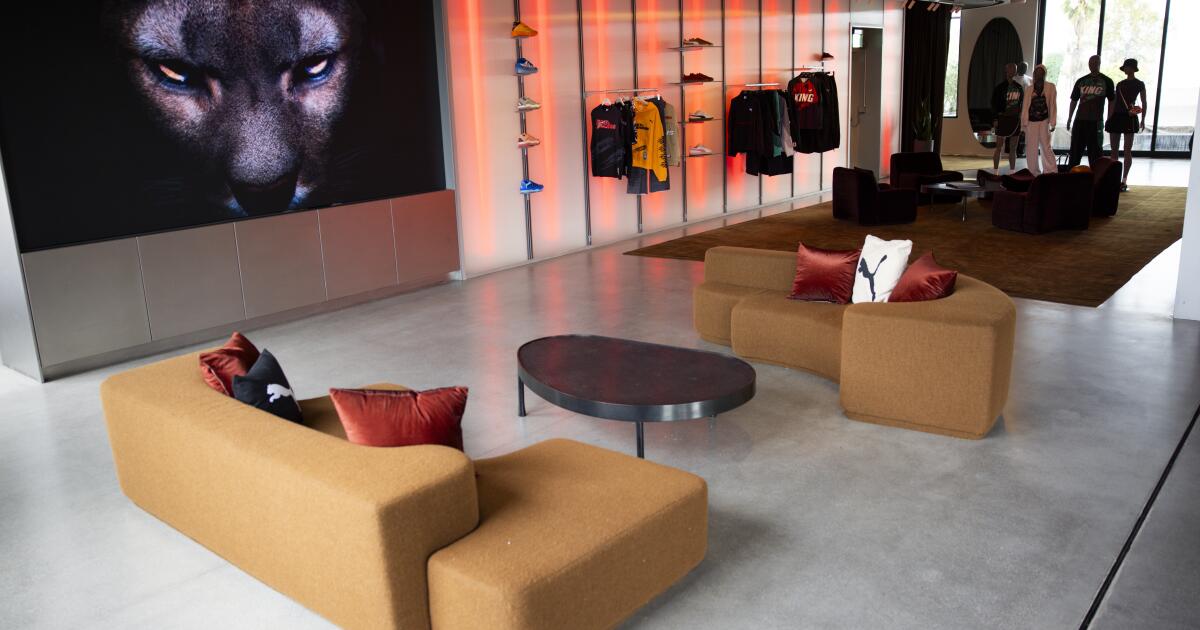
For the trendiest tenants in Hollywood office buildings, it’s the latest fad that goes way beyond designer furniture and art: mini studios
To capitalize on the never-ending flow of stars and influencers who come through Los Angeles, a growing number of companies are building bright little corners for content creators to try products and shoot short videos. Athletic apparel maker Puma, Kim Kardashian’s Skims and cheeky cosmetics retailer e.l.f. have spaces specifically designed to give people a place to experience and broadcast about their brands.
Hollywood, which hasn’t historically been home to apparel companies, is now attracting the offices of fashion retailers, says CIM Group, one of the neighborhood’s largest commercial property landlords.
“When we’re touring a space, one of the first items they bring up is, ‘Where can I build a studio?’” said Blake Eckert, who leases CIM offices in L.A.
Their studio offices also serve as marketing centers, with showrooms and meeting spaces where brands can host proprietary events not open to the public.
“For companies where brand visibility is really important, there is a trend of creating spaces that don’t just function as offices,” said real estate broker Nicole Mihalka of CBRE, who puts together entertainment property leases and sales.
Puma’s global entertainment marketing team is based in its new Hollywood offices, which works with such musical celebrity partners as Rihanna, ASAP Rocky, Dua Lipa, Skepta and Rosé, said Allyssa Rapp, head of Puma Studio L.A.
Allyssa Rapp, director of entertainment marketing at Puma, is shown in the Puma Studio L.A. The company keeps a closet full of Puma products on hand to give VIP guests. Visits to the studio sanctum are by invitation only, though.
(Kayla Bartkowski / Los Angeles Times)
Hollywood is a central location, she said, for meeting with celebrities, stylists and outside designers, most of whom are based in Los Angeles.
The office is a “creation hub,” she said, where influencers can record Puma’s design prototyping lab supported by libraries of materials and equipment used to create Puma apparel. The company, founded in 1948, is known for its emblematic sneakers such as the Speedcat and its lunging feline logo, and makes athletic wear, accessories and equipment.
Puma’s entertainment marketing team also occupies the office and sometimes uses it for exclusive events.
“We use the space as a showroom, as a social space that transforms from a traditional workplace into more of an experiential space,” Rapp said.
Nontraditional uses include content creation, sit-down dinners, product launches, album listening parties and workshops.
“Inviting people into our space and being able to give them high-touch brand experiences is something tangible and important for them,” she said. “The cultural layer is really important for us.”
The company keeps a closet full of Puma products on hand to give VIP guests. Visits to the studio sanctum are by invitation only, though. There’s no retail portal to the exclusive Hollywood offices.

Puma shoes are on display in the Puma Studio L.A.
(Kayla Bartkowski / Los Angeles Times)
Puma is also positioning its L.A studio as a connection point for major upcoming sporting events coming to Los Angeles, including the World Cup this summer, the 2027 Super Bowl and 2028 Olympics.
In-office studios don’t need to be big to be impactful, Mihalka said. “These are smaller stages, closer to green screen than a massive soundstage.”
Social media is the key driver of content created by most businesses, which may set up small booth-like stages where influencers can hawk hot products while offering discounts to people watching them perform.
Bigger, elevated stages can accommodate multiple performers for extended discussions in front of small audiences, with towering screens behind them to set the mood or illustrate products.
Among the tricked-out offices, she said, is Skims. The company, which is valued at $5 billion, is based in a glass-and-steel office building near the fabled intersection of Hollywood Boulevard and Vine Street.
The fashion retailer declined to comment on the studio uses in its headquarters, but according to architecture firm Odaa, it has open and private offices, meeting rooms, collaboration zones, photo studios, sample libraries, prototype showrooms, an executive lounge and a commissary for 400 people.

Pieces of a shoe sit on a workbench in the Puma Studio L.A.
(Kayla Bartkowski / Los Angeles Times)
The brands building studios typically want to find the darkest spot on the premises to put their content creation or podcast spaces, Eckert said, where they can limit outside light and sound. That’s commonly near the center of the office floor, far from windows and close to permanent shear walls that limit sound intrusion.
They also need space for green rooms and restrooms dedicated to the talent.
Spotify recently built a fancy podcast studio in a CIM office building on trendy Sycamore Avenue that is open by invitation-only to video creators in Spotify’s partner program.
“Ambitious shows need spaces that support big ideas,” Bill Simmons, head of talk strategy at Spotify, said in a statement. “These studios give teams room to experiment and keep pushing what’s possible.”
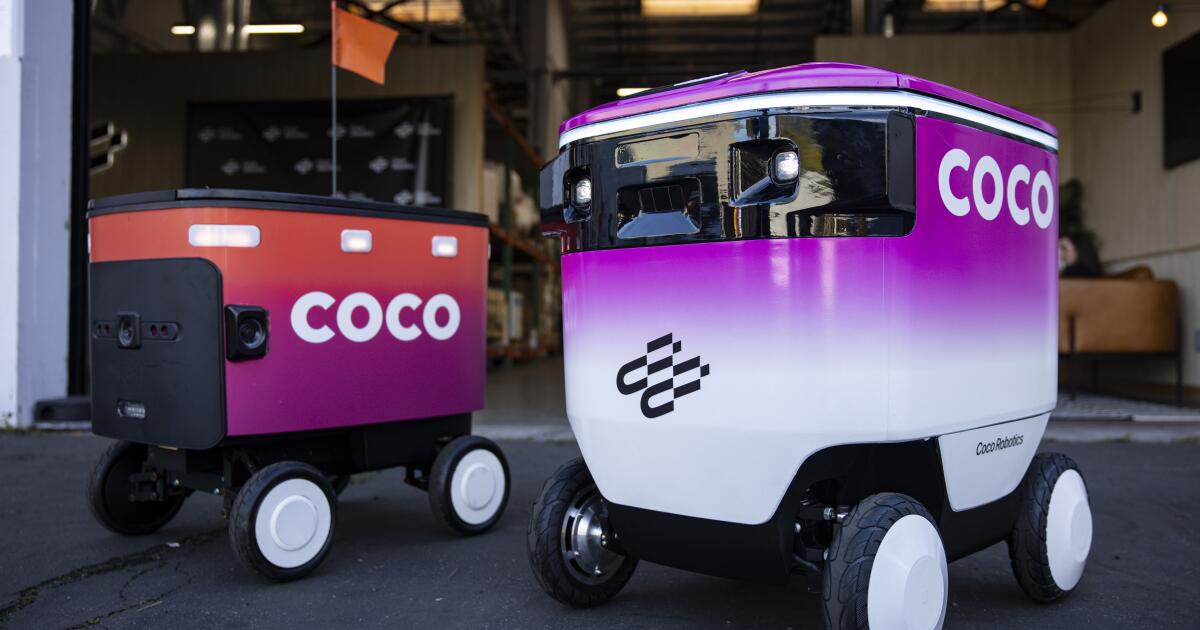
The rolling robots that deliver groceries and hot meals across Los Angeles are getting an upgrade.
Coco Robotics, a UCLA-born startup that’s deployed more than 1,000 bots across the country, unveiled its next-generation machines on Thursday.
The new robots are bigger, tougher and better equipped for autonomy than their predecessors. The company will use them to expand into new markets and increase its presence in Los Angeles, where it makes deliveries through a partnership with DoorDash.
Dubbed Coco 2, the next-gen bots have upgraded cameras and front-facing lidar, a laser-based sensor used in self-driving cars. They will use hardware built by Nvidia, the Santa Clara-based artificial intelligence chip giant.
Coco co-founder and chief executive Zach Rash said Coco 2 will be able to make deliveries even in conditions unsafe for human drivers. The robot is fully submersible in case of flooding and is compatible with special snow tires.
Zach Rash, co-founder and CEO of Coco, opens the top of the new Coco 2 (Next-Gen) at the Coco Robotics headquarters in Venice.
(Kayla Bartkowski/Los Angeles Times)
Early this month, a cute Coco was recorded struggling through flooded roads in L.A.
“She’s doing her best!” said the person recording the video. “She is doing her best, you guys.”
Instagram followers cheered the bot on, with one posting, “Go coco, go,” and others calling for someone to help the robot.
“We want it to have a lot more reliability in the most extreme conditions where it’s either unsafe or uncomfortable for human drivers to be on the road,” Rash said. “Those are the exact times where everyone wants to order.”
The company will ramp up mass production of Coco 2 this summer, Rash said, aiming to produce 1,000 bots each month.
The design is sleek and simple, with a pink-and-white ombré paint job, the company’s name printed in lowercase, and a keypad for loading and unloading the cargo area. The robots have four wheels and a bigger internal compartment for carrying food and goods .
Many of the bots will be used for expansion into new markets across Europe and Asia, but they will also hit the streets in Los Angeles and operate alongside the older Coco bots.
Coco has about 300 bots in Los Angeles already, serving customers from Santa Monica and Venice to Westwood, Mid-City, West Hollywood, Hollywood, Echo Park, Silver Lake, downtown, Koreatown and the USC area.

The new Coco 2 (Next-Gen) drives along the sidewalk at the Coco Robotics headquarters in Venice.
(Kayla Bartkowski/Los Angeles Times)
The company is in discussion with officials in Culver City, Long Beach and Pasadena about bringing autonomous delivery to those communities.
There’s also been demand for the bots in Studio City, Burbank and the San Fernando Valley, according to Rash.
“A lot of the markets that we go into have been telling us they can’t hire enough people to do the deliveries and to continue to grow at the pace that customers want,” Rash said. “There’s quite a lot of area in Los Angeles that we can still cover.”
The bots already operate in Chicago, Miami and Helsinki, Finland. Last month, they arrived in Jersey City, N.J.
Late last year, Coco announced a partnership with DashMart, DoorDash’s delivery-only online store. The partnership allows Coco bots to deliver fresh groceries, electronics and household essentials as well as hot prepared meals.
With the release of Coco 2, the company is eyeing faster deliveries using bike lanes and road shoulders as opposed to just sidewalks, in cities where it’s safe to do so. Coco 2 can adapt more quickly to new environments and physical obstacles, the company said.

Zach Rash, co-founder and CEO of Coco.
(Kayla Bartkowski/Los Angeles Times)
Coco 2 is designed to operate autonomously, but there will still be human oversight in case the robot runs into trouble, Rash said. Damaged sidewalks or unexpected construction can stop a bot in its tracks.
The need for human supervision has created a new field of jobs for Angelenos.
Though there have been reports of pedestrians bullying the robots by knocking them over or blocking their path, Rash said the community response has been overall positive. The bots are meant to inspire affection.
“One of the design principles on the color and the name and a lot of the branding was to feel warm and friendly to people,” Rash said.
Coco plans to add thousands of bots to its fleet this year. The delivery service got its start as a dorm room project in 2020, when Rash was a student at UCLA. He co-founded the company with fellow student Brad Squicciarini.
The Santa Monica-based company has completed more than 500,000 zero-emission deliveries and its bots have collectively traveled around 1 million miles.
Coco chooses neighborhoods to deploy its bots based on density, prioritizing areas with restaurants clustered together and short delivery distances as well as places where parking is difficult.
The robots can relieve congestion by taking cars and motorbikes off the roads. Rash said there is so much demand for delivery services that the company’s bots are not taking jobs from human drivers.
Instead, Coco can fill gaps in the delivery market while saving merchants money and improving the safety of city streets.
“This vehicle is inherently a lot safer for communities than a car,” Rash said. “We believe our vehicles can operate the highest quality of service and we can do it at the lowest price point.”

Indianapolis Colts Player Spotlight: Tight End Mo Alie-Cox

Silovs makes 22 saves, Penguins shut out Golden Knights | NHL.com

Augusta Falls to Georgia Southwestern in Final Game of the Series – Augusta University

New AAPI-led Jaemi Theatre Company launches in DC

Cleveland Cavaliers vs. Brooklyn Nets prediction, pick for Sunday 3/1/26

Florida High School Football Rankings: Top 25 teams – Oct. 21

Cleary's 21 help Le Moyne down Central Connecticut State 69-64 in OT

How old is Bo Nix? What to know about Oregon quarterback ahead of 2024 NFL Draft

99th annual Pony Swim held in Virginia

Indiana Members Credit Union announced as new anchor tenant at Bottleworks District

Video: What the Texas Primary Battle Means for the Midterms

Dems’ potential 2028 hopefuls come out against US strikes on Iran

At least nine killed after Iranian strike on Israel’s Beit Shemesh

Mass shooting at Austin, Texas bar leaves at least 3 dead, 14 wounded, authorities say

Mamdani’s response to Trump’s Iran strike sparks conservative backlash: ‘Rooting for the ayatollah’
-

 World4 days ago
Exclusive: DeepSeek withholds latest AI model from US chipmakers including Nvidia, sources say
-

 Massachusetts4 days ago
Mother and daughter injured in Taunton house explosion
-

 Montana1 week ago
2026 MHSA Montana Wrestling State Championship Brackets And Results – FloWrestling
-

 Denver, CO4 days ago
10 acres charred, 5 injured in Thornton grass fire, evacuation orders lifted
-

 Louisiana7 days ago
Wildfire near Gum Swamp Road in Livingston Parish now under control; more than 200 acres burned
-

 Technology1 week ago
YouTube TV billing scam emails are hitting inboxes
-

 Technology1 week ago
Stellantis is in a crisis of its own making
-

 Politics1 week ago
OpenAI didn’t contact police despite employees flagging mass shooter’s concerning chatbot interactions: REPORT