Business
In the battle of the brands, the Dodgers are strong but Yankees reign supreme


The World Series betting odds might be in the Dodgers’ favor, but when it comes to the battle of the brands, the Yankees have a leg up (sorry, Angelenos).
The Yankees are the highest-valued team in Major League Baseball, with a valuation of $7.6 billion, and its brand is valued at an estimated $1.2 billion, according to an analysis this year from Forbes. The Dodgers are the runner-up, with a $5.5-billion valuation and $1.1-billion brand.
Underscoring and helping to drive the Yankees’ domination on retail shelves and airwaves has been the proliferation of the team’s iconic logo in the cultural zeitgeist, including Jay-Z’s ball cap and a partnership with Gucci. Hollywood frequently gives the franchise free product placement, putting the white-on-navy insignia on characters in movies and television shows, furthering its cultural reach. (The Yankees’ logo was inspired by an interlocking “N” and “Y” design from Tiffany’s in 1877.)
“The Yankees have this status where they’ve transcended baseball,” said Jim Andrews, a Northwestern University sports marketing professor who founded the sports marketing consulting firm A-Mark Partnership Strategies. “You see people wearing that logo all around the world.”
But don’t count out the Dodgers just yet. The signing of Japanese baseball phenom Shohei Ohtani last year to a 10-year, $700-million contract ignited fan interest around the world, particularly in the baseball-obsessed market of Japan.
That energized fan base has translated into tourism dollars for Los Angeles, as Japanese tourists have descended upon the city — and on Little Tokyo — to watch the Dodgers and Ohtani throughout the season.
Small businesses in Little Tokyo have displayed Dodgers decorations in their windows, and blue-clad visitors, often wearing Ohtani shirts or jerseys, frequently wander the streets. A massive mural of Ohtani, painted by artist Robert Vargas, looms over 1st Street on the side of the Miyako Hotel.
“In terms of the internationalization … they are beating the Yankees right now in the Japanese market through Shohei Ohtani,” said Thilo Kunkel, a professor at Temple University’s school of sport, tourism and hospitality management. The Dodgers are “using international superstars to build their team brand, and they’ve certainly done really well.”
Though the Dodgers are bested by the Yankees in total number of social media followers (12.9 million to 17.6 million), L.A.’s fans engage with the team more on social media, with the Dodgers racking up the most likes, shares, reposts, comments and video views of any team in MLB, according to data from business intelligence firm Kore, which was recently acquired by global marketing agency Two Circles. The 2.3 million new social media followers the Dodgers added this season was tops in the league as well, Kore figures show.
“The Dodgers really are a story of growth,” said Daniel Foltz, corporate partnerships strategy and data analyst at Kore. “It would have been very easy for them to sign Shohei, get the gift of having the most unique player in baseball, and then just cruise. They have instead done a great job this year of building on it, not letting any of the momentum go to waste.”
There’s history between these two teams. The Dodgers and Yankees have previously met 11 times in the World Series, most recently in 1981, when the Dodgers emerged as champions.
This year’s matchup presents a huge opportunity not only for the teams to boost their brands, but also for Major League Baseball to build on the increased ratings and fan interest it has won in recent years, said Andrews, of Northwestern.
The league’s gains have been helped by the star power of players such as Ohtani and the Yankees’ Aaron Judge, as well as additions such as the introduction of the pitch clock, which has quickened the pace of games.
Though media rights have already been settled for these games, viewership numbers for a matchup like this could give either team more negotiating power for future media rights deals, Kunkel said.
The Yankees broadcast their regular season games through their team-owned Yankees Entertainment and Sports Network, which is the most-watched regional sports network in the U.S. as of last year. (Amazon and Sinclair Broadcast Group have minority stakes in the network.)
The Dodgers own SportsNetLA, which is distributed by Charter Communications (which operates the Spectrum brand), as part of an $8.35-billion deal struck more than a decade ago. Though nonsubscribers were shut out from Dodgers games for years, Spectrum reached a deal in 2020 to broadcast games on DirecTV and U-Verse. (Other pay-TV operators, such as Cox, are still excluded.)
Having a recognizable and valuable brand is a huge advantage in the sports world, Andrews said.
“The bigger the brand, the more merchandise you’re selling and the more money you’re making,” he said. “If you can do that, it gives you that baseline revenue to build your business off of.”
The Yankees generated $679 million in revenue in 2023, while the Dodgers raked in $549 million, according to Forbes’ calculations.
This World Series not only represents a battle between two of the league’s storied and successful franchises, but also the nation’s two top media markets — L.A. and New York — which adds to the brand strength of those franchises, said Bryan Harris, founder and chief executive of 25 Hits, a marketing communications firm with sports expertise.
It’s part of how these two brands have transcended the sports sphere and made their way into fashion, lifestyle and pop culture, particularly internationally.
“The baseball cap is, if anything, the American uniform,” said John Thorn, the official MLB historian since 2011. “New York and L.A. have come to symbolize America in distant lands. To be a media capital or a cultural capital is to become a fashion capital.”

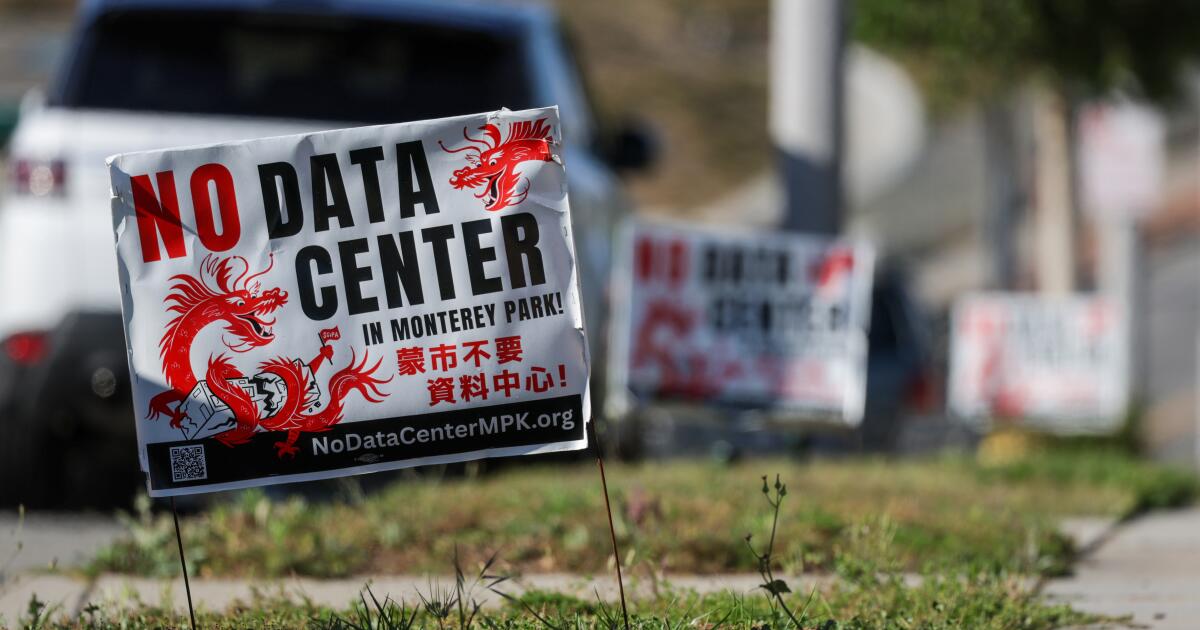
Residents of Monterey Park voted overwhelmingly to ban data centers on election day, making the San Gabriel Valley city the first in the nation to do so by public vote.
As of Wednesday, 86% of votes were in favor of Measure NDC, the city ban, according to the Los Angeles County registrar-recorder/county clerk.
Other cities and towns have passed moratoriums on data centers, as a wave of opposition sweeps the country. But the Monterey Park vote can only be overturned by another ballot measure, making it the most permanent data center ban in a jurisdiction.
Monterey Park’s City Council had already banned data centers by ordinance, after a proposed 247,000-square-foot data center met an outpouring of public anger and concern. The developer withdrew that plan.
That facility would have been less than 500 feet away from the nearest home, and would have used three times the electricity of the entire 60,000-person city. Residents said it would have caused noise and air pollution and driven up electricity rates.
“This ensures long-lasting protections for current and future generations,” Amy Wong, co-founder of the group San Gabriel Valley Progressive Action, said of the vote. “It means that future city councils cannot overturn a data center ban, even if data center developers wanted to spend money to fund pro-data center candidates.”
The measure had no formal opposition. The developer of the proposed facility, investment firm HMC StratCap, said it wouldn’t engage in the ballot fight when it withdrew in March.
The Data Center Coalition, an industry trade group, expressed disappointment in the vote.
“It sends a signal that the area is closed for business, both for data centers and for other significant economic development projects,” state policy director Khara Boender said.
“It deprives local residents of the opportunity to compete for jobs and investment, while also causing the area to relinquish substantial long-term economic investment, high-wage jobs, and critical tax revenue to neighboring areas or other states.”
SGV Progressive Action worked with hyperlocal groups including No Data Center Monterey Park to rally support for the measure.
The group is now focused on stopping data center proposals in the City of Industry and fighting a move by City of Industry, Santa Fe Springs, Vernon and City of Commerce to welcome data centers and other industry with fast-tracked permitting and tax incentives.
City of Industry, in the San Gabriel Valley, and Vernon, south of downtown L.A., are primarily industrial areas, each with around 300 permanent residents. They are employment centers, and tens of thousands of workers commute in daily.
There has been little vocal opposition to data centers among the few residents of these cities. Wong said the protest is primarily coming from the surrounding neighborhoods.
“If a data center gets built in City of Industry, residents across the region would bear the brunt of pollution and increased utility costs,” Wong said, noting that it is surrounded by 16 other cities and unincorporated communities.
Data center proposals have been limited in California compared to Virginia, Texas, Georgia, Illinois and Arizona, which sit at the center of a recent boom in hyperscaler facilities to power artificial intelligence.
California has the third-most data centers in the country, with 300, but high electricity rates, expensive land and regulatory hurdles mean that fewer, and smaller, facilities are currently planned than in other hotspots.
That doesn’t mean opposition hasn’t been fierce. In Coachella and Imperial County, residents are showing up in droves to protest local proposals.
In the San Gabriel Valley, Montebello, El Monte and Baldwin Park have all enacted temporary moratoriums, and Alhambra recently banned data centers as part of a zoning code update.
Wong said she hoped the ballot measure vote would galvanize the opposition. “The vote is a testament to the people power of our region,” she said. “Our region is worth protecting, and we won’t let data centers determine our future.”

A rule intended to prevent rent gouging in the wake of the Eaton and Palisades fires has lapsed in Los Angeles County, possibly exposing some renters to hikes.
The executive order that blocked rent increases was issued by Gov. Gavin Newsom amid the devastating wildfires last year. Under the order, landlords couldn’t increase rents by more than 10% above their prefire levels.
The rule, which was supposed to be temporary and was repeatedly extended, ended Friday after a vote to extend it again failed to garner enough votes. Supervisor Lindsey Horvath, whose district includes Pacific Palisades, sounded the alarm in a motion to extend price protections that failed to pass at the Board of Supervisors’ May 19 meeting.
“These price gouging protections continue to be necessary as construction and rebuilding continue, and as thousands of people remain displaced,” the motion said. “Families which signed short-term leases could face drastic price increases of 50% or more without further price gouging protection.”
Los Angeles County is home to more than 1 million rental properties, though not all of them needed protection from the new rule. There are already stricter rent increase caps for many residences, depending on the location, type and age of the building. Despite the rent control in the region, the people of Los Angeles pay among the highest rents in the country.
It is uncertain whether renters will face rapidly rising rents now that the protection has lapsed. But some real estate experts and policymakers said there was no need for the temporary rule that was part of the governor’s state of emergency.
Supervisors Kathryn Barger, Janice Hahn and Holly Mitchell abstained from voting on the motion to extend the protection, while Supervisors Hilda Solis and Horvath supported it.
“I abstained because I did not see sufficient evidence to justify extending this emergency ordinance, nor did I see evidence to eliminate it entirely,” Hahn said.
Barger’s office said she supported allowing the protections to sunset while waiting to see whether new information emerged.
“Market data already shows countywide rents are only about 2% above pre-emergency levels and rental inventory has grown,” Barger representative Helen E. Chavez Garcia said. “The Supervisor is also mindful of the burden these ongoing protections place on small property owners throughout the county.”
Mitchell did not immediately respond to a request for comment.
There haven’t been steep rent hikes in neighborhoods within three miles of the Palisades fire, according to a Times analysis of data from Zillow, the property listing company.
In ZIP Codes within three miles of the Palisades fire, rent increased 4.8% from December 2024 to April 2025. In areas around the Eaton fire, which destroyed swaths of Altadena, rent jumped 5.2% in the same period.
In L.A. County, ZIP Codes farther from the fires saw only about a 2% increase.
A landlords representative, Jesus Rojas of the Apartment Owners Assn. of Greater Los Angeles, told the supervisors during public comment at the meeting that the county’s rent-gouging rules have “long outlived the emergency they were intended to address” and are now being “wrongfully used to harm thousands of rental housing providers throughout the county.”
“There is no proof that multifamily rental housing providers are hugely increasing rents for impacted homeowners,” Rojas said.
Indeed, there are strong signs that the property market in the Los Angeles area has at last begun to cool.
L.A. metro-area rent prices recently fell to a four-year low, with the median rent slipping to $2,167 in December.
Meanwhile, condominium sales had their slowest start of the year in decades. Condo sales in Los Angeles have plummeted to a 20-year low, with fewer than 2,000 units sold in January and February — the worst start to the year since 2005.
Newsom defended the price-gouging protections shortly after they went into effect.
“In the days following the Los Angeles firestorms, we worked quickly to protect Los Angeles survivors from any form of exploitation,” he said in February 2025. “The state has the tools in place to not only block price gouging during this emergency, but also to prosecute bad actors.”
The Los Angeles County Department of Consumer and Business Affairs said it received more than 2,000 complaints after the fires, alleging that retailers and landlords were taking advantage of people put in hardship by their losses, and sent out more than 2,000 cease-and-desist letters to businesses and landlords for alleged price gouging, said Morine Merritt, who oversees department investigations into consumer and real estate fraud.
“Close to 90% of the complaints that we received involved allegations of rent increases,” Merritt said in an interview. Now that the fire-related protections have expired, existing laws and “regular market conditions determine price increases for goods and services, including rents,” she said.
Crackdowns on fire-related rent gouging have been rare, said Chelsea Kirk of the activist organization the Rent Brigade, which analyzed L.A. County’s rental market in the year after the fires. It reported 18,360 potential examples of price gouging in listings but said that few lawsuits had been filed by authorities so far.
Last week, Rent Brigade announced what it said was the first private civil lawsuit brought by a family that claimed to be rent-gouged in the aftermath of the wildfires. Plaintiffs Randall and Candy Renick, whose Altadena home was damaged, said they were charged nearly three times the maximum permitted rate for nearly 10 months. They seek restitution of $96,000 plus civil penalties and attorneys’ fees.
The rental market has probably stabilized since the fires, Kirk said, but other families may still be “locked into illegal rents” that they agreed to pay when they were in a rush to find housing after they were displaced.


Dear Mr. Pelley:
I meant what I said in my letter last week to the 60 Minutes team: joining 60 Minutes is the honor of my career and I am grateful to be working alongside the people who have contributed to the most important television journalism brand this country has ever produced. While I’m new to 60 Minutes, I’ve devoted my career to investigative journalism and storytelling. I started this job excited to collaborate and to benefit from the wisdom and experience of the 60 Minutes veterans, with you among them. For that reason, one of the first things I did in my new role was call you to talk and invite you to dinner. It is a profound disappointment that you rejected that overture and chose ambush instead. Yesterday, you hijacked my first meeting with staff to disparage me, my qualifications, and my intentions with remarkable incivility and contempt. I welcome a diversity of viewpoints and respectful debate among the team, but this was nothing of the sort. Yesterday’s performative display of hostility enacted in front of the staff instead of in a civil, private conversation-demonstrated that you have no interest in contributing to the future success of the show, or approaching my new tenure with a mind open to collaboration and progress. I am here to deliver first-in-class news programming, not to make headlines about newsroom drama. I am eager to work alongside those who share this goal.
Despite yesterday’s misconduct, I had hoped that in sitting down with you today we could find a path forward together. You made clear that you are not interested in such a path.
Your antipathy to the future of the show has come through loud and clear. And I have heard you. I therefore write on behalf of CBS News, Inc. (“CBS”) to inform you that your employment with CBS is terminated for cause effective immediately. Enclosed is your formal termination letter.
Sincerely,
Nick Bilton
Executive Producer, 60 Minutes
-
 Lifestyle6 minutes ago
With Highway 1 open, Big Sur braces for its busiest summer in years
-
 Politics13 minutes ago
Commentary: Bass clears first hurdle, but if Pratt holds off Raman, the mayoral race could be a holy war
-
 Sports21 minutes ago
The Ball brothers’ head coach at Chino Hills, Steve Baik, is the new coach at Calabasas
-
World31 minutes ago
Social media operation linked to Iran manipulated public through fake Irish and Scottish profiles
-
 News58 minutes ago
National Guard has done little to reduce violent crime in D.C., a new study finds
-

 Los Angeles, Ca2 hours ago
Man claiming to be armed robs Culver City bank, gets away with $10,000
-

 Detroit, MI3 hours ago
Fired Detroit TV anchor Taryn Asher files sex discrimination lawsuit against old station, claims new GM protected men
-

 San Francisco, CA3 hours ago
San Francisco family devastated as they face nearly 90% rent increase

