Business
In Colorado Springs, a Club Q hero and his wife become local leaders


A photo of me hangs on the walls of the Atrevida Beer tasting room.
It’s from 2018, when I was there to profile owner Jess Fierro. At the time, she was one of the few professional Latina brewers in the country.
Although I’m more of a bourbon guy, I loved her story. She and husband Rich, two San Diego kids, fell in love, then weathered his multiple tours in Iraq and Afghanistan as an Army officer.
Seven days. Seven states. Nearly 3,000 miles. Gustavo Arellano talks to Latinos across the Southwest about their hopes, fears and dreams in this election year.
Once he got out and they settled in Colorado Springs, she said it was his time to follow her. A former cosmetologist, she had adopted brewing as a hobby while he was stationed in Germany. It turned into a passion, then a mission.
She won a Vice TV reality series, using the prize — a distribution deal — and the attention to open Atrevida (Spanish for “daring”) in a small strip mall with a stunning view of the Rockies. She immediately earned accolades, and not just for beers with Mexican flavors — tamarind, Mexican chocolate, chile. Atrevida’s slogan — “Diversity, it’s on tap!” — and Pride flag out front struck a chord with people looking for community in a deeply conservative and evangelical city.

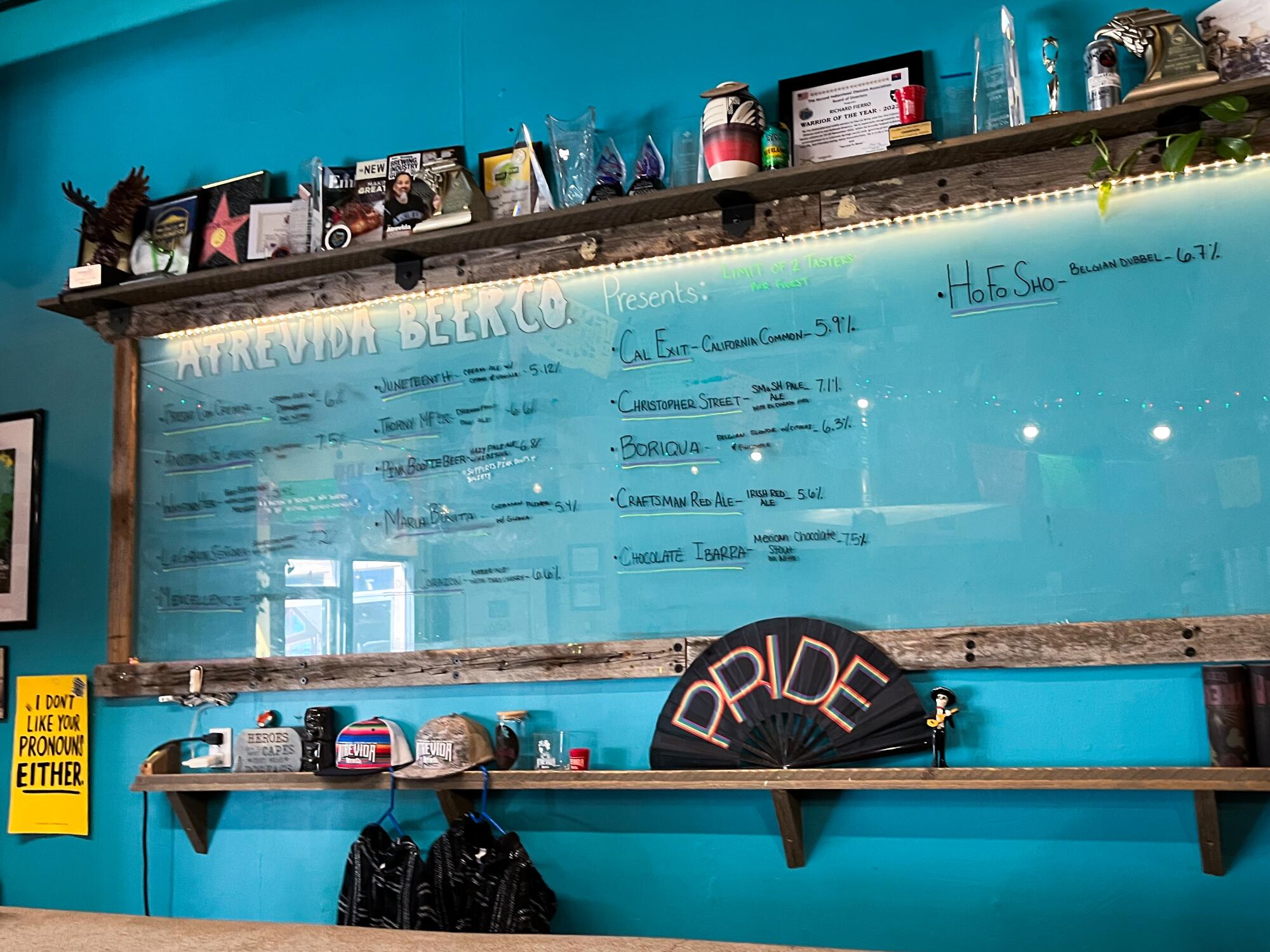
Chio Scott, a Hispanic Business Council Chamber board member, top left, and Jess Fierro attend a Colorado Springs Hispanic Chamber event at the Cheyenne Mountain Resort in Colorado Springs, Colo., on Aug. 17, 2024. Above, a view from the bar at Atrevida Beer Co. in Colorado Springs, Colo.
(Rachel Woolf / For The Times, Gustavo Arellano / Los Angeles Times)
“If you can’t stand in allyship with folks when no one’s looking,” she told me in 2018, “then what kind of person are you?”
I found the quote in one of my old notebooks. My story never published, because my mother was dying of cancer. But I promised the couple that I would return one day.
On a muggy Saturday afternoon — Day 4 of my road trip through the Southwest looking for the political soul of Latinos in a presidential election year — I found a radically transformed brewery.
It was twice as big, and there were more beers than ever. I remembered all the plaques and clippings celebrating Jess’ success. Now, there were new awards. One for “La Familia Valiente” — the Brave Family. Another that deemed Rich “Warrior of the Year.”
If you can’t stand in allyship with folks when no one’s looking, then what kind of person are you?
— Jess Fierro
On Nov. 19, 2022, a gunman stormed Club Q, Colorado Springs’ only LGBTQ+-friendly nightclub, killing five people and injuring 25. The Fierros were there to see a friend of their daughter, Kassy, perform in drag. Among the dead was Kassy’s boyfriend. The toll would have been worse if Rich hadn’t helped subdue the gunman. The national media anointed him with a label he immediately rejected: hero.
Atrevida was swarmed with orders for T-shirts and other memorabilia — a blessing and a curse for the Fierros, because what happens when the nation wants to think of you as anything but your business?
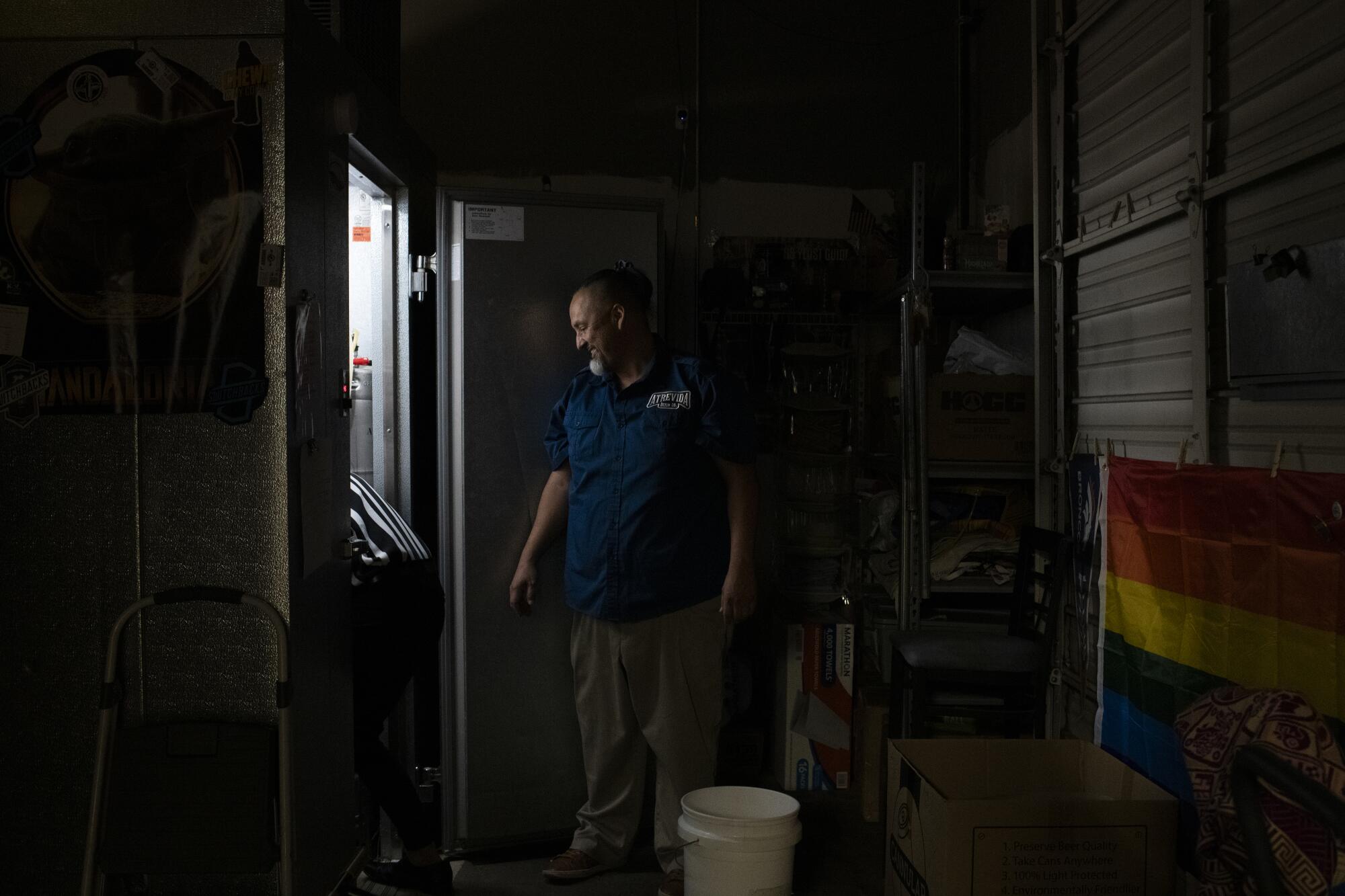
After finishing a delicious strawberry cream ale, I went to the back to greet Jess. The small fermenting tanks from my last visit had been replaced by much larger ones that she was planning to return because their tops wouldn’t open without hitting the ceiling. Rich was busy strapping down a kegerator on the back of his immaculate brown El Camino.
The couple were going to serve Atrevida suds at the summer gala for the Colorado Springs Hispanic Chamber, which calls itself the Concilio. She is the group’s chair, and he is also deeply involved. The Fierros still get requests to speak about their lives and that tragic night at Club Q. They might not like to be called heroes, but they gladly wear the label of leaders — and they want to inspire other Latinos to do the same, even as they’re still learning.
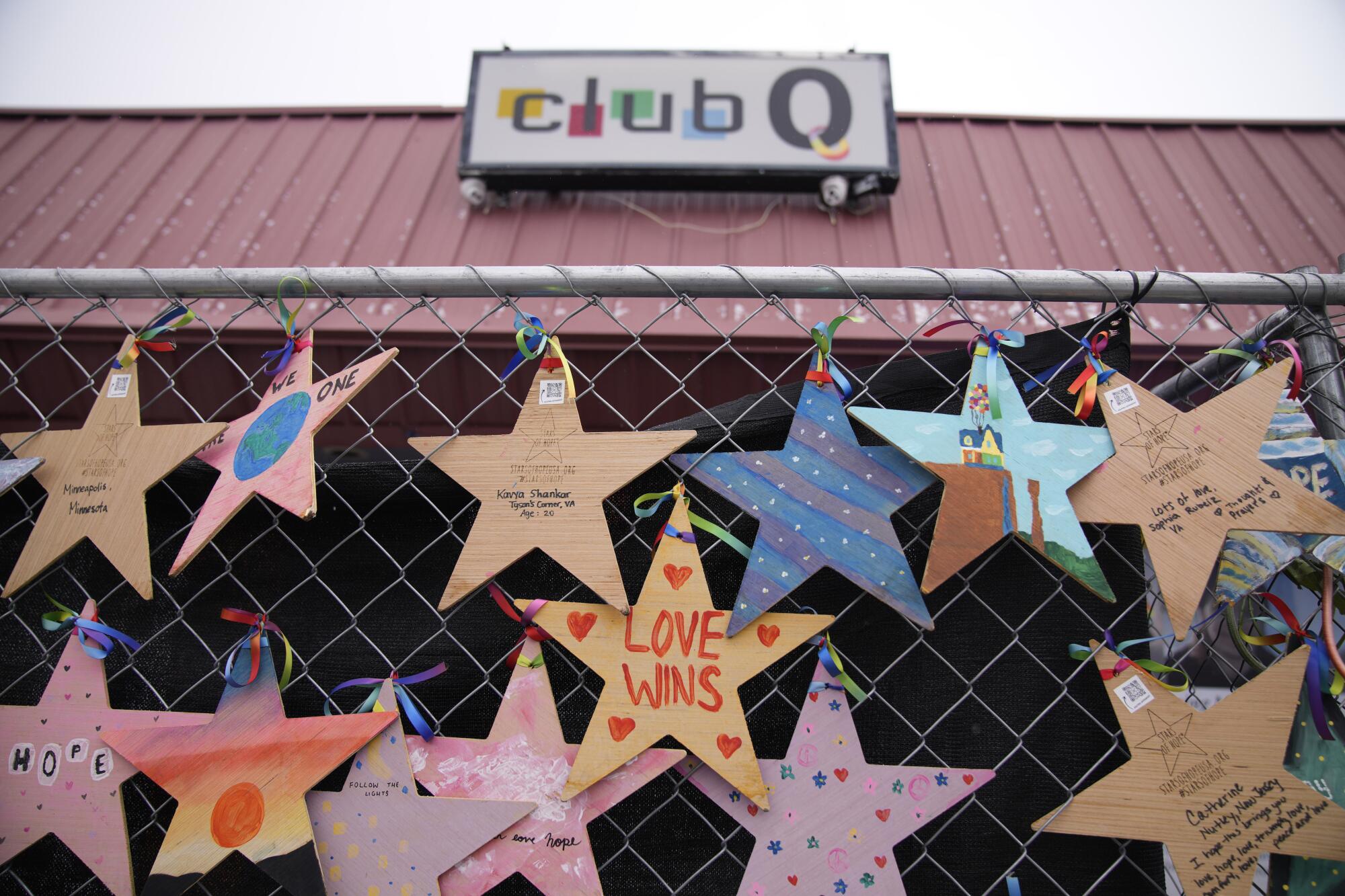
Jess and Rich Fierro still get requests to speak about their lives and the tragic night at Club Q, when a gunman massacred five people on Nov. 19, 2022. Rich helped subdue the shooter at the LGBTQ+ club in Colorado Springs, Colo.
(David Zalubowski / Associated Press)
“This is one of those scary rungs of the ladder that I’ve been able to mount,” said Jess, 47. Strong in voice and direct in temperament, she wore thick-framed glasses and a shiny red dress. Rich, also 47, in knee-length shorts and socks, blemish-free Nike Cortezes and a black Atrevida tank top, looked like a defensive lineman ready to kick it at the beach.
“So now I have to be that voice for representation in the areas that I’m at, because that’s where our community needs to be,” she continued. “You have to be loud and proud. It’s not enough to show up and say you’re here for the causa. You have to know why you show up.”

The Concilio gala was at a private country club within the Cheyenne Mountain Resort.
Lowriders lined the parking lot leading to the clubhouse, where the party would spread out next to the swimming pool and a small lake. A youth mariachi band and a baile folklorico troupe performed; a covers band played Chicano favorites such as War and Earth, Wind and Fire. Food and tequila stands offered free samples.
Small-business owners are the lifeblood of communities. A 2023 U.S. Treasury report showed that Latinos owned a quarter of all new businesses nationwide — proof of a people yearning for more. The shindig at first seemed like any other Hispanic chamber of commerce event, with people handing me business cards like dealers at a blackjack table.
But pride radiated like I’ve rarely seen. Colorado Springs is only 18% Latino, so the Concilio mixer felt like a family reunion, in spite of the location.

Ballet Folklorico De Barajas dancer Mary Jane Deleon performs at an August 2021 Colorado Springs Hispanic Chamber event at Cheyenne Mountain Resort in Colorado.
(Tom Cooper / Getty Images)
During introductions, an announcer pronounced “mariachi” as “marishi” and misgendered legendary East L.A. rockers Los Lobos “Las Lobos.” Country club members, almost all white and middle-aged and tanned, looked on quizzically from poolside lounge chairs.
“We need to show ourselves that we can lead,” said Julissa Soto, vice chair of the Concilio. She came to the U.S. from Mexico 27 years ago in the trunk of a car and now sits on the Colorado public health department’s Health Equity Commission. She jokes that she went “from nada to Prada.”
“I knew this country was not built for us,” she said. “That’s why we all need to step up. When you’re doing something, what goes around comes around, and people see it.”
The Concilio is nonpartisan, and its board members include both Republicans and Democrats. El Paso County, where Colorado Springs is located, has become more liberal as it has diversified but is still resolutely red. More than 50% went for Trump in 2020.
The Fierros are registered Democrats who plan to vote for Kamala Harris, but they don’t consider themselves partisans. This year, Atrevida hosted a taco truck run by a vocal Trump supporter, drawing complaints from some regulars.
Rich Fierro, right, and Taylor Salazar work on replacing a keg during a November 2023 event hosted by the Fierro family at Atrevida Beer Co. in Colorado Springs, Colo.
(Washington Post via Getty Images)
“I told them, ‘Go talk to him, and go eat some great tacos,’” Rich said. His grin was almost as wide as his shoulders. “You don’t have to agree, but we do have to learn from each other.”
He and Jess pointed people out. There went a former Orange County public defender who’s now on the Colorado Springs City Council. That guy runs a great restaurant. She’s a professor. He’s a small-business owner.
We were at the Atrevida booth, where workers and friends handed out rainbow-colored wristbands with the brewery’s name.
Suddenly, Rich got up. “I’m going to go fanboy,” he said.
As the Fierros slowly moved through the crowd, they kept getting stopped. There were hugs, there was small talk, there were thanks for their actions during the Club Q massacre. The couple acknowledged everyone but kept moving.
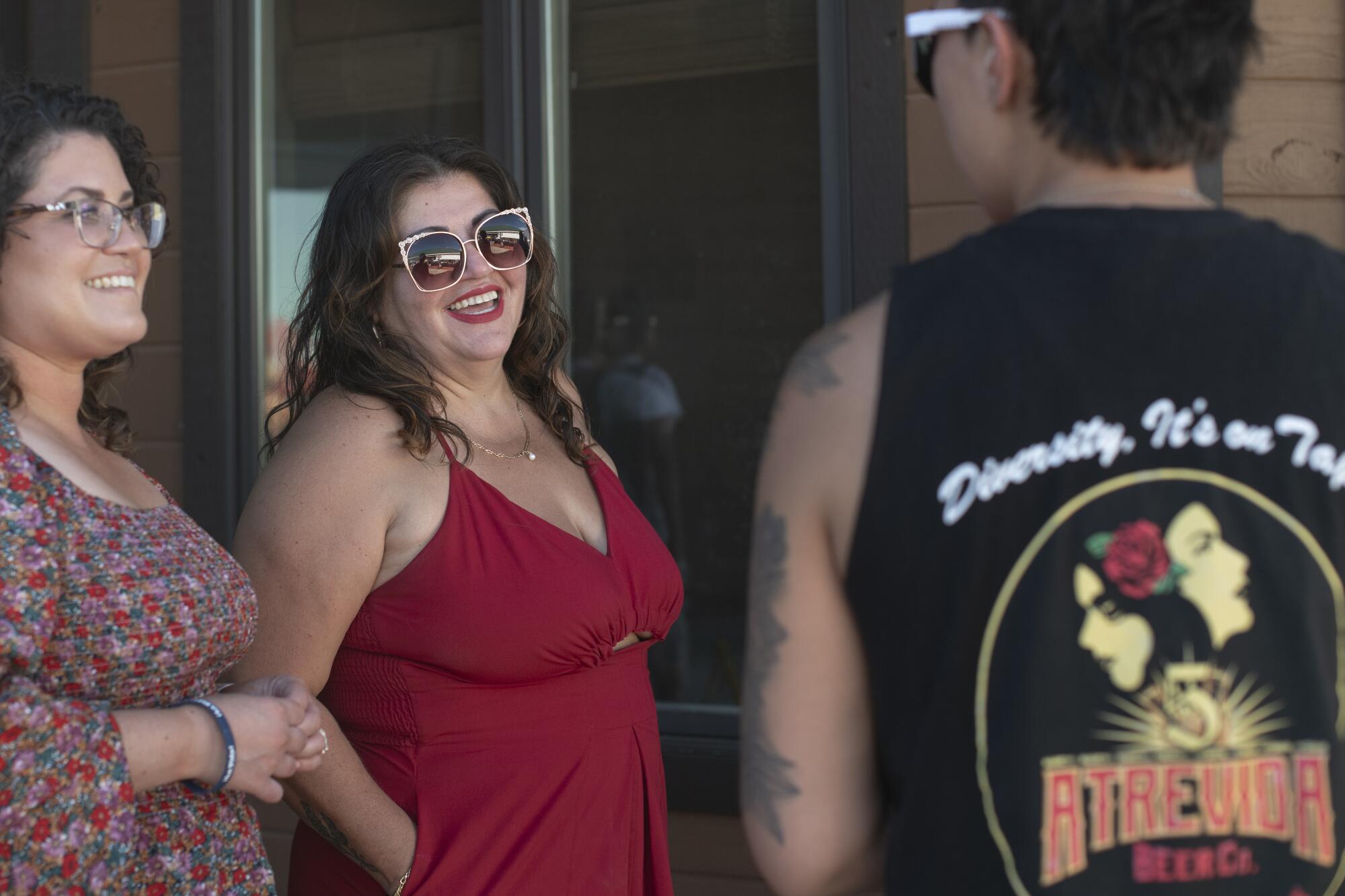
Joanne Law, from left, Jess Fierro and Taylor Salazar mingle at an Aug. 17, 2024, event in Colorado Springs, Colo.
(Rachel Woolf / For The Times)
He finally reached a VIP area, where Emilio Rivera — most famous for his roles in “Sons of Anarchy” and its spinoff, “Mayans M.C.” — was signing autographs. The actor didn’t know who Rich was, at first.
“Last name Fierro, like steel,” the brewery owner said as Rivera signed his Mayans M.C. T-shirt. It finally clicked, and the actor’s mood changed.
“I got to ask you a personal question,” Rivera said to Chip Law, a friend of the Fierros who also survived the Club Q massacre along with his wife. “How are you, mentally?”
“We take care of each other,” Law responded.
I knew this country was not built for us. That’s why we all need to step up.
— Julissa Soto
“On 9/11, all of us went to war,” Rich said. He gestured at his friend and referenced the date of the massacre. “On 11/19, we went to war.”
He now works for U.S. Space Command, the Department of Defense branch charged with safeguarding American interests in outer space. He travels around the country to talk to students about joining the program. The day after the Concilio shindig, he was flying to San Diego for a weeklong trek through Southern California schools.
“I’ve always wanted to do education — that was my [college] major,” he said while Rivera continued to greet fans. “But I just cussed too much, so I could never be a teacher. But now, I can. These kids get so excited. No one else from the federal government is talking to them. But we believe in them.”
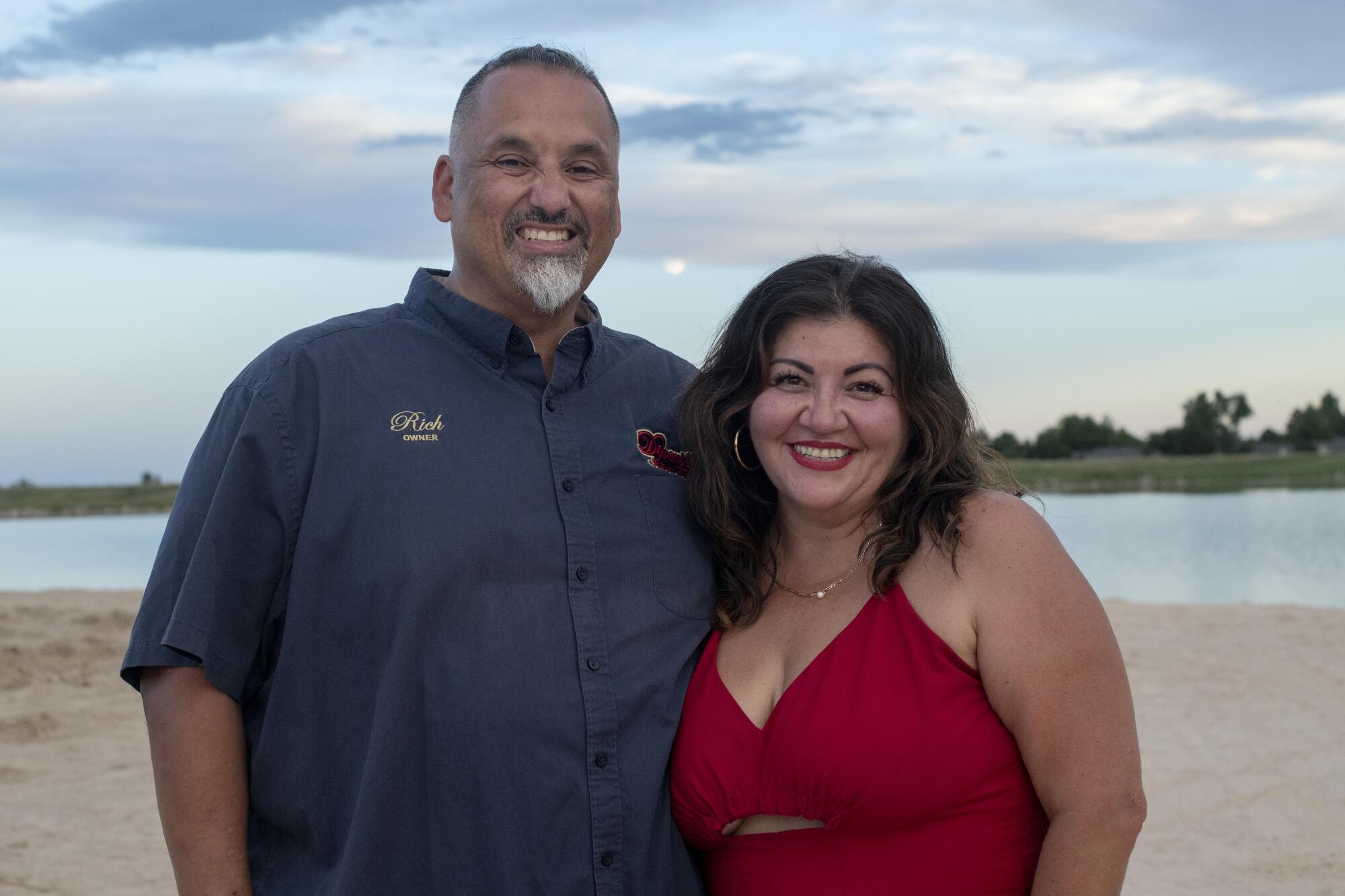
Rich and Jess Fierro have taken up roles in brewing, leadership and education. “It’s not about stepping up,” he said. “It’s about showing up.”
(Rachel Woolf / For The Times )
I mentioned that what he was doing was hero—
“Nope, nope,” he interjected, shaking his head in disagreement.
I clarified that I wasn’t going to call him a hero. But what the couple are doing — stepping up in Colorado Springs, in brewing, leadership and now in education — is heroic, and more Latinos need to follow their lead.
“It’s not about stepping up,” he said. “It’s about showing up.”
His wife joined us as more people approached. One of her former cosmetology students asked for advice on how to start his own salon. Someone invited her husband to talk to students. The Fierros smiled and networked, and networked some more.
I hugged them and took off, as even more people waited to talk about joining the Concilio.
Next time, I promised, my wife — a small-business owner herself — will join us. And I won’t introduce them as Jess and Rich Fierro, Club Q survivors and heroes.
They’re Jess and Rich Fierro, local leaders. We should all follow their lead.

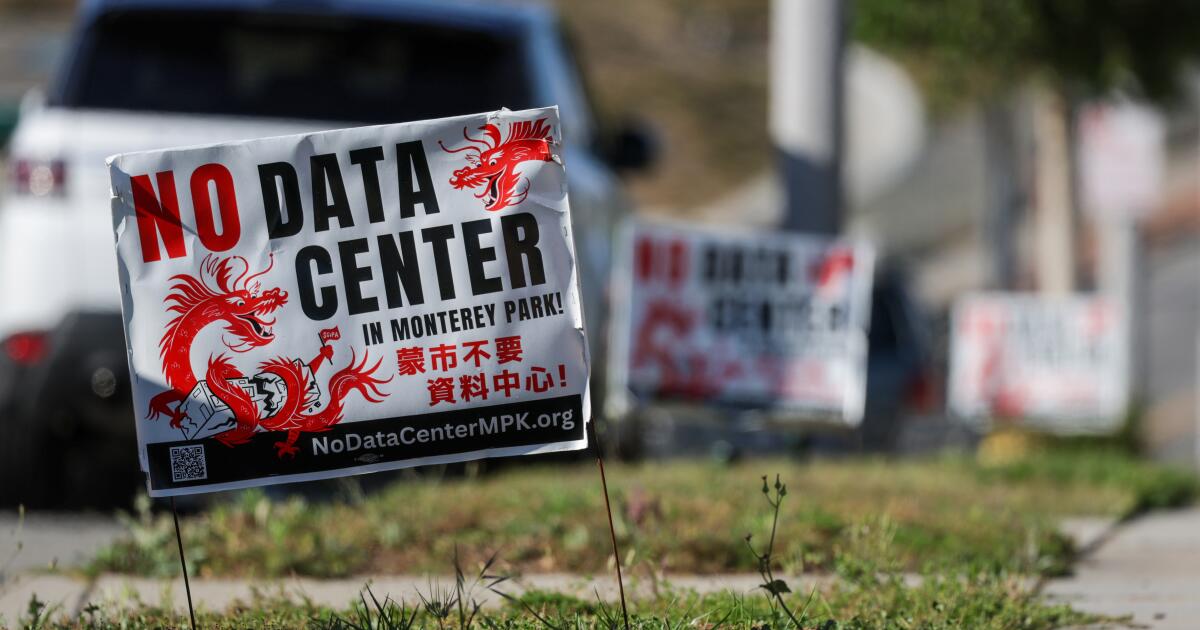
Residents of Monterey Park voted overwhelmingly to ban data centers on election day, making the San Gabriel Valley city the first in the nation to do so by public vote.
As of Wednesday, 86% of votes were in favor of Measure NDC, the city ban, according to the Los Angeles County registrar-recorder/county clerk.
Other cities and towns have passed moratoriums on data centers, as a wave of opposition sweeps the country. But the Monterey Park vote can only be overturned by another ballot measure, making it the most permanent data center ban in a jurisdiction.
Monterey Park’s City Council had already banned data centers by ordinance, after a proposed 247,000-square-foot data center met an outpouring of public anger and concern. The developer withdrew that plan.
That facility would have been less than 500 feet away from the nearest home, and would have used three times the electricity of the entire 60,000-person city. Residents said it would have caused noise and air pollution and driven up electricity rates.
“This ensures long-lasting protections for current and future generations,” Amy Wong, co-founder of the group San Gabriel Valley Progressive Action, said of the vote. “It means that future city councils cannot overturn a data center ban, even if data center developers wanted to spend money to fund pro-data center candidates.”
The measure had no formal opposition. The developer of the proposed facility, investment firm HMC StratCap, said it wouldn’t engage in the ballot fight when it withdrew in March.
The Data Center Coalition, an industry trade group, expressed disappointment in the vote.
“It sends a signal that the area is closed for business, both for data centers and for other significant economic development projects,” state policy director Khara Boender said.
“It deprives local residents of the opportunity to compete for jobs and investment, while also causing the area to relinquish substantial long-term economic investment, high-wage jobs, and critical tax revenue to neighboring areas or other states.”
SGV Progressive Action worked with hyperlocal groups including No Data Center Monterey Park to rally support for the measure.
The group is now focused on stopping data center proposals in the City of Industry and fighting a move by City of Industry, Santa Fe Springs, Vernon and City of Commerce to welcome data centers and other industry with fast-tracked permitting and tax incentives.
City of Industry, in the San Gabriel Valley, and Vernon, south of downtown L.A., are primarily industrial areas, each with around 300 permanent residents. They are employment centers, and tens of thousands of workers commute in daily.
There has been little vocal opposition to data centers among the few residents of these cities. Wong said the protest is primarily coming from the surrounding neighborhoods.
“If a data center gets built in City of Industry, residents across the region would bear the brunt of pollution and increased utility costs,” Wong said, noting that it is surrounded by 16 other cities and unincorporated communities.
Data center proposals have been limited in California compared to Virginia, Texas, Georgia, Illinois and Arizona, which sit at the center of a recent boom in hyperscaler facilities to power artificial intelligence.
California has the third-most data centers in the country, with 300, but high electricity rates, expensive land and regulatory hurdles mean that fewer, and smaller, facilities are currently planned than in other hotspots.
That doesn’t mean opposition hasn’t been fierce. In Coachella and Imperial County, residents are showing up in droves to protest local proposals.
In the San Gabriel Valley, Montebello, El Monte and Baldwin Park have all enacted temporary moratoriums, and Alhambra recently banned data centers as part of a zoning code update.
Wong said she hoped the ballot measure vote would galvanize the opposition. “The vote is a testament to the people power of our region,” she said. “Our region is worth protecting, and we won’t let data centers determine our future.”

A rule intended to prevent rent gouging in the wake of the Eaton and Palisades fires has lapsed in Los Angeles County, possibly exposing some renters to hikes.
The executive order that blocked rent increases was issued by Gov. Gavin Newsom amid the devastating wildfires last year. Under the order, landlords couldn’t increase rents by more than 10% above their prefire levels.
The rule, which was supposed to be temporary and was repeatedly extended, ended Friday after a vote to extend it again failed to garner enough votes. Supervisor Lindsey Horvath, whose district includes Pacific Palisades, sounded the alarm in a motion to extend price protections that failed to pass at the Board of Supervisors’ May 19 meeting.
“These price gouging protections continue to be necessary as construction and rebuilding continue, and as thousands of people remain displaced,” the motion said. “Families which signed short-term leases could face drastic price increases of 50% or more without further price gouging protection.”
Los Angeles County is home to more than 1 million rental properties, though not all of them needed protection from the new rule. There are already stricter rent increase caps for many residences, depending on the location, type and age of the building. Despite the rent control in the region, the people of Los Angeles pay among the highest rents in the country.
It is uncertain whether renters will face rapidly rising rents now that the protection has lapsed. But some real estate experts and policymakers said there was no need for the temporary rule that was part of the governor’s state of emergency.
Supervisors Kathryn Barger, Janice Hahn and Holly Mitchell abstained from voting on the motion to extend the protection, while Supervisors Hilda Solis and Horvath supported it.
“I abstained because I did not see sufficient evidence to justify extending this emergency ordinance, nor did I see evidence to eliminate it entirely,” Hahn said.
Barger’s office said she supported allowing the protections to sunset while waiting to see whether new information emerged.
“Market data already shows countywide rents are only about 2% above pre-emergency levels and rental inventory has grown,” Barger representative Helen E. Chavez Garcia said. “The Supervisor is also mindful of the burden these ongoing protections place on small property owners throughout the county.”
Mitchell did not immediately respond to a request for comment.
There haven’t been steep rent hikes in neighborhoods within three miles of the Palisades fire, according to a Times analysis of data from Zillow, the property listing company.
In ZIP Codes within three miles of the Palisades fire, rent increased 4.8% from December 2024 to April 2025. In areas around the Eaton fire, which destroyed swaths of Altadena, rent jumped 5.2% in the same period.
In L.A. County, ZIP Codes farther from the fires saw only about a 2% increase.
A landlords representative, Jesus Rojas of the Apartment Owners Assn. of Greater Los Angeles, told the supervisors during public comment at the meeting that the county’s rent-gouging rules have “long outlived the emergency they were intended to address” and are now being “wrongfully used to harm thousands of rental housing providers throughout the county.”
“There is no proof that multifamily rental housing providers are hugely increasing rents for impacted homeowners,” Rojas said.
Indeed, there are strong signs that the property market in the Los Angeles area has at last begun to cool.
L.A. metro-area rent prices recently fell to a four-year low, with the median rent slipping to $2,167 in December.
Meanwhile, condominium sales had their slowest start of the year in decades. Condo sales in Los Angeles have plummeted to a 20-year low, with fewer than 2,000 units sold in January and February — the worst start to the year since 2005.
Newsom defended the price-gouging protections shortly after they went into effect.
“In the days following the Los Angeles firestorms, we worked quickly to protect Los Angeles survivors from any form of exploitation,” he said in February 2025. “The state has the tools in place to not only block price gouging during this emergency, but also to prosecute bad actors.”
The Los Angeles County Department of Consumer and Business Affairs said it received more than 2,000 complaints after the fires, alleging that retailers and landlords were taking advantage of people put in hardship by their losses, and sent out more than 2,000 cease-and-desist letters to businesses and landlords for alleged price gouging, said Morine Merritt, who oversees department investigations into consumer and real estate fraud.
“Close to 90% of the complaints that we received involved allegations of rent increases,” Merritt said in an interview. Now that the fire-related protections have expired, existing laws and “regular market conditions determine price increases for goods and services, including rents,” she said.
Crackdowns on fire-related rent gouging have been rare, said Chelsea Kirk of the activist organization the Rent Brigade, which analyzed L.A. County’s rental market in the year after the fires. It reported 18,360 potential examples of price gouging in listings but said that few lawsuits had been filed by authorities so far.
Last week, Rent Brigade announced what it said was the first private civil lawsuit brought by a family that claimed to be rent-gouged in the aftermath of the wildfires. Plaintiffs Randall and Candy Renick, whose Altadena home was damaged, said they were charged nearly three times the maximum permitted rate for nearly 10 months. They seek restitution of $96,000 plus civil penalties and attorneys’ fees.
The rental market has probably stabilized since the fires, Kirk said, but other families may still be “locked into illegal rents” that they agreed to pay when they were in a rush to find housing after they were displaced.


Dear Mr. Pelley:
I meant what I said in my letter last week to the 60 Minutes team: joining 60 Minutes is the honor of my career and I am grateful to be working alongside the people who have contributed to the most important television journalism brand this country has ever produced. While I’m new to 60 Minutes, I’ve devoted my career to investigative journalism and storytelling. I started this job excited to collaborate and to benefit from the wisdom and experience of the 60 Minutes veterans, with you among them. For that reason, one of the first things I did in my new role was call you to talk and invite you to dinner. It is a profound disappointment that you rejected that overture and chose ambush instead. Yesterday, you hijacked my first meeting with staff to disparage me, my qualifications, and my intentions with remarkable incivility and contempt. I welcome a diversity of viewpoints and respectful debate among the team, but this was nothing of the sort. Yesterday’s performative display of hostility enacted in front of the staff instead of in a civil, private conversation-demonstrated that you have no interest in contributing to the future success of the show, or approaching my new tenure with a mind open to collaboration and progress. I am here to deliver first-in-class news programming, not to make headlines about newsroom drama. I am eager to work alongside those who share this goal.
Despite yesterday’s misconduct, I had hoped that in sitting down with you today we could find a path forward together. You made clear that you are not interested in such a path.
Your antipathy to the future of the show has come through loud and clear. And I have heard you. I therefore write on behalf of CBS News, Inc. (“CBS”) to inform you that your employment with CBS is terminated for cause effective immediately. Enclosed is your formal termination letter.
Sincerely,
Nick Bilton
Executive Producer, 60 Minutes
-
 Sports8 minutes ago
The Ball brothers’ head coach at Chino Hills, Steve Baik, is the new coach at Calabasas
-
World18 minutes ago
Social media operation linked to Iran manipulated public through fake Irish and Scottish profiles
-
 News45 minutes ago
National Guard has done little to reduce violent crime in D.C., a new study finds
-

 Los Angeles, Ca2 hours ago
Man claiming to be armed robs Culver City bank, gets away with $10,000
-

 Detroit, MI2 hours ago
Fired Detroit TV anchor Taryn Asher files sex discrimination lawsuit against old station, claims new GM protected men
-

 San Francisco, CA3 hours ago
San Francisco family devastated as they face nearly 90% rent increase
-

 Dallas, TX3 hours ago
Wings’ top pick Azzi Fudd hosts clinic as Cash App donates to Dallas nonprofit
-

 Miami, FL3 hours ago
Patients left scrambling for care after Miami-Dade woman accused of operating an unlicensed surgery recovery center

