Business
Here’s who is running in the heated race for insurance commissioner

In a typical election year, the interest in the down-ballot race for California insurance commissioner musters modest interest at best.
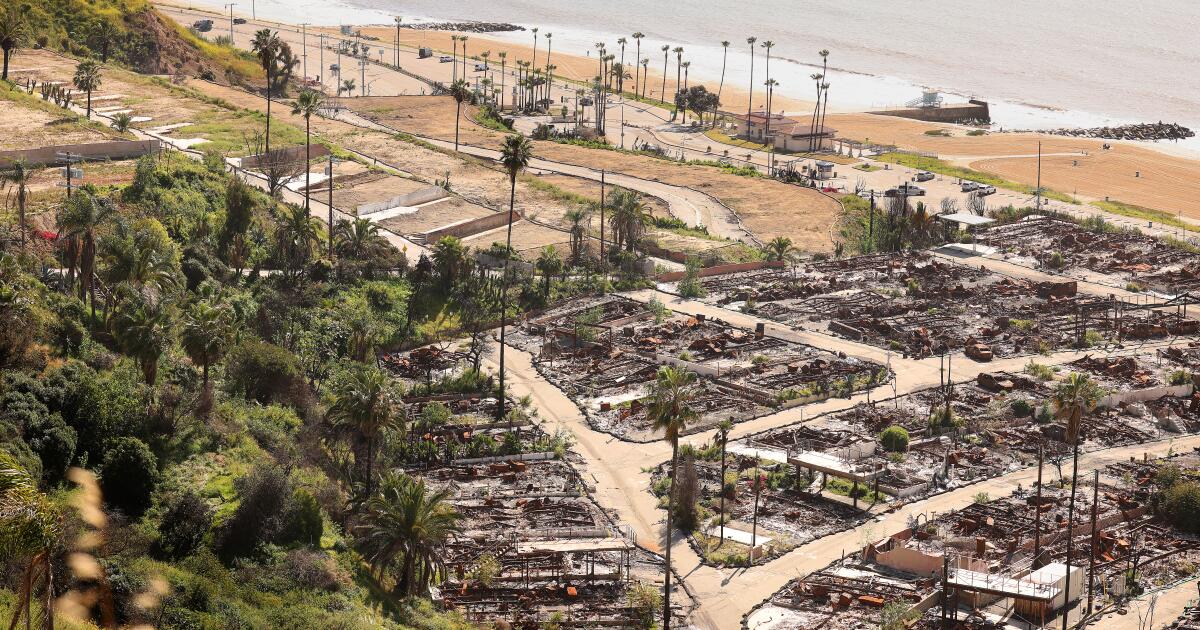
That all changed on Jan. 7, 2025, when wildfires swept through L.A. County, damaging or destroying more than 18,000 homes and killing at least 31 people.
The resulting anger directed at the insurance industry over how it has handled claims has helped draw four Democrats into the race, who will be vying this weekend for a critical endorsement at the party’s annual convention in San Francisco ahead of the June 2 primary election.
“We haven’t seen this level of competition and, frankly, choice on the Democratic side since it first became an elected office in 1990,” said Jamie Court, president of Consumer Watchdog, a Los Angeles insurance advocacy group. “They represent wide-ranging views and a broad diversity of candidates.”
Up for endorsement are state Sen. Benjamin Allen (D-Santa Monica), whose district includes the Palisades fire zone; former San Francisco Supervisor Jane Kim; former state Sen. Steven Bradford; and San Francisco businessman Patrick Wolff, who has not held elective office.
Three Republicans have declared their candidacies, but that party’s convention isn’t until April. The filing deadline to file for the race is March 6.
The GOP field includes businessman Robert Howell, who lost by 20 points in the 2022 general election to current Insurance Commissioner Ricardo Lara. Also running are insurance agent Stacy Korsgaden from Grover Beach, and attorney Merritt Farren, whose Pacific Palisades home burned down.
Peace and Freedom Party candidate Eduardo Vargas, a Los Angeles school teacher, is on the ballot too.
The race also follows Lara’s two troubled terms in office, during which he has been accused of cozying up to and receiving money from the insurance industry for his first campaign and conferences abroad.
Lara has denied any wrongdoing, and all the Democratic candidates have vowed not to accept insurance industry donations.
“For me and maybe for many survivors, it’s not a position that we ever thought much about, but now with many of our lives devastated by our dealings with insurers I think many survivors will be watching much more closely this time around,” said Joy Chen, executive director of the Eaton Fire Survivors Network, a community group that has accused Lara of being soft on insurers and has called for his resignation.
Allen was perceived by some as the leading candidate for the party’s nomination when he announced his candidacy in September. He has held his seat for more than a decade and is the only sitting legislator in the race. He said he would not be running if not for the wildfire that struck his district.
“The fire certainly was a searing experience, helping hundreds of people get their claims paid right, but it kind of begs the question of why should you have to call your state senator to get treated right,” he said.
Allen’s platform includes a number of ideas to ensure policyholders are treated better, including requiring insurers to clearly explain claim denials. But also key to his campaign is stabilizing an insurance market that over the last several years has seen insurers drop policyholders by the hundreds of thousands, especially in fire-prone neighborhoods.
That forced them onto the California FAIR Plan, the insurer of last resort. It’s rolls grew even more since the January fires and the insurer has been sued by fire victims over its claims practices. Allen wants to build insurer confidence in the market by having insurer requests for rate hikes reviewed in months, rather than the year or more they can drag out now.
He also points to his legislative record, especially his authorship of Proposition 4, which was approved by voters in 2024 and set aside $10 billion in general obligation bonds to fund climate resiliency and environmental protection projects — an important part, he said, of lowering insurance risks.
Allen has drawn a key endorsement from California Sen. Adam Schiff and as of Dec. 31 had about $1 million in the bank, more than any other candidate. But the race was shook up last month when progressive politician Kim declared her candidacy. She boasted an endorsement from U.S. Sen. Bernie Sanders (I-Vt.), for whom she worked as his California political director during the 2020 presidential campaign.
She also has drawn attention for a plan to create a state-run disaster insurance policy for Californians.
Residents would continue to buy regular home insurance from the commercial market but would buy coverage for wildfires and other disasters from the state, similar to plans in some other countries.
The idea has come under sharp criticism from Court, who said it will shift the risk of costly disasters to taxpayers while allowing insurers to make profits from the more predictable end of the home insurance market.
“We have to explore some different models, because the current system is not working. It’s too expensive and a market failure,” said Kim, adding that the plan could evolve.
Bradford, who represented communities in south L.A County and the South Bay in the Legislature, has been endorsed by L.A. Mayor Karen Bass. He said he’s running as a pragmatist and unifier.
“What we’ve been doing for far too long has been a whole lot of finger pointing and doing the blame game,” he said.
Bradford wants insurers to open their pricing books and give homeowners “real, guaranteed” premium discounts for upgrading their property.
He also is proposing a public–private partnership that shares the risk for insurers who write policies in fire-prone neighborhoods.
Wolff, a political newcomer, is a Chartered Financial Analyst, real estate investor and former hedge manager who cites his experience building a home and auto insurance brokerage for financial services firm Capital One.
“I spent the first half of 2025 really deeply studying the commissioner’s role and the history, and the race — the politics of everything. And after really doing that deep dive, I decided to step forward,” said Wolff, who wrote his campaign a $500,000 check and loaned it another $100,000.
He also thinks rate hikes sought by insurers need to be reviewed more quickly but wants the insurance department to publish annual reports on how specific companies handled claims.
“The insurance industry has basically lobbied to keep that data anonymous at the company level, and I think it’s really important to make that information public,” Wolff said.
Under California’s open primary system, the top two candidates will move on to the Nov. 3 general election, which means two Democrats could run up against each other if a Republican isn’t able to consolidate the GOP vote.
Steve Maviglio, a longtime political consultant currently working for State Treasure Fiona Ma, who is seeking the office of lieutenant governor, said that the race is wide open.
“This is a statewide election with millions of people with candidates they’ve never heard of,” he said.
With multiple candidates seeking the endorsement, it may be hard for any single one to reach the 60% threshold of delegate votes needed.
“If no one is endorsed, somebody is going to have to be the breakout candidate, and the way you do that is with money or organization,” Maviglio said. “Until I see that happen, it’s totally up in the air.”

Johnny Beig may have played in a semi professional cricket league in Australia, but this summer he’s a big fan of soccer in the United States.
It’s not just because he’s rooting for the World Cup team, though.
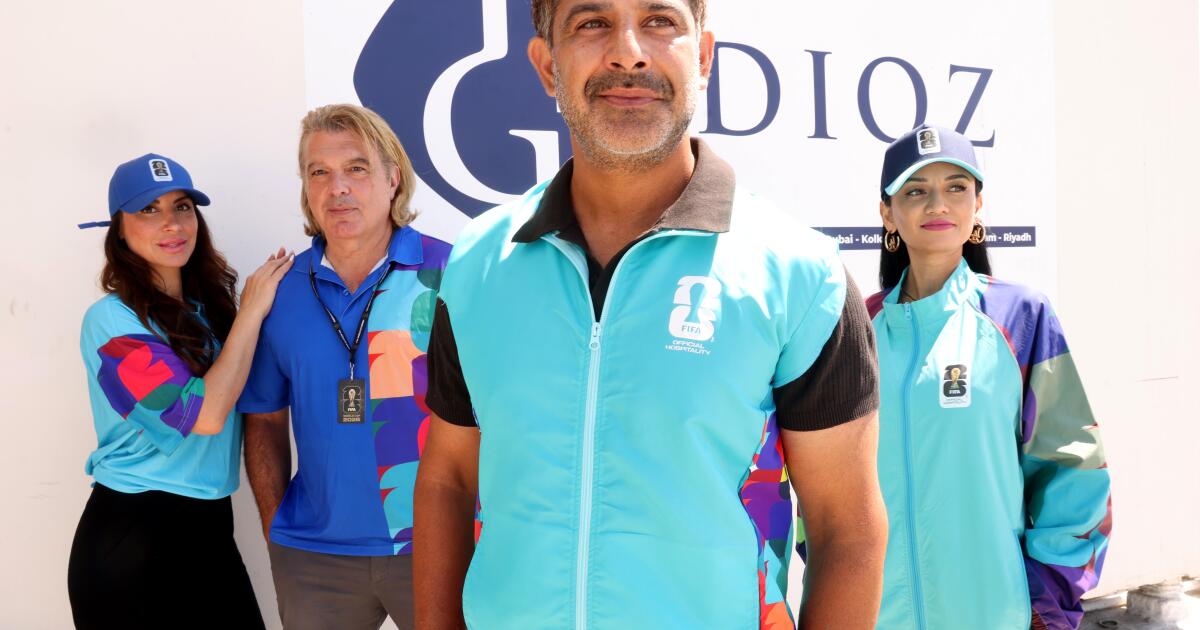
FIFA emblems are featured on jerseys that were created by the Dioz Group and distributed for all employees at the 16 FIFA World Cup venues this summer.
(Genaro Molina / Los Angeles Times)
Last year, Beig’s Beverly Hills-based company, Dioz Group, won a $2.5 million contract with On Location, FIFA’s hospitality partner, to design, manufacture and distribute uniforms for all employees working at FIFA World Cup venues this summer.
These include the people welcoming attendees into stadiums, VIP lounge chefs, waiters and the flagbearers during the opening ceremony.
After a multi-step application process, including presentations of its planning and strategy, Dioz says it produced more than 50,000 clothing garments including suits, jackets, shirts and hats and delivered them to the 16 World Cup venues around the U.S., Canada and Mexico in June.
Thanks in part to the World Cup contract, the company’s revenue has reached $15 million so far this year, compared with $20 million last year, Beig said. He declined to disclose the company’s net income but said the business was profitable.
“We are working with larger names that we would have never imagined we would,” he said. “The FIFA World Cup is the pinnacle. Working with the largest sporting event in the world is what we’re very proud of. I don’t think it gets any bigger than that.”

Volunteers line up to prepare to display the Canadian flag before a World Cup round of 32 knock-out match between Canada and South Africa at SoFi Stadium on Sunday.
(Kelvin Kuo / Los Angeles Times)
Dioz is among the many small businesses across Los Angeles that are getting a boost from the global sporting event, said Kevin Klowden, a senior fellow at the Milken Institute.
The influx of hundreds of thousands of fans into the city has been a boon to hotels, transportation services and restaurants, in addition to those in the special events and logistics economy, Klowden said, calling the event the “equivalent of multiple Super Bowls.”
“The number of contracts that are there, it’s a big deal,” he said. “Given the fact that L.A.’s filming is only slowly recovering, having something like the World Cup is definitely a boost.”
Dioz was co-founded by Johnny, 44, and his brother Tony in 2006. The brothers were born in India and raised in Australia, where Johnny enjoyed a brief career as a semi professional cricket player.
He realized his future wasn’t as a professional athlete, but he wanted to stay connected to the sports world, so he began making uniforms for his cricket team in 2006.
He then got a referral to make uniforms for multiple teams in the area before starting an apparel company.
“I wanted to stick with something I was passionate about, which is sports,” he said.

Volunteers unravel the center field display before a World Cup round of 32 knock-out match between Canada and South Africa at SoFi Stadium on Sunday.
(Ronaldo Bolanos / Los Angeles Times)
In 2012, Beig moved to Los Angeles and established Dioz‘s Los Angeles headquarters to tap into the U.S. market. During the pandemic, the company started supplying medical apparel to hospitals and schools, and the business took off, with revenue doubling in 2020, Beig said.
Dioz now has over 150 employees, including 15 in L.A., and manufactures its apparel at factories in China, India, Bangladesh, Turkey and the Philippines. Tony runs an office in Dubai.
Before the World Cup, Dioz provided employee uniforms for events including Super Bowl LIX and Copa America, which may have given it a leg up on the FIFA contact.
Now, with a World Cup contract on their resume, Beig said he’s setting his sights on even bigger events.
“This gives us an edge over the next FIFA events worldwide as well, where we can showcase our skills and we can handle it,” Beig said. “So it gives us a good opportunity to work with sporting events like the UEFA Championship and Premier League.”
As companies get new business from the World Cup, Klowden said it’s important that they leverage their new position to continue that growth.
Companies that benefited from the World Cup might be in a position to bid on even bigger contracts, especially with the Olympics coming up in 2028, Klowden said.
“The really important part in any of these deals is that if a company ran something like this, then they are able to build off of that success,” Klowden said. “Let’s say you’re a company that did a big uniform order or a big food order, and the World Cup goes, and you invested in new manufacturing capacity, or you invested in new clothing machines, or whatever you do; suddenly you don’t have that market anymore, then you’ve just wasted all that money ramping up.”
Surcharges that California homeowners have been hit with statewide by insurers defraying the costs of Los Angeles County’s wildfires were ruled legal in a decision released late Tuesday.
L.A. County Superior Court Judge Tiana Murillo turned down a petition by advocacy group Consumer Watchdog to halt the charges, which insurers began levying last year after the state’s insurer of last resort couldn’t pay all its January 2025 fire claims.
The California FAIR Plan, financially backed and operated by the state’s licensed home insurers, needed a $1-billion bailout from the insurers after it was hit with some $4 billion in claims.
Under a deal Insurance Commissioner Ricardo Lara worked out with the FAIR Plan in 2024, the insurers could seek state approval to surcharge their residential policyholders for up to half of any assessment totaling $1 billion in case the plan needed a bailout in an “extreme worst case scenario” — as it turned out it did.
A total of 105 insurers, including State Farm General — California’s largest home insurer — Farmers and Mercury sought and received approval for the surcharges.
Because the FAIR Plan assessed its member insurers based on their share of the state’s home insurance market, the policyholder surcharges were in the same ballpark. The median fee for homeowners was $28, according to the department of insurance.
The fee can be more or less according to the size of a homeowner’s premium and is split into monthly payments that insurers can spread over one or two years. Condo owners and renters on average were surcharged less.
In a court filing, Consumer Watchdog said $420 million in surcharges were approved.
In its April 2025 lawsuit filed against Lara, the Los Angeles group made a series of arguments in seeking to overturn the residential surcharges, which it deemed an industry bailout. It did not sue over related commercial surcharges.
Consumer Watchdog contended in its lawsuit that the surcharges violated Proposition 103 — the 1988 measure that governs insurer rate hikes — because the proposition does not allow for them.
It also claimed Lara did not follow regulatory protocol in promulgating the new policy.
The group further alleged that the FAIR Plan’s governing statutes do not give Lara the authority to permit the surcharges — and that the statutes require insurers to share in the plan’s profits and losses, and not shift losses to policyholders.
Murillo, and another judge who previously heard the case, turned down all of the consumer group’s arguments in separate rulings, the last of which Murillo issued Tuesday night.
Lara celebrated his legal victory over Consumer Watchdog, which has accused Lara of having close ties to insurers and sought to oust him from office. His terms ends in January.
“This victory sends a loud and clear message: The era of allowing special interests to derail consumer choice is over. We have the momentum, we have the authority, and we will continue to fight until every Californian has access to the coverage they deserve,” Lara said in a statement.
Attorney Will Pletcher, litigation director of Consumer Watchdog, said the group disagreed with the decision and would “consider all options to move this forward.”
“It’s important to try to protect California consumers from these surcharges that we think are in pretty clear conflict with both Proposition 103 and the FAIR Plan,” he said.
Hilary McLean, a spokesperson for the plan, said in a statement it did not have any position on the ruling, given the plan “does not have a role in determining how insurers manage costs associated with assessment.”
Denni Ritter, vice president of state government relations for the American Property Casualty Insurance Assn., a major industry trade group, said the decision rejected “the reckless lawsuit brought by the self-interested group Consumer Watchdog…”
“This ruling preserves a vital tool to protect the stability of the California insurance market. Blocking cost recovery would have undermined the state’s last-resort coverage option,” she said in a statement.
The 2024 policy was issued in response to the rapid growth of the plan due to a series of wildfires over the last decade that prompted multiple insurers to retreat from the state’s home insurance market.
The plan had 264,000 homeowners on its rolls in September 2022, a figure that rose to 452,0000 in the months before the fires — and its residential policyholders have since increased to 663,000 as of March.
The FAIR Plan offers policies that typically cost more than those issued by regular insurers while offering less coverage.
A Times analysis last year found that in the Palisades and Eaton fire zones, the plan’s rolls nearly doubled to 28,440 from 2020 to 2024.
That concentration of policyholders led to the plan’s large losses during the Jan. 7 wildfires, which damaged or destroyed more than 18,000 structures, killing at least 31 people.
It’s been estimated that the insured losses for the wildfires could ultimately total as much as $40 billion, exceeding any past wildfires worldwide. Ritter said that so far insurers have paid $23.7 billion in claims.
The 2025 wildfires were not the only time the FAIR Plan has needed a bailout, though it is the first time its member insurers surcharged policyholders.
In 1993, it assessed carriers after fires in Altadena and Malibu, and in 1994 it did so after the Northridge earthquake. The assessments totaled $260 million.
The plan received approval this year from the insurance department for a 29% rate increase for its homeowner dwelling policy that will take effect in October.

An electric Tesla Semi truck crashed into two vehicles in Dayton, Nev., over the weekend, killing two people and raising questions about the truck’s safety features.
The Lyon County Sheriff’s Office responded to a major collision around 7 a.m. on Sunday at the intersection of Highway 50 and Traditions Parkway about 40 miles east of Reno, the office said.
The office confirmed a semi-truck was involved in the accident, and footage of the scene shows it was a Tesla Semi.
It is the first known crash involving a Tesla Semi, an electric Class 8 truck that Tesla is building in Nevada and plans to ramp up production of. As interest in Tesla’s electric passenger vehicles wanes, the company is betting on the truck to give it a needed boost.
The trucks do not have the Full Self-Driving mode available in Tesla cars, but Tesla’s website says they come standard “with active safety features that pair with advanced motor and brake controls to deliver traction and stability in all conditions.”
According to the Lyon County Sheriff’s Office, preliminary statements obtained at the scene suggest the truck driver may have fallen asleep behind the wheel.
The crash is under investigation by the Nevada State Police Highway Patrol, which said additional information may be released next week.
The Record-Courier identified the victims as Sergio and Jennifer Villanueva, a couple who got married in 2022.
Tesla has not clarified if its semitruck has an automatic emergency braking system. Federal regulators are currently weighing a mandate for emergency braking systems in vehicles more than 10,000 pounds.
-

 Los Angeles, Ca1 hour ago
Wildfire burning on hillside near Cal State San Bernardino
-

 Detroit, MI2 hours ago
Pistons sign premier shot-blocker to two-way contract
-

 San Francisco, CA2 hours ago
1 dead, 1 injured in Bay Point shooting; suspect sought
-

 Dallas, TX2 hours ago
Viral video shows Egypt coach, team director in Dallas police confrontation
-

 Miami, FL2 hours ago
Fourth of July celebrations planned across South Florida for America’s 250th birthday
-

 Boston, MA2 hours ago
‘Forever grateful for all we accomplished together’: Jayson Tatum speaks out about Jaylen Brown trade – Boston News, Weather, Sports | WHDH 7News
-

 Denver, CO2 hours ago
Nations Cup in Colorado another showcase for Denver’s bid to host the 2031 Rugby World Cup
-

 Seattle, WA2 hours ago
USA Coach Mauricio Pochettino To Throw Out First Pitch At Seattle Mariners Game

