Business
Here’s how the 2025 legislative session closed: The lowdown on the environment


Gov. Gavin Newsom wrapped up the 2025 legislative session with the usual flurry of activity, signing several important environmental, energy and climate bills and vetoing others ahead of Monday’s deadline.
Among the newest laws in California are efforts to accelerate clean energy projects and advance the state’s position as a climate leader — but also decisions to ramp up oil drilling and reject the phase-out of forever chemicals.
Here’s a look at what happened this year:
In September, Newsom signed a blockbuster suite of bills including the reauthorization of California’s signature cap-and-trade program, which sets limits on greenhouse gas emissions and lets large polluters buy and sell emissions allowances at quarterly auctions. The Legislature extended the program by 15 years to 2045, rebranded it as “cap-and-invest” and specified how its revenues will be allocated for wildfire prevention efforts, high-speed rail and other projects.
The greenhouse gas trading program is seen as essential for the state to meet its climate targets, including reaching carbon neutrality by 2045.
“California really needed to act this year to decisively try to put in policies to meet our climate goals [and support] the economy and different sectors,” said Susan Nedell, senior western advocate with the nonpartisan policy group E2. She called state legislative efforts especially important as the Trump administration aims to erode California’s authority on tailpipe emission standards, electric vehicle initiatives and renewable energy projects, among others.
“This is the time for California to lead, and I really feel like they came through on it as a state,” Nedell said.
WHAT ELSE BECAME LAW
- One of the more controversial bills of the year was Senate Bill 237, which makes it easier to drill up to 2,000 new oil wells in Kern County. It’s a tradeoff that also makes it more difficult to drill new oil or gas wells offshore. Legislators said it will help address the volatility of gasoline prices following announcements from oil companies Phillips 66 and Valero that they are shutting down two big refineries in the state. Environmental groups were quick to condemn the bill.
- Also controversial was Assembly Bill 825, which will expand California’s participation in a regional power market — enabling the state to buy and sell more clean power with other Western states. Opponents feared that it will cede some control of California’s power grid to out-of-state authorities, including the federal government. Supporters said it will improve grid reliability and save money for ratepayers.
- January’s firestorm in L.A. led to a renewed focus on the state’s approach to fires, including Senate Bill 254, which contains various policies to address California’s aging electric infrastructure and wildfire prevention goals. It will secure about $18 billion to replenish the state’s wildfire fund — a state insurance policy for utilities — which officials say will help protect ratepayers from excessive utility liability costs. It also will establish a program to speed up the construction of power lines needed for clean energy projects.
- Assembly Bill 39 requires cities and counties with at least 75,000 residents to plan for more electrification infrastructure by 2030, including electric vehicle charging and building upgrades. The measures must address the needs of low-income households and disadvantaged communities.
- Senate Bill 80 will create a $5-million fund to accelerate research and development for fusion energy. Fusion creates energy by slamming two atoms together. The state hopes to launch the world’s first fusion energy pilot project by the 2040s. “Fusion energy has the immense potential to provide consistent, clean baseload power on demand that will help us meet our clean energy goals,” said Sen. Anna Caballero (D-Merced), the bill’s author, in a statement.
- Assembly Bill 888 creates a grant program to help low-income homeowners clear defensible space around their houses and install fire-safe roofs. It is “exactly the kind of proactive, people-first policy California needs,” said Eric Horne, California director for the nonprofit Megafire Action, which is geared to ending large wildfires.
- Senate Bill 653 means that state agencies have to pay more attention to using native species in their fire prevention work and use science-based standards to avoid introducing invasive, fire-prone species.
- Senate Bill 429 establishes the Wildfire Safety and Risk Mitigation Program at the California Department of Insurance, which will fund research into developing and deploying a public wildfire catastrophe model — a computer simulation that estimates property damage from large wildfires and helps communities better assess and prepare for risk.
- Assembly Bill 462 streamlines approvals for accessory dwelling units on properties affected by the 2025 wildfires in the California Coastal Zone, requiring decisions on coastal permits within 60 days and eliminating some appeals.
- Assembly Bill 818 accelerates local permitting for rebuilding homes and allows residents to place temporary homes, such as manufactured homes or ADUs, on private lots during reconstruction.
- Assembly Bill 245 gives residents additional time to rebuild their homes or businesses in the wake of the 2025 wildfires without experiencing a property tax increase.
- Senate Bill 614 will establish new regulations for the safe transport of carbon dioxide captured from large polluters or removed from the atmosphere. The legislation will authorize the development of dedicated pipelines to move CO2 to underground geological formations for permanent storage, and was described by Newsom as a vital next step for the state’s burgeoning carbon capture, removal and sequestration market.
- Assembly Bill 14 expands the “Protecting Blue Whales and Blue Skies Program” statewide. The program encourages large vessels to voluntarily reduce their speed in designated areas in order to reduce air pollution and reduce the risk of fatal vessel strikes and harmful underwater acoustic impacts on whales.
WHAT WAS VETOED
- The governor vetoed Senate Bill 34, which would have required the South Coast Air Quality Management District to consider certain factors before implementing regulations at the region’s ports. Opponents, including health and environmental groups, said it would have ultimately weakened its authority and ability to meet clean air standards. In its place, the air district and the ports are pursuing a voluntary cooperative agreement that will include obligations for zero-emissions infrastructure and other clean-air efforts. “With the current federal administration directly undermining our state and local air and climate pollution reduction strategies, it is imperative that we maintain the tools we have,” Newsom wrote in his veto.
- Assembly Bill 740 would have directed the state’s energy agencies to create an implementation plan for “virtual power plants” — networks of small energy resources such as smart thermostats, home batteries and rooftop solar panels that can help reduce strain on the grid. Newsom vetoed it earlier this month, stating that it would result in additional costs for the California Energy Commission’s already depleted operating fund. But Edson Perez, California lead at the nonprofit Advanced Energy United, called its veto a “costly mistake” and said the bill would have saved ratepayers more than $13 billion.
- Newsom this week also vetoed Senate Bill 682, which would have phased out the use of perfluoroalkyl and polyfluoroalkyl substances, known as PFAS, or “forever chemicals,” in consumer products such as nonstick cookwear and products for infants and children. The governor cited concerns about affordability in his veto.
Earlier this year, the governor also signed the most significant reforms to the California Environmental Quality Act, or CEQA, since it originally became law in 1970. Signed in June, Assembly Bill 130 and Senate Bill 131 exempt a broad array of housing development and infrastructure projects from CEQA in an effort to ease new construction in the state. Supporters said it will help address the state’s housing crisis, while many environmental groups were outraged by the move.
“While California was able to advance on grid regionalization, strengthen energy affordability, uphold local air quality protection, and protect endangered species, we’re frustrated by the Governor’s vetoes of measures that would have banned forever chemicals, prioritized cost effective energy consumption, expanded virtual power plants to lower electricity bills, and banned microplastics,” said Melissa Romero, policy advocacy director with the nonprofit California Environmental Voters.

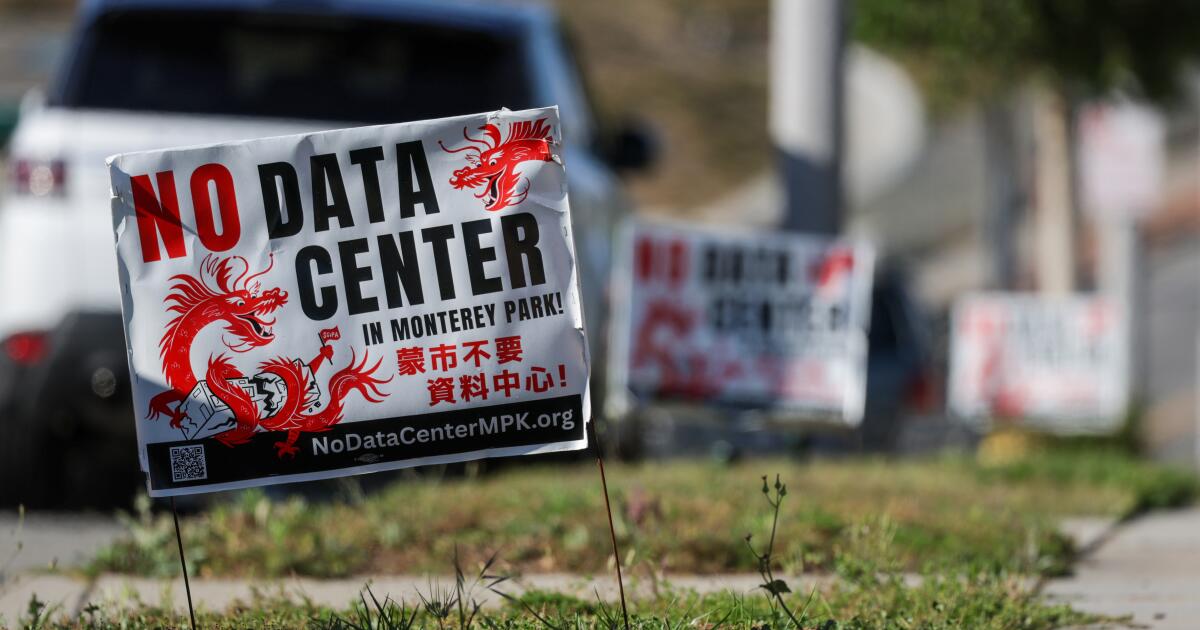
Residents of Monterey Park voted overwhelmingly to ban data centers on election day, making the San Gabriel Valley city the first in the nation to do so by public vote.
As of Wednesday, 86% of votes were in favor of Measure NDC, the city ban, according to the Los Angeles County registrar-recorder/county clerk.
Other cities and towns have passed moratoriums on data centers, as a wave of opposition sweeps the country. But the Monterey Park vote can only be overturned by another ballot measure, making it the most permanent data center ban in a jurisdiction.
Monterey Park’s City Council had already banned data centers by ordinance, after a proposed 247,000-square-foot data center met an outpouring of public anger and concern. The developer withdrew that plan.
That facility would have been less than 500 feet away from the nearest home, and would have used three times the electricity of the entire 60,000-person city. Residents said it would have caused noise and air pollution and driven up electricity rates.
“This ensures long-lasting protections for current and future generations,” Amy Wong, co-founder of the group San Gabriel Valley Progressive Action, said of the vote. “It means that future city councils cannot overturn a data center ban, even if data center developers wanted to spend money to fund pro-data center candidates.”
The measure had no formal opposition. The developer of the proposed facility, investment firm HMC StratCap, said it wouldn’t engage in the ballot fight when it withdrew in March.
The Data Center Coalition, an industry trade group, expressed disappointment in the vote.
“It sends a signal that the area is closed for business, both for data centers and for other significant economic development projects,” state policy director Khara Boender said.
“It deprives local residents of the opportunity to compete for jobs and investment, while also causing the area to relinquish substantial long-term economic investment, high-wage jobs, and critical tax revenue to neighboring areas or other states.”
SGV Progressive Action worked with hyperlocal groups including No Data Center Monterey Park to rally support for the measure.
The group is now focused on stopping data center proposals in the City of Industry and fighting a move by City of Industry, Santa Fe Springs, Vernon and City of Commerce to welcome data centers and other industry with fast-tracked permitting and tax incentives.
City of Industry, in the San Gabriel Valley, and Vernon, south of downtown L.A., are primarily industrial areas, each with around 300 permanent residents. They are employment centers, and tens of thousands of workers commute in daily.
There has been little vocal opposition to data centers among the few residents of these cities. Wong said the protest is primarily coming from the surrounding neighborhoods.
“If a data center gets built in City of Industry, residents across the region would bear the brunt of pollution and increased utility costs,” Wong said, noting that it is surrounded by 16 other cities and unincorporated communities.
Data center proposals have been limited in California compared to Virginia, Texas, Georgia, Illinois and Arizona, which sit at the center of a recent boom in hyperscaler facilities to power artificial intelligence.
California has the third-most data centers in the country, with 300, but high electricity rates, expensive land and regulatory hurdles mean that fewer, and smaller, facilities are currently planned than in other hotspots.
That doesn’t mean opposition hasn’t been fierce. In Coachella and Imperial County, residents are showing up in droves to protest local proposals.
In the San Gabriel Valley, Montebello, El Monte and Baldwin Park have all enacted temporary moratoriums, and Alhambra recently banned data centers as part of a zoning code update.
Wong said she hoped the ballot measure vote would galvanize the opposition. “The vote is a testament to the people power of our region,” she said. “Our region is worth protecting, and we won’t let data centers determine our future.”

A rule intended to prevent rent gouging in the wake of the Eaton and Palisades fires has lapsed in Los Angeles County, possibly exposing some renters to hikes.
The executive order that blocked rent increases was issued by Gov. Gavin Newsom amid the devastating wildfires last year. Under the order, landlords couldn’t increase rents by more than 10% above their prefire levels.
The rule, which was supposed to be temporary and was repeatedly extended, ended Friday after a vote to extend it again failed to garner enough votes. Supervisor Lindsey Horvath, whose district includes Pacific Palisades, sounded the alarm in a motion to extend price protections that failed to pass at the Board of Supervisors’ May 19 meeting.
“These price gouging protections continue to be necessary as construction and rebuilding continue, and as thousands of people remain displaced,” the motion said. “Families which signed short-term leases could face drastic price increases of 50% or more without further price gouging protection.”
Los Angeles County is home to more than 1 million rental properties, though not all of them needed protection from the new rule. There are already stricter rent increase caps for many residences, depending on the location, type and age of the building. Despite the rent control in the region, the people of Los Angeles pay among the highest rents in the country.
It is uncertain whether renters will face rapidly rising rents now that the protection has lapsed. But some real estate experts and policymakers said there was no need for the temporary rule that was part of the governor’s state of emergency.
Supervisors Kathryn Barger, Janice Hahn and Holly Mitchell abstained from voting on the motion to extend the protection, while Supervisors Hilda Solis and Horvath supported it.
“I abstained because I did not see sufficient evidence to justify extending this emergency ordinance, nor did I see evidence to eliminate it entirely,” Hahn said.
Barger’s office said she supported allowing the protections to sunset while waiting to see whether new information emerged.
“Market data already shows countywide rents are only about 2% above pre-emergency levels and rental inventory has grown,” Barger representative Helen E. Chavez Garcia said. “The Supervisor is also mindful of the burden these ongoing protections place on small property owners throughout the county.”
Mitchell did not immediately respond to a request for comment.
There haven’t been steep rent hikes in neighborhoods within three miles of the Palisades fire, according to a Times analysis of data from Zillow, the property listing company.
In ZIP Codes within three miles of the Palisades fire, rent increased 4.8% from December 2024 to April 2025. In areas around the Eaton fire, which destroyed swaths of Altadena, rent jumped 5.2% in the same period.
In L.A. County, ZIP Codes farther from the fires saw only about a 2% increase.
A landlords representative, Jesus Rojas of the Apartment Owners Assn. of Greater Los Angeles, told the supervisors during public comment at the meeting that the county’s rent-gouging rules have “long outlived the emergency they were intended to address” and are now being “wrongfully used to harm thousands of rental housing providers throughout the county.”
“There is no proof that multifamily rental housing providers are hugely increasing rents for impacted homeowners,” Rojas said.
Indeed, there are strong signs that the property market in the Los Angeles area has at last begun to cool.
L.A. metro-area rent prices recently fell to a four-year low, with the median rent slipping to $2,167 in December.
Meanwhile, condominium sales had their slowest start of the year in decades. Condo sales in Los Angeles have plummeted to a 20-year low, with fewer than 2,000 units sold in January and February — the worst start to the year since 2005.
Newsom defended the price-gouging protections shortly after they went into effect.
“In the days following the Los Angeles firestorms, we worked quickly to protect Los Angeles survivors from any form of exploitation,” he said in February 2025. “The state has the tools in place to not only block price gouging during this emergency, but also to prosecute bad actors.”
The Los Angeles County Department of Consumer and Business Affairs said it received more than 2,000 complaints after the fires, alleging that retailers and landlords were taking advantage of people put in hardship by their losses, and sent out more than 2,000 cease-and-desist letters to businesses and landlords for alleged price gouging, said Morine Merritt, who oversees department investigations into consumer and real estate fraud.
“Close to 90% of the complaints that we received involved allegations of rent increases,” Merritt said in an interview. Now that the fire-related protections have expired, existing laws and “regular market conditions determine price increases for goods and services, including rents,” she said.
Crackdowns on fire-related rent gouging have been rare, said Chelsea Kirk of the activist organization the Rent Brigade, which analyzed L.A. County’s rental market in the year after the fires. It reported 18,360 potential examples of price gouging in listings but said that few lawsuits had been filed by authorities so far.
Last week, Rent Brigade announced what it said was the first private civil lawsuit brought by a family that claimed to be rent-gouged in the aftermath of the wildfires. Plaintiffs Randall and Candy Renick, whose Altadena home was damaged, said they were charged nearly three times the maximum permitted rate for nearly 10 months. They seek restitution of $96,000 plus civil penalties and attorneys’ fees.
The rental market has probably stabilized since the fires, Kirk said, but other families may still be “locked into illegal rents” that they agreed to pay when they were in a rush to find housing after they were displaced.


Dear Mr. Pelley:
I meant what I said in my letter last week to the 60 Minutes team: joining 60 Minutes is the honor of my career and I am grateful to be working alongside the people who have contributed to the most important television journalism brand this country has ever produced. While I’m new to 60 Minutes, I’ve devoted my career to investigative journalism and storytelling. I started this job excited to collaborate and to benefit from the wisdom and experience of the 60 Minutes veterans, with you among them. For that reason, one of the first things I did in my new role was call you to talk and invite you to dinner. It is a profound disappointment that you rejected that overture and chose ambush instead. Yesterday, you hijacked my first meeting with staff to disparage me, my qualifications, and my intentions with remarkable incivility and contempt. I welcome a diversity of viewpoints and respectful debate among the team, but this was nothing of the sort. Yesterday’s performative display of hostility enacted in front of the staff instead of in a civil, private conversation-demonstrated that you have no interest in contributing to the future success of the show, or approaching my new tenure with a mind open to collaboration and progress. I am here to deliver first-in-class news programming, not to make headlines about newsroom drama. I am eager to work alongside those who share this goal.
Despite yesterday’s misconduct, I had hoped that in sitting down with you today we could find a path forward together. You made clear that you are not interested in such a path.
Your antipathy to the future of the show has come through loud and clear. And I have heard you. I therefore write on behalf of CBS News, Inc. (“CBS”) to inform you that your employment with CBS is terminated for cause effective immediately. Enclosed is your formal termination letter.
Sincerely,
Nick Bilton
Executive Producer, 60 Minutes
-

 Michigan9 seconds ago
Michigan Lottery Daily 3, Daily 4 results for June 3, 2026
-

 Massachusetts7 minutes ago
Mass. House votes to set new rules for DiZoglio’s audit
-

 Minnesota10 minutes ago
Minneapolis considers closing dog park sitting on Indigenous land
-

 Mississippi15 minutes ago
Mississippi Court of Appeals Brings ‘Court on the Road’ Prog…
-

 Missouri22 minutes ago
Two airlifted after serious crash in Cole County
-

 Montana25 minutes ago
Clark Fork River remains central to Missoula’s identity, conservation groups say
-

 Nebraska30 minutes ago
Miss Nebraska festivities kick off with opening ceremonies
-

 Nevada37 minutes ago
Hillel of Northern Nevada Builds Community at the University

