Business
Gen Alpha kids are spending big money on skin care. Some adults are concerned


Fourth grader Naiya White knows what you think about her twice-daily beauty regimen and her Sephora shopping trips.
“I heard all you guys were freaking out about 10-year-olds using skin care,” she says in a TikTok video posted last month, standing outside a Sephora store in Grand Junction, Colo. “So let’s go pick some out!”
Moments later, White is making her way down the hot pink Glow Recipe aisle in an oversize Lilo & Stitch T-shirt and sparkly green eyeliner, ticking off her favorite products in rapid succession.
“I’d recommend this avocado cleanser; it’s nourishing and gentle,” she says, holding up a $28 tube of face wash. “The mist is also a yes — it makes your skin look super glowy and it’s hydrating. This moisturizer is also one of my favorites and it smells delicious. The hyaluronic Plum Plump balm is a great sleep mask for lips.”
In conclusion, she says with more than a hint of sass, “For all the cranky, musty, dusty adults out there who think little kids shouldn’t be using skin care … get it together!”
Naiya, 10, is part of a fast-growing army of preteens who are swarming into beauty stores around the country and buying up cleansers, moisturizers, toners, face masks and, in some cases, potent anti-wrinkle serums, exfoliants and peels that are intended to slow the aging process in much older consumers. They’re showing off their multi-hundred-dollar hauls and elaborate morning and nighttime routines on TikTok, where the catchphrase “Sephora Kids” has been hashtagged more than 11,000 times.
The obsession with skin care among Gen Alpha — typically defined as those born between 2010 and 2024 — is leading to a windfall of unexpected business for the booming $164-billion global skin-care industry, which historically has targeted women, not girls. But cosmetics brands and the retailers that carry their products are facing a delicate balancing act as they navigate the phenomenon and figure out how to market to a growing cohort of impressionable customers.
“I don’t want to see younger kids using active ingredients, using exfoliating products, because it’s just not necessary,” said Shai Eisenman, founder and chief executive of Bubble, one of the skin-care lines most coveted by Gen Z and Gen Alpha consumers. “We have a responsibility as a brand, and that responsibility is not to sell as many products as possible.”
Gea Gueron, a sales associate at Larchmont Beauty Center, helps a young customer look at products.
(Carlin Stiehl / For The Times)
In June, cosmetics chain Ulta Beauty released an analysis of customer data that showed members of Gen Alpha become interested in beauty much earlier than their predecessors.
“While Gen Z females started experimenting with beauty products and services around age 13, Gen Alpha is eclipsing them by five years — starting at the average age of 8 for females and males,” the report said. “They also start more concretely defining what beauty means to them around the age of 11.”
The burgeoning skin-care trend, which Ulta Beauty began noticing in the last year, is “driven by the rise of new skincare rituals and trending products on TikTok,” a spokesperson said in a statement, adding that Gen Alpha overwhelmingly views skin care as a form of self-care and wellness.
Skin-care mania has divided millennial parents, many of whom grew up washing their faces in the shower with a bar of soap — if at all — and now are baffled by the multistep get-ready-with-me videos that their children are diligently following on social media.
Any video Naiya and I make at Sephora or Ulta, people have something to say. But I feel like a lot of adults forget what it’s like to be a child.
— Ashley Paige, Naiya White’s mom
Dermatologists and estheticians say the unease is more than just the usual hand-wringing of an older generation. They worry “skinfluencers” are pushing children to splurge on products that in some cases could cause damage to sensitive young skin, and are concerned the craze is kick-starting an unhealthy fixation with physical appearance.
“A lot of tweens and teens are now using anti-aging products, so they’re starting way too young,” said Dr. Carol Cheng, a pediatric dermatologist and an assistant clinical professor of dermatology at UCLA. In recent months, she has seen some patients arrive for their appointments with “bags of products to make sure they’re optimizing what they’re doing.”
“They’re using things like vitamin C serums, salicylic acid, really expensive products that have actives that can actually harm their skin,” Cheng said, referring to active ingredients meant to address specific conditions such as wrinkles and dark spots. Such harsh chemicals, she added, can cause irritation, redness, burning, peeling and stinging.
At CatEye Beauty Skincare, a boutique day spa in San Diego, girls are bringing in pictures of Korean women with so-called glass skin — a Korean beauty trend that refers to a clear and luminous complexion — and saying, “I want my skin to look like this,” owner Catherine Noel said.
“I’ve had a couple girls come in with very wealthy parents and they wanted a pumpkin peel on their perfect face,” she said. “That would be something for a 35-year-old woman, not somebody who’s 12.”
Amid reports and videos of unsupervised Sephora Kids descending upon the stores en masse, wreaking havoc on product testers and harassing employees, longtime shoppers have taken to the retailer’s online community page to post complaints, including one thread proposing a ban on customers under 16.
“I know that Sephora has basically become the new Claire’s for kids, and buying Drunk Elephant products that are full of actives and retinoids that are harmful to [kids’] skin is the latest Gen Alpha trend, but the testers are getting destroyed,” one customer wrote. “Everything from kids mixing skincare and makeup testers together to make ‘smoothies’ to opening new makeup packages and using them.”
The backlash hasn’t stopped Ashley Paige, Naiya White’s mom, from taking her to Sephora and Ulta Beauty a couple of times a month and filming their excursions for the more than 40,000 people who follow their joint TikTok page, @sparkleandchaos.
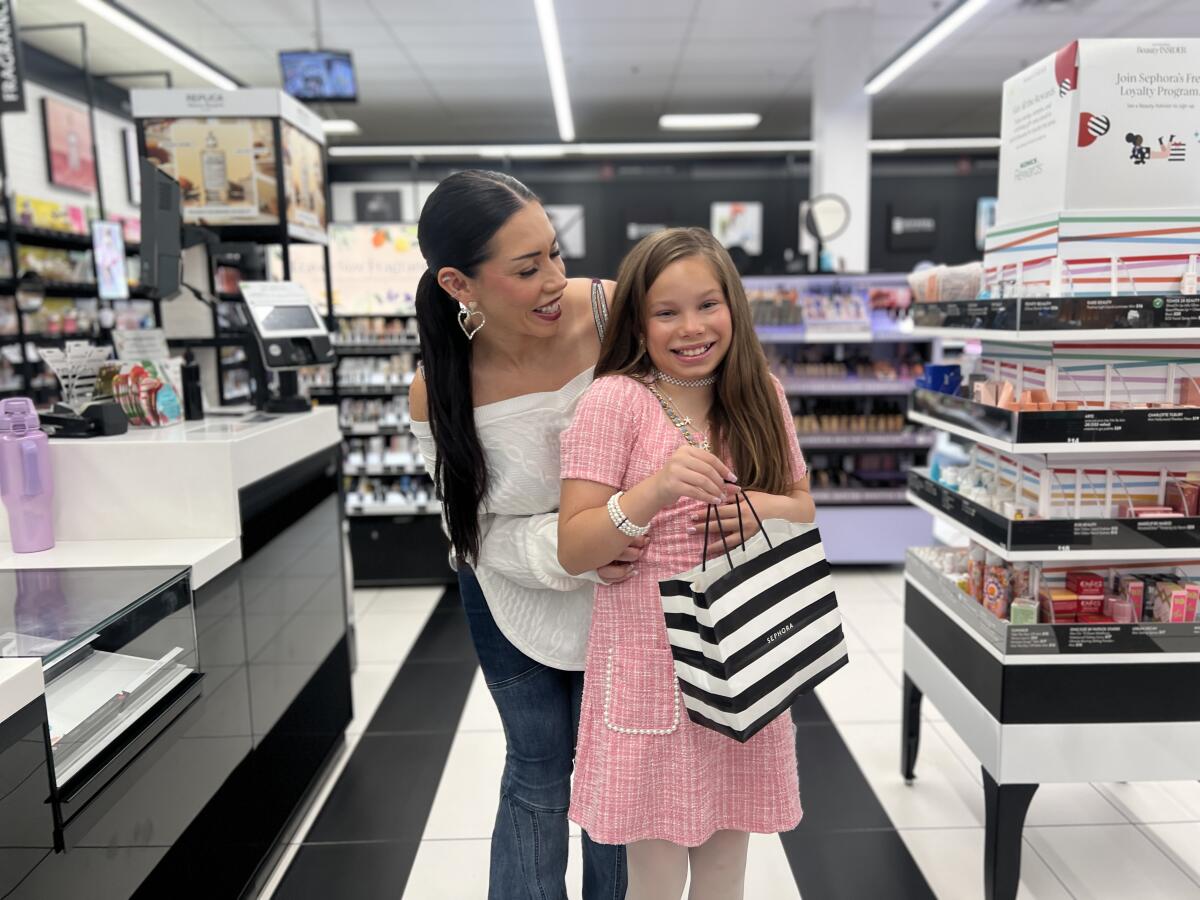
Ashley Paige, 37, left, and her daughter, 10-year-old Naiya White, at a Sephora store.
(Courtesy of Ashley Paige)
“Any video Naiya and I make at Sephora or Ulta, people have something to say,” Paige, 37, said in an interview with The Times. “But I feel like a lot of adults forget what it’s like to be a child.”
The duo’s first video, posted in January, addressed the backlash head-on, with Naiya instructing fellow Sephora Kids on how to behave politely in the stores.
“I heard they were about to ban testers because of us — that is not OK. Girls, clean up after yourselves,” she says in the video, which has been viewed more than 6 million times. “You need to be polite to all the people who work here, OK? You want a good rep, not a bad one.”
Industry professionals say an early introduction to skin care can be a positive thing if messaged correctly.
They’re steering young skin-care enthusiasts away from products with active ingredients and focusing instead on a minimalist approach centered on helping them develop healthy daily habits. The three basics, they say, are appropriate for any age: a gentle cleanser, a hydrating moisturizer and a good sunscreen.
That’s generally the protocol that Naiya follows, albeit with some extra steps.
“In the morning, I like to use my Bubble face wash and my Bubble Cloud Surf moisturizer and my Bubble tinted sunscreen,” Naiya said. Bubble launched in 2020 as a Gen Z-oriented brand with eye-catching packaging in vibrant colors and bold fonts, and quickly caught on with preteens as well.

“We don’t think anyone under 13 needs anything other than sunscreen, cleanser and moisturizer,” Bubble CEO Shai Eisenman says.
(Bubble)
“At night is when I use my Evereden kids multivitamin face wash and Evereden kids multivitamin face cream — it smells floral-y,” Naiya continued. “Sometimes I use toner. I also use the Aquaphor balm under my eyes to help with puffiness and stuff.”
Gen Alpha already wields significant spending power and is expected to become an economic force in the coming years. Companies of all kinds are developing new products to appeal to the demographic, which is growing rapidly with more than 2.8 million children born globally every week. By the end of the year, they will number nearly 2 billion — the largest generation ever, according to McCrindle Research, which is credited with coining the term.
Ulta Beauty, which operates more than 1,400 stores in all 50 states, said that in response to greater interest among Gen Alpha, it has “expanded our offerings to include simplified, dermatologist-approved products designed for younger skin.” In its most recent fiscal year, total sales increased 9.8% to $11.2 billion, with skin care accounting for 19% of company revenue, up from 17% the year prior.
“We do not proactively promote skin care to Gen Alpha,” a spokesperson said. “As more younger shoppers engage with us, we focus on guiding them — and their parents — toward informed choices” including educational resources, ingredient-based guidance and age-specific training for store associates.
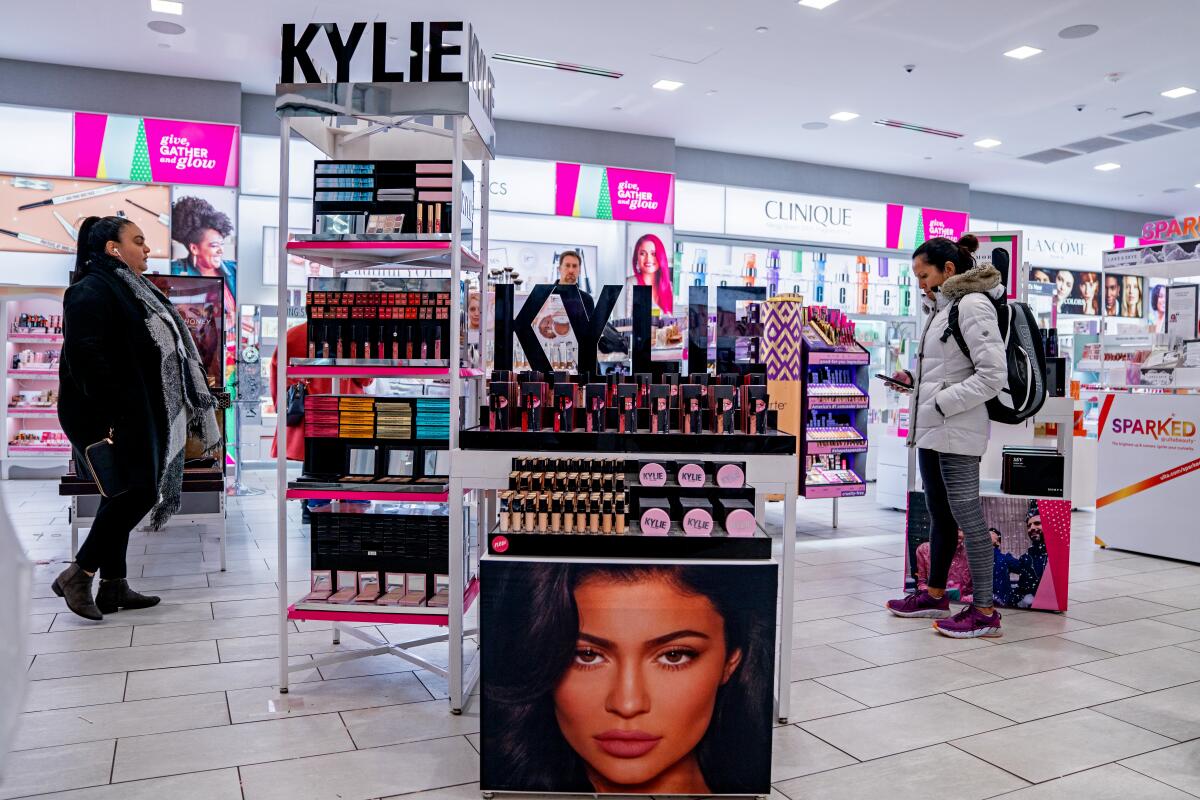
An Ulta Beauty store in New York City. The cosmetics retailer released an analysis of customer data this summer that showed members of Gen Alpha become interested in beauty much earlier than their predecessors — starting at the average age of 8.
(David Dee Delgado/Getty Images)
That said, beauty companies are routinely teaming up with entertainment brands and toy makers to release kid-friendly limited-edition collections.
Ulta Beauty on Sunday launched two partnerships: an assortment of makeup, skin-care and hair-care items tied to the November release of Universal Pictures’ movie musical “Wicked,” as well as a separate collection with Mini Brands, featuring tiny $9.99 replicas of many of the chain’s bestselling products.
“All your favorite beauty brands are now cuter and more collectible than ever with Mini Brands x Ulta Beauty!” the retailer’s website says. “With over 68 different minis to collect, every unboxing is a fun surprise!”
Bubble used similar playful language in its recent rollout of Bubble Charms, “the CUTEST way to accessorize your Tell All Lip Balm.” The lip balm “comes with an adorbz keychain” and “will make your crush text u back,” the company says on its website.
In May, Bubble announced a collaboration with Pixar tied to the release of “Inside Out 2,” an animated film about the roiling emotions of puberty that grossed $1.6 billion worldwide at the box office. The products included in the limited-edition Pixar collection were safe for all ages, Eisenman said.

Bubble, a skin-care line beloved by Gen Z and Gen Alpha, launched in 2020. It recently partnered with Pixar on a product collaboration for the release of “Inside Out 2.”
(Bubble)
Today Bubble has about 50,000 brand ambassadors who help promote the company, participate in its product testing program and receive special discounts and freebies; 20,000 of them are 13 to 18 years old. On Bubble’s website and social media posts, the company routinely highlights which products and practices are suitable for kids.
“Just cuz you saw it on TikTok doesn’t mean it’s right for your face!” reads the caption in a Bubble Instagram post this year that featured a three-step skin-care routine for customers under 13. “Great skincare can be super simple.”
“A lot of younger kids are using products that are inappropriate,” Eisenman said. “For us, one of the most important elements is to be a good force and an educating source in this space.”
I’ve had a couple girls come in with very wealthy parents and they wanted a pumpkin peel on their perfect face. That would be something for a 35-year-old woman, not somebody who’s 12.
— Catherine Noel, owner of CatEye Beauty Skincare
At CatEye Beauty, owner Noel added a “teen facial with skincare lesson” to her list of services in March. The $120, 45-minute treatment is designed for people 11 to 15 years old and includes a double cleanse, mild exfoliation and, if necessary, extractions to clear out clogged pores.
“They still have baby skin,” she said. “I don’t like this trend of young girls coming in and using very expensive products, especially since they’re made for adults.”
Gen Alpha’s love of skin care is even prompting consternation among Gen Z.
At Larchmont Beauty Center on a recent Friday afternoon, eighth grader Maren and her friend, Shiri, stopped in to pick up a pack of hair bands. The two are on the border of Gen Z and Gen Alpha, but consider themselves members of the older generation.
“Our generation is a lot more chill,” she said. “I feel like millennials are full-face and we’re just like, some makeup. And then the people younger than us are like: skin care.”
Calling the trend “a little freaky,” 14-year-old Maren said she knows of kids “who are like 9, and they’re doing the same stuff I’m doing.”
“It’s insane that like a 9-year-old who has perfect skin is doing a 12-step skin-care routine.”


Residents of Monterey Park voted overwhelmingly to ban data centers on election day, making the San Gabriel Valley city the first in the nation to do so by public vote.
As of Wednesday, 86% of votes were in favor of Measure NDC, the city ban, according to the Los Angeles County registrar-recorder/county clerk.
Other cities and towns have passed moratoriums on data centers, as a wave of opposition sweeps the country. But the Monterey Park vote can only be overturned by another ballot measure, making it the most permanent data center ban in a jurisdiction.
Monterey Park’s City Council had already banned data centers by ordinance, after a proposed 247,000-square-foot data center met an outpouring of public anger and concern. The developer withdrew that plan.
That facility would have been less than 500 feet away from the nearest home, and would have used three times the electricity of the entire 60,000-person city. Residents said it would have caused noise and air pollution and driven up electricity rates.
“This ensures long-lasting protections for current and future generations,” Amy Wong, co-founder of the group San Gabriel Valley Progressive Action, said of the vote. “It means that future city councils cannot overturn a data center ban, even if data center developers wanted to spend money to fund pro-data center candidates.”
The measure had no formal opposition. The developer of the proposed facility, investment firm HMC StratCap, said it wouldn’t engage in the ballot fight when it withdrew in March.
The Data Center Coalition, an industry trade group, expressed disappointment in the vote.
“It sends a signal that the area is closed for business, both for data centers and for other significant economic development projects,” state policy director Khara Boender said.
“It deprives local residents of the opportunity to compete for jobs and investment, while also causing the area to relinquish substantial long-term economic investment, high-wage jobs, and critical tax revenue to neighboring areas or other states.”
SGV Progressive Action worked with hyperlocal groups including No Data Center Monterey Park to rally support for the measure.
The group is now focused on stopping data center proposals in the City of Industry and fighting a move by City of Industry, Santa Fe Springs, Vernon and City of Commerce to welcome data centers and other industry with fast-tracked permitting and tax incentives.
City of Industry, in the San Gabriel Valley, and Vernon, south of downtown L.A., are primarily industrial areas, each with around 300 permanent residents. They are employment centers, and tens of thousands of workers commute in daily.
There has been little vocal opposition to data centers among the few residents of these cities. Wong said the protest is primarily coming from the surrounding neighborhoods.
“If a data center gets built in City of Industry, residents across the region would bear the brunt of pollution and increased utility costs,” Wong said, noting that it is surrounded by 16 other cities and unincorporated communities.
Data center proposals have been limited in California compared to Virginia, Texas, Georgia, Illinois and Arizona, which sit at the center of a recent boom in hyperscaler facilities to power artificial intelligence.
California has the third-most data centers in the country, with 300, but high electricity rates, expensive land and regulatory hurdles mean that fewer, and smaller, facilities are currently planned than in other hotspots.
That doesn’t mean opposition hasn’t been fierce. In Coachella and Imperial County, residents are showing up in droves to protest local proposals.
In the San Gabriel Valley, Montebello, El Monte and Baldwin Park have all enacted temporary moratoriums, and Alhambra recently banned data centers as part of a zoning code update.
Wong said she hoped the ballot measure vote would galvanize the opposition. “The vote is a testament to the people power of our region,” she said. “Our region is worth protecting, and we won’t let data centers determine our future.”

A rule intended to prevent rent gouging in the wake of the Eaton and Palisades fires has lapsed in Los Angeles County, possibly exposing some renters to hikes.
The executive order that blocked rent increases was issued by Gov. Gavin Newsom amid the devastating wildfires last year. Under the order, landlords couldn’t increase rents by more than 10% above their prefire levels.
The rule, which was supposed to be temporary and was repeatedly extended, ended Friday after a vote to extend it again failed to garner enough votes. Supervisor Lindsey Horvath, whose district includes Pacific Palisades, sounded the alarm in a motion to extend price protections that failed to pass at the Board of Supervisors’ May 19 meeting.
“These price gouging protections continue to be necessary as construction and rebuilding continue, and as thousands of people remain displaced,” the motion said. “Families which signed short-term leases could face drastic price increases of 50% or more without further price gouging protection.”
Los Angeles County is home to more than 1 million rental properties, though not all of them needed protection from the new rule. There are already stricter rent increase caps for many residences, depending on the location, type and age of the building. Despite the rent control in the region, the people of Los Angeles pay among the highest rents in the country.
It is uncertain whether renters will face rapidly rising rents now that the protection has lapsed. But some real estate experts and policymakers said there was no need for the temporary rule that was part of the governor’s state of emergency.
Supervisors Kathryn Barger, Janice Hahn and Holly Mitchell abstained from voting on the motion to extend the protection, while Supervisors Hilda Solis and Horvath supported it.
“I abstained because I did not see sufficient evidence to justify extending this emergency ordinance, nor did I see evidence to eliminate it entirely,” Hahn said.
Barger’s office said she supported allowing the protections to sunset while waiting to see whether new information emerged.
“Market data already shows countywide rents are only about 2% above pre-emergency levels and rental inventory has grown,” Barger representative Helen E. Chavez Garcia said. “The Supervisor is also mindful of the burden these ongoing protections place on small property owners throughout the county.”
Mitchell did not immediately respond to a request for comment.
There haven’t been steep rent hikes in neighborhoods within three miles of the Palisades fire, according to a Times analysis of data from Zillow, the property listing company.
In ZIP Codes within three miles of the Palisades fire, rent increased 4.8% from December 2024 to April 2025. In areas around the Eaton fire, which destroyed swaths of Altadena, rent jumped 5.2% in the same period.
In L.A. County, ZIP Codes farther from the fires saw only about a 2% increase.
A landlords representative, Jesus Rojas of the Apartment Owners Assn. of Greater Los Angeles, told the supervisors during public comment at the meeting that the county’s rent-gouging rules have “long outlived the emergency they were intended to address” and are now being “wrongfully used to harm thousands of rental housing providers throughout the county.”
“There is no proof that multifamily rental housing providers are hugely increasing rents for impacted homeowners,” Rojas said.
Indeed, there are strong signs that the property market in the Los Angeles area has at last begun to cool.
L.A. metro-area rent prices recently fell to a four-year low, with the median rent slipping to $2,167 in December.
Meanwhile, condominium sales had their slowest start of the year in decades. Condo sales in Los Angeles have plummeted to a 20-year low, with fewer than 2,000 units sold in January and February — the worst start to the year since 2005.
Newsom defended the price-gouging protections shortly after they went into effect.
“In the days following the Los Angeles firestorms, we worked quickly to protect Los Angeles survivors from any form of exploitation,” he said in February 2025. “The state has the tools in place to not only block price gouging during this emergency, but also to prosecute bad actors.”
The Los Angeles County Department of Consumer and Business Affairs said it received more than 2,000 complaints after the fires, alleging that retailers and landlords were taking advantage of people put in hardship by their losses, and sent out more than 2,000 cease-and-desist letters to businesses and landlords for alleged price gouging, said Morine Merritt, who oversees department investigations into consumer and real estate fraud.
“Close to 90% of the complaints that we received involved allegations of rent increases,” Merritt said in an interview. Now that the fire-related protections have expired, existing laws and “regular market conditions determine price increases for goods and services, including rents,” she said.
Crackdowns on fire-related rent gouging have been rare, said Chelsea Kirk of the activist organization the Rent Brigade, which analyzed L.A. County’s rental market in the year after the fires. It reported 18,360 potential examples of price gouging in listings but said that few lawsuits had been filed by authorities so far.
Last week, Rent Brigade announced what it said was the first private civil lawsuit brought by a family that claimed to be rent-gouged in the aftermath of the wildfires. Plaintiffs Randall and Candy Renick, whose Altadena home was damaged, said they were charged nearly three times the maximum permitted rate for nearly 10 months. They seek restitution of $96,000 plus civil penalties and attorneys’ fees.
The rental market has probably stabilized since the fires, Kirk said, but other families may still be “locked into illegal rents” that they agreed to pay when they were in a rush to find housing after they were displaced.


Dear Mr. Pelley:
I meant what I said in my letter last week to the 60 Minutes team: joining 60 Minutes is the honor of my career and I am grateful to be working alongside the people who have contributed to the most important television journalism brand this country has ever produced. While I’m new to 60 Minutes, I’ve devoted my career to investigative journalism and storytelling. I started this job excited to collaborate and to benefit from the wisdom and experience of the 60 Minutes veterans, with you among them. For that reason, one of the first things I did in my new role was call you to talk and invite you to dinner. It is a profound disappointment that you rejected that overture and chose ambush instead. Yesterday, you hijacked my first meeting with staff to disparage me, my qualifications, and my intentions with remarkable incivility and contempt. I welcome a diversity of viewpoints and respectful debate among the team, but this was nothing of the sort. Yesterday’s performative display of hostility enacted in front of the staff instead of in a civil, private conversation-demonstrated that you have no interest in contributing to the future success of the show, or approaching my new tenure with a mind open to collaboration and progress. I am here to deliver first-in-class news programming, not to make headlines about newsroom drama. I am eager to work alongside those who share this goal.
Despite yesterday’s misconduct, I had hoped that in sitting down with you today we could find a path forward together. You made clear that you are not interested in such a path.
Your antipathy to the future of the show has come through loud and clear. And I have heard you. I therefore write on behalf of CBS News, Inc. (“CBS”) to inform you that your employment with CBS is terminated for cause effective immediately. Enclosed is your formal termination letter.
Sincerely,
Nick Bilton
Executive Producer, 60 Minutes
-

 Los Angeles, Ca1 hour ago
Man claiming to be armed robs Culver City bank, gets away with $10,000
-

 Detroit, MI1 hour ago
Fired Detroit TV anchor Taryn Asher files sex discrimination lawsuit against old station, claims new GM protected men
-

 San Francisco, CA2 hours ago
San Francisco family devastated as they face nearly 90% rent increase
-

 Dallas, TX2 hours ago
Wings’ top pick Azzi Fudd hosts clinic as Cash App donates to Dallas nonprofit
-

 Miami, FL2 hours ago
Patients left scrambling for care after Miami-Dade woman accused of operating an unlicensed surgery recovery center
-

 Boston, MA2 hours ago
Clover plans to reopen some locations after sudden closure, thanks to an anonymous investor
-
 Denver, CO2 hours ago
New report finds Denver metro home buyers and sellers experiencing ‘unattainability fatigue’
-

 Seattle, WA2 hours ago
Seattle mayor grilled over public safety, affordability, CCTV

