Business
Earth’s 1st Asteroid Mining Prospector Heads to the Launchpad


A private company is aiming to heave a microwave oven-size spacecraft toward an asteroid later this week, its goal to kick off a future where precious metals are mined around the solar system to create vast fortunes on Earth.
“If this works out, this will probably be the biggest business ever conceived of,” said Matt Gialich, the founder and chief executive of AstroForge, the builder and operator of the robotic probe.
That may sound familiar: A decade ago, news stories were aflutter about the wealth promised by asteroid mining companies. But things didn’t quite work out.
“We blossomed three or four years too early for the big gold rush of investor enthusiasm for space projects,” said David Gump, the former chief executive of Deep Space Industries, one of the earlier batch of would-be asteroid miners. Eventually the money dried up; Deep Space Industries was sold off in 2019 and never reached an asteroid.
AstroForge is betting on things being different this time around. The California company has already launched a demonstration spacecraft into Earth orbit and raised $55 million in funding. Now the company is set to actually travel toward a near-Earth asteroid in deep space.
AstroForge’s second robotic spacecraft, called Odin, is bundled into a SpaceX Falcon 9 rocket that will also launch a privately built moon lander and a NASA-operated lunar orbiter as soon as Wednesday from Florida. About 45 minutes after the launch, Odin will separate and begin its solo journey into deep space, while the moon missions — the Athena lander from Intuitive Machines and NASA’s Lunar Trailblazer — take off on their own separate journeys.
No commercial company has ever launched an operational mission beyond the moon, and AstroForge is the first company to receive a license from the Federal Communications Commission that allows it to transmit from deep space. AstroForge will communicate with the spacecraft using undisclosed dishes in India, South Africa, Australia and the United States.
At first, AstroForge kept its target asteroid a secret, fearing competitors. But in January, the company announced the destination, an object called 2022 OB5. Mr. Gialich said he was more confident of AstroForge’s advantage.
“We’re the only one that’s actually doing anything,” he said. “Who else is preparing to go to an asteroid?”
Asteroid 2022 OB5 is small, no more than 330 feet across, about the size of a football field. AstroForge’s science team assessed the asteroid by using telescopes, including the Lowell Observatory and the Large Binocular Telescope in Arizona, to estimate its metallic content. They believe that 2022 OB5 is an M-type, a class of asteroids comprising 5 percent of known space rocks that may have a high amount of metal. The analysis of the asteroid has not yet been published.
Stephanie Jarmak, a planetary scientist at the Harvard-Smithsonian Center for Astrophysics, said the company’s analysis was plausible.
“There are several different ways to determine whether it’s an M-type or not,” she said, including studying the asteroid’s brightness, or albedo. A higher brightness suggests the presence of more metal. She lauded the company for being more open about its target asteroid. “I thought that was really nice,” she said.
M-type asteroids are thought to be rich in metals such as iron and nickel. These could be useful as a resource for construction in space, perhaps to build new spacecraft and machinery. However, some M-types may also be rich in more valuable platinum group metals, or P.G.M.s, used in devices such as smartphones. The windfall would be huge if these could be mined in abundance and brought to Earth.
“A single one-kilometer-diameter asteroid, if it was platinum-bearing, would contain about 117,000 tons of platinum,” said Mitch Hunter-Scullion, the founder and chief executive of the Asteroid Mining Corporation in Britain. His company is taking a slower approach and plans to demonstrate technologies on the moon later this decade.
“That’s about 680 years of global supply. You’re talking about centuries of platinum demand from a single asteroid,” Mr. Hunter-Scullion said. “Even if you get 1,000 tons of platinum, you’re sitting there with the next half century of mobile phones.”
Not everyone is convinced that so much valuable metal will be found inside M-type asteroids.
“There’s not enough P.G.M.s in asteroids to justify that as a stand-alone business,” said Joel C. Sercel, the founder and chief executive of TransAstra, a company that is developing a giant bag that could be used to grab and extract resources from asteroids in the future. The company will test a small mock-up of the technology aboard the International Space Station following a launch to the station this summer.
The legalities of mining asteroids and selling their resources remain uncertain.
In 2015, President Obama signed a law allowing asteroid resources to be sold on Earth. But no one has yet put this law to the test.
“Is AstroForge going to make a claim? Does the fact they reach this asteroid before anybody else mean nobody else can go to it?” asked Michelle Hanlon, a law professor specializing in space at the University of Mississippi. “It’s going to be interesting to see the international reaction.”
Odin will arrive in late 2025 after a journey of about 300 days to 2022 OB5. The asteroid follows an orbit around the sun similar to Earth’s. The probe will fly past the asteroid at a distance of 0.6 miles, using two black-and-white cameras to snap pictures. Zooming by the object at thousands of miles per hour, the spacecraft will have an encounter that will last five and a half hours.
“And it’s probably only the last 10 minutes that we’re getting pictures bigger than a pixel,” Mr. Gialich said.
The goal is for these pictures to be enough to tell if the asteroid is metallic.
“Hopefully it looks shiny,” Mr. Gialich said. However, it’s very possible that any metal could be mixed into the asteroid’s soil and not be visible.
“I’m not sure how much compositional information they can get purely from images,” Dr. Jarmak, the planetary scientist, said.
Craters on the surface may hint at hidden metal though, Mr. Gialich said, adding: “We expect to see cracking on the surface” that could be indicative of metallic content.
The spacecraft will also precisely track the asteroid’s position in space during the flyby. Doing so could allow the density of the asteroid to be calculated, based on its gravitational tug on the spacecraft. Higher density would hint at more metallic content.
Success is not guaranteed. AstroForge’s first mission, Brokkr-1, was launched into low-Earth orbit in April 2023 to test the company’s planned asteroid refining technology. But the mission encountered problems and burned up in the atmosphere. Mr. Gialich said that AstroForge had improved its technologies on the Odin spacecraft by relying on components produced in-house.
Vestri, the third mission of AstroForge, will be its most ambitious. That spacecraft, the size of a refrigerator, will be designed to land on an asteroid as soon as next year, possibly even 2022 OB5 if the metallic content is confirmed. Vestri’s landing legs would be equipped with magnets designed to stick to the surface of the asteroid and be capable of estimating how many P.G.M.s are present.
It’s unclear how successful this mission will be. “If it’s made out of solid metal it will stick,” said Benjamin Weiss, a planetary scientist at the Massachusetts Institute of Technology. However, many asteroids are known to be rubble piles, essentially collections of rocks held together loosely by gravity, such as the asteroid Bennu that was visited by NASA’s ORISIS-REx spacecraft.
“They are barely held together,” Dr. Weiss said, meaning that the magnets might just end up pulling a few rocks away from the surface as the lander drifts away.
Only one spacecraft, the Rosetta spacecraft from the European Space Agency, has visited a suspected M-type asteroid before, a flyby of the asteroid 21 Lutetia in 2010. The presence of metal at that time was inconclusive. A much more capable mission, NASA’s $1.2 billion Psyche spacecraft, is currently on its way to an asteroid bearing the same name by 2029. Astronomers think the asteroid may be a fragment of a failed planet’s core and is rich in metal.
Results from the Odin mission’s analysis of 2022 OB5 could be a tantalizing tease for Psyche. “If it turns out it’s made of solid metal, that would support the idea that some of these larger bodies like Psyche could be the cores of differentiated bodies,” Dr. Weiss said.
Lindy Elkins-Tanton at Arizona State University, the principal investigator on Psyche and also an adviser to AstroForge, said that the opportunities afforded by commercial deep space missions like Odin are exciting, enabling small and fast missions at low cost. “It’s going to be a bit of a game-changer,” she said.
Others are more focused on what Odin means for asteroid mining in the present tense.
“It’s probably the highest achievement in the sector so far,” Mr. Hunter-Scullion of Asteroid Mining Corporation said. Mr. Sercel of TransAstra also applauded the company.
“We’re gung-ho for AstroForge and wish them the best of luck,” he said. “We’re behind them 100 percent.”
Now there’s just the small matter of the launch and journey to the asteroid, and the hope that what Odin finds will lead to the riches long touted from asteroid mining.
“If we make it, I’m popping champagne,” Mr. Gialich said.



Social media company Snap showcased a pair of its $2,195 augmented reality glasses Tuesday, staking a claim in a race to reshape how people interact with computers.
The Santa Monica tech company faces fierce competition as it takes on bigger rivals such as Meta that are dominating the sale of smart glasses and needs to convince more people to buy another gadget. Google is planning to release smart glasses in the fall and Apple is reportedly working on a pair as well.
The announcement also shows how the rising popularity of artificial intelligence-powered tools is fueling the release of hardware beyond the smartphone. While Snap and Google have failed to get consumers to buy smart glasses in the past, tech companies have been doubling down on the idea.
In a speech at the AWE conference in Long Beach, Snap’s chief executive and co-founder Evan Spiegel highlighted how people could do more with its AR glasses, Specs, than with rival products. He views the glasses as the next “major leap in computing.”
People can learn to play the drums, figure out how to fix their car, watch videos and more with the glasses, which are now available for preorder and are expected to ship in the fall. Augmented reality involves overlaying digital objects onto a person’s view of the physical world.
“The smartphone put our lives in our pockets, but augmented reality puts computing into the world where life actually happens, and that is the shift from phones to Specs,” Spiegel said.
Meta sells a variety of AI glasses, including a more expensive pair with a display and wristband that lets people ask questions to an AI assistant and answer calls and texts, along with other tasks. It’s also worked on a prototype of AR glasses called Orion.
Meta has a reputation of incorporating features released by Snap, the parent company of disappearing messaging app Snapchat. That has included a popular feature where photos and videos vanish in 24 hours.
“Those copycats up north aren’t going to be stealing this one,” said Spiegel, as the crowd erupted into applause and laughter.
While smart glasses aren’t as popular as smartphones, sales have grown.
Meta, which has a partnership with Ray-Ban, is leading in the sale of smart glasses without displays, according to the International Data Corporation. Roughly 2.25 million units of these glasses shipped in the first quarter of this year, a 167% jump year-over-year.
“Dethroning the giant that is Meta won’t come easy,” wrote Jitesh Ubrani, an IDC research manager in a post this week about smart glasses. “Meta’s core advantage isn’t just market share; it’s distribution.”
Meta has been expanding its retail footprint, opening up new stores in California.
But Snap will have to convince people that it’s worth paying $2,195 for a pair of AR glasses with more tech features. Spiegel pointed to the hefty price tags of the Mac in 1984 and Apple’s $3,500 mixed-reality headset.
“New computers almost always begin as something that just a few people can really afford,” he said.
On Tuesday, Snap’s share price dropped about 10%, closing at roughly $5.16.
Snap’s big bet on AR glasses comes at a crucial point for the company, which slashed 16% of its full-time workforce, or 1,000 workers, in April to cut costs. Snap this year also ended a deal with AI company Perplexity that was expected to bring the social media company $400 million.

Los Angeles fund manager Capital Group has completed its $210-million purchase of the Bunker Hill skyscraper it already occupied as a renter and vows to continue expanding its downtown presence.
Capital Group was an anchor tenant at Bank of America Plaza, which it will now operate as a landlord. The 55-story tower at 333 S. Hope St. was completed in 1974 and has long ranked as one downtown’s most prominent office addresses. Capital Group has been headquartered there since 1978.
Bank of America Plaza at 333 S. Hope St. was purchased by investment firm Capital Group. The building also houses the firm’s headquarters.
(Robert Gauthier / Los Angeles Times)
The move to buy the building at a substantial discount to its previous value is part of a pattern of well-heeled tenants deciding to become owners instead of renters in recent years as office property values plunged due to the pandemic and a shift to remote work for many companies.
“We knew the best landlord we could possibly have would be ourselves,” said Capital Group Chief Executive Mike Gitlin when the sale was first announced in April.
Bank of America Plaza’s previous owner, Brookfield Properties, defaulted on a $400 million loan and put the building on the market instead of facing foreclosure.
It was the largest office sale in Los Angeles in 2026 and the largest in Los Angeles County since 2023, according to real estate brokerage Colliers, which marketed the property on behalf of the court-appointed receiver.
Potential buyers competing for Bank of America Plaza included both private and institutional investors from the U.S. and overseas, said Mark Schuessler, a broker at Colliers.
Capital Group has been headquartered in downtown Los Angeles since it was founded in 1931, according to Chief Operating Officer Rob Klausner . “We view it as the ideal location to invest in as we bring our Los Angeles based teams together,” he said.
Capital Group is the largest occupant in the building, taking up 350,000 square feet on 14 floors. It plans to gradually take over another five floors as it consolidates employees from other offices downtown and in Santa Monica.
“The best way to ensure a great environment in downtown L.A. is to create what we’re calling a vertical campus” with 2,100 employees, Gitlin said. “It was just this unique opportunity where the price was much lower than it had been historically, and it was for sale.”
Bank of America is also a large tenant in the building and will continue to have its name on top. Other occupants include economic consulting firm Analysis Group Inc., law firm Musick Peeler & Garrett and Alliant Insurance Services.
Capital Group has more than 9,000 employees in 34 offices in multiple countries. It manages $3.4 trillion in assets for millions of wealth management and institutional clients, a representative said.
Owner-users have surged as key players in L.A.’s office market, now accounting for nearly half of all deals, according to real estate data provider CoStar , while institutional investors’ share of purchases has fallen from 45% to 26%.
Office users from the public sector are among the buyers. The city of Los Angeles plans to buy a 35-story tower downtown for use by the Department of Water and Power.
Manulife U.S. Real Estate Investment Trust said in April that it would sell its high-rise at 865 S. Figueroa St. for $92.5 million pending approval from Los Angeles officials. It has an assessed value of $248 million.
Another major public buyer of a downtown office building was Los Angeles County, which in 2024 bought Gas Co. Tower for $200 million, a steep drop from its $632-million valuation in 2020. County officials said at the time that the foreclosure sale was too good a deal to pass up.
The county is gradually moving workers into the 55-story skyscraper at the base of Bunker Hill that was widely considered one of the city’s most desirable office buildings when it was completed in 1991.
Business
Commentary: Small investors have powered SpaceX higher, but they’ll shoulder much of the risk when reality bites
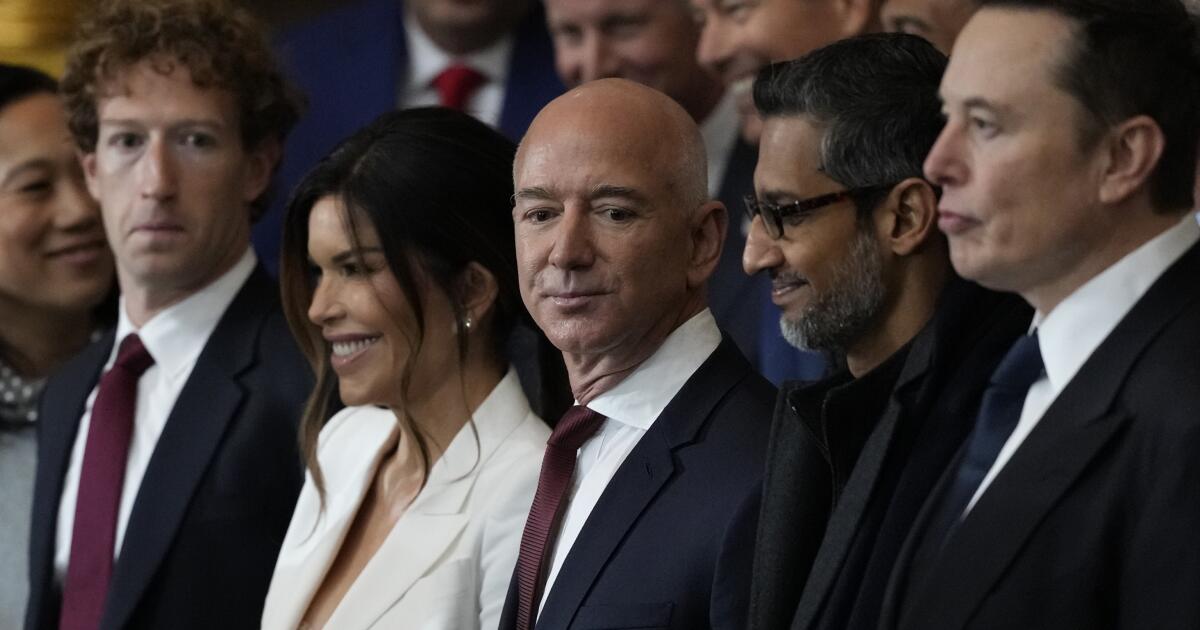
Who will pay the price when the SpaceX hype ebbs? History says it will be the little guy.
In the second trading day as a public company, SpaceX’s initial public offering still was being treated as an extraordinary event in Wall Street history:
The largest IPO ever, creating the first trillionaire in Elon Musk, its boss, and bringing the company’s market value to $2.28 trillion.
On Monday, the stock gained 19.6% on top of its first-day gain of 19%, closing at $192.50. But the IPO is extraordinary in other ways that are becoming more clear as the pre-IPO frenzy yields to the company’s post-IPO reality.
The SpaceX IPO raises unprecedented questions about Wall Street’s role in future mega-IPOs, what this event means for the current bull market in stocks, the wisdom of concentrating so much wealth in so few hands and the rise of wealth inequality. The answers to these questions may not be pretty.
The fact that Wall Street designed a deal that needed $20 billion of retail money to get it across the line tells you something about who they wanted in the building.
— Financial commentator Patrick Boyle
Last week, I pointed to some issues connected to the SpaceX IPO, including the utterly fantastical rationale for the company’s outsized market valuation and the prospect that billions of dollars of shares may be shoved into the retirement accounts of investors who don’t want them, thanks to the willingness of Nasdaq and other stock index sponsors to accept the shares into their indices well ahead of the customary “seasoning” delay.
But there’s more to think about. Start with the paucity of control that shareholders will get for their investments.
Law professor Ann Lipton, who monitors shareholder rights from the University of Colorado, reminds us of the traditional observation that “shareholders have three powers with respect to the corporations in which they invest: to vote, to sell, and to sue,” enabling them to “protect their investment and discipline management.”
Investors in SpaceX have none of those options.
The single votes that they acquire for every SpaceX Class A share offered in the IPO is swamped by the 10 votes per share of the company’s class B stock. As I reported last week, Musk will own a mere 12.3% of the Class A shares, but 93.6% of the Class B shares, which have 10 votes each. That gives him 85.1% of all shareholder votes.
As a result, the prospectus says, “Mr. Musk will be able to control the outcome of matters requiring shareholder approval,” including the selection of directors and even whether he himself should step down.
Wall Street firms have enticed retail investors into buying into the IPO — Fidelity, for example, reduced the minimum account balance allowing clients to buy into an IPO from $100,000-$500,000 to $2,000.
But although those buyers can sell at any time, they will be punished for selling within the first 15 days after the IPO: The “first flip,” Fidelity warns, will result in their being blocked from future IPOs for six months; a second flip blocks them for a year and a third blocks them permanently.
On the other hand, insiders can sell a lot sooner than is customary. Typically, insiders of newly public companies have to wait at least six months before selling their shares, a period known as the lockup.
SpaceX insiders, however, can start selling their shares as soon as the second trading day after the company issues its second-quarter financial disclosure, expected around Aug. 11. (Musk and some other highly placed insiders have committed to holding their shares for at least 366 days.)
SpaceX reserved an unusually large tranche of its IPO for retail investors — 20% or more of the $75 billion raised. “The fact that Wall Street designed a deal that needed $20 billion of retail money to get it across the line tells you something about who they wanted in the building,” notes the former hedge fund operator and YouTube financial commentator Patrick Boyle.
Why did the company and its underwriters do that? It’s because, compared with institutions, retail investors are credulous, vulnerable to hype, and given to hanging on to a stock long after institutions have done the math on an underperforming investment and exited.
Shareholder lawsuits? Nope. The SpaceX bylaws require that any shareholder actions be brought not in court, but in arbitration — traditionally a management-favoring venue.
So no vote, no sales, no lawsuits. That might not matter as much if shareholders could count on the SpaceX board to protect their interests, but your old Magic 8 Ball, if it’s on the ball, might counsel: “Don’t count on it.”
Of the six board members listed in the IPO prospectus (not counting Musk and Gwynne Shotwell, who basically runs SpaceX as its chief operating officer), four are old cronies of Musk’s. They’re Ira Ehrenpreis, a longtime director of Tesla, which Musk controls; Antonio Gracias, a director of Musk’s private firms Neuralink and the Boring Co. and a former Tesla director; Steve Jurvetson, another former Tesla director; and Luke Nosek, a co-founder of PayPal, which was the original source of Musk’s wealth.
The boards of Musk’s companies have generally indulged his desires. Gracias and Jurvetson were on the board of SolarCity, which Musk merged into Tesla when the former was looking financially impaired in 2016. Ehrenpreis was on the Tesla board when it gifted Musk with a $1-trillion pay package last year.
That brings us to the question of whether it’s healthy for society to have so much wealth concentrated in the hands of mega-plutocrats such as Jeff Bezos, Mark Zuckerberg and Musk. These are people who are not at all shy about wielding their wealth to get their way, devil take the hindmost. Herman Melville put his finger on the issue in Moby-Dick, through Father Mapple’s sermon, in which he thunders, “Sin that pays its way can travel freely, and without a passport; whereas Virtue, if a pauper, is stopped at all frontiers.”
Melville wrote that in 1851, but it echoes in Musk’s DOGE service, where his henchpersons ran roughshod through federal programs, stripping them of personnel and funds in what turned out to be a vastly overstated claim of budgetary savings. The wreckage included the U.S. Agency for International Development, or USAID, which could have played an important role in addressing the ongoing Ebola virus outbreak, the cause of illness and death for hundreds of victims in Africa.
But DOGE helped the Trump administration reduce USAID to an empty shell. “About two weeks into the Trump administration, Musk tweeted that he just spent the weekend feeding USAID into the wood chipper,” recalls former USAID health official Nicholas Enrich, who was present at the destruction.
The siren song of Musk’s wealth and the prospect that investors would buy in despite the fantastical claims being made for SpaceX’s future allowed Musk to bully the biggest Wall Street investment banks into capitulating to his vision, and to his personal IPO design. (The IPO prospectus lists 32 banks as underwriters.)
In a normal IPO, the banks’ role is to test the waters for an upcoming issue, determining the right opening price. In this case, Musk decreed an opening price of $135 per share and the banks went along. They also accepted what may be record-low fees for what turned out to be their order-taking role.
Traditional IPO fees run as high at 7% of the issue, though fees have been trending toward 1% on mega-deals. For SpaceX, the fee was 0.7%; that number is small but it still came to about $500 million, to be doled out by Goldman Sachs and Morgan Stanley, the lead banks.
This may be the right moment to consider that even the most high-flying investment crazes generally end in tears. AI is beginning to have that acrid smell. It’s proper to note that the driver of SpaceX’s valuation isn’t its space launches or its Starlink orbital wifi satellites, but its commitment to AI.
(Part of what may be driving the SpaceX frenzy my be the gains collected by early investors in Tesla, which have lent Musk a visionary’s halo. That said, however, Tesla wasn’t added to the Standard & Poor’s 500 index and therefore into large-cap index funds until 10 years after its 2010 IPO.)
That’s what accounts for almost all of the $28.5 trillion “total addressable market” the company claims for its services, never mind that it’s a distant also-ran in the AI business. Never mind that for SpaceX, AI does little but burn money, accounting for $12.7 billion of its $20.7 billion in capital expenditures last year while losing $6.36 billion on $3.2 billion in revenue.
Does the SpaceX IPO signal a bull-market top? That question was raised Sunday by Michelle Celarier, one of the nation’s most percipient financial market reporters. “The laws of economics say there has to be a break someday,” she wrote. “How brutal it will be and how effective governments and central banks will be in controlling the fallout is the unknown.”
Celarier quotes Erica Payne, the founder and president of Patriotic Millionaires, observing that “86 percent of Americans are worried about the price of food. Elon Musk is a trillionaire. These two things are deeply, inherently connected.”
The SpaceX IPO may eventually stand in retrospect as a monument to this moment.
-
Business14 seconds ago
Snap unveils its $2,195 augmented reality glasses as rivalry with Meta heats up
-
 Entertainment7 minutes ago
‘KPop Demon Hunters’ was a ‘bright spot’ in a year of declining diversity among streaming films, study finds
-
 Lifestyle10 minutes ago
Ziggy Marley turns grief into light on ‘Brightside’ and brings the vibration to the Hollywood Bowl
-
 Politics15 minutes ago
Commentary: Gerrymanders, judges and an alley-oop: A look at the midterm fight for control of Congress
-
 Sports25 minutes ago
L.A. defies the skeptics for a World Cup marked by unity, fearless fun
-

 World37 minutes ago
Israeli air strikes on Lebanon continue despite US-Iran deal
-
 News1 hour ago
President Trump calls to delay nomination of intel pick Jay Clayton
-

 Los Angeles, Ca2 hours ago
Neighbors say Encino mansion brings rowdy parties, scantily clad women to quiet street

