Business
Commentary: Trump won't last forever. Here's what it will take to rebuild what he's tearing down

The all-purpose adage offering optimism — and sometimes pessimism — to those confronting a crisis head-on is: “This too shall pass.”
One gets the impression that this is a crutch favored by some major institutions that have capitulated to Donald Trump’s demands — such as universities that have committed to fines and payouts stretching out several years, beyond the end of Trump’s current (and final) term and law firms that have made nebulous commitments to represent Trump’s favored litigants in cases that may not even be brought until after the 2028 elections.
Some institutions and services that have suffered major cuts in government funding may be tempted to hunker down, covering what they think may be a temporary shortfall in the expectation that a subsequent administration will restore the withheld funding and cover their interim losses. Recovery, however, may be tougher than they think.
The best-case scenario is that we limp along for the next three and a half years…But that’s just a hope.
— Jonathan Howard, New York University
I reached out to some of my most trusted contacts in science, medicine, labor and other fields, hoping to hear encouragement that the current situation will be fleeting and it isn’t too soon to look ahead; Trump’s presidential term, after all, is finite.
I ended up with a string of the gloomiest conversations in my long career — and I’ve covered two foreign civil wars and more stock market crashes and economic slumps than I can count. (Well, let’s say more than a dozen.)
“We’re still in free fall and people are still in a ‘shock and awe’ phase,” says vaccinologist Peter Hotez, who has written to defend sound science throughout Trump’s terms. “What’s happening right now is continuing to evolve, and we don’t really know where it’s going. It’s important not to take the attitude of ‘this too will pass,’ hunker down for a couple of years and then it will go back to the way it was.”
The administration’s cuts in biomedical research funding, the “continuing ascendance of the MAHA movement” — Robert F. Kennedy Jr.’s disdain for accepted science in favor of pseudoscience — betokens a dark period ahead, Hotez told me. “Even if these things stop tomorrow, you’ve got a pretty demoralized physician and scientific workforce. What this administration has done has given being a scientist an unsavory element — it’s no longer a noble profession.”
Of particular concern is the administration’s injection of partisan ideologies into the scientific grant-making process, shattering applicants’ confidence that their submissions are considered fairly. The scoring of grant applications by professional panels used to be the key element in the process.
“Now, even if you get a fundable score,” Hotez says, “there’s still somebody behind the curtain who still could nix it for ideological reasons. And even if your first year is funded there’s no guarantee for out years.”
The uncertainty that injects could hamstring scientific research for a generation, or longer.
“How easy is it to rebuild a lab that’s been hit by cuts?” says John P. Moore, a professor of microbiology and immunology at Weill Cornell Medical College, where labs have been hobbled by the administration’s toying with grants. “The answer is it’s very difficult, once you lose key members of a research group, who are often the senior technicians who have institutional memory and keep a program going day to day. At a certain point, a freeze or a termination is not reversible.”
Moore also points to the consequences of a loss of foreign-born scientists. “America is now not a welcoming country for immigrants, period. Scientists who are here on short-term visas are realizing that their future is not in this country. Other countries are seeking to suck up talent that otherwise would have come here. That’s going to have an impact over time, and it’s not going to be easy to reverse.”
In my conversations with scientists, one name kept coming up: Trofim Lysenko, the charlatan whose reign over Soviet science during Stalin’s regime from the 1930s to the 1960s and whose promotion of an anti-science ideology, especially a campaign against genetics research, encompassed repeated crop failures and famines costing some 7 million lives. I made the connection between Lysenkoism and Trump’s appointment of Robert F. Kennedy Jr. to head the Department of Health and Human Services in November.
“The Soviet Union did everything they could to invest back in science and genetics and molecular biology, but it was still stagnant,” says Angela Rasmussen, a leading American virologist now working in Canada. “But despite the attempts to rebuild what Lysenko had torn down, they were never able to compete with people everywhere else because they had lost so much by shutting down all genetics research during that time.”
Three factors could be lasting obstacles: Trump’s undermining of federal employment, of the law and of the economy.
Trump has systematically demoralized the workforce responsible for enforcing the regulations that remain. That’s the observation of David Weil, a labor expert at Brandeis University whose nomination by President Biden for a top-level post at the Department of Labor was sidelined by conservative opposition in 2022.
The law has been a thin reed to lean on, Weil observes. A key example is the attack by Elon Musk’s SpaceX on the National Labor Relations Board, which garnered an opinion from the notoriously right-wing 5th Circuit Court of Appeals last month finding that the NLRB’s structure “violates the separation of powers” established by the Constitution. That’s a remarkable finding, given that the NLRB was established 90 years ago, in 1935.
“If the Supreme Court upholds the 5th Circuit, “ Weil told me, “that’s the end of the NLRA,” the act that established the board, “and we go back to a system where there’s no federal statutory method for protecting private sector workers.”
What Weil finds especially disquieting is the Supreme Court’s practice of allowing Trump to continue challenged policies while the underlying issues are litigated. “Instead of letting the status quo to prevail until we adjudicate the issues, they’re letting Trump prevail until they adjudicate. That, to me, is a formula for destruction. How do you rebuild then?”
The court has done this by lifting the stays on Trump policies imposed by lower courts, pending further rulings. That’s what happened as recently as Monday, when the court overturned a Los Angeles federal judge’s order that had barred “roving patrols” of immigration officers from snatching people off Southern California streets based on how they look, what language they speak, what work they do or where they happen to be.
One issue casting a shadow over all others is the future course of Trump’s economy. At this moment, the warning signs are all flashing red. Inflation is on the rise — core inflation as measured by the personal consumption index, the Federal Reserve’s preferred metric, rose in July to an annualized rate of 2.9%, the highest rate since February; economists expect the rate to keep rising as businesses pass through more of their tariff-related costs to consumers.
Meanwhile, new hiring has ground to a screeching halt, according to the latest government statistics. The unemployment rate notched up to 4.3% in July, not the direction Trump would like to see. The rate hasn’t been this high since the pandemic year of 2021.
Trump also has remade the government’s relationship with industry, extracting a fee from the AI chipmaker Nvidia of 15% of its revenue from selling chips to China and taking a 9.9% equity stake in the faltering chipmaker Intel. That’s not the first time the government has owned a piece of a public company — it owned most of GM during the Great Recession, but later sold its stake; Trump is talking about making a habit of these buy-ins through a sovereign wealth fund, an idea that’s far from universally favored by political leaders and economists.
Trump’s rampage through government agencies, especially those devoted to science, health and the economy, has left some so severely damaged that fixing what’s broken might require the establishment of a Cabinet-level post to oversee the repair job.
Consider the state of the Centers for Disease Control and Prevention, where five top officials resigned or were forced out late last month — including CDC Director Susan Monarez, who was fired after less than a month on the job after tangling with Health and Human Affairs Secretary Robert F. Kennedy Jr. Anyone tasked by a future administration with rebuilding the CDC, which once set the global gold standard for public health, will have to be told: “You know you’ll be starting from scratch, right?”
It’s only fair to say that the GOP hasn’t had a monopoly on philistine attacks on scientific research. The pioneer of such cocksure philistinism was Sen. William Proxmire (D-Wis.), who started issuing his “Golden Fleece” awards in 1975. Proxmire became addicted to the fawning press attention he got from caricaturing serious scientific research as ludicrous. His know-nothing rabble-rousing appalled progressives who otherwise admired him for his principled stands against the Vietnam War and in favor of campaign finance reform.
But its more lasting and destructive effect was to render political attacks on scientific research acceptable. Proxmire’s goal was personal aggrandizement. The goal of the current attackers is more sinister — they’re engaged in an anti-science campaign for strictly ideological purposes.
“The best-case scenario is that we limp along for the next three and a half years,” says Jonathan Howard, a neurologist at New York University and a practiced debunker of the pseudoscience that contaminated efforts to fight the pandemic. “Good people stay on and do good work the best they can and we get a reprieve in three and a half years and the amount of damage they’re able to do is limited in that time. But that’s just a hope.”

Johnny Beig may have played in a semi professional cricket league in Australia, but this summer he’s a big fan of soccer in the United States.
It’s not just because he’s rooting for the World Cup team, though.
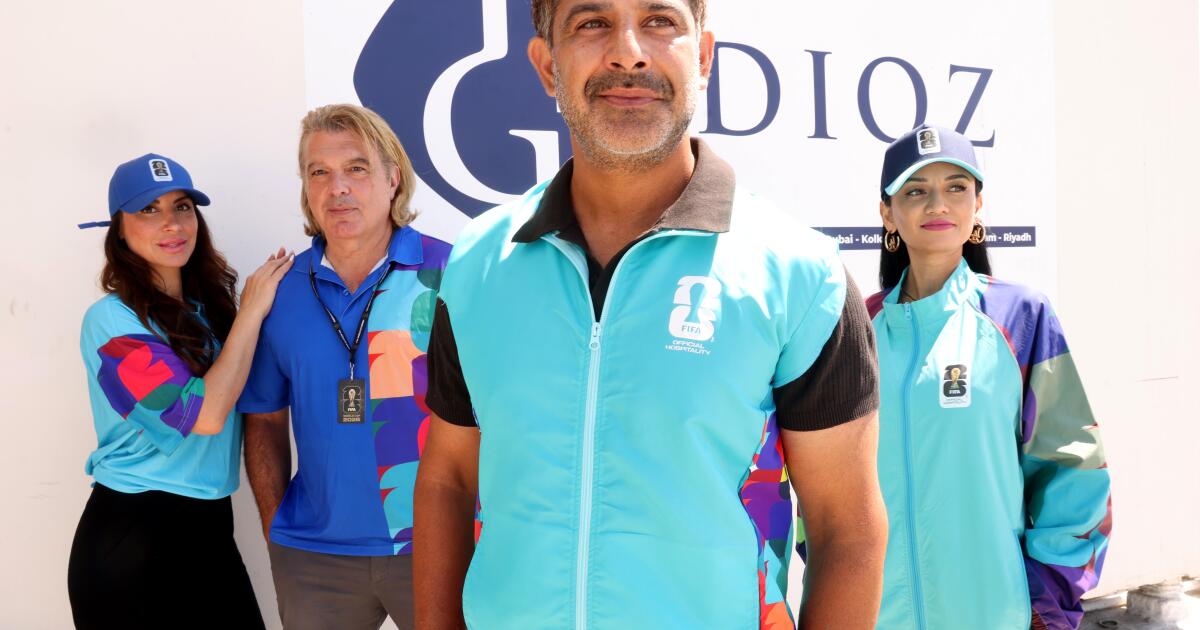
FIFA emblems are featured on jerseys that were created by the Dioz Group and distributed for all employees at the 16 FIFA World Cup venues this summer.
(Genaro Molina / Los Angeles Times)
Last year, Beig’s Beverly Hills-based company, Dioz Group, won a $2.5 million contract with On Location, FIFA’s hospitality partner, to design, manufacture and distribute uniforms for all employees working at FIFA World Cup venues this summer.
These include the people welcoming attendees into stadiums, VIP lounge chefs, waiters and the flagbearers during the opening ceremony.
After a multi-step application process, including presentations of its planning and strategy, Dioz says it produced more than 50,000 clothing garments including suits, jackets, shirts and hats and delivered them to the 16 World Cup venues around the U.S., Canada and Mexico in June.
Thanks in part to the World Cup contract, the company’s revenue has reached $15 million so far this year, compared with $20 million last year, Beig said. He declined to disclose the company’s net income but said the business was profitable.
“We are working with larger names that we would have never imagined we would,” he said. “The FIFA World Cup is the pinnacle. Working with the largest sporting event in the world is what we’re very proud of. I don’t think it gets any bigger than that.”

Volunteers line up to prepare to display the Canadian flag before a World Cup round of 32 knock-out match between Canada and South Africa at SoFi Stadium on Sunday.
(Kelvin Kuo / Los Angeles Times)
Dioz is among the many small businesses across Los Angeles that are getting a boost from the global sporting event, said Kevin Klowden, a senior fellow at the Milken Institute.
The influx of hundreds of thousands of fans into the city has been a boon to hotels, transportation services and restaurants, in addition to those in the special events and logistics economy, Klowden said, calling the event the “equivalent of multiple Super Bowls.”
“The number of contracts that are there, it’s a big deal,” he said. “Given the fact that L.A.’s filming is only slowly recovering, having something like the World Cup is definitely a boost.”
Dioz was co-founded by Johnny, 44, and his brother Tony in 2006. The brothers were born in India and raised in Australia, where Johnny enjoyed a brief career as a semi professional cricket player.
He realized his future wasn’t as a professional athlete, but he wanted to stay connected to the sports world, so he began making uniforms for his cricket team in 2006.
He then got a referral to make uniforms for multiple teams in the area before starting an apparel company.
“I wanted to stick with something I was passionate about, which is sports,” he said.

Volunteers unravel the center field display before a World Cup round of 32 knock-out match between Canada and South Africa at SoFi Stadium on Sunday.
(Ronaldo Bolanos / Los Angeles Times)
In 2012, Beig moved to Los Angeles and established Dioz‘s Los Angeles headquarters to tap into the U.S. market. During the pandemic, the company started supplying medical apparel to hospitals and schools, and the business took off, with revenue doubling in 2020, Beig said.
Dioz now has over 150 employees, including 15 in L.A., and manufactures its apparel at factories in China, India, Bangladesh, Turkey and the Philippines. Tony runs an office in Dubai.
Before the World Cup, Dioz provided employee uniforms for events including Super Bowl LIX and Copa America, which may have given it a leg up on the FIFA contact.
Now, with a World Cup contract on their resume, Beig said he’s setting his sights on even bigger events.
“This gives us an edge over the next FIFA events worldwide as well, where we can showcase our skills and we can handle it,” Beig said. “So it gives us a good opportunity to work with sporting events like the UEFA Championship and Premier League.”
As companies get new business from the World Cup, Klowden said it’s important that they leverage their new position to continue that growth.
Companies that benefited from the World Cup might be in a position to bid on even bigger contracts, especially with the Olympics coming up in 2028, Klowden said.
“The really important part in any of these deals is that if a company ran something like this, then they are able to build off of that success,” Klowden said. “Let’s say you’re a company that did a big uniform order or a big food order, and the World Cup goes, and you invested in new manufacturing capacity, or you invested in new clothing machines, or whatever you do; suddenly you don’t have that market anymore, then you’ve just wasted all that money ramping up.”
Surcharges that California homeowners have been hit with statewide by insurers defraying the costs of Los Angeles County’s wildfires were ruled legal in a decision released late Tuesday.
L.A. County Superior Court Judge Tiana Murillo turned down a petition by advocacy group Consumer Watchdog to halt the charges, which insurers began levying last year after the state’s insurer of last resort couldn’t pay all its January 2025 fire claims.
The California FAIR Plan, financially backed and operated by the state’s licensed home insurers, needed a $1-billion bailout from the insurers after it was hit with some $4 billion in claims.
Under a deal Insurance Commissioner Ricardo Lara worked out with the FAIR Plan in 2024, the insurers could seek state approval to surcharge their residential policyholders for up to half of any assessment totaling $1 billion in case the plan needed a bailout in an “extreme worst case scenario” — as it turned out it did.
A total of 105 insurers, including State Farm General — California’s largest home insurer — Farmers and Mercury sought and received approval for the surcharges.
Because the FAIR Plan assessed its member insurers based on their share of the state’s home insurance market, the policyholder surcharges were in the same ballpark. The median fee for homeowners was $28, according to the department of insurance.
The fee can be more or less according to the size of a homeowner’s premium and is split into monthly payments that insurers can spread over one or two years. Condo owners and renters on average were surcharged less.
In a court filing, Consumer Watchdog said $420 million in surcharges were approved.
In its April 2025 lawsuit filed against Lara, the Los Angeles group made a series of arguments in seeking to overturn the residential surcharges, which it deemed an industry bailout. It did not sue over related commercial surcharges.
Consumer Watchdog contended in its lawsuit that the surcharges violated Proposition 103 — the 1988 measure that governs insurer rate hikes — because the proposition does not allow for them.
It also claimed Lara did not follow regulatory protocol in promulgating the new policy.
The group further alleged that the FAIR Plan’s governing statutes do not give Lara the authority to permit the surcharges — and that the statutes require insurers to share in the plan’s profits and losses, and not shift losses to policyholders.
Murillo, and another judge who previously heard the case, turned down all of the consumer group’s arguments in separate rulings, the last of which Murillo issued Tuesday night.
Lara celebrated his legal victory over Consumer Watchdog, which has accused Lara of having close ties to insurers and sought to oust him from office. His terms ends in January.
“This victory sends a loud and clear message: The era of allowing special interests to derail consumer choice is over. We have the momentum, we have the authority, and we will continue to fight until every Californian has access to the coverage they deserve,” Lara said in a statement.
Attorney Will Pletcher, litigation director of Consumer Watchdog, said the group disagreed with the decision and would “consider all options to move this forward.”
“It’s important to try to protect California consumers from these surcharges that we think are in pretty clear conflict with both Proposition 103 and the FAIR Plan,” he said.
Hilary McLean, a spokesperson for the plan, said in a statement it did not have any position on the ruling, given the plan “does not have a role in determining how insurers manage costs associated with assessment.”
Denni Ritter, vice president of state government relations for the American Property Casualty Insurance Assn., a major industry trade group, said the decision rejected “the reckless lawsuit brought by the self-interested group Consumer Watchdog…”
“This ruling preserves a vital tool to protect the stability of the California insurance market. Blocking cost recovery would have undermined the state’s last-resort coverage option,” she said in a statement.
The 2024 policy was issued in response to the rapid growth of the plan due to a series of wildfires over the last decade that prompted multiple insurers to retreat from the state’s home insurance market.
The plan had 264,000 homeowners on its rolls in September 2022, a figure that rose to 452,0000 in the months before the fires — and its residential policyholders have since increased to 663,000 as of March.
The FAIR Plan offers policies that typically cost more than those issued by regular insurers while offering less coverage.
A Times analysis last year found that in the Palisades and Eaton fire zones, the plan’s rolls nearly doubled to 28,440 from 2020 to 2024.
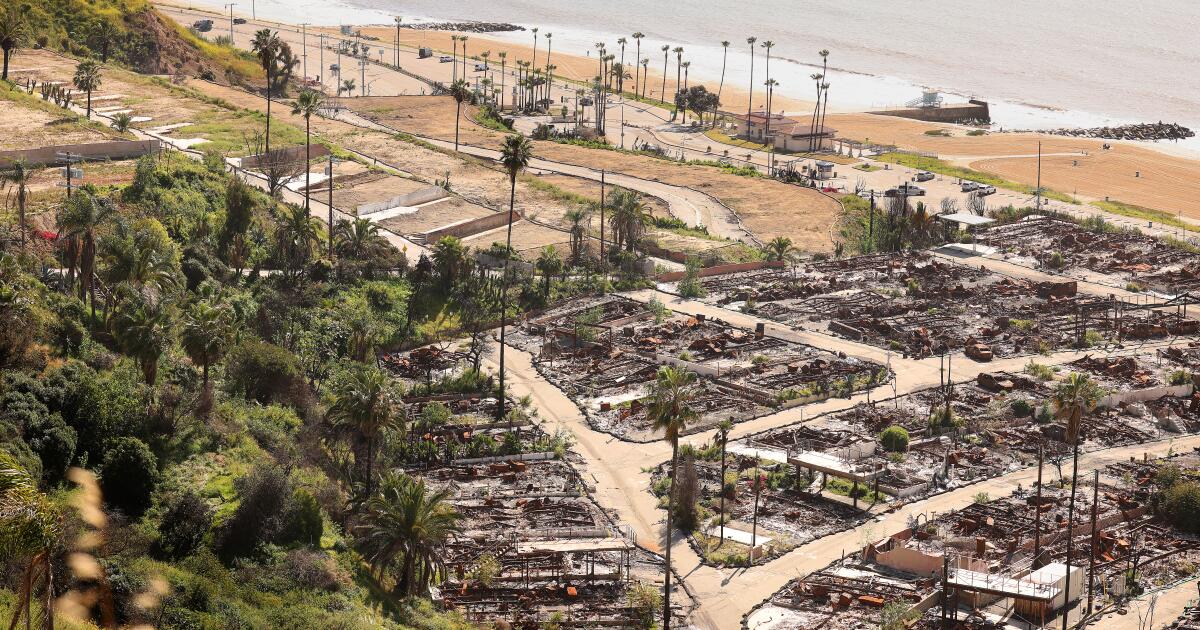
That concentration of policyholders led to the plan’s large losses during the Jan. 7 wildfires, which damaged or destroyed more than 18,000 structures, killing at least 31 people.
It’s been estimated that the insured losses for the wildfires could ultimately total as much as $40 billion, exceeding any past wildfires worldwide. Ritter said that so far insurers have paid $23.7 billion in claims.
The 2025 wildfires were not the only time the FAIR Plan has needed a bailout, though it is the first time its member insurers surcharged policyholders.
In 1993, it assessed carriers after fires in Altadena and Malibu, and in 1994 it did so after the Northridge earthquake. The assessments totaled $260 million.
The plan received approval this year from the insurance department for a 29% rate increase for its homeowner dwelling policy that will take effect in October.

An electric Tesla Semi truck crashed into two vehicles in Dayton, Nev., over the weekend, killing two people and raising questions about the truck’s safety features.
The Lyon County Sheriff’s Office responded to a major collision around 7 a.m. on Sunday at the intersection of Highway 50 and Traditions Parkway about 40 miles east of Reno, the office said.
The office confirmed a semi-truck was involved in the accident, and footage of the scene shows it was a Tesla Semi.
It is the first known crash involving a Tesla Semi, an electric Class 8 truck that Tesla is building in Nevada and plans to ramp up production of. As interest in Tesla’s electric passenger vehicles wanes, the company is betting on the truck to give it a needed boost.
The trucks do not have the Full Self-Driving mode available in Tesla cars, but Tesla’s website says they come standard “with active safety features that pair with advanced motor and brake controls to deliver traction and stability in all conditions.”
According to the Lyon County Sheriff’s Office, preliminary statements obtained at the scene suggest the truck driver may have fallen asleep behind the wheel.
The crash is under investigation by the Nevada State Police Highway Patrol, which said additional information may be released next week.
The Record-Courier identified the victims as Sergio and Jennifer Villanueva, a couple who got married in 2022.
Tesla has not clarified if its semitruck has an automatic emergency braking system. Federal regulators are currently weighing a mandate for emergency braking systems in vehicles more than 10,000 pounds.
-

 Austin, TX5 minutes ago
July 4th: Austin celebration preview, safety tips
-

 Alabama8 minutes ago
Alabama unveils the Alabama Catfish Trail
-

 Alaska13 minutes ago
Some of the best America has to offer can be seen at its national parks
-

 Arizona20 minutes ago
Milwaukee Brewers vs Arizona Diamondbacks score, lineups, live updates
-

 Arkansas23 minutes ago
Arkansas Game and Fish ramps up lake patrols for busy Fourth of July weekend
-

 California35 minutes ago
Mother, daughter found ‘alive and well’ after going missing on Southern California hiking trail
-

 Colorado38 minutes ago
Thousands forced to evacuate in Colorado as wildfire spreads
-

 Connecticut43 minutes ago
AGANORSA Leaf Aniversario Connecticut Tubo Ships

