Business
Column: The rise of Kamala Harris shows that our political 'polarization' was always a myth

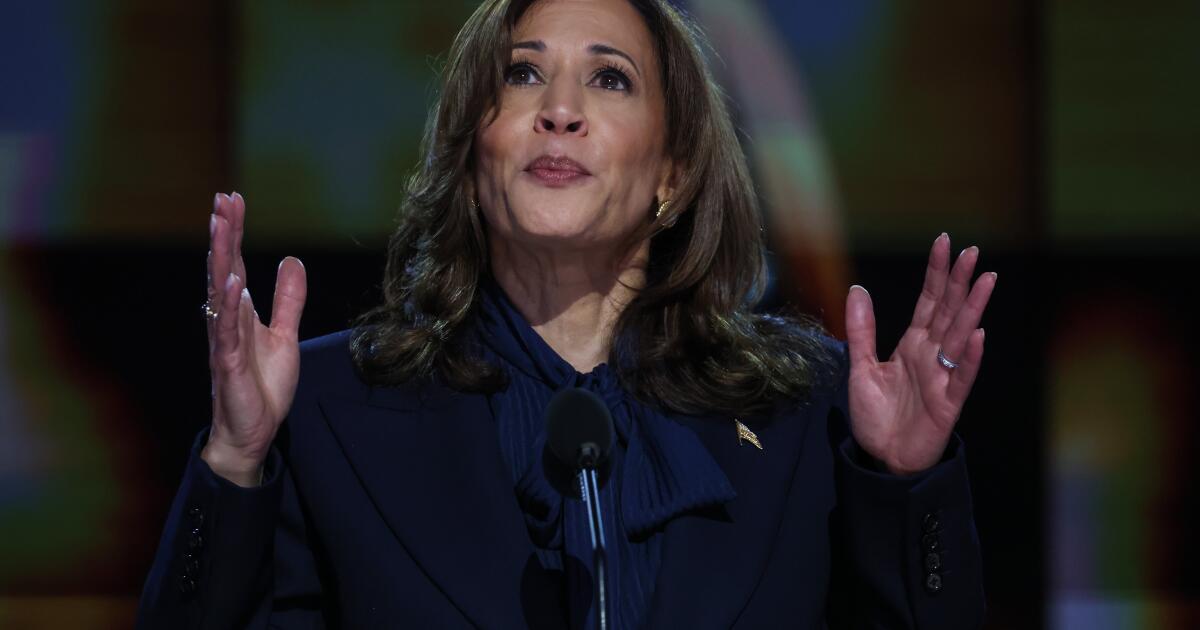
A funny thing happened after July 21, when President Biden ended his campaign for reelection. It’s not merely that Kamala Harris emerged to take his place; it’s that her campaign had overcome the polarization of American politics.
At least, that’s the reading provided by not a few political pundits. But it’s not quite true. The reality is that Harris’ rise as a leading political figure demonstrates that America was never as polarized as our commentators claimed.
I made this point nearly three years ago, in the wake of the failed recall effort against Gov. Gavin Newsom. The recall failed by a 2-to-1 vote. As i observed at the time, the commentariat persisted in viewing the result through the prism of the “polarization” theme, even though it demonstrated conclusively that in California, at least, there was broad agreement, not disagreement, about Newsom’s policies on fighting COVID, abortion and gun control.
Another four years of Donald Trump’s chaotic leadership, this time focused on advancing the dangerous goals of Project 2025, will hurt real, everyday people and weaken our sacred institutions.
— Letter from 200 former Republican aides endorsing Kamala Harris for president
Harris has (so far) finessed the polarization meme by making an explicit appeal to voters based on issues likely to find widespread conformity across the partisan spectrum. These include abortion rights (despite the issue’s appearance as a wedge driving Americans apart) and economic policies aimed at the middle class.
The harvest appears to be a surge in cross-party support for the Harris campaign. On Monday, more than 200 former Republican aides to presidents George W. and George H.W. Bush and Sens. Mitt Romney and John McCain endorsed Harris in an open letter, stating that “another four years of Donald Trump’s chaotic leadership, this time focused on advancing the dangerous goals of Project 2025, will hurt real, everyday people and weaken our sacred institutions.”
A dozen lawyers who served Ronald Reagan and both Bushes in the White House issued their own joint endorsement, stating, “We believe that returning former President Trump to office would threaten American democracy and undermine the rule of law in our country.”
The Harris campaign, emboldened by positive polls, is seeking to expand its presence into Sun Belt states that were either judged out of reach or leaning Republican, such as Georgia, Arizona and North Carolina.
Yet it may be more accurate to view these developments not as Harris overcoming polarization, but as her exposing the shallowness of the polarization impression. Political scientists have increasingly come to the conclusion that the apparent polarization of debate in the U.S. is an artifact of where that debate has been conducted — chiefly on social media.
“At first blush, the American political landscape can seem quite bleak, in part because of heightened political polarization,” observed researchers from UC Berkeley and Columbia University in March. But they found that “the landscape of debate is distorted by social media and the salience of negativity present in high-profile spats.”
The misimpression among Americans, they wrote, fosters “a false reality about the landscape of debate which can unnecessarily undermine their hope about the future.”
The methods used by social media platforms to grab and hold users’ attention deserves much of the blame for this distortion, they asserted. “There is evidence that negative information spreads more quickly on social media and is often amplified by social media algorithms that promote or push content to the forefront of users’ pages,” they wrote.
“This negativity is exacerbated by non-human actors or ‘bots’ that often inflame online conflicts …. These factors combined suggest that negative, conflict-laden debates will flow to the top of people’s timelines.”
A similar conclusion was reached by political scientists James Druckman of the University of Rochester, Matthew Levendusky of the University of Pennsylvania and their colleagues, who found in a 2020 paper that the “hyper-partisan polarization” that defined current American politics in the 21st century was “affective polarization” — meaning that when people were asked in surveys about the party whose policies they opposed, was based on “stereotypes and media exemplars of ideologically extreme and politically engaged partisans.”
What was happening, they wrote, was that people incorrectly assumed that those extremists “comprise the majority of the other party.”
Another factor is Trump, who “is also a polarizer: he takes existing trends and pours gasoline on them,” Levendusky told me.
Still, the image of a hopelessly polarized America is belied by opinion polls and ballot results on individual issues. Nearly two-thirds of Americans feel that abortion should be legal in all or most cases, according to a survey issued in May by the Pew Research Center. That’s higher than it was in 1995.
More evidence comes from abortion-related ballot initiatives in seven states in 2022 and 2023, following the Supreme Court’s overturning of Roe vs. Wade: The pro-abortion rights position prevailed in every one, including in the red states Ohio, Kansas and Kentucky. Abortion rights measures will be on the ballot in 10 states this November, including Florida, Missouri, Nebraska and South Dakota.
Sizable majorities also are seen in opinion polls in favor of stricter gun laws and antipandemic measures such as masking and social distancing. COVID vaccines may be the target of obstreperous antivaccination fanatics, but most Americans have voted with their feet by walking into vaccine clinics: 81% of Americans have received at least one shot and 70% are considered fully vaccinated with multiple doses.
That includes states in which antivaccination politics reign, such as Florida, where the Republican-appointed surgeon general, Joseph Ladapo, has issued antivax recommendations so misleading that he was publicly rebuked by the Centers for Disease Control and Prevention and the Food and Drug Administration. Despite Ladapo’s antivax propaganda, 81.4% of Floridians have received at least one shot and 68.6% are considered fully vaccinated.
As for the homogenizing of the major parties’ opposing positions on matters of public concern — liberals becoming Democrats and conservatives becoming Republicans — that’s not polarization so much as what Levendusky described as “the partisan sort” in his 2009 book of the same name. Voters take their cues from the leaders of their favored party, he noted, “looking to elites who share their values to figure out where they stand on the issues.”
“People have gotten a bit more divided over time, but much less than people think,” Levendusky says. “People have sorted themselves so that Democrats are now mostly one side of the issue, and Republicans on the other. A generation ago, you had lots of pro-environment Republicans, pro-choice Republicans (and pro-life Democrats!), Democrats who were strong gun rights supporters, and so on. Now, that’s much less true.”
What is true is that the platforms of the two major parties have moved further apart; more precisely, while the Democratic Party stayed where it had been, slightly left of center, the Republican Party moved distinctly toward the extreme right.
The reason, Levendusky argued in his book, was the flow of evangelicals and other fundamentalist Christians into the Republican Party starting in the 1970s. Party leaders — the “elite,” in Levendusky’s term — moved rightward to accommodate this new, outspoken bloc; some nonfundamentalist party members followed along, but most remained centrist on economic issues and abortion rights.
This process is relatively new in American politics. During the New Deal, the most obdurate critics of Franklin Roosevelt’s policies were Democrats — Southern Democrats, to be sure, but his party members nonetheless — while among his most loyal supporters were liberal Republicans. One of the two aides who served in FDR’s Cabinet for all 12 of his years in office, Harold Ickes, was a Republican. (The other was Frances Perkins, a Democrat.) Lyndon Johnson had to trample over opposition by the Southerners in his party to get the Civil Rights and Voting Rights acts passed in the 1960s.
Just as the Republicans had a progressive wing, the Democrats had a conservative wing comprising Wall Street bankers and corporate executives such as Alfred P. Sloan, the chairman and chief executive of General Motors. Sloan and his fellow rich reactionaries established a rump anti-New Deal bloc, the American Liberty League, to lobby against FDR’s policies from inside the Democratic Party.
FDR rhetorically drummed them out of the party — their “two particular tenets,” he said, are that “you should love God and then forget your neighbor” — but they remained part of the party until the league disbanded in 1940.
In recent years, Levendusky observed, there has been a shift in both parties toward the extremes. But it’s not as pronounced as social media posters and political commentators would have it. “The majority of the electorate remain closer to the center than to the poles.”
That’s where Harris is right now, which may be the key to her placing the “polarization” ogre in its grave for good.




The race to bring air travel to the sky is heating up as Santa Cruz-based Joby Aviation and Toyota launch a joint venture to commercially produce air taxis.
The companies said in a news release Tuesday that they will work together on productivity, quality and costs and move toward mass production of Joby’s electric vertical takeoff aircraft. Joby and Toyota were first linked when Toyota made a nearly $400-million investment in the company in 2020. It has since increased its backing of the company to $900 million.
“It’s really meaningful for us to take on this challenge together with Joby, a partner that shares the same vision,” Toyota Chair Akio Toyoda said. “We believe this strengthened relationship is an important step forward in realizing the future mobility society.”
Joby‘s all-electric vertical takeoff vehicles are designed to hold four passengers and a pilot and can travel at up to 200 mph. The vehicle uses six tilting propellers to achieve vertical takeoff before switching to forward flight.
In February, Joby announced a partnership with Uber to start service in the United Arab Emirates this year, bringing on-demand air taxi rides to the country. It plans to expand to the U.S. after the completion of its final stage of Federal Aviation Administration testing.
Prior to its full FAA certification, Joby is hoping to launch early flight operations later this year as part of a White House program that will bring flights to several states, including New York, Texas and Arizona. Flights in California will not begin until after obtaining FAA certification.
Joby has been in a fierce battle to be the first with taxis in the sky with its Northern California competitor Archer Aviation. The two companies are involved in overlapping lawsuits, with Joby alleging corporate espionage against Archer, and Archer filing a suit alleging dubious ties to China that sparked an investigation into Joby by the U.S. International Trade Commission.
“Toyota has been by Joby’s side for nearly a decade, providing invaluable guidance and support as we built the foundation for manufacturing our aircraft,” JoeBen Bevirt, Joby’s chief executive and founder, said in the news release. “Together, we share a vision of making aerial mobility an everyday reality, and we look forward to delivering on that promise together.”
Joby Aviation’s shares, which have fallen more than 30% this year, climbed 3% on Tuesday to $8.92.
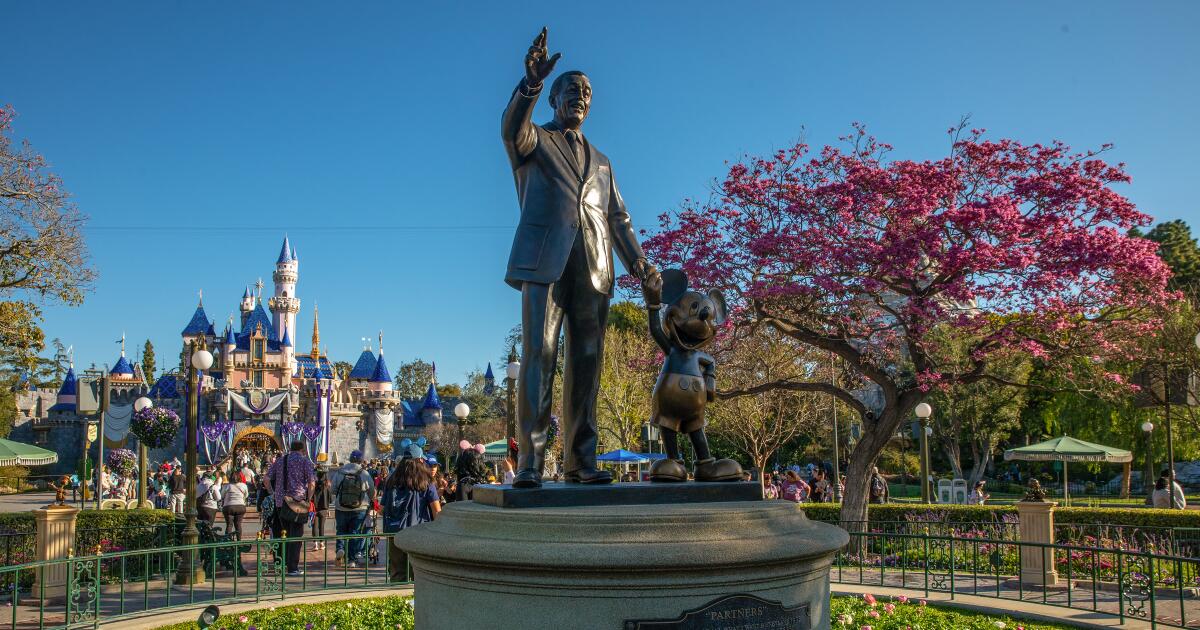
Disneyland Resort in Anaheim will offer $59 tickets for select evening admission to either theme park as part of a new promotion.
The one-day, one-park evening ticket offer will allow attendees to enter Disney California Adventure at 5 p.m. or Disneyland at 7 p.m. Park reservations are still required, as has been the case since the COVID-19 pandemic.
The offer only applies for admission from July 12 through Aug. 5 on Sundays to Wednesdays.
Disneyland Resort is commemorating its 70th anniversary through Aug. 9, and has introduced new shows and additions to rides as part of the occasion.
Walt Disney Co.’s theme parks and experiences business are a crucial boost to its finances, making up about 56% of the company’s operating income last fiscal year.
During the Burbank-based company’s most recent earnings call in May, Disney executives said attendance at its U.S.-based parks was down 1% compared with the prior year, a shift they attributed to “continued softness” in international visitations. However, the company said at the time that it was starting to move past those issues.
Disney’s experiences division reported $9.5 billion in revenue in that fiscal second quarter, up 7% compared with the same period a year ago, something executives said was due to higher guest spending domestically and more capacity on its cruise line.

An aging downtown office complex will be converted into apartments as part of an ambitious plan by local real estate companies to create 4,000 affordable housing units in Los Angeles.
The first project will be a $200-million makeover of the L.A. World Trade Center, a sprawling white elephant of an office complex on Figueroa Street built in the 1970s that will be turned into 512 apartments in one of the largest affordable housing conversions to date downtown.
Future projects being planned in the central city for delivery over the next five years will include other office-to-apartment conversions and new housing built from the ground up.
The 10-story World Trade Center, right, at Figueroa and Fourth streets in downtown Los Angeles, was built in the mid-1970s.
(Myung J. Chun / Los Angeles Times)
Behind the building campaign unveiled Monday are two of the region’s largest real estate companies, Jamison and Kennedy Wilson. Jamison is the city’s most prolific converter of offices to market-rate apartments and currently has a major makeover of a downtown office skyscraper underway for tenants who can pay top rents.
Kennedy Wilson, a real estate investment company based in Beverly Hills, owns Vintage Housing, which builds and operates affordable housing using tax credits and other state and federal financing to help fund it.
Vintage Housing and Jamison’s new affordable housing division, Arden Residential, will take on the campaign to build the housing where qualified tenants will pay rents below market rates.
Rents in the World Trade Center — which will be renamed Sky Castle when it opens in early 2028 — are expected to start at $937 for a one-bedroom unit. Some two- and three-bedroom units would rent for $1,100 and $1,300 per month, respectively, developers said.
Sky Castle will have shared amenities found in more expensive modern apartments, the developers said, such as a fitness center, resident lounge and co-working space. It already has six tennis courts on the roof, which may be converted to pickleball courts, Jamison Chief Executive Garrett Lee said.
The goal is to build higher quality affordable housing by using efficient construction methods Jamison has learned through building more than 8,000 market-rate apartments in the past, Lee said. The makeover of the World Trade Center will mark Jamison’s 15th conversion of an office building to housing.
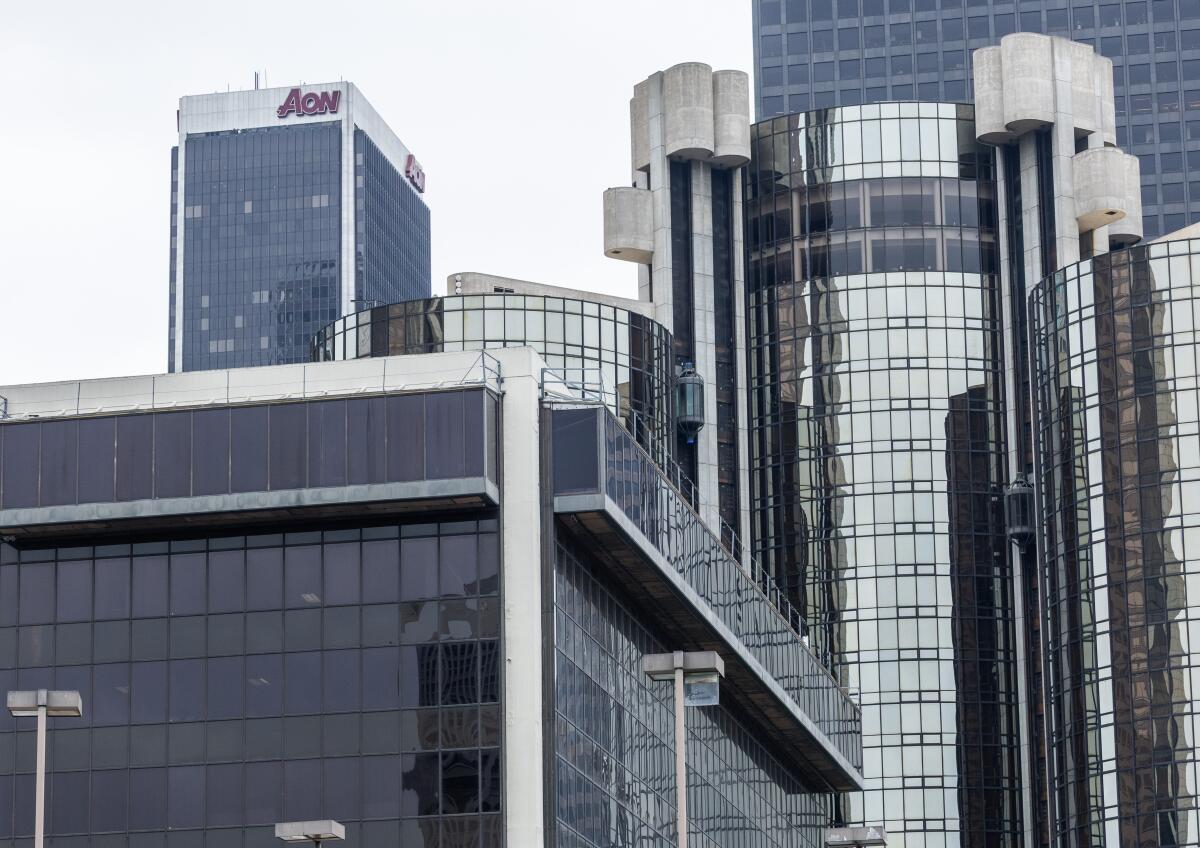
The plan to redevelop the L.A. World Trade Center, bottom left, is one of the largest affordable housing conversions to date downtown.
(Myung J. Chun / Los Angeles Times)
The 10-story World Trade Center was built in the mid-1970s to fanfare saying it would be home to international companies. In 1976, The Times described the center as a place to prepare for an overseas trip where visitors could get passports and visas, as well as exchange dollars for francs, marks, rubles and other currency. There was a language school and branches of U.S., Swiss and Japanese banks.
By the mid-1980s, the 400,000-square-foot office complex covering a city block at Figueroa and Fourth streets had lost its international flavor and was falling out of favor with corporate tenants who were moving into glossy new skyscrapers on Bunker Hill and in other locations.
The building has been cleared of remaining office tenants to allow work to begin in August, Lee said.
Kennedy Wilson is a nationwide operator of market-rate apartments that has also moved into building affordable housing in the last decade, said Nicholas Bridges, global head of capital markets at the company.
Building affordable, workforce housing “in almost all cases requires public subsidies,” Bridges said, and Kennedy Wilson has developed expertise in assembling “a cocktail of public financing sources” that includes low-income housing tax credits and tax-exempt bonds.
In the past, many housing developers have shied away from building affordable housing because assembling the subsidies needed to make construction profitable is challenging.

An artist’s rendering shows what the L.A. World Trade Center could look like after being redeveloped into affordable housing. The new complex is to be called Sky Castle.
(Ian Camarillo)
“It’s complicated,” Bridges said, “and not for the faint of heart.”
Eligible tenants must earn between 30% and 80% of the median income in the area where the housing is built.
Jamison and Kennedy Wilson will develop about 15 affordable housing projects between downtown and the 405 Freeway, Bridges said, many of them in aging office buildings such as the World Trade Center that are already owned by Jamison and are close to public transit.
Substantial potential for affordable housing lies in L.A.’s underused office buildings, he said.
“In this post-COVID world, the way people are utilizing office buildings, particularly older office buildings, has just fundamentally changed,” he said.
It makes sense for developers of conventional multifamily housing to move to building affordable housing, Lee said, because the government supports it through subsidies, zoning reform and the fast-tracking of construction permits. The city of Los Angeles also recently streamlined its adaptive reuse rules to make it easier to convert office buildings to housing.
“There are a lot of incentives pushing us in this direction,” Lee said.
-

 New Hampshire41 seconds ago
Have You Ever Actually Talked to a New Hampshire Police Officer? Here’s Your Chance
-

 New Jersey4 minutes ago
Exclusive | NJ’s suburbs are in a full-blown bidding war frenzy — with houses going 33% above asking
-

 New Mexico9 minutes ago
Dispatches from Route 66: Finding queer hope in New Mexico and Arizona
-

 North Dakota19 minutes ago
WATCH LIVE: Trump speaks in North Dakota ahead of July Fourth
-
Ohio24 minutes ago
Children found in ‘deplorable’ Ohio home were part of same family
-

 Oklahoma31 minutes ago
Oklahoma opens Taiwan Regional Trade Office at State Capitol
-

 Oregon33 minutes ago
Strict fire restrictions in effect on BLM lands in Washington, Oregon ahead of July 4
-
Pennsylvania39 minutes ago
From Chocolate Avenue to the World Cup, how Hershey, Pennsylvania, shaped Christian Pulisic


