Business
Column: The latest info on California's $20 minimum wage for fast food workers — higher pay, no job losses and minimal price hikes

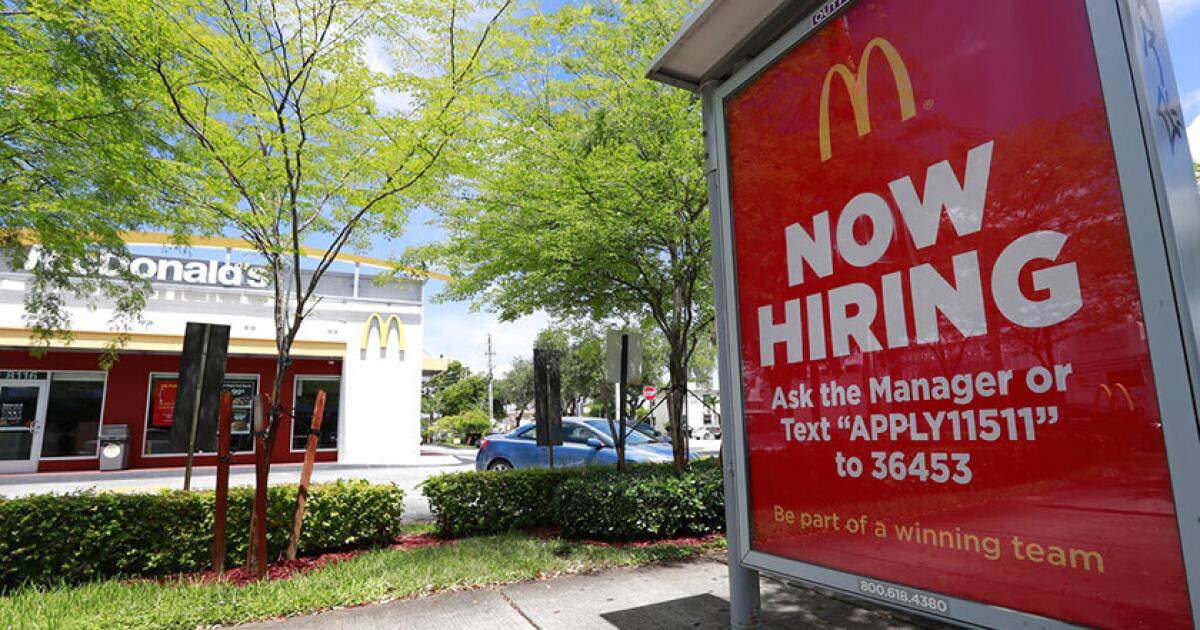
Which of California’s economic initiatives droves conservatives batty the most? No question: It’s the state’s $20 minimum wage for fast food workers, which went into effect April 1.
For months before the wage increase, conservative pundits and economists filled the airwaves and newspaper columns with predictions that it would produce an employment bloodbath at fast food restaurants.
Some went further, purporting to find actual evidence of huge job losses. The Wall Street Journal claimed to have discovered losses of 10,000 jobs between September 2023 and January 2024, even before the new wage went into effect. The estimate was duly parroted by the conservative Hoover Institution.
What’s good for workers is good for business, and as California’s fast food industry continues booming every single month our workers are finally getting the pay they deserve.
— Gov. Gavin Newsom on the state’s $20 minimum wage for fast food workers
Two new analyses of the actual wage and price impacts of the $20-per-hour minimum have appeared this month. They employ slightly different statistics, but their conclusions are the same: There have been no job losses in fast food resulting from the increase. By some measures, employment has increased.
The first analysis to appear came from the Institute for Research on Labor and Employment at UC Berkeley. It found no measurable job losses, significant wage gains (as one might expect from raising the minimum wage to $20 from an average of less than $17), and modest price increases at the cash register averaging about 3.7% — far lower than the fast food franchise lobby claimed were necessary.
The second comes from a joint project of the Harvard Kennedy School and UC San Francisco. Not only did that survey find no job losses, but it also debunked claims or conjectures from minimum-wage critics that the increase would show up as reductions in hours or fringe benefits.
Nothing of the kind has surfaced in the months just before or just after the new law, according to the Harvard-UCSF survey’s authors, Daniel Schneider of Harvard and Kristen Harknett of UCSF.
“In response to wage increases,” they wrote, “employers could have looked to cut costs by reducing fringe benefits such as health or dental insurance, paid sick time, or retirement benefits. We find no evidence of reductions.”
These results are important for several reasons. One is that the fast-food minimum wage increase is one of the sharpest ever, and the resulting wage the highest in the country (with a few minor exceptions).
It’s also one of the most tightly targeted, applying to California stores of fast food chains with more than 60 nationwide locations. The sector employs about 750,000 workers in the state, 90% of whom were paid less than $20 an hour — on average, slightly less than $17 — before the new wage went into effect.
“This is a big deal because of how many workers are getting raises,” UC’s veteran labor expert Michael Reich, the lead author of the Berkeley study, told me. The estimated average 18% raise for affected workers means that some will be able to afford a better apartment or a used car. Employers get benefits too: “The minimum wage kills a lot of vacancies and improves the supply of labor coming to those restaurants.” That means less worker turnover, which is a bothersome expense.
The fast food raise has been presented as a signature achievement by California’s Democratic governor, Gavin Newsom, who depicts it as emblematic of the state’s progressive labor policies. “What’s good for workers is good for business, and as California’s fast food industry continues booming every single month our workers are finally getting the pay they deserve,” Newsom said in August.
Fast food employment in California rose after April’s minimum wage increase (solid red line), often faster than in the rest of the country.
(UC Berkeley)
California has been a leader in raising minimum wages. The overall state minimum wage this year is $16 an hour and is scheduled to rise to $16.50 on Jan. 1; that’s the highest state-level minimum and the highest except for the District of Columbia, where it’s $17.50. (Certain localities in some states have higher minimums.) The California minimum wage for certain healthcare workers will rise to between $18 and $23 on Wednesday.
The issue is also timely, for California voters will be asked on election day to vote on a minimum wage increase for employees at all but the smallest businesses to $17 immediately and $18 on Jan. 1.
All that has made the fast-food minimum a favorite target for employers, their lobbyists and some right-of-center economic commentators.
The minimum wage issue occupies a peculiar place in economic analysis. Many economists and commentators judge it by intuition — if you raise the price of something, such as the price of fast food labor, conventional economics say you’ll get less of it. Hence, higher minimum wage, fewer jobs.
But it’s also among the most heavily studied of all economic phenomena, with the overwhelming majority of studies finding little or no employment effect from a higher minimum. But none examined the effects of a minimum higher than $15.
That left the door open for critics of the California minimum to claim that this higher minimum was destined to wreak havoc on fast food employment. Some jumped the gun by finding job losses even before the law went into effect — ostensibly because employers were cutting jobs in anticipation of higher costs.
As I reported in June, the California Business and Industrial Alliance placed a full-page ad in USA Today, citing the Wall Street Journal’s figure of 10,000 fast-food jobs lost during the fall and early winter and describing 12 restaurants or chains as “victims of Newsom’s minimum wage.”
This was “baloney, sliced thick,” I wrote. Some of the chains listed were victims of other economic factors, such as competition, or financial manhandling by their private equity owners.
The figure of 10,000 job losses proved to be a statistical error: The Wall Street Journal used non-seasonally adjusted job figures, so it missed the fact that fast-food employment always falls in the September-January period, so the looming minimum wage played no role.
That was something of a curveball for UCLA economics professor Lee Ohanian, who had cited the Journal’s figure in two columns published by the Hoover Institution, where he is a senior fellow, writing that the pace and timing of the employment decline made it “tempting to conclude that many of those lost fast-food jobs resulted from the higher labor costs employers would need to pay” when the new law kicked in.
Ohanian told me in June that he hadn’t realized that the figures weren’t seasonally adjusted, and that he would query the Journal about the issue in anticipation of writing about it again. He told me more recently that he did write to the Journal but didn’t receive a reply, and that he hasn’t revisited the issue thus far.
So what do we know now about the $20 fast food minimum?
Government labor statistics haven’t shown an employment decrease in the fast-food category leading up to the April 1 date or in most of the months since then. The Berkeley researchers, led by Reich, found that fast-food employment rose almost steady this year from January through August, when it exceeded 750,000 for the first time.
According to the Bureau of Labor Statistics, employment in the sector during that period has run ahead of last year’s monthly figures in every month except June. From April 2023 through August this year, the BLS says, California fast food employment rose by about 3,200 jobs on a seasonally adjusted basis.
Reich’s team questioned reports of sizable price increases by restaurants aiming to pass their labor cost increases onto customers. The Wall Street Journal, for example, quoted one restaurant owner saying he had raised menu prices by 10%, and a McDonald’s franchisee fretting about losing his customer base if he had to raise the price of a Happy Meal to $20. This was nothing but a flight of fancy: The price of a Happy Meal in California ranges from $4 to $8 today, depending on its content and size.
Based on their examination of menus from nearly 1,600 California restaurants, the Berkeley researchers calculated the average price increase to be about 3.7% — “or about 15 cents on a $4 hamburger.” That was less than the 4.8% average increase imposed on fast-food customers from April 2023 to April 2024. Their math suggests that fast food restaurants passed about 62% of their labor cost increase in April to customers; the rest was taken out of profits.
None of this is likely to be the last word on the minimum wage issue. Future increases for fast food workers will be in the hands of an advisory wage council and subject to legislative oversight. It’s still early in the post-$20 era; wage and price effects may take many more months, even a year, to emerge, though over time the hourly minimums for other employment sectors may move higher, making the fast food wage less of an outlier.
Employment figures, moreover, can be hard to validate. Several different statistical models are in use by states and the federal government. UCLA’s Ohanian reminded me that the quarterly census of employment and wages of the Bureau of Labor Statistics, which covers about 95% of businesses, is current only through the end of March. The next release, covering the second quarter of 2024, won’t be published until December; it’s calibrated with the bureau’s other estimates only once a year.
Don’t expect anything published then to quash the debate over California’s fast food labor policy. The evil of the minimum wage is a favorite chew toy in conservative politics.
But the bottom line is that workers in the California fast-food industry are better off today than they were six months ago. Who has a problem with that?


Grocery Outlet is opening new locations across California, rebuilding its network in the Golden State after closing stores early this year.
A new branch in Ontario Ranch is scheduled to open July 23, and more openings are planned for later this summer.
The location will be operated by independent owners Gloria and Jason Pineda. By the end of August, the discount grocery retailer plans to open stores in Ramona, San Francisco, Clovis and Petaluma as well.
The Emeryville, Calif.-based chain announced the closure of 36 stores in March, including nine California locations. The closures were an attempt to roll back an overexpansion in the wrong markets, resulting in a loss in 2025. Grocery Outlet did not announce which locations would be closed at the time, but they were listed for sublease by advisory firm Gordon Bros.
Among those listed was an Ontario location closer than seven miles from the soon-to-open site.
Five other Southern California locations were marked for closing in Azusa, Brawley, El Cajon, La Habra, Ontario and Poway. In Central California, the Kerman, Patterson and Ridgecrest stores were also listed for sublease. Outside of California, stores in Idaho, New Jersey, Maryland, Ohio and Pennsylvania also were listed.
In an earnings call in May, Grocery Outlet Chief Executive Jason Potter said the restructuring was helping boost the company’s profit.
“These closures are now complete and have improved fleet quality and will strengthen the earnings profile of the business over time,” he said.
Grocery Outlet was founded in San Francisco in 1946 as a discount grocery store chain selling overstock of limited-time or holiday food items. There are about 280 Grocery Outlet locations in California, accounting for more than half of its total store count.
Though Grocery Outlet has cultivated a dedicated consumer base on TikTok and other social media posts from grocery bargain hunters, it faces fierce competition from other budget grocery chains, including Aldi, which is set to open 180 stores in 2026. It also competes with Trader Joe’s, Walmart and Amazon, which have steadily gained customers.
Last year it was also hurt by the lapse in federal food assistance during the 43-day government shutdown.
In the wake of rising grocery prices and economic anxiety, some low-income customers who would once have shopped at budget grocery chains such as Grocery Outlet are turning to food banks instead. According to Los Angeles Regional Food Bank, 1.2 million people visit its food banks per month.
Grocery Outlet’s net sales rose 4% in the first quarter from a year earlier to $1.17 billion. It recorded a net loss of $180 million for the period.
It said it had closed locations as part of its optimization plan. It also underwent a store refresh program, changing products and is clustering locations to boost profit and customer traffic.
“Our value-oriented product offering continues to resonate with consumers. While we’re encouraged by the progress we’re beginning to see, we’re not satisfied with our current level of performance and are focused on the work we have in front of us,” Potter said on the earnings call.
Grocery Outlet shares have fallen more than 25% over the last 12 months. The Dow Jones industrial average has climbed more than 15% during the same period.

On July 9, the Trump administration delivered a gift to Cadiz Inc., a politically well-connected firm that has been trying for decades to win approval for a scheme to pump water out of the Mojave Desert and market it to water agencies across the Southland.
The administration approved the company’s application to convert an abandoned 220-mile oil and gas pipeline crossing the desert to carry water instead. Susan Kennedy, the chief executive of Cadiz, called the approval “a pivotal milestone” that would enable the project to move into its construction stage.
Here’s betting that Kennedy’s statement was somewhat premature. The project still faces significant opposition from environmentalists, local Indian tribes and the state of California. It has been declared ready to go — and declared dead, too — so often that it could serve as a character in a zombie movie or streaming series.
I haven’t seen anything to persuade me that there’s not going to be any environmental damage.
— Ileene Anderson, Center for Biological Diversity
Indeed, this is the second time that Trump has greenlighted this project. He did so during his first term, but his decision was overturned during the Biden administration; Trump’s most recent approval overturned that action — but there’s no promising that the next president, whoever that is, won’t overturn this one.
I’ve been covering the Cadiz project for nearly 25 years, starting in 2002; I take credit for helping to put the kibosh on a proposal for the Metropolitan Water District, which supplies water to 13 million Southern California residents, to partner with Cadiz.
In fact, there’s reason to wonder whether Cadiz itself still wants to do the project, even though in the past it described it as its potential corporate lifeblood.
Last year Cadiz reported that nearly 90% of its revenue stemmed from the sale of water filtration equipment manufactured by ATEC, a Hollister firm it acquired in 2022. That segment is its only profitable operation, though the $2.5 million in operating income the unit produced in 2025 was swamped by losses in its other operations — mostly the sale of fruits and vegetables grown on its desert tract — producing an overall loss of $25.6 million. The company has never reported a profit.
Kennedy told me this week that she now sees the water treatment business as “the future of our company — an enormous market opportunity.” She said “demand for filtration is skyrocketing,” with cleansed stormwater “the biggest source of new water supply.” Cadiz has doubled its manufacturing capacity for the equipment, and “we expect to double again.” The company has also signed an agreement to produce hydrogen at its desert site by installing a solar array for power.
Meanwhile, Cadiz is taking steps to hive off the infrastructure it has planned to use for its water project, mostly two unused pipelines, into a special purpose subsidiary. These entities are typically aimed at insulating the parent company from the risks and liabilities of a speculative investment.
In this case, Kennedy told me, the idea is to open the water project more broadly to outside investors.
In practice, that means that the pipelines Cadiz proposes to use to transport desert waters to urban, industrial and agricultural users would fall into the hands of private equity firms, which haven’t been known as a class for their devotion to the public interest. Cadiz would end up with a minority stake in the pipelines, Kennedy says.
Transporting water out of the desert faces so many headwinds that it may make more sense to divest the business and shift over into less controversial enterprises, like filtering poisonous minerals out of reclaimed stormwater and producing hydrogen.
It’s worth reacquainting ourselves with the company’s discreditable history. The Cadiz project was the brainchild of British-born Keith Brackpool, who had a checkered record as an investment promoter. As I wrote in 2002, he pleaded guilty in London in 1983 to criminal charges that included dealing in securities without a license.
Brackpool’s pitch was that by stockpiling water from the Colorado River under the Cadiz sands in years when a surplus was available and delivering it during droughts, the company could assuage the supply crisis confronting Southern California.
I wrote years ago that the project boasted “a sort of shimmering authenticity” — if one didn’t look too closely. Yes, the state faces a long-term water shortage. But the problem is that there’s no surplus water in the Colorado available for California. Cadiz has never made a conclusive case that it could withdraw as much water from its desert tract as it proposed without draining its underground aquifer to a dangerous level or causing its contamination with carcinogenic minerals.
After he started pitching the project in the mid-1990s it began to look as though the company’s principal asset was political juice. Former Rep. Tony Coelho, an important Democratic Party fundraiser, served on the Cadiz board. Cadiz and Brackpool were leading campaign contributors to former Gov. Gray Davis, who was thought to be the source of pressure on the Metropolitan Water District to make a deal with Cadiz. Brackpool hobnobbed with former Los Angeles Mayor Antonio Villaraigosa, who received campaign contributions from him and Cadiz. (Brackpool is no longer associated with Cadiz.)
Kennedy herself had been associated with Cadiz since before she became chief of staff to former Gov. Arnold Schwarzenegger in 2005. Before her appointment, and while she was serving on the state Public Utilities Commission, the firm paid her $120,000 in consulting fees. In 2009, Schwarzenegger endorsed the water scheme as “a path-breaking, new, sustainable groundwater conservation and storage project.”
For years, Cadiz shares traded as a sort of plaything for water investors hoping for a big score over the horizon — what craps players call “betting on the come.” In this case the bet is on the distant prospect that government approvals would eventually make the project real.
For these players, the investments tended to be cheap compared to the potential gains. The largest shareholder of Cadiz, with a 35% stake, is Netherlands-based Heerema International Services, a global industrial infrastructure company. Its holding is worth about $115 million at the current stock price — peanuts for a company that collects revenue of about $5 billion a year.
Then there’s Trump. In March 2017, his Interior Department reversed two Obama administration rulings that had blocked Cadiz’s ability to use a 43-mile pipeline to carry water from the desert to Southern California users. Biden’s Interior Department canceled those rulings. The July 9 action applies to a separate 220-mile pipeline.
In its recent ruling, the Interior Department’s Bureau of Land Management stated that the pipeline conversion would have “no significant impact … on the quality of the human environment” and therefore no environmental impact statement was even needed.
Environmental groups and other plaintiffs who have been fighting the project are “looking at all our options” for legal challenge, says Ileene Anderson, a senior scientist at the Center for Biological Diversity, a plaintiff in lawsuits challenging the project. “I haven’t seen anything to persuade me that there’s not going to be any environmental damage,” she says.
When I spoke with Kennedy in January 2024, a few weeks after she took over as Cadiz CEO, she acknowledged that the company’s name had become a “poison pill.” Her plan was to “change the company so people think about it differently.”
At that time, this amounted to refocusing its water supply program on serving users in San Bernardino County rather than urban users throughout Southern California. The idea was to counteract what she called a “political” claim that its goal was to drain the desert to “fill swimming pools in L.A.”
Kennedy didn’t mention ATEC then, but she talks about it today with unalloyed enthusiasm. Indeed, she asserted that the water filtration and hydrogen production businesses together could use as much of the company’s available water as it would pipe miles across the desert.
Kennedy is correct to maintain that government, which once built Hoover Dam, the Central Valley Project and Glen Canyon Dam as crucial pieces of our water infrastructure, “has gotten out of the business.”
But it’s wrong to say that it’s because government can’t afford such projects. Ceding them to private equity is a choice. Given Americans’ dependence on water as a life-giving commodity, do we really want to establish private firms as toll-takers on the water highway, permitted to charge what they wish to maximize their profits? Cadiz may be beating a path to that future, but it may not be a happy journey.

Hollywood’s fascination with YouTube creators is going to the next level.
Los Angeles-based investment firm Content Partners and media entrepreneur Ed Simpson announced Tuesday that they are launching a new company, Wonderloom Media, that will acquire YouTube-creator led businesses.
Wonderloom’s first acquisition is YouTube true-crime channel Dr. Insanity, which has more than 5 million subscribers and more than 1.3 billion total views.
Content Partners owns or licenses more than 800 films and more than 3,000 hours of television content. The company co-owns the “CSI” franchise.
“This is a kind of next step evolution in the type of IP we will be acquiring,” Alphonse Lordo, a partner at Content Partners, said in an interview.
The effort comes as the film industry continues to struggle to bring more people into movie theaters and has had recent success with the YouTube creator-led films “Obsession” and “Backrooms.” As studios and TV networks have shed jobs over the years, more entertainment workers are applying their expertise at major YouTube creator-led businesses, which have continued to grow their audiences.
YouTube’s audience has shifted from smartphones to TVs, on which many U.S. consumers watch YouTube videos with their families. That in turn has attracted streamers such as Netflix to partner with YouTube creators to bring their content to the same platform that has high-budget television shows and movies.
Simpson, a former TV producer who will be Wonderloom’s chief executive, said Dr. Insanity was the “perfect first acquisition” because it had a loyal audience, proven storytelling and meaningful room to expand. “True crime is an incredibly sticky genre of programming that works just as well as it does on YouTube, as it does on Netflix and linear and cable channels,” he said in an interview.
Financial terms of the deal were not disclosed.
Wonderloom, based in L.A., also will assist entrepreneurs who started YouTube channels grow their businesses.
The new company also is eyeing possible acquisitions in food, travel and general entertainment programming, added Simpson, a former chief strategy officer at Wheelhouse, a production firm behind “America’s Sweethearts: Dallas Cowboy Cheerleaders.”
“This is about building the next generation studio, so we think of this as the beginnings of Paramount, of Warner Bros., of those great studios,” Simpson said. “We see this space following in that very same pattern right now.”
Other Hollywood companies also are getting into the creator business acquisition space. Last month, Century City-based Creative Artists Agency said it was partnering with Integrated Media Co. to form a $250-million holding company called Compound Creative Holdings that will acquire and operate a portfolio of creator economy businesses.
-

 Wisconsin11 minutes ago
Flood relief grant applications now open for nonprofits, churches in Northeast Wisconsin
-

 West Virginia17 minutes ago
New law allows employers to provide benefits for independent contractors in West Virginia
-

 Wyoming23 minutes ago
Election Q&A: Jessica Crowder for Wyoming House District 43
-

 Crypto29 minutes ago
Blackrock Becomes World’s First $15 Trillion Asset Manager, Unleashes Tokenization Blitz
-
 Finance35 minutes ago
Big financing steps forward for The 78, Foundry Park projects
-

 Fitness41 minutes ago
More Muscle, Less Fat—Is This High-Tech Workout A New Fitness Answer?
-

 Movie Reviews53 minutes ago
Film Review: “The Odyssey” – MediaMikes
-
World1 hour ago
Movie Review: In Christopher Nolan’s ‘The Odyssey,’ an ancient epic is reborn


