Business
Column: Harris is right about housing assistance and price gouging. Here's what you should know

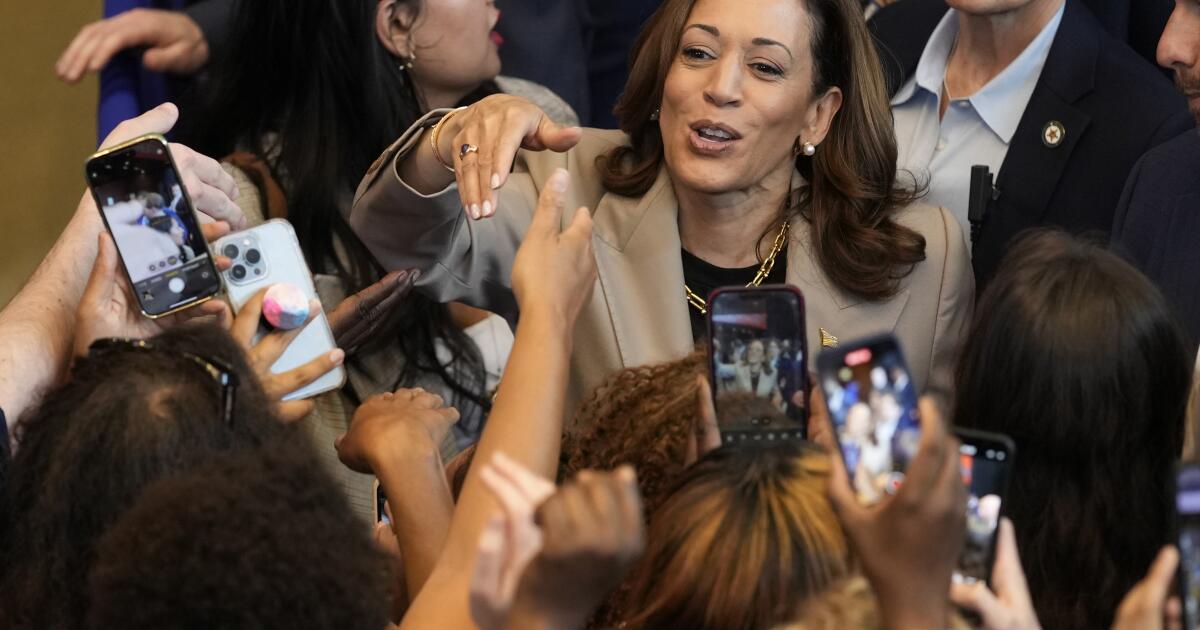
Up to now, Kamala Harris’ presidential campaign has been careful about rolling out its policy initiatives, and — at least in political terms — for good reason.
Policy details at this stage of a campaign do little but give opponents and pundits grist for nitpicking. Most voters aren’t very interested in the details of what a given legislative venture will look like once it goes through the Capitol Hill meat grinder. Political journalists, for their part, seem to be chiefly interested in teasing out holes in the proposal.
For Harris’ campaign, this looks like a lose-lose proposition. After grousing incessantly that Harris hadn’t offered policy specifics since becoming the evident Democratic nominee on July 21, the press has moved on to questioning her intentions, sometimes by seizing on misrepresentations of her actual proposals.
Vice President Harris will … direct her Administration to crack down on unfair mergers and acquisitions that give big food corporations the power to jack up food and grocery prices.
— Harris campaign
That has been happening since Friday, when Harris issued her first policy “agenda.” This was largely devoted to lowering the cost of housing, food, medical services and child-raising for families, and generated a swell of quibbles in the press and the punditocracy. As it happens, however, Harris is right about the burden of those costs, and right about the best ways to address them.
At this point in an election cycle, presidential campaigns are all about themes and impressions. Harris plainly is setting out a theme of help for an American middle class that has rightly felt neglected by government for decades. Donald Trump’s theme is … what, beyond whining about how he’s treated?
Harris’ professed desire to lower food prices led to a spurt of news articles and columns asserting that she was proposing “price controls.”
It’s hard to know where that idea came from; it peaked even before Harris’ policy brief was issued Friday, when the hand-wringers discovered that she was contemplating nothing of the kind.
Some commentators, abetted by the right-wing peanut gallery, may simply have extrapolated from indications that she was targeting price gouging, but that’s on them, not her. (The Murdoch-owned New York Post strained so hard to tag her policies as “Kamunism” that one almost fears that it gave itself a hernia.)
The Harris campaign in its formal statement proposed “the first-ever federal ban on price gouging on food and groceries.”
Some commentators pointed out that the average net profit margin for supermarkets is about 1%. They argued that this rules out any indication that Americans had been the victim of gouging by retailers.
Is that so?
It’s true that retail grocery profit margins are in the very low single digits. They always have been. But food retailing is a high-volume business, so margins below 2% can translate into annual profits of — to take just two examples — $1.3 billion (at Albertsons) and $2.2 billion (at Kroger).
Food and beverage retailers raised their prices during the pandemic — and have kept them at the higher levels since then.
(Federal Trade Commission)
That doesn’t mean that the grocers can’t gouge shoppers. After all, they did so during the pandemic.
How do we know this? From their own financial disclosures, which show that Albertsons and Kroger jacked up prices well beyond any increases in their costs.
The pretax profit margin at Albertsons rose from 0.96% in 2019 to 1.62% in 2020 and 2.92% in 2021; it fell back to 2.01% in 2023, once the pandemic appeared to move to the rearview mirror. At Kroger, the margin went from 1.62% in 2019 to 2.54% the following year. It dipped to 1.49% in 2021, but rose again to 1.96% in 2022 and 1.89% last year.
Nothing can explain the pandemic-era spike in profits better than these companies raising prices faster than their costs. In other words, gouging.
The Federal Trade Commission said so, without using the term. It found that food and beverage retailer revenues rose to 7% over total costs during the pandemic, well beyond “their recent peak of 5.6 percent in 2015.” That trend, the FTC reported, “casts doubt on assertions that rising prices at the grocery store are simply moving in lockstep with retailers’ own rising costs.”
Even beyond the food sector, as I reported earlier, corporate profiteering was unmistakably a significant contributor to inflation over the last few years. That was the conclusion of a team at the Federal Reserve Bank of Kansas City, who reported that markup growth “could account for more than half of 2021 inflation.” The annualized inflation rate reached 5.8% that year.
Notwithstanding the ginned-up controversy over Harris’ anti-gouging initiatives, it’s proper to note that price gouging and its country cousin, price-fixing, have traditionally been a bipartisan concern.
In 2020, Donald Trump issued an executive order to prevent gouging on health and medical resources, which makes his claim that Harris’ initiatives on prices are tantamount to “communism” seem more than a teensy bit hypocritical.
In the food sector, Republicans and Democrats in Congress last year took aim at price-fixing in the meat packing business. In 2022, StarKist pleaded guilty to price-fixing on tuna and paid a $100-million fine; Bumble Bee had also pleaded guilty and its former chief executive was sentenced to a prison term.
One linchpin of Harris’ attack on food prices is closer scrutiny of consolidation in the food industry. “Vice President Harris will … direct her Administration to crack down on unfair mergers and acquisitions that give big food corporations the power to jack up food and grocery prices,” the campaign stated.
If you’re an executive of Kroger and Albertsons, you can probably figure out that she’s talking about you. Those grocery giants are trying to push through a gargantuan $24.6-billion merger that, like all such mergers, will almost certainly produce higher prices at the checkout conveyor. The Harris campaign telegraphed that she will give the Federal Trade Commission more authority to chase bad actors in the food sector. The FTC already has sued to block the merger, and it’s a fair supposition that under a President Harris the agency won’t be backing off.
On housing, Harris is proposing $25,000 in down-payment assistance for first-time home buyers, with special attention for first-generation buyers. Her campaign didn’t specify how that assistance would be delivered, but did project that more than 4 million first-time buyers would be eligible over four years.
This proposal generated cavils in the chattering classes that it would drive home prices up to absorb the $25,000 grant, putatively keeping homes out of the reach of the beneficiaries.
A couple of points are germane here. One is that government-sponsored down-payment assistance programs are in place in all 50 states and the District of Columbia. The difference in Harris’ proposal is that it would be federalized and somewhat more generous than many state programs.
Pundits who claim that the proposal would drive prices higher must not know much about how the housing market works. First, fewer than one-third of home buyers are first-time buyers.
Sellers who assume that all their bidders are sitting on $25,000 in government cash risk pricing their homes out of a market in which two-thirds are using their own resources.
Budget hawks at the Committee for a Responsible Federal Budget, which was founded with money from a hedge fund billionaire, fretted that the down-payment proposal would raise the federal deficit by $100 billion over 10 years, at least.
To put this in perspective, consider the biggest federal giveaway to homeowners, the mortgage interest deduction from federal income tax.
This deduction costs the Treasury about $30 billion a year; if the increase in the standard deduction enacted in the Republicans’ Tax Cuts and Jobs Act of 2017 expires as scheduled next year, the cost of the mortgage deduction will soar to $84 billion in 2026, according to the congressional Joint Committee on Taxation.
Unlike the down-payment assistance contemplated by Harris, the deduction on home mortgage interest and points is heavily skewed toward the wealthy.
More than 63% of its claimants in tax year 2018, the most recent for which the IRS provides statistics, had incomes higher than $100,000; the $123 billion of deductible interest and points they reported to the IRS was 73% of the total.
More to the point, the mortgage interest deduction is a lousy tool for spurring home ownership, which supposedly is the goal of such tax breaks. That’s because it is “targeted at the wealthy, who are almost always homeowners,” as Harvard economists Edward L. Glaeser and Jesse Shapiro observed in 2003.
For middle- and low-income Americans, on the other hand, the No. 1 obstacle to home ownership is the down payment. Helping those households buy a house is tantamount to the government putting its money where its mouth is.
During an impromptu encounter with the press Sunday, Harris rightly described her initiatives as investments, not spending. Consider her remarks about the child tax credit, on which she proposes to restore to the level of up to $3,600 per child enacted in the Biden administration’s American Rescue Plan, and to raise to $6,000 for the first year of a child’s life.
“The return on investment in terms of what that will do and what it will pay for will be tremendous,” she said.
She’s right: In 2021, when the higher credit was enacted, the credit reduced the child poverty rate by about 30%, keeping as many as 3.7 million children out of poverty by the end of that year. When the enhancements expired in January 2022 and the credit fell to $2,000, the child poverty rate spiked to 17% from 12.1%, plunging those 3.7 million children back under the poverty line.
This is the program that Sen. JD Vance, the GOP candidate for vice president, claims to love. But when a raise in the program came up for a vote in the Senate earlier this month, Vance didn’t even bother to show up to vote.

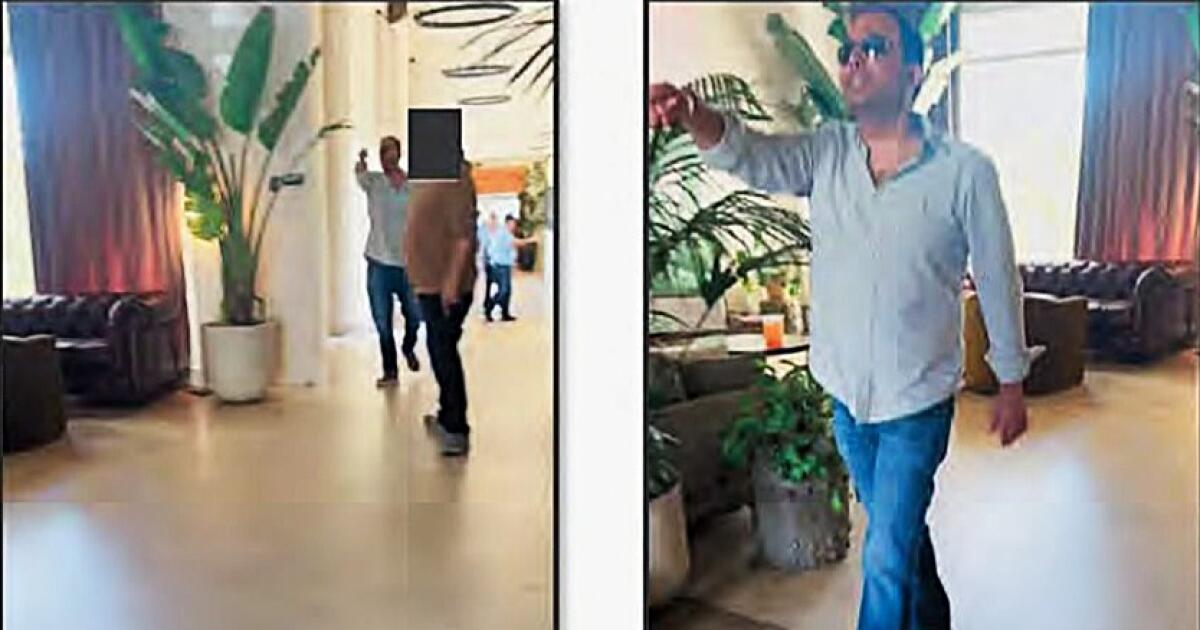
An Orange County real estate investor accused of criminally defrauding an Arizona bank of nearly $100 million pleaded not guilty Monday and remains in custody.
Mahender Makhijani, 44, of Corona del Mar — who also was ordered by an arbitrator to pay $1.34 billion in a separate civil fraud case — was arraigned in Santa Ana federal court on two charges.
He is accused of bank fraud and making a false statement to a bank in a June 8 case involving a $100 million real estate loan made by Phoenix-based Western Alliance Bank. He was taken into custody on June 10.
Makhijani is accused of providing bogus collateral for the October 2024 loan now in default. In a civil lawsuit, Western Alliance said the outstanding balance as nearly $99 million.
Prosecutors say he falsified title insurance policies that showed the bank would have a first lien on the underlying collateral if the loan went bad, when in fact it did not.
A trial was set for August 11 before U.S. District Judge David O. Carter in Santa Ana.
Michael Schachter, his criminal defense attorney, did not respond to messages seeking comment.
In the civil case, an arbitrator in May ordered Makhijani to pay Laguna Beach real estate mogul Mohammad Honarkar $1.34 billion after ruling he had fraudulently induced him into a 2021 joint venture — and then wrested control and lost to creditors more than two dozen properties Honarkar had owned.
Makhijani has not been criminally charged in that case, but prosecutors alleged in an affidavit in support of the bank fraud charges that he used “force and threats” in his dealings with Honarkar and others — including taking over the landmark Hotel Laguna in 2023 that Honarkar was renovating.
Prosecutors sought to hold Makhijani without bail after his arrest.
The affidavit noted he is a legal Indian immigrant with a home and bank accounts in that country, has access to private jets and threatened to “run away” if caught in a difficult situation.
The request was denied and he was granted $500,000 bail.
However, Makhijani remains in custody after a hearing sought by prosecutors last month before Magistrate Judge Autumn Spaeth.
The judge declined to accept a $450,000 cashier’s check submitted by a Makhijani associate for the bail, finding insufficient proof the source of the funds was legitimate, according to court records.
Makhijani is not prominent outside Orange County real estate circles, but he established a thriving distressed-assets business over the last decade that attracted prominent Southern California real estate investors.
Prosecutors said it paid for a lifestyle that included two multimillion-dollar homes in Corona del Mar, a luxury apartment in Newport Beach and various luxury vehicles.
As of last month, prosecutors had not fully traced his assets, which they believe are not held in his name and some of which may be in India.
The businessman employed an array of shell companies and strawmen to sign documents on his behalf, and to stand in for him as operators of his companies, according to the affidavit.
Makhijani told an associate he took extra precautions because wanted to insulate himself from litigation and that “they were sharks in the distressed world who took advantage of people,” the affidavit stated.
Business
Many indie festival films struggle to get distribution. Alamo Drafthouse is trying to change that

Dine-in movie theater chain Alamo Drafthouse Cinema is launching a new initiative to show unreleased independent films that had successful festival runs, a move that comes as specialty films have struggled to gain distribution.
The Alamo Exclusives program, announced Wednesday, will give limited theatrical runs to films that showed at festivals including Sundance, the Toronto International Film Festival, Tribeca Festival and South by Southwest festival, as well as Alamo’s own Fantastic Fest.
The idea is to help showcase films that received critical acclaim, but did not secure distribution or acquisition deals. The chain will not acquire these films, but instead will enter into agreements with filmmakers to exhibit their films on Alamo Drafthouse screens. By showing these films to audiences on the big screen, these films could get the momentum they need for further opportunities.
The program’s first film will be the documentary “Butthole Surfers: The Hole Truth and Nothing Butt,” which debuted last year at South by Southwest and chronicles the history of the punk rock band.
The film will be shown in Alamo Drafthouse theaters for a limited time later this summer.
The Austin-based chain, which is owned by Sony Pictures, has a long history of curating indie films for its audiences, giving Alamo Drafthouse confidence that its viewers want to see these kinds of movies, company chief executive Michael Kustermann said in a statement.
“Time and again, they’ve shown they’ll come out to support bold, original films when given the opportunity,” he said. The new Alamo Exclusives “gives us another way to champion filmmaker-driven films that deserve to be discovered and connect them with the wider Alamo Drafthouse audience.”
The initiative comes at a difficult time for indie films. Since the pandemic upended the movie business, traditional studios and distributors have had less appetite for risk, including betting on smaller indie films out of festivals.
And as the 2023 dual writers’ and actors’ strikes thinned out theatrical lineups, that aversion to uncertainty became a push for reliable and profitable hits.
“Too many incredible films premiere at festivals and then never receive the theatrical life they deserve,” Lisa Dreyer, director of Fantastic Fest and film innovation at Alamo, said in a statement. “We are actively searching for films across all genres, from horror to comedy, to everything in-between, to champion in this new, exciting way.”
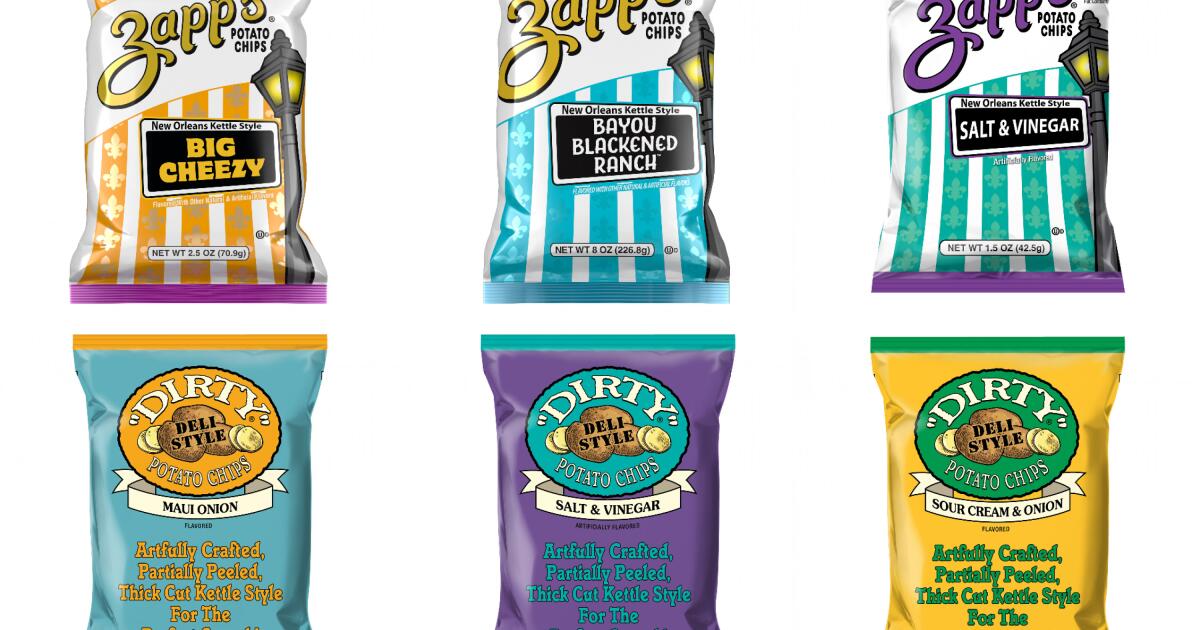
The recall of a popular chip brand over salmonella concerns was recently upgraded to the U.S. Food and Drug Administration’s highest level, just ahead of the Fourth of July holiday and countless backyard barbecues.
On June 24, the FDA designated the recall of several varieties of Zapp’s and Dirty brand potato chips as Class I, meaning it’s “a situation in which there is a reasonable probability that the use of or exposure to a violative product will cause serious adverse health consequences or death.”
FDA has classified the following items as Class I:
Zapp’s
- 1.5-ounce Zapp’s Bayou Blackened Ranch Kettle Chips
- 2.5- and 8-ounce Zapp’s Bayou Blackened Ranch Potato Chips
- 1.5- and 8-ounce Zapp’s Big Cheezy Potato Chips
Dirty
- 1.5- and 2-ounce Dirty Brand Salt and Vinegar Potato Chips
- 2-ounce Dirty Maui Onion Chips
- 2-ounce Dirty Sour Cream and Onion Potato Chips
The chips are produced by Utz Quality Foods, LLC, which on April 28 issued a recall after learning “that a seasoning containing dry milk powder, sourced from California Dairies, Inc. and supplied by a third-party supplier, may contain the presence of Salmonella.”
Salmonella can lead to sometimes deadly infections in elderly people, young children and those with weakened immune systems, according to the FDA.
More than 680,000 bags are included in the recall.
Anyone who has these products should not eat them and should discard them immediately.
What to look for
Salmonella is a foodborne illness that can be fatal to young children, pregnant women, older adults and people with weakened immune systems, according to the National Institutes of Health.
Symptoms may develop 12 to 72 hours after infection, according to the FDA.
The FDA said that people with strong immune systems infected with salmonella may experience fever, diarrhea (which may be bloody), nausea, vomiting and abdominal pain. The illness can last four to seven days.
In rare cases, the infection may produce more severe illnesses such as arterial infections, endocarditis and arthritis, the agency added.
What to do if infected
If you contract salmonella, the Centers for Disease Control and Prevention recommends drinking plenty of fluids to prevent dehydration.
The CDC advises consulting a doctor before taking antidiarrheal medicine or antibiotics. If severe symptoms continue after two days, seek medical help, the agency says.
Because those with diarrhea can spread salmonella to others, it’s also recommended to avoid sharing food or preparing meals for others, sexual contact and swimming in public pools, and to stay home while sick.
Times staff writer Jasmine Mendez contributed to this report.
-

 San Francisco, CA7 minutes ago
Multiple people lose eyes, hands in illegal fireworks-related injuries in San Francisco
-
 Dallas, TX10 minutes ago
Texas took this Dallas couple’s newborn baby for 3 weeks. A judge says their rights were violated
-

 Miami, FL15 minutes ago
South Florida foundation empowering thousands of young girls through education, mentorship, community support
-

 Boston, MA22 minutes ago
Where to watch Boston Red Sox vs Chicago White Sox: TV channel, start time, streaming for July 7
-

 Denver, CO25 minutes ago
House fire in Denver fully engulfs power pole, detached garage mostly destroyed
-

 Seattle, WA25 minutes ago
WEST SEATTLE SCENE: Stranded dog’s rocky rescue
-

 Milwaukee, WI40 minutes ago
College wasn’t on his radar. This nonprofit helped him — and hundreds more
-

 Atlanta, GA45 minutes ago
Atlanta man killed in SE Georgia shooting, GBI investigating

