Business
Column: Elon Musk is suing to stop the government from enforcing labor laws. The Supreme Court might agree with him


Few business leaders have taken to heart more than Elon Musk the old lawyer’s saw that if you don’t have the facts or the law on your side at trial, pound the table.
Musk has truculently flouted regulatory standards of all varieties as the guiding spirit of companies such as Twitter, Tesla and SpaceX — keeping factories open despite pandemic shutdown orders, allegedly committing securities fraud by issuing misleading tweets about his investment plans and ignoring government safety recommendations for self-driving automotive technologies.
As I’ve reported, Musk has gotten his way with regulators and municipal officials “through bluster and intimidation.”
This is an effort by a group of lawyers who are foes of the administrative state and the New Deal-era legislation that created the NLRB and the SEC to essentially end enforcement of those statutes.
— Catherine Fisk, UC Berkeley
Now he’s trying what may be his most audacious flip-off to regulators yet:
Faced with an accusation by the National Labor Relations Board that SpaceX improperly fired nine employees in 2022, among other illegal acts, the company, which is controlled by Musk, filed a lawsuit in federal court in Texas to declare the NLRB’s action — indeed, the board itself — unconstitutional.
There’s more to it than that, however. The SpaceX lawsuit takes direct aim at the very enforcement structure of the NLRB, through which appointed administrative law judges weigh unfair labor practice charges laid against employers and recommend penalties to be imposed by the board itself.
The company’s argument is that because the judges are largely immune from being fired other than “for good cause,” their role in enforcement deprives accused parties of their constitutional right to trial by jury.
It also asserts that the board’s power to act as judge and jury in employment cases and the members’ immunity from being removed by the president violates the separation of powers principle in the Constitution. In sum, SpaceX claims that it’s being held “subject to unlawful proceedings before an unconstitutionally structured agency.”
More such claims are in the offing from businesses facing regulatory scrutiny. According to a transcript obtained by Bloomberg, grocery chain Trader Joe’s made the same argument at a Jan. 16 NLRB hearing on charges that it engaged in illegal union-busting by retaliating against unionization advocates among its workers.
What are these companies up to? The SpaceX claims are unusual, but they’re not unique in recent regulatory litigation. Similar claims have been brought against the Securities and Exchange Commission and the Consumer Financial Protection Bureau.
“This is an effort by a group of lawyers who are foes of the administrative state and the New Deal-era legislation that created the NLRB and the SEC to essentially end enforcement of those statutes,” says Catherine Fisk, an employment and labor law authority at UC Berkeley law school.
Unable to challenge the laws themselves — they’ve been upheld by Supreme Court decisions dating back to the 1930s — or the regulations directly, Fisk told me, “they’re arguing that the administrative structure is in some part unconstitutional.”
Before delving into the details of the SpaceX lawsuit, let’s examine the NLRB’s enforcement case. The agency says SpaceX illegally fired the nine workers for circulating an open letter complaining about Musk’s “repeated conduct of issuing inappropriate, disparaging, sexually charged comments on Twitter,” which he owns. The silence of SpaceX management about Musk’s conduct, the letter said, allowed a “culture of sexism, harassment and discrimination” to “pervade … the workplace.”
The NLRB filed a formal complaint against SpaceX on Jan. 3, encompassing not only the firings but charges that it illegally interrogated workers and conducted illegal surveillance of their activities. The agency scheduled a hearing on the charges before an administrative law judge for March 5 in Los Angeles.
The very next day, SpaceX filed its lawsuit.
By some measures, SpaceX’s response to the NLRB charges might be interpreted as overkill. Even if it’s found to have committed all the violations, the consequences are meager. The NLRB can’t levy monetary fines.
It can order back pay and reinstatement for workers who have been wrongly discharged, but those wouldn’t make much of a dent in the finances of a company that was reported to have brought in $8 billion in revenue last year from government and commercial contracts.
Moreover, SpaceX hasn’t yet come before an administrative law judge over the NLRB charges, much less having them voted on by the full board. Its lawsuit, then, looks like a shot across the NLRB’s bow. The company asks the trial judge in Texas to block the NLRB’s case against it, declare that the NLRB’s structure is unconstitutional, and permanently prohibit the agency from pursuing unfair labor practice charges via administrative law judges.
That points to the conclusion that this case, and others like it, aim to exploit the veer to the right seen throughout the federal judiciary generally and the Supreme Court in particular.
This variety of attack on regulations went out of fashion in the 1930s, Fisk observes. The Supreme Court, which had overturned a sheaf of New Deal initiatives as well as state minimum wage laws, turned back to the middle in the face of rising public disdain and the court-packing scheme of Franklin Roosevelt.
FDR ultimately abandoned his proposal, but after 1936 the court ceased ruling against the New Deal — upholding the National Labor Relations Act, which created the NLRB, in 1937.
“For 85 years, those arguments weren’t made,” Fisk says, “because lawyers knew that they would get nowhere with them — they might even get sanctioned. The Supreme Court signaled that it was up to Congress to design regulatory structures.”
But today’s Supreme Court isn’t your great-grandfather’s Supreme Court. “The Supreme Court has given lawyers reason to think that they might be able to invalidate part or all of these statutes as being unconstitutional.”
As recently as last week, a majority of justices appeared ready to overturn or at least pare back the so-called Chevron doctrine, the nearly 40-year-old principle that courts should defer to agencies’ interpretations of their governing laws as long as those interpretations aren’t plainly unreasonable.
Overturning the doctrine, as industry litigants urged the court to do during oral arguments Jan. 17, could sap regulatory agencies’ ability to base their rule-making on expert advice.
Although Congress could theoretically overcome any regulatory problems created by an adverse court ruling by amending the laws in question, that’s not a good bet given the profound dysfunction reigning these days on Capitol Hill. The industries will have achieved their goals for years into the future.
That brings us to Musk’s litigation strategy. SpaceX filed its lawsuit against the NLRB not in Southern California, where the company is headquartered, or Washington, D.C., where the NLRB maintains its main office, but in federal court in Brownsville, Texas, a judicial outpost on the Mexican border. This reflects the practice of filing anti-government lawsuits in remote federal courtrooms in Texas, where plaintiffs have a good chance of drawing a right-wing judge.
On the face of it, that tactic may have failed in this case, because the Brownsville court has two judges, one of whom was appointed by Donald Trump and the other by Barack Obama, and the SpaceX case was assigned to Rolando Olvera, who was Obama’s appointee.
SpaceX, however, is playing a longer game. Any appeal from the Texas federal court would go to the extremely conservative U.S. 5th Circuit Court of Appeals, which I’ve described in the past as “the hackiest of hack-ridden federal courts.”
The New Orleans-based appellate court upheld Texas’ malevolent SB 8 antiabortion law in 2022, for example, after which the Supreme Court allowed the law to go into effect.
Last year it partially endorsed a ruling by federal Judge Matthew Kacsmaryk of Texas narrowing access to the abortion drug mifepristone. Kacsmaryk’s ruling was based on a tendentious and long-abandoned reading of an antique 1873 law, but that was enough for the issue to come before the Supreme Court, which has the case on its docket this year.
More to the point, the 5th Circuit has implicitly endorsed the practice of challenging regulations by taking aim at the constitutionality of regulatory agencies. It did so in a case targeting the Consumer Financial Protection Bureau brought by the payday lending industry, which has long been in the CFPB’s crosshairs.
A 5th Circuit panel composed of three Trump-appointed judges ruled the bureau’s funding mechanism unconstitutional; the government appealed that ruling to the Supreme Court, which heard oral arguments on Oct. 3 but hasn’t yet ruled.
The most important 5th Circuit case from the standpoint of SpaceX and Trader Joe’s, and any other businesses that chose to follow in their wake, is Jarkesy vs. SEC.
That case was brought by a hedge fund operator who was hit with $1 million in fines and penalties for fraud by the Securities and Exchange Commission in 2013. The 5th Circuit ruled against the SEC in 2022, finding that it was an unconstitutional breach of Jarkesy’s right to trial by jury for an administrative judge at the SEC to have ruled on Jarkesy’s crime and imposed the penalties, even though they were later approved by the commission itself.
The government appealed to the Supreme Court, which heard oral arguments on Nov. 30 but hasn’t issued a decision. SpaceX’s position draws closely from the 5th Circuit’s ruling in Jarkesy, which is cited no fewer than 13 times in SpaceX’s 25-page lawsuit.
The NLRB has called foul on SpaceX’s choice of venue, calling the company’s rationale for filing in Brownsville “less than paper thin.” The allegedly unlawful conduct of SpaceX took place entirely at the company’s headquarters in the Southern California enclave of Hawthorne, and nothing actually happened in Texas. The government has asked Olvera to transfer the case to federal court in Los Angeles, but he hasn’t yet ruled.
Put it all together, and the SpaceX lawsuit bears watching.
As I’ve written before, conservative federal judges, many of them appointed by Trump, have the power to move the country to the far right for decades to come, eroding reproductive health care, eviscerating gun control laws and making life more difficult for ordinary Americans depending on the federal government to protect their rights. Elon Musk, pursuing his own personal interests, is urging them to keep at it.



Dear Mr. Pelley:
I meant what I said in my letter last week to the 60 Minutes team: joining 60 Minutes is the honor of my career and I am grateful to be working alongside the people who have contributed to the most important television journalism brand this country has ever produced. While I’m new to 60 Minutes, I’ve devoted my career to investigative journalism and storytelling. I started this job excited to collaborate and to benefit from the wisdom and experience of the 60 Minutes veterans, with you among them. For that reason, one of the first things I did in my new role was call you to talk and invite you to dinner. It is a profound disappointment that you rejected that overture and chose ambush instead. Yesterday, you hijacked my first meeting with staff to disparage me, my qualifications, and my intentions with remarkable incivility and contempt. I welcome a diversity of viewpoints and respectful debate among the team, but this was nothing of the sort. Yesterday’s performative display of hostility enacted in front of the staff instead of in a civil, private conversation-demonstrated that you have no interest in contributing to the future success of the show, or approaching my new tenure with a mind open to collaboration and progress. I am here to deliver first-in-class news programming, not to make headlines about newsroom drama. I am eager to work alongside those who share this goal.
Despite yesterday’s misconduct, I had hoped that in sitting down with you today we could find a path forward together. You made clear that you are not interested in such a path.
Your antipathy to the future of the show has come through loud and clear. And I have heard you. I therefore write on behalf of CBS News, Inc. (“CBS”) to inform you that your employment with CBS is terminated for cause effective immediately. Enclosed is your formal termination letter.
Sincerely,
Nick Bilton
Executive Producer, 60 Minutes

The co-founder of Aspiration, Joseph Sanberg, was sentenced to 14 years in prison on Monday after defrauding investors and lenders of over $248 million.
The startup, an eco-friendly digital banking company boasting fossil fuel-free investments, carbon offsets for gas purchases, and a debit card with cash-back benefits for shopping at clean companies, was founded by Sanberg and Andrei Cherny. Cherny left the company in 2022 and has not been charged.
Sanberg, an Orange County native, pleaded guilty to wire fraud in October after being arrested in March last year. Aspiration subsequently filed for bankruptcy and liquidated all of its assets by July.
Sanberg and venture capitalist Ibrahim AlHusseini, who also faces charges, together forged a series of bank statements in order to obtain loans. From 2020 to 2021, the pair forged AlHusseini’s bank statements to show millions of dollars in assets in order to obtain millions of dollars from lenders.
Additionally, they forged a letter from their audit committee stating that $250 million in funds were available, when in reality Aspiration had less than $1 million. The amount of loans defrauded exceeded $248 million.
In 2021, Sanberg artificially inflated Aspiration’s 2021 revenue by $44 million by recruiting 27 fake customers to sign letters of intent pledging tens of thousands of dollars per month for tree planting services. Sanberg himself funded the contracts and used the inflated revenue numbers to obtain more loans.
The charges sparked an NBA investigation into salary cap allegations due to Aspiration’s connections with Clippers owner Steve Ballmer.
Ballmer personally invested $60 million in Aspiration, all of which was lost. He is now the target of a civil lawsuit alleging his participation in the scheme. Ballmer denies the allegations.
The team announced a $300-million sponsorship deal with Aspiration, and Clippers player Kawhi Leonard signed a four-year, $28-million marketing contract with the company, which reportedly performed no duties. The issue has raised concerns about how players are circumventing the NBA’s salary cap.
The team lost the $300-million sponsorship deal and an additional $20 million paid for carbon offset purchases.
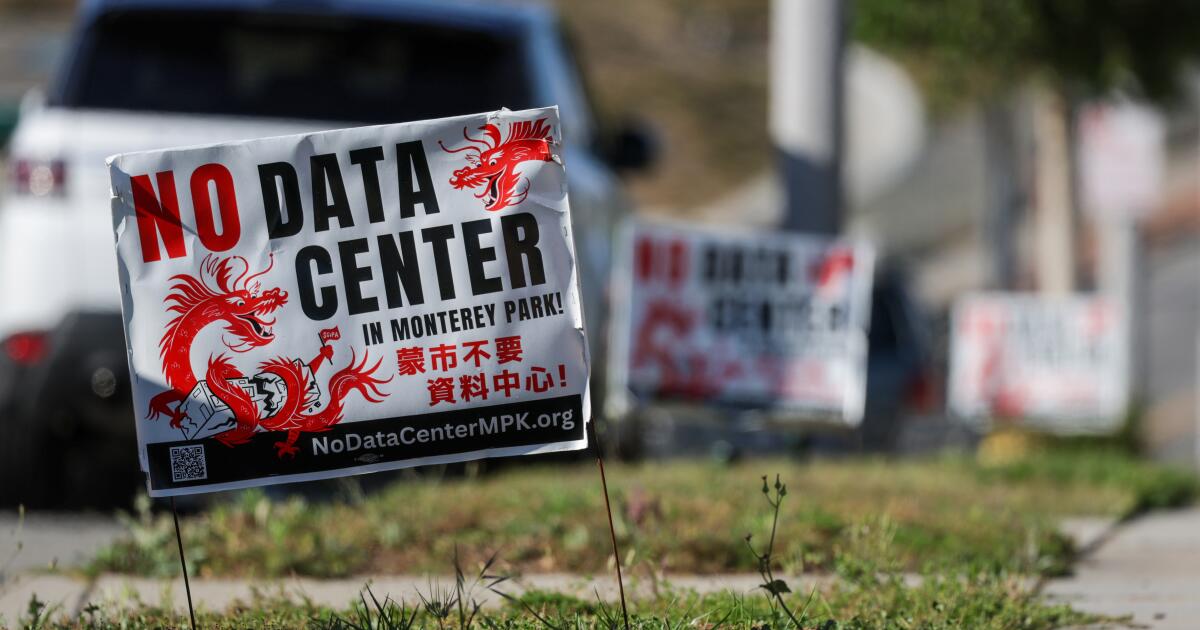
Residents in the city of Monterey Park will be the first in the nation to vote on a permanent ban on data centers Tuesday.
If approved, Measure NDC would prohibit data centers within the city limits and could only be overturned by another vote.
Yard signs saying “No Data Center” in English and Chinese with images of dragons line sidewalks in the San Gabriel Valley city.
As a wave of data center opposition sweeps the country, numerous towns and counties across the U.S. have instituted temporary moratoria and other restrictions on the facilities. But only a handful have instituted indefinite bans, and just four other towns have sent related matters to the ballot.
Supporters are hoping the vote will set a precedent for the rest of the region, where residents are fighting proposals in Vernon and City of Industry.
“This is about as permanent a ban as we can get,” said Steven Kung, co-founder of the group No Data Center Monterey Park. “Winning Measure NDC would send a huge message to the rest of the San Gabriel Valley about how residents don’t want data centers.”
The ballot measure emerged from the fight against a 247,000-square-foot center proposed in 2024 by the Australian-owned investment firm HMC StratCap for a residential area in Monterey Park.
The facility would have sat less than 500 feet away from the nearest home and used three times the electricity of the 60,000-person, predominantly Asian American city.
While the developer touted the potential for jobs and tax revenue, residents expressed concerns about noise and air pollution, rising electricity rates and a potential to lower property values.
The company pulled its plans in late March following public outcry and a March 4 city council vote to extend a temporary data center moratorium and place a ban on Tuesday’s ballot.
In a letter to the city council, HMC StratCap said it would pursue a different use for the land and would not engage in a ballot measure fight.
The city council later banned data centers indefinitely, the first in California to do so, said Mayor Elizabeth Yang. But she’s still been out campaigning for the measure with all four other council members.
“If a council puts in an ordinance, a future council can reverse it too,” said Yang. “With the ballot measure, unbanning it is a lot harder because you need the entire city to vote on it.”
The measure proposes the ban “to protect air quality, drinking water resources, and public health” and “prevent impacts to electricity and water rates.”
While California places third in the country for existing data centers with about 300 facilities, it hasn’t been a hot spot in the recent AI-driven data center boom. High electricity rates, expensive land and regulatory hurdles mean that fewer, and smaller, facilities are currently planned than in Virginia, Texas, Georgia, Illinois or Arizona.
“Most of California’s data centers are small by today’s standards,” said Shaolei Ren, an engineering professor at UC Riverside who studies how to reduce the environmental impacts of data centers. “Ten years ago, they would be medium-sized, but the power demand for new AI data centers has increased a lot.”
The average operating data center demands 45 megawatts, according to the Washington Post, while the average planned one would draw 430 MW. The one proposed for Monterey Park would have required about 50 MW at peak demand.
As proposals crop up in SoCal, they’re met with fierce opposition. Montebello, El Monte and Baldwin Park have all enacted temporary moratoria, and Alhambra recently banned data centers as part of a zoning code update. City of Industry, Vernon, City of Commerce and Santa Fe Springs are moving in the other direction, trying to court developers and streamline data center approvals. Community groups are fighting that.
Outside the San Gabriel Valley, residents of Coachella and Imperial County are showing up in droves to protest local proposals.
Matthew Shaw, a volunteer with the Coalition for Responsible Data Center Development, who recently published a report on opposition to AI data centers, said a vote to ban them in Monterey Park “would lead to copycats, partially because so many groups are just opposed to any data center development at all.”
While there is no formal opposition to Measure NDC, some building trades like Ironworker Local 433 supported the Monterey Park data center when it was still live before city council. Those in the data center industry are lamenting the state of public opinion.
“These are multi-billion-dollar assets that are built by multi-trillion-dollar companies. These things will get done,” said Mehdi Paryavi, chairman of the International Data Center Authority. “My biggest problem is that our industry does not invest enough in community engagement.”
Paryavi said towns that seek to limit data centers are missing out on thousands of jobs generated by data center construction, operations and customers, as well as faster artificial intelligence speeds and better performance.
Kung said local community organizers are “looking at the empirical evidence” and seeing a ban as a win.
“We’ve never seen a city that embraces a data center and is like, ‘Look how our quality of life has increased, look how all the revenue has gone into citywide improvements,’” he said. “That just doesn’t exist.”
-

 Arizona1 minute ago
Arizona State Adds Alabama Assistant Michael White To Coaching Staff
-

 Arkansas6 minutes ago
Arkansas driver’s licenses and state IDs now available in Apple Wallet
-

 California13 minutes ago
California’s race for governor and other key primaries remain unsettled as vote count continues
-

 Colorado16 minutes ago
Colorado community reels after police say driver with revoked license hits three pedestrians, killing one
-

 Connecticut21 minutes ago
Night forecast for June 2
-

 Delaware28 minutes ago
Thomas Jefferson University to run Delaware’s first medical school
-

 Florida31 minutes ago
Man accused of kidnapping woman at Wawa in Central Florida
-

 Georgia36 minutes ago
5 things to know about Georgia mosquito problem amid heat, drought

