Business
Column: After smearing Anthony Fauci, House Republicans proceed to defame a prominent vaccine scientist


Peter J. Hotez is one of America’s most prominent vaccine experts. A professor at Baylor College of Medicine, he’s also co-director of the Texas Children’s Center for Vaccine Development, which has developed and licensed a safe and effective COVID-19 vaccine that has been distributed widely in the third world.
He’s also among our most prominent critics of the anti-vaccine and anti-science movements that have so thoroughly infected our public discourse — most recently in his 2023 book “The Deadly Rise of Anti-Science: A Scientist’s Warning.” In my columns I’ve quoted him often on that theme.
But Hotez, 66, has had nothing to do with research into the origins of COVID-19, which is supposedly the principal topic of inquiry by the House Select Subcommittee on the Coronavirus Pandemic.
Anyone who wants my emails and can stomach the Qanon, Putin, and Nazi threats is more than welcomed to them.
— Peter Hotez
So that raises the question of why the subcommittee chose to post a tweet about Hotez on Monday, completely out of the blue.
The tweet accused Hotez of complicity with an effort by David Morens of the National Institutes of Health to circumvent freedom-of-information inquiries by using a private, rather than official, email account. As these things go, the tweet exposes Hotez to public vituperation on social media and possibly physical harm.
The tweet read as follows:
“Meet Dr. Peter Hotez. Friend and potential accomplice to Dr. Fauci’s Senior Advisor — Dr. David Morens. New evidence suggests Dr. Hotez frequently communicated with Dr. Morens about FOIA evasion tactics and COVID-19 origins.”
Also on Monday, the subcommittee demanded by letter that Hotez turn over all documents and communications between him and six federal agencies and 25 individuals, most of whom are scientists researching COVID’s origins. The letter asserted that Hotez was “involved in frequent e-mail discussions” with Morens and Peter Daszak of EcoHealth Alliance “regarding the origins of the coronavirus pandemic.”
A subcommittee spokesperson told me by email that its rationale for targeting Hotez is that among the 30,000 pages of emails Morens provided for its inquiry, “Dr. Hotez is involved in thousands.” In its letter, however, the panel cited only two emails; there are indications in the files it has released that to the extent Hotez is “involved” in emails with Morens, it’s as an addressee in group exchanges with other scientists.
The spokesperson also stated that “Dr. Hotez has relevant communications regarding the origins of COVID-19 with not only many individuals in the federal government and other scientists pertinent to our investigation, but also with Chinese scientists and researchers.” If it knew that, however, why would it need to ask Hotez to provide the communications? Plainly it’s engaged in a fishing expedition.
In any event, the panel’s letter doesn’t cite any evidence that Hotez was “a potential accomplice” of Morens’, much less justify singling him out via a tweet. The subcommittee’s Democratic membership, who I previously condemned for their cowardly and shameful complicity in the panel’s attack on Daszak, didn’t respond to my request for comment.
Its tweet and its letter demonstrate how far the subcommittee has gone off the rails, its inquiry having deteriorated into a campaign to smear legitimate scientists working on what may be the most important public health imperative of our time: preparing to fight the next pandemic by understanding the latest one.
The message, observes scientist and science writer Philipp Markolin, is crystal clear. It’s “speak up against us and our political myth making, and we will publicly smear and punish you with the power of the state.”
As I’ve written, to advance this campaign the subcommittee has placed respected scientists in the dock and showered them with public vituperation, misrepresented their research and ridiculed the scientific method. It has stigmatized EcoHealth Alliance and its president, Peter Daszak, provoking government bureaucrats to cut off their funding.
On Monday, the subcommittee turned its gunsights on Fauci, a revered expert in virology and immunology who was director of the National Institute of Allergy and Infectious Diseases for 38 years and a key figure in the development of therapies to fight HIV infection.
That hearing was grounded to a complete halt when member Marjorie Taylor Greene (R-Ga.) went on a tear accusing Fauci of killing dogs and asserting “he belongs in prison.” The panel struggled mightily to get Greene to shut up so the hearing could continue. But that was only one low note among many as the GOP majority lived down to our worst expectations.
Instead of responsibly examining the origins of COVID, the subcommittee has burrowed into a series of rabbit holes. It has sought proof that Fauci manipulated a scientific paper to “suppress” scientific findings that the pandemic originated with a leak from a Chinese virology institute.
That effort has failed because not only is there no evidence to support it, but because its own evidence proves that Fauci urged researchers to notify law enforcement authorities if they determined that a lab-leak actually happened. As I’ve reported, learned scientific opinion overwhelmingly supports the theory that the pandemic originated in a spillover of the SARS-CoV-2 virus, which causes COVID, from infected wildlife to humans.
The subcommittee also has become fixated on evidence that Morens deliberately tried to evade public records laws and NIH policies by conducting some of his correspondence with NIH-funded scientists via private emails, which he mistakenly thought would protect them from freedom-of-information requests. The members may be right about Morens’ activities, but that doesn’t get them any closer to the origins of COVID — after 15 months of wheel-spinning.
That brings us back to the attack on Hotez. He appears to be an innocent bystander to the subcommittee’s campaign of character assassination waged against Fauci and other leaders in COVID research until the panel tried to drag him through the swamp it created.
Hotez hasn’t participated in research into COVID’s origins; he mentioned that research in his book about anti-science, but only as an illustration of how the lab-leak theory became part of the disinformation epidemic related to COVID. That epidemic includes misrepresentations about the safety and efficacy of the COVID vaccines, which is an area in which Hotez has considerable expertise.
So let’s examine the subcommittee’s claims about Hotez.
How many emails are behind the subcommittee’s assertion in its letter to Hotez that “you were involved in frequent e-mail discussions” with Morens and Peter Daszak of EcoHealth Alliance regarding the origins of the coronavirus pandemic”?
Two, according to the letter itself and the file of emails the subcommittee released as evidence in its investigation of Morens.
Both emails were cited in the subcommittee’s letter to Hotez. But neither has anything to do with the origins of COVID-19. In one, Hotez tells Morens in a jocular tone that he has sent “many emails to [Fauci] over the years, but I don’t think anything incriminating.”
The second referred to an email that Morens mistakenly sent to Hotez but was meant for Daszak; Hotez wrote back to advise Morens that he sent the email to the wrong Peter, which Morens promptly acknowledged.
The panel’s letter, issued over the signature of its chairman, Rep. Brad Wenstrup (R-Ohio), points out rather gleefully that Hotez responded to its tweet by stating, also by tweet, that “anyone who wants my emails and can stomach the Qanon, Putin, and Nazi threats is more than welcomed to them. Some I’ve published in my books, others in my articles on anti-science and antisemitism.”
The members seemed to take that as an official offer, as opposed to a mordant joke. But it’s unclear that Hotez even has the authority to fulfill the subcommittee’s demand, since he conducts all his correspondence via his Baylor email account. That suggests that a decision about whether and how to respond would be in Baylor’s hands; the school hasn’t yet responded to the subcommittee.
The fact is that the subcommittee has wasted nearly a year and a half chasing a chimera. Its members have nattered on endlessly about their responsibility to safeguard the taxpayers’ money. But how much has it squandered in this spavined, untrustworthy inquiry?
Wenstrup and his colleagues can’t be unaware that their public smear of Hotez may well place him in the crosshairs of people intent on doing him harm. Last year, he was accosted in front of his home by two anti-vaccine agitators demanding that he debate Robert F. Kennedy Jr. about vaccine safety. In his book he reproduced vituperative emails, including one that called him “a living Mengele.”
That’s the atmosphere pervading the public discussion of science in the U.S. today. The Select Subcommittee has done its best to contribute to this poisonous miasma. It needs to retract its statement about Hotez, post-haste. And the Democrats on the subcommittee need to speak out about their GOP colleagues’ invasion of a scientist’s privacy and their vilification of science and scientists generally. If they remain silent, they can’t evade responsibility for the consequences.


Los Angeles is the birthplace of modern skateboarding, a city so chock-full of spots that whenever I leave the house for an errand or crosstown meeting, I scan the landscape looking for handrails and schoolyards I recognize from old skate videos. But four years after moving to the city, I have yet to skate any of the major landmarks: Never hit the ledges at the Jkwon plaza, never ollied across the Santa Monica sand gaps, never rolled around the West Los Angeles Courthouse.
Instead, a few mornings each week, I get up early and head to a Costco parking lot.
I am drawn there by a pair of parallel curbs that were designed to corral shopping carts. Unbeknown to shoppers on their way to rotisserie chicken and pallets of toilet paper, the curbs are world famous.
Their image has been reproduced on stickers, T-shirts and skateboard graphics. Pilgrims fly across the country and from Europe to skate them, sometimes taking dimensions so they can mold replicas back home. In January, when Nike released a limited-edition skate shoe under Costco’s Kirkland brand, it was an Easter egg for those in the know.
When I tell my normal friends about the curbs, they often ask if there is some unifying feature that makes all Costco parking lots great for skating, or if this particular Costco’s curbs are somehow extra special. The answer to both is, not really.
The curbs at my Costco are double-sided, meaning they have level asphalt on either side, which allows you to perform popover tricks that are impossible on sidewalks and planters. But mostly the spot is known because people in L.A. started frequenting it. As videos spread on social media, more people showed up, and the cycle of skate fame commenced, until one day “Costco curbs” were recognizable to skaters around the world.
I should note that I am 48 years old, which puts me around the median age of the regulars who skate at Costco in the mornings. Every now and then I meet someone in their 20s or early 30s, but the overall vibe is more AARP than Maximum Rad.
What I love about Costco is that it is the perfect expression of how skateboarders can turn even the blandest form of American architecture — the big box parking lot — into a thriving community space. At a time when people are lonely and disconnected, a bunch of 40- and 50-year-olds gather around low-stakes terrain, reconnecting with old friends and joking about tricks they can no longer do.
One morning last August, I arrived at the lot around 7:30 and found Jason Filipow, a 55-year-old Costco regular, clearing pebbles with an electric blower. Filipow was there with David Chaiken, 59. The last time they had seen each other was almost 40 years earlier, when they were both arrested while skateboarding in a drained municipal pool in South Carolina. Chaiken now lives in Texas and was in L.A. to visit his 30-year-old son. They had organized a reunion session at Costco over Instagram. If not for skateboarding, they probably would never have crossed paths again.
Chaiken has gray hair, fused vertebrae, a repaired rotator cuff and two metal plates in his left arm. On the morning I met him, he was wearing a single elbow pad on the bum left side; his right arm had a tattoo of a cup of coffee under the words “Mug Life.” As Chaiken rolled around getting warm, Filipow rubbed wax on the curbs, spritzed them with sealant, smoothed the droplets with a rag, jumped rope for two minutes, and queued Eric B. & Rakim on a portable speaker.
Popular spots are where skate history gets written. The Del Mar Skate Ranch north of San Diego was where a young Tony Hawk learned to fly in the early 1980s; a decade later, Embarcadero Plaza in San Francisco set the template for the urban-centric “street” skateboarding that is now the sport’s main voice. The Costco I go to — whose precise location in L.A. County I am not going to reveal because no one who skates there wants to ruin it — reflects how skateboarding now extends deep into middle age. It is a place where loss comes into focus and just showing up is a win.
After Filipow completed his prep ritual, I asked him if, like me, he found skateboarding to be more meaningful now that he is closer to the end than the beginning.
“For sure,” he said. “It’s that feeling of, it’s still possible.”
Curb Enthusiasm
Curbs are the closest thing skateboarding has to a universal training ground. They’re the first thing you ollie up, the first slick surface you slide across, the first right angle you grind through on your axles. Ask almost any skateboarder where they started out, and more often than not the answer is the curb in front of a local school, or behind some Jack in the Box, or a branch of the Department of Motor Vehicles, where the slick red paint denoting “no parking” is the skate equivalent of being dipped in gold.
For me it was a white curb behind a small office complex in Napa, Calif., where I went to high school. My friends nicknamed the spot “Solar Crisis” because it was lit by a towering light pole whose fuzzy glow reminded us of the unstable sun in a bad science fiction movie of the same name.
The leader of our crew, Victor Ramos, was a few years older and owned the skate shop where we hung out. He understood the bargain: he got to run the clubhouse but had to be the designated adult. In an era when everyone seemed to be a latchkey kid, Victor let boys be boys while yanking us back from hard drugs, violence and other categories of truly bad. He was the 21-year-old who could make fun of smoking teenagers without seeming like a scold, both a source of authority and someone you could chill with at a curb.
In California and much of the rest of the country, curbs tend to have an angled base that engineers call “the batter.” The batter creates a small ramp whose purpose is to redirect wayward tires back into the roadway. It also makes curbs a great obstacle for skateboarding: When hit just right with skateboard wheels, the batter kicks the rider atop the curb and makes a loud slap right before the axles tear into concrete. Skaters call this a “slappy.”
Slappies were popularized in the early 1980s by skaters who began slashing into curbs with the same carving motions they used to grind the lips of swimming pools. By the time I got heavily into the sport in the early ’90s, they were considered a retrograde trick. Young people were supposed to ollie, getting all four wheels off the ground, and land on top of the curb, not ram into them like guys in their 30s did.
Curbs remained a central feature of skateboarding, but as a basic building block where you figured out new tricks on the way to benches, ledges and handrails, depending on how gnarly you were. I spent the late ’90s and 2000s chasing that path before regressing. As my supply of free time and vertical leap diminished, I was humbled back to curbs and forced to learn slappies as an adult.
A Hot-Pink Board With a Skull
It turns out I was not alone. Somewhere around my mid-30s skate companies started releasing a slew of boards with graphics from the early ’80s and ’90s. Social media was populating with accounts dedicated to curbs and skate nostalgia, while companies like Tired Skateboards began marketing explicitly to over-the-hill skaters of the sort who use orthotics and toe stretchers to keep it going.
According to my iPhone, I did my first slappy on Dec. 14, 2013, at 2:44 p.m. I know this because Victor filmed it at the North Berkeley BART station shortly after I moved back to Northern California following a decade in New York. I was 36 and remember him coaching me through the trick. I now wish I had the off-camera banter instead of the eight-second edit he texted me after I landed one.
We had been out of touch for 15 years, but within a week of my return were back to filming tricks. Only now we were a pair of yuppies, an identity fated for me, but a significant turn for him.
Victor came from a family of agricultural workers who immigrated to the United States from Mexico when he was a child. Scarcity defined his experience in ways it had not defined mine. The story of his first skateboard, for instance, was a winding tale of neighborhood barter that netted him a hot-pink board with a skull on it. Mine is my dad driving me to a skate shop on my birthday and buying me a new board after I pointed to it on a rack.
By the time we linked back up, Victor was working as a graphic designer at a fast-growing start-up in a South of Market skyscraper. He had sold the shop in Napa, moved to San Francisco and put himself through college working restaurant jobs. We were now both responsible professionals, but on weekends we skated together, often in the parking lot of the Rockridge BART station, one of the best curb spots in the Bay Area. When Covid shut down offices in 2020, BART ridership collapsed and an algae bloom of freshly waxed curbs took over the station’s parking lot.
Like sourdough and Peloton rides, skateboarding helped people around the country blast through the tinnitus of lockdown life. Skate companies reported sales doubling and tripling while skate magazines documented an explosion in D.I.Y. skate parks that arose in newly deserted spaces. An interesting feature of this spike in activity was the big contributions from groups not normally associated with skateboarding: young women and middle-aged men.
A Best-Selling Midlife Crisis
Mastering a skateboard trick takes focus, and for a moment, it distracts you from whatever else is going on.
When the pandemic began, Ira Ingram had just turned 40. Ingram is a fixture of the Costco scene who goes by the nickname Curb Killer. He grew up skateboarding in Orange County and spent his teens and 20s chucking himself down stairs and handrails, then rediscovered curbs in his late 30s. Bald, fat (his description) and careening through a divorce, he resolved to spend lockdown making a short video, which skaters call a “part.”
The part, called “MID LIFE CRISIS,” is a compilation of curb tricks broken up by outtakes with the spectacle of a 250-pound man slamming into concrete. Half of it was filmed at Costco, and in an accompanying interview Ingram talks about how skateboarding helped him through one of the darkest moments of his life. The sport is his therapy; it’s his link to friends and music. “Everything good, you could draw a line to skateboarding,” he says in the video.
“Mid Life Crisis” came out in August 2021, about the same time that Heroin Skateboards began selling a “Curb Killer” skateboard with Ingram’s name on the top. The board has a wide egg shape that was popular in the early ’90s. Splayed across the bottom are cartoonish horror graphics of an egg in a hockey mask holding a bloody machete that it used to mutilate a pair of curbs that are obviously the ones at Costco.
The Curb Killer sold out in days and helped transform Heroin from a niche brand to a top-selling skate company. Five years later, Heroin is now selling the Curb Killer 9. Ingram asked me to make clear that while he is good on curbs he is “not a real pro skater.” That is, in fact, his appeal. He skates like a normal guy having fun, and it reminds you of being with friends.
‘Some News’
On Friday, July 31, 2020, I drove from Oakland to Napa to skate an outdoor mini ramp in a friend’s backyard. Victor had been texting me about some mystery stomach troubles, but resolved to come out and skate with us.
I parked my Volkswagen S.U.V. with two child car seats next to Victor’s Mini Cooper. As we pulled boards out of our respective trunks, he told me something extraordinary. The start-up he worked for had been sold for a billion dollars. I bluntly asked how much money he had made.
Victor seemed embarrassed by the sudden abundance. He said he would be “pretty good.” I never learned the exact value of “pretty good,” but it was more like buy a house no problem than life of private jets. It was still a life-altering sum, and the supply of good will I felt for Victor was so bottomless and pure, so free of jealousy or status envy, that I wanted to thank whoever bought his company for allowing me to experience it.
Six days later, Victor sent a group text to update his friends on “some news.” His stomach pains had gotten so bad that he had gone to the hospital. The doctors found a tumor.
“So, colon cancer,” he wrote.
He’d already had an operation. He was recovering while waiting for pathology reports, but had gotten up to walk that morning, which felt nice. “Like a good sesh,” he wrote.
During the procession of chemo, surgeries and more chemo, Victor went from rolling on a board to positioning a lawn chair in front of a curb so he could cheer the session and film tricks. None of the treatments went well, and whatever hope we had at the beginning was doused by his thinning frame. In May 2022, Victor drove to a Napa skate park and left his board under a canopy by the bowl, officially done.
“I hope some kid finds it and rips it hard,” he wrote a friend. “It’s weird letting it go tho.”
I moved to Los Angeles the next month and fell in with a new crew at Costco. As Victor faded, the words “I love you” began showing up in our texts, replacing the jokey vulgar phrases we used to yell at each other when someone was being too timid on their board.
That fall, when I drove north to see him for the last time, friends warned me that he might not be well enough for visitors. They advised that the best chance to say goodbye was to linger near his childhood home, where he was in hospice. So I posted myself at a curb and texted Victor that I was nearby and could come by if he could handle it. A few slappies later, he texted back, and I drove over to yap about skateboarding for an hour. When it was time to go we hugged, pulled tighter, and for the first time in 30 years of friendship, cried in each other’s arms.
No Comply
Recently I was skating Costco with Ira Ingram. He is now 46 and pays the rent making films and publishing Art Bar magazine with his new wife.
It had been an epic morning: Jérémie Daclin, a former pro skater from Lyon, France, was there, part of a slappy vacation Daclin takes to California each year. The sun was out, and the lot was uncharacteristically sparse, so there were fewer cars to dodge. The session extended to late morning.
Our friend Chris Fairbanks, a 51-year-old stand-up comedian, started trying a “no comply” over a planter box. Think of it as a long skip on a skateboard, only harder than that sounds. Ingram was standing by his van (license plate: CURBS) complaining about diesel prices when he noticed Fairbanks getting closer to landing the trick, so he sauntered over and started filming.
For the next few minutes they fell into a routine every skater knows, the one where the guy trying the trick says he will land it on the next attempt, then fails; the friend filming says he can film only one more, then stays for yet another. Each continued to encourage the other by claiming they were running out of time to make it happen. Then it did happen, and Fairbanks rode away to cheers.
When I asked Fairbanks about it later, he said his first thought was that it might be the last time he did that trick. He got a hip replacement in 2018 and needs to do the other. Sometime sooner than later, he said, he will head home after skateboarding and realize it was his last session. Just not today.
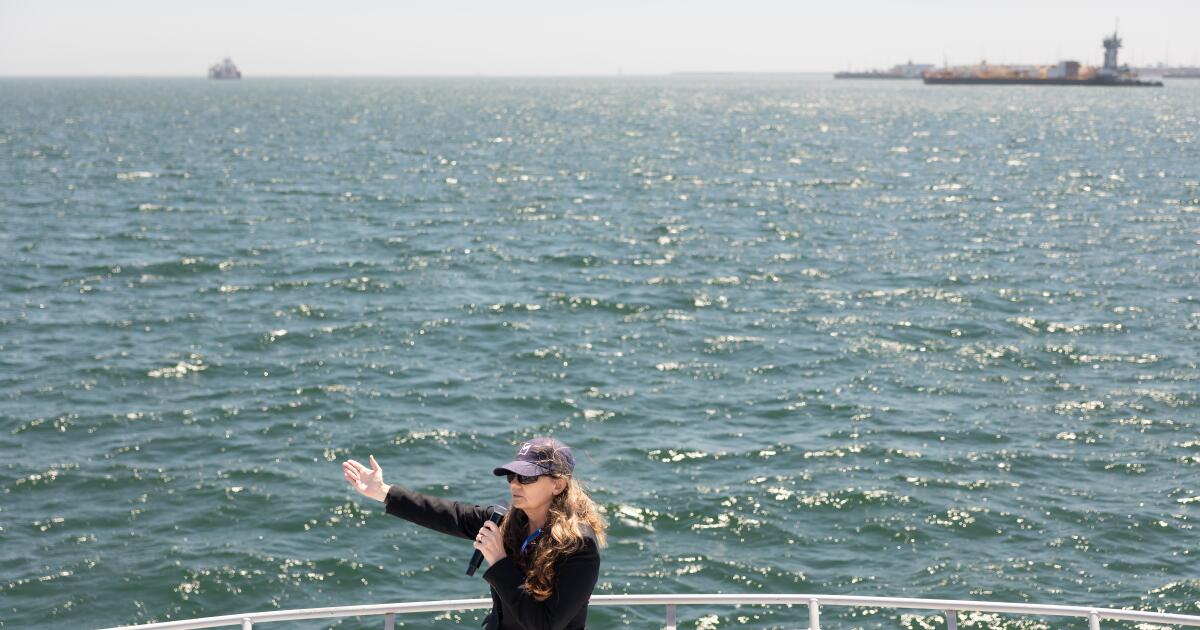
While the Trump administration takes extraordinary measures to halt the development of offshore wind power in the United States, Southern California is advancing a $4.7-billion plan to deploy hundreds of towering wind turbines in waters off the state’s coast.
The proposed Pier Wind project at the Port of Long Beach is a 400-acre terminal for the positioning, storage and assembly of some of the world’s largest offshore wind turbines, which would be towed north to federal wind lease areas some 20 miles off Morro and Humboldt bays.
Offshore wind is a key climate solution and officials say the project is crucial to helping California reach its goal of 25 gigawatts of offshore wind power by 2045. The Port of Long Beach is one of only two areas primed for the assembly work; the other is Humboldt Harbor near Eureka. The port will create the land for the project through a massive dredge-and-fill operation in the water.
This is the second in an occasional series on the state of the energy transition in California amid opposition from the Trump administration.
California’s approach is to push forward with offshore wind preparations that fall within its jurisdiction, readying the ports and the power grid to eventually take on electricity from 1,000 turbines in federal waters. The aim is to wait out the current administration, which is notoriously hostile toward a form of renewable energy that is booming elsewhere in the world.
“We’re just moving forward with all the things in our control because the port infrastructure has a long lead time,” said Suzanne Plezia, managing director of engineering services with the Port of Long Beach, on a recent catamaran ride around the harbor’s cranes and cargo towers. The work is supposed to be completed within a decade.
“We’re in it for the long haul because we do believe offshore wind is part of our energy future,” she said.
The state’s work is in some way an act of defiance against the Trump administration, which has taken more than two dozen actions against offshore wind power since the president’s second term began in January 2025, including canceling half a billion dollars in funding for port preparations in Humboldt.
Most recently, the White House struck a series of unprecedented deals with energy companies that held offshore wind leases in federal waters, paying them nearly $2 billion to abandon their plans and instead invest in U.S. oil and gas projects. Wind lease areas are stretches of ocean designated by the U.S. government for potential offshore wind development.
One of those deals was with Golden State Wind, which held one of the five leases off the coast of California. State officials are investigating that deal, including a subpoena from the California Energy Commission seeking details about the payout.
“The operative word is not ‘resist’ — it’s ‘create,’ ” California Energy Commission Chair David Hochschild told hundreds of attendees at the Pacific Offshore Wind Summit in Long Beach recently.

A rendering of the proposed Pier Wind project at the Port of Long Beach.
(Port of Long Beach)
Among them were regulators, lawmakers, investors and industry representatives from the U.S. and abroad who said they remain optimistic about offshore wind’s prospects and vowed to keep to their plans. They point to the United Kingdom, where nearly one-fifth of electricity generation now comes from offshore wind.
But the question of whether President Trump’s actions are succeeding at slowing California and U.S. progress also percolated throughout the summit.
Much of the uncertainty surrounds financing, whether investors still see offshore wind as a smart place to put money.
“We are asking ourselves, do we want to do offshore wind at all?” said Sean Boyd, executive director of EY Parthenon, an arm of Ernst & Young that advises investors and companies, during a panel discussion.
While California is still moving toward its 2045 target, it is not on track to meet its 2030 goal of 2 to 5 gigawatts of offshore wind.
Last year, Gov. Gavin Newsom released about half of a $475-million tranche of Proposition 4 funding for offshore wind projects, but has so far not released the rest. The latest draft of Newsom’s 2026-27 budget would defer the remaining $241 million to a future year — and by default, a future governor.
But California’s efforts are also unprecedented. While much of the world’s offshore wind power is affixed to the seafloor, including off the East Coast of the U.S., the turbines off California will need to float because the ocean here is much deeper. The state’s planned lease areas are between 1,600 and 4,200 feet, far deeper than any other floating wind farms in the world.
“There’s an awful lot of risk in first-of-a-kind technology,” said Boyd. “But the single biggest fundamental risk that runs through all of this is the market risk. Is there a long-term floating offshore wind market in California?”
Many state officials say the answer is unequivocally yes.
“California cannot allow this instability in Washington to derail our long-term climate and energy goals,” said Assemblyman Rick Chavez Zbur (D-Los Angeles). “We have to continue planning, we have to continue investing, we have to continue building, because offshore wind remains one of the most important tools we have.”
The Trump administration has turned offshore wind into a political football, describing the technology as “doomed” and a threat to national security that is restricting U.S. energy dominance. Trump argues offshore wind is costly and intermittent because it relies on the wind to blow.
But experts say it is meant to be part of a robust clean energy portfolio, complementing other renewable sources, such as solar power and battery energy storage. Many supporters are biding their time until the next election.
“Will offshore wind exist in California and the United States?” asked Jim Lanard, co-founder and chief executive of developer Magellan Wind. “I say resoundingly yes — and it will take off very quickly in 2029.”
Some of the state’s residents are opposed, however, including members of the San Luis Obispo-based REACT Alliance, which sees offshore wind as a threat to coastal communities and the marine environment. The group said it lobbied the Trump administration to make its deal with Golden State Wind, and it is now urging Equinor, another of the leaseholders, to strike a similar agreement and walk away from its plans off the Central Coast.
Other groups, including local tribes and environmental justice organizations, are watching the state’s efforts closely for potential effects such as sediment disruption and erosion, changes in whale migration and pollution from construction. Wilmington, Carson and other communities around the Port of Long Beach already face some of the worst air quality in the region.
But many offshore wind believers say the train has already left the station. Globally, the market is continuing to grow rapidly, led by China, which installed 6.6 gigawatts of new offshore wind capacity in 2025, bringing its cumulative total to 48.4 gigawatts, according to the Global Wind Energy Council.
Some said the need for the technology will only increase as artificial intelligence data centers drive energy demand, along with soaring electricity costs and constrained oil supplies from the war with Iran.
“This is a pivotal moment for energy,” said Noel Hacegaba, chief executive of the Port of Long Beach. “Rising fuel costs are sharpening the case for domestically produced power and for energy independence. … This is renewable energy’s moment.”
The enthusiasm was apparent as the catamaran bobbed around the future site of Pier Wind, which recently received a $20-million grant from the California Energy Commission. The plans include a large wharf with a staging area for the turbine components, plus a “wet storage” area for the assembled units in the water waiting to be towed away, among other elements.
Depending on the final specifications, Pier Wind would be able to assemble one or two turbines per week, each as tall as the Eiffel Tower and capable of generating 20 to 25 megawatts of wind power. Once towed to the lease areas up the coast, their electricity would flow back to land via floating underwater cables and, ultimately, tied into the state’s main grid.
“The world is watching to see what California does next,” Hacegaba said.

The chemical leak that triggered evacuations across a swath of Orange County on Friday is located at GKN Aerospace, a manufacturing company based in the United Kingdom.
A leading aerospace firm
The company manufactures landing gears, jet engines and other materials for commercial and military aircraft.
GKN Aerospace’s Garden Grove facility, which sits on 15.5 acres on Western Avenue, designs, analyzes, tests and certifies military canopies, cockpit windows and passenger windows, according to its website.
The company has been at the site since 2004, according to city documents.
“GKN Aerospace manufactures the world-leading F-35 canopy from its Garden Grove facility, as well as transparencies for the Boeing 787 Dreamliner and 737, the Airbus A350, HondaJet and Bombardier C-Series,” the company’s website states.
What company is saying
A spokesperson for GKN Aerospace told The Times on Friday that they are responding to the situation and working with fire crews and specialized hazardous materials teams.
“There are no reports of injuries at this time, and our priority remains the safety of our employees, responders, and the surrounding community,” the spokesperson said. “The situation at our Garden Grove site remains ongoing, and we are fully focused on working with emergency services and the relevant authorities to ensure the safety of our employees and the local community.”
The problem
There are three large tanks with a highly toxic chemical called methyl methacrylate, or MMA, used to make plastic, at the site in the 12000 block of Western Avenue in Garden Grove.
One tank that officials have said is “in crisis” has about 7,000 gallons of the chemical left in it. It started experiencing a rise in temperatures on Thursday, which triggered temporary evacuations. But fire crews were called out to the site again on Friday.
Craig Covey, a division chief with the Orange County Fire Authority and the incident commander, described two possible scenarios for the tank during a news conference on Friday afternoon.
“One, it fails and cracks, and all the product leaks out onto the ground,” Covey said, and efforts are underway to try to prevent the liquid from “getting into the storm drains and the river channels and into our oceans.”
Or, it will explode, he said.
Officials have been working to come up with what Covey said were “out of the box” ideas to prevent as much damage as possible.
“Our group is going to do everything they can to come up with a third, a fourth, a fifth option,” he said.
OSHA inspections
The company’s Garden Grove facility has undergone four inspections by the Occupational Safety and Health Administration since 2018, which resulted in 10 violations, public records show.
More information about those violations was not immediately available.
In 2019, the California Department of Industrial Relations filed a request in Orange County Superior Court that a judge order the company to pay $2,898 in unpaid civil penalties.
The citation, outlined in court records, alleged the company in April 2018 “failed to ensure that all machinery and equipment in service were inspected or maintained as recommended by the manufacturer.”
The company also received a violation for allegedly failing to “implement and effective written injury and illness prevention program” in accordance with state law.
It doesn’t appear that any of the violations were related to the tanks at the center of Friday’s incident.
The documents do not say how the company responded to the inspection reports.
“Safety at our facilities is paramount,” a GKN spokesperson said in response to questions from The Times. “We follow all standard safety protocols and processes and are regularly audited by numerous state and federal agencies.”
“Our focus and priority today is on working with emergency services and the relevant authorities to address the issue at hand and protect the local community,” the spokesperson added.
This year the company sought permission from the Garden Grove planning commission to construct a new employee break room on the site. The plans included the construction of a new 1,504 square-foot building, a roof deck and an open-air patio, according to city documents.
Questions from officials
Congressman Derek Tran, an Orange County Democrat, said Friday night that he had spoken with the leadership of GKN Aerospace and had “urged the company to take full responsibility for the panic and disruption that tens of thousands of residents are currently experiencing.”
“We agreed the priority is the safety of the community and addressing the urgent crisis at hand,” Tran wrote in a post on social media.
“I’m continuing to work with emergency personnel to ensure that residents are safe and have the resources they need while officials work to mitigate the impacts of the hazmat incident.”
-
 Detroit, MI20 minutes ago
Metro Detroit veterans charity pleads for end to donation bin vandalism across metro area
-

 San Francisco, CA32 minutes ago
Person stabbed at SF Carnaval festival, in critical condition
-

 Dallas, TX38 minutes ago
Louisville Kings beat Dallas Renegades, control UFL playoff destiny
-

 Miami, FL44 minutes ago
Lionel Messi subbed off early in Miami win over Philadelphia
-

 Boston, MA50 minutes ago
Boston firefighters mourn Robert Kilduff’s line-of-duty death: “He is irreplaceable”
-

 Denver, CO56 minutes ago
Avalanche – Golden Knights Game 3: Live updates, analysis, highlights
-

 Seattle, WA1 hour ago
Natisha Hiedeman, Flau’jae Johnson lead Seattle Storm to 97-85 win over Mystics
-

 San Diego, CA1 hour ago
Francella Perez’s Memorial Day Forecast

