Business
Column: A Trump judge eviscerates a pro-worker regulation at the request of big employers

The Biden administration’s support of worker rights and union organizing has become a byword.
President Biden has restored the National Labor Relations Board to its traditional role as protector of collective bargaining rights. He walked the United Auto Workers picket line during its ultimately successful contract negotiations with the Big Three automakers.
He has nominated and renominated the outstanding worker advocate Julie Su as secretary of Labor. And he swept a gaggle of Trump-appointed union-busters and anti-union ideologues out of a key federal agency responsible for ruling on disputes involving government union contracts.
As major companies have consciously invested in building brands…as the cornerstone of their business strategy, they have also shed their role as the direct employer of the people responsible for providing their products and services.
— David Weil, “The Fissured Workplace”
But now he has run up against a brick wall of hard-right anti-union ideology put in place by his predecessor: another Trump-appointed ultra-partisan federal judge using his perch in an obscure courthouse to make policy for the entire nation.
We’re talking about J. Campbell Barker of the U.S. District Court of Tyler, Texas. Last week Barker, ruling in a lawsuit brought by the U.S. Chamber of Commerce and 12 other business lobbies, invalidated an NLRB rule aimed at broadening the standard by which big corporations could be held jointly responsible for the welfare and unionization rights of workers employed by their franchisees.
Barker was appointed by Trump in 2019 after a career as a Texas state lawyer writing briefs to restrict voting rights and LGBTQ+ rights, supporting Trump’s travel ban on Muslim-majority nations and attacking access to contraceptives and abortion.
On March 8, he ruled that the NLRB’s joint-employer regulation, issued in October, was so broad that it would “treat virtually every entity that contracts for labor as a joint employer.”
Many workers whose wages or workplace conditions were effectively dictated by big companies that fobbed their responsibilities onto franchise owners would consider that anything but a drawback.
The NLRB is certain to appeal Barker’s decision, probably to the New Orleans-based 5th Circuit Court of Appeals, which has set its own standard for far-right judicial overreach. The board had earlier argued that Barker shouldn’t have taken the lawsuit in the first place, because by law NLRB final rules can be appealed only to the federal appeals court in the District of Columbia. Barker rejected that argument.
Big business has been fighting efforts to broaden legal interpretations of joint-employer status for decades. The plaintiffs in this lawsuit included lobbies for builders, restaurants, hotels and convenience stores.
Many of them base their business models on their ability to control workplace conditions from afar while pushing legal liability for labor violations onto franchise owners, whom they often describe (inaccurately) as small mom-and-pop operations just scraping by.
Among the plaintiffs is the Chamber of Commerce of Longview, Texas. Longview is a small city in the east Texas oil patch; presumably its chamber was recruited because the plaintiffs figured that its presence would give them standing to sue in the federal district court in Tyler, which has two judges, both appointed by Donald Trump, including Barker. They got their wish.
Another plaintiff is the Coalition for a Democratic Workplace. You might suppose that an organization bearing that name represents the whole panoply of business stakeholders, from fast-food workers to corporate employers, but no.
“Democratic” here means much the same thing as it did when “German Democratic Republic” signified a Communist dictatorship in East Germany, which was anything but a democratic workers’ paradise. The coalition comprises 600 employer groups “joined by their mutual concern over regulatory overreach by the National Labor Relations Board.”
Now let’s turn to the lawsuit itself. If you surmise that its opening brief, filed on Nov. 9, bristled with disinformation, you would be right.
The brief stated that the NLRB “rammed” the rule changes through on the claim that “the 90-year-old National Labor Relations Act has been misinterpreted for most of its existence.” (Actually, the board is only 88 years old.)
A couple of points here. First, it’s a little unclear what the plaintiffs meant by “ramming through” the new rule. The NLRB first proposed the rule in September 2022, and didn’t promulgate it until 13 months later. In the interim it put the proposal out for public comments, of which it received 13,000.
The plaintiffs implied that the NLRB’s joint-employer rules have been static since the board’s founding in 1935. Nothing could be further from the truth.
The standard came before the Supreme Court more than once, starting in 1964. The board amended it, sometimes narrowing and sometimes expanding its definition of joint employer, in 1982, 2002, 2007, 2018 and 2020, before the latest version was issued in October.
The plaintiffs wring their hands over the fact that the board reversed a rule that it “promulgated just three years ago.” You might ask yourself: Hmm, what changed in Washington between 2020 and 2023?
If you guessed that the Trump administration was turned out of office and replaced by the Biden administration, well done.
The latter gave the NLRB a Democratic majority, just as the former had given it a Republican majority. Presidents have the power to do that and most have done so when they were succeeding a president of the other party. So when the plaintiffs depict the board as an unchanging entity that reversed itself, they’re lying, possibly in the hope that a judge will be too stupid to notice their sleight of hand. Or too partisan to care.
But they can’t avoid explicitly stating their true concern with the joint-employer rule: The rule threatens employers with “billions of dollars in liability and costs.”
Defining joint-employer responsibilities has become more important in recent decades as more businesses turn to the franchise model, which gives fast-food, hotel and retailing behemoths plausible deniability over how their front-line workers are treated and paid.
“As major companies have consciously invested in building brands … as the cornerstone of their business strategy,” labor expert David Weil wrote in his 2014 book “The Fissured Workplace,” “they have also shed their role as the direct employer of the people responsible for providing their products and services.” The trend, Weil wrote, encompasses hotel maids, cable installers, commercial janitors and merchandise pickers in Amazon warehouses — all are actually on the payroll of third-party employment firms.
(By the way, Biden nominated Weil in 2021 to a high-level position at the Department of Labor, but the nomination was killed by opposition from Republicans and Big Business.)
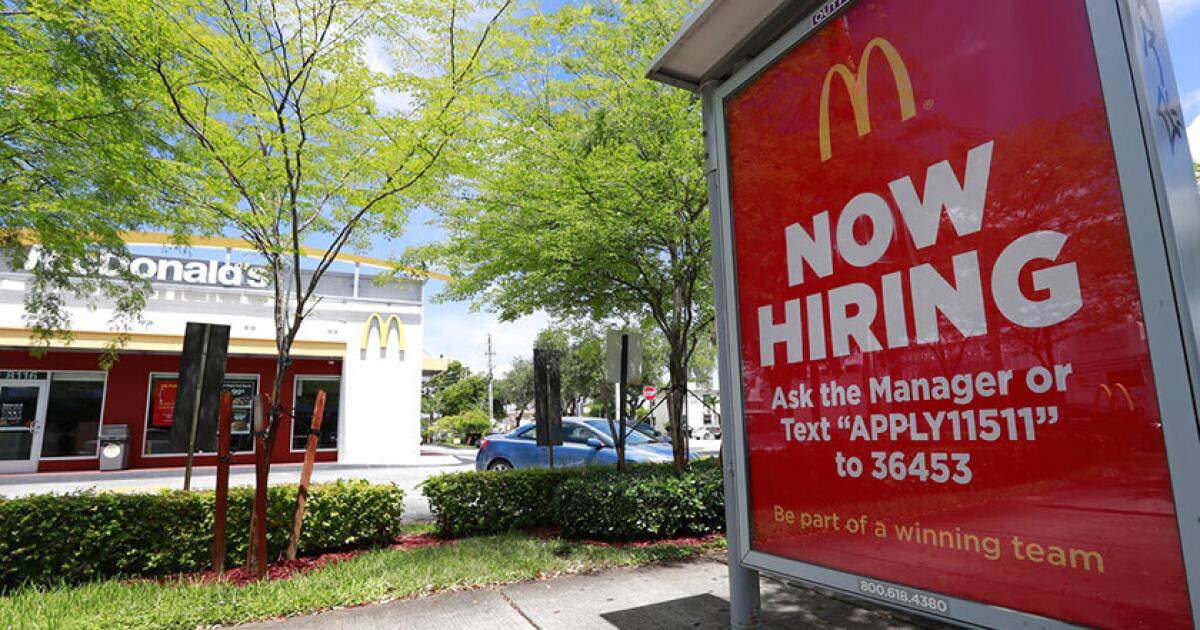
In recent years, the principal target of joint-employer cases at the NLRB has been McDonald’s. That’s unsurprising, since with more than $119 billion in overall international sales it’s the largest franchisor in the world.
The Obama-era NLRB brought a massive case against the company and 29 franchisees in 2014, which turned into what was regarded as the biggest case the board ever instituted, and the longest. The main issue was whether the company had participated in — in fact, helped to run — a nationwide attack on the Fight for $15 union campaign for a higher minimum wage at its restaurants.
Then-NLRB general counsel Richard Griffin alleged at the outset that the franchisees fired, suspended, cut work hours, threatened, spied on and interrogated employees involved in the union campaign, all of which he interpreted as illegal responses to union organizing.
Administrative Law Judge Lauren Esposito cited evidence that the anti-union response was “formulated and implemented” from McDonald’s headquarters in Chicago and that the company provided franchisees with “suggested policies” and legal training in labor relations — so much so that the company was properly regarded as the franchise workers’ joint employer.
By the time Esposito prepared to rule, Trump was president. He replaced Griffin with Peter Robb, whose record as an anti-labor lawyer was well nigh unassailable and whose hostility to the joint-employer rule was manifest. Before Esposito could rule, Robb settled the cases against the franchisees by ordering back pay for the workers who were fired or had their hours cut. But the settlements didn’t involve McDonald’s Corp., which therefore skated on the joint-employer issue.
Esposito rejected the settlements, but she was overruled by the NLRB’s new, Republican majority. The sole dissent came from Lauren McFerran, an Obama appointee who was the only Democrat then on the board.
“A finding of joint-employer status,” she wrote, “would have important collateral consequences for McDonald’s, in both unfair labor practice proceedings involving its franchisees and … if workers employed at McDonald’s franchisees sought to organize (that is, unionize).”
In other words, the Trump NLRB moved heaven and earth to keep McDonald’s from being declared a joint employer.
McFerran is now chair of the NLRB, presiding over a 3-1 Democratic majority. (One seat on the five-member board is vacant.)
The NLRB’s joint-employer rule would bring millions of workers — typically low-wage workers without health or retirement benefits and virtually no job security — under the umbrella of their well-heeled ultimate employers. It’s possible, if not certain, that they would see an improvement in their working lives, through better wages and more opportunity to unionize.
Even big franchisees or labor brokers don’t have to care about their public image — most customers don’t even know they exist. But McDonald’s, Marriott, Walmart and Amazon have a lot to lose in public esteem by getting tagged as an abuser of workers.
If the NLRB had its way, they would no longer be getting away with shedding their responsibilities. Let’s hope that Judge Barker’s ruling is a temporary obstacle to making the world work better.


Shares in Elon Musk’s rocket company SpaceX halted their three-day slide that had erased roughly $600 billion off its market value.
SpaceX shares closed at $156.11 with a nearly 1% gain on Tuesday, a slight recovery from a 16% fall on Monday.
That loss dropped the stock below $160.95, where it ended the day June 12 after a 19% surge during its record initial public offering. The IPO gave it a market cap of $2.2 trillion, making SpaceX one of the world’s most valuable public companies.
It also turned Musk into the world’s first trillionaire, a status he retains despite the sell-off.
The downturn probably reflects investor unease over the company’s spending plans and potential debt load, analysts say.
SpaceX raised a total of $86 billion after underwriters exercised their right to sell additional shares, on top of the $75 billion initially raised. It was the largest IPO in history.
A little more than half a billion shares were distributed to institutional and retail investors at a price of $135, with the stock opening at $150 as some holders immediately flipped shares for a profit.
Shares rose as high as $176.52 during the IPO before settling at the $160.95 price. In the weeks since, shares reached a high of $225.64, meaning that some investors lost money or are underwater with paper losses.
Since the IPO, SpaceX has dropped some big bucks.
It announced last week that it was acquiring AI coding startup Cursor for $60 billion in a deal expected to close in the third quarter. The San Francisco company, founded in 2022, enables engineers to instruct software in English to run coding tasks autonomously.
It also sold $25 billion in bonds on Tuesday , unusual for a company that just went public, much less for one that just raised a record sum.
The IPO surpassed the 2019 offering by Saudi Aramco, Saudi Arabia’s state-owned oil giant, which raised $29.4 billion, the prior record holder.
S&P Global issued a report last week that assigned SpaceX a “BBB” credit rating, the lowest possible rating to qualify as an investment grade credit risk. It noted the company will have “elevated capital expenditure” through 2029.
SpaceX rivals OpenAi and Anthropic filed this month for initial public offerings that, while not expected to be as large as Musk’s company, will be large in their own right.
Wedbush analyst Dan Ives, who has been bullish on SpaceX stock, said the market is digesting “massive debt and equity raises from Big Tech players” in the coming years.
“This is part of an industry wave of debt offerings on Wall Street, like Alphabet and SpaceX among others,” he wrote in an email.
With the stock already giving up gains since the IPO, it will be further tested when tranches of locked-up shares held by current and former employees are released.
At least 20% of the shares will be released after second-quarter results are disclosed sometime in the coming months, with all the lockups expiring in December.
SpaceX, based in Texas, is the leading launch services company in the world, with its Falcon 9 rocket accounting last year for the vast majority of satellites sent into space.
It is also the leading satellite-based broadband provider with its Starlink service. But the extraordinary interest in the IPO was driven by Musk’s plans to make the company an AI leader — including plans to launch orbiting satellite data centers powered by the sun that crunch AI data.
He merged his xAI artificial intelligence company into SpaceX this year, with the combined entity recently announcing it was leasing computer power to rivals Anthropic and Google at two terrestrial data centers it has constructed.
Musk moved the company’s headquarters from Hawthorne to Texas in 2024, but it retains large operations in the South Bay city and blasts off regularly from Vandenberg Space Force Base in Santa Barbara County.
Investment research firm Morningstar placed a $780-billion valuation on SpaceX, focusing on its core rocket and Starlink broadband satellite businesses. It suggested investors wait a few months for the stock to settle before buying in.
“I think the day-to-day stock price movements are usually based on market sentiment,” said report co-author Nicolas Owens, an equity analyst at Morningstar. “So I was not surprised when it went way up right after the IPO — and I’m not surprised it [came down]. Not much has really changed in the fundamentals.”
Mike Alves, founder of Pasadena’s Vida Vision Fund, has a stake in SpaceX that accounts for 46% of his AI and robotics fund.
He said he was not perturbed by the stock drop, noting that Facebook fell under $18 a share just months after its May 2012 IPO closed at $38 a share. It has since risen more than 1,000% above its offering price.
“The volatility doesn’t really matter because you’re going to multiply your best investment many times, so I’m not so worried about it,” he said, adding that investors seeking shares could now “scoop them up at a good deal.”

The nation is awash in data center hate and California is no exception.
Temporary bans have cropped up across the state as residents from Imperial County to San José fight proposals in their communities. Monterey Park became the first city in the country earlier this month to permanently ban data centers by a popular vote. And a recent poll sponsored by the environmental group Net-Zero California showed 70% of state residents don’t want data centers in their communities.
But unlike in Virginia, Texas, Ohio and other states where residents are fighting 400-plus megawatt hyperscaler facilities in their backyards, California has some major barriers keeping data centers at bay.
Sky high industrial electricity prices are more than double the national average. Long wait times to connect to the grid have some new data centers sitting empty in Silicon Valley. And the state regulates the size of the backup generators that keep the centers running when the grid goes down. That has limited most facilities to a fraction of the size that artificial intelligence increasingly demands.
That all means that California is seeing less of a boom — fewer proposed data centers, and smaller in size — than in the country’s hot spots.
“California isn’t even on the map today,” said Mehdi Paryavi, chairman of the International Data Center Authority. “Taxes are high, land is expensive, water is scarce, energy is difficult to find, communities are pushing back. There are all kinds of problems.”
Northern California and Southern California were hubs for an earlier generation of data centers. “But over time, as the sector has grown, the overwhelming majority has been developed elsewhere,” said Andrew Batson, head of data center research at real estate intelligence firm JLL.
“Almost all the data center demand being generated from California is being serviced by adjacent states,” from places such as Phoenix and Las Vegas, Batson said, “where power is much cheaper, land is more affordable, and regulations are quite less.”
Still, “California can’t outsource all it’s data center capacity,” and the state expects to see growth over the coming years.
Fifty-one facilities are currently planned in the state, according to a recent study from the Pew Research Center, an 18% increase over the 277 operating today. According to a study from UC Riverside, data center electricity use in the state doubled between 2019 and 2023.
But some grid operators elsewhere are already seeing overwhelming loads, such as the Pennsylvania-New Jersey-Maryland Interconnection that expects about 40% to be added to its total demand, largely from data centers, by 2035. Compare that to the California Energy Commission which expects data centers to drive an increase of about 2 gigawatts by 2030, and 5 GW by 2040. That’s about 4 and 9% of its 52 GW peak load respectively.
“It’s a significant amount of demand growth, but it’s not dwarfing all the other factors,” said Mark Specht, a senior energy manager at the Union of Concerned Scientists who put out a report on California data center growth last month. “Some of the projections we’re seeing for increased electricity demand from electric vehicles in 2045 is actually higher than the demand from data centers.”
California regulations are part of what’s keeping data centers relatively small: A state rule requires any backup generator bigger than 100 megawatts to be certified as a power plant.
Specht’s report found none of the current data centers in California and almost none of the proposed ones require that certification because they fall under the 100 MW cap. (Exceptions include a 417 MW planned facility in Santa Clara and a 330 MW one in Imperial County blocked Tuesday by a moratorium vote.)
One hundred MW could power a small city’s peak demand, yet the average U.S. data center is expected to demand over 600 MW by 2030, according to the energy intelligence company Cleanview.
A San Francisco Chronicle analysis showed that California facilities currently make up about 5% of national data center power demand, but that share is expected to fall to 1% if building proceeds as planned across the country.
Still, the growth that does exist is raising concerns among utility ratepayer advocates and environmentalists, not to mention the general public.
“There are real costs at stake,” said Mark Toney executive director at The Utility Reform Network, a ratepayer advocacy group.
He noted Pacific Gas & Electric anticipates a massive amount of new demand from data centers — about 10 GW worth — or enough to power 7.5 million homes. That would require grid upgrades he estimates at about $10 billion, partly borne by ratepayers. Interest has been high in PG&E territory because it serves the San Francisco Bay area, where California’s projected data center buildout is concentrated around San Jose, now that Santa Clara has reached capacity.
Data center electricity projections come with uncertainty, and PG&E says its confirmed large load in the pipeline — mostly data centers — is closer to 5.3 GW.
Whatever demand materializes, TURN and others are fighting to shield ratepayers from the costs of PG&E’s buildout, a battle playing out at the Public Utilities Commission.
PG&E spokesperson Rob Stillwell said data centers help reduce rates by spreading the costs of grid maintenance over more customers. He noted data centers already have to pay the up front costs of connecting to the grid, under a temporary rule.
But TURN says those don’t include all of the infrastructure and broader grid updates that PG&E will have to invest in to support data centers.
And the rule only applies for PG&E territory and doesn’t require data centers to bring their own clean power.
TURN is now backing a bill from State Sen. Steve Padilla (D-Chula Vista) that would require all data centers to pay for 100% of the costs of new transmission upgrades as well as new clean energy to cover at least half their required electricity. The industry is opposing the effort.
Another Padilla bill would approve data centers faster if they use more clean energy. One from Assemblymember Rebecca Bauer-Kahan (D-Orinda), would require data centers to disclose their energy use to the state. And bills by Assemblymember Diane Papan (D-San Mateo) would require them to project and report their water use as part of permitting and licensing.
Yet politicians have been hesitant to regulate. Last year, similar bills were either watered down, didn’t make it through the legislature or were vetoed by Gov. Gavin Newsom.
At a panel in January, gubernatorial candidates were asked how they would balance environmental concerns about data centers with their potential to drive economic activity.
“We have to make sure that those data centers are paying their fair share,” said Xavier Becerra, adding that businesses need to move away from diesel backup generators.
Former candidate Tom Steyer of San Francisco answered with a dodge or a dose of realism, depending on your view.
“What data centers are looking for is cost to compute and speed to compute, and the good news is that California’s energy is so expensive on a cost basis, they’ll never come here,” Steyer said. “We may talk all we want about data centers, but they’re not coming.”

Bed Bath & Beyond is looking to stage a comeback as the decades-old company reopens stores in partnership with the Container Store in 22 cities, including two in Southern California.
To the delight of die-hard fans and coupon collectors, for a limited time the new stores will accept the chain’s blue and white coupons, no matter how old they are.
Customers can use their expired coupons until July 13. The company is also holding a contest to find the oldest coupon out there, with a prize of a home renovation worth $100,000.
“For decades, our customers treated these coupons like treasure,” said Bed Bath & Beyond Inc. President Amy Sullivan in a statement Monday. “They tucked them into purses, filing cabinets, cookbooks and memory boxes because they believed they would be valuable someday. We think they were right.”
Bed Bath & Beyond, which sells home goods including towels and kitchen gadgets, filed for bankruptcy in 2023 and shut down all its locations. Following its bankruptcy, Bed Bath & Beyond was bought by Overstock.com, which has since rebranded to Beyond, Inc.
The company announced the first phase of its brick-and-mortar reopenings last week. In addition to stores in New York, Colorado, Illinois and other states, two locations will open in California in the coming weeks in Costa Mesa and Century City in Los Angeles.
Over the last few years, social media users lamented that they could not use their expired Bed Bath & Beyond coupons.
“Found my entire stash of Bed bath and beyond coupons today,” one Reddit user said earlier this year. “Sad I never got to use them.”
Another Reddit user said they found a large stack of expired coupons two years ago. “I know I should probably toss them out at this point, but they were fun to collect,” they wrote.
In 2025, Beyond, Inc.’s executive chairman Marcus Lemonis vowed he would never reopen stores in California due to the “over-regulated, expensive” business environment. He ruled out future retail stores in the state in a statement posted on X last August.
Less than a year later, however, the company announced 12 planned storefronts in the Golden State, including five in Southern California. The new stores, dubbed Bed Bath & Beyond + The Container Store, will offer home organizational products as well as bed sheets, pillows and more.
Gov. Gavin Newsom welcomed the retailer back to the state.
“With a thriving economy growing faster than all other developed nations, California always reaches out with an open hand — not a closed fist,” he posted on X in April.
The Container Store filed for bankruptcy in 2024 and emerged from it in early 2025. Bed Bath & Beyond acquired the Container Store in April for about $150 million in stock and convertible notes, part of the company’s attempt at a comeback after its own bankruptcy.
“Our customers don’t think about their homes in categories,” Lemonis said in a statement. “By bringing Bed Bath & Beyond and The Container Store together, we’re creating a destination where customers can buy products, organize their spaces, design custom solutions and access services all under one roof.”
-

 Alaska35 seconds ago
Smokejumpers, aircraft responding to new fire near Ambler
-

 Arizona4 minutes ago
Arizona creates task force to crack down on cargo thefts
-

 Arkansas15 minutes ago
Razorbacks’ Guard Darius Acuff Selected No. Overall in 2026 NBA Draft
-

 California19 minutes ago
DOJ charges 10 Southern California defendants in largest federal healthcare fraud crackdown in US history
-

 Colorado24 minutes ago
Erie Town Council approves sale of Colorado mineral rights for major oil and gas development
-

 Connecticut30 minutes ago
Man charged with murder in death of Duxbury, Massachusetts woman in Connecticut home
-

 Delaware34 minutes ago
Vigil held for 2 teens killed in hit-and-run in New Castle County; driver in custody
-

 Florida39 minutes ago
Meet the Florida Democrats running for governor against David Jolly

