Business
California legislators say new laws must protect farmworkers from extreme heat

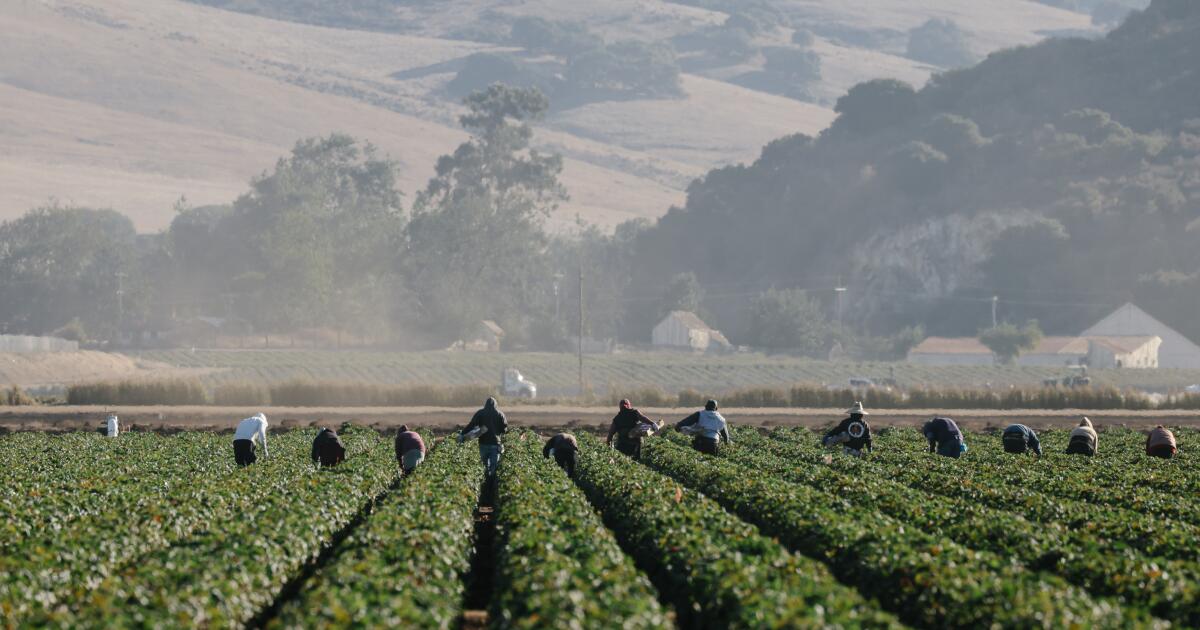
State lawmakers, responding to a report that the agency charged with ensuring worker safety in California has sharply cut back on enforcement of outdoor heat protection laws, said new legislation is needed to protect employees amid escalating periods of extreme heat.
Their comments addressed an investigation by the Los Angeles Times and Capital & Main that found that field inspections by the California Division of Occupational Safety and Health, known as Cal/OSHA, dropped by nearly 30% between 2017 and 2023. The number of violations issued to employers during that period fell by more than 40%.
“I’m incredibly disappointed, and I’m actually infuriated,” said Assemblymember Liz Ortega (D-San Leandro), chair of the Labor and Employment Committee.
Ortega, whose committee has heard testimony from farmworkers accusing Cal/OSHA of not enforcing safety laws, said the agency has repeatedly offered the “same excuses” for failing to ramp up inspections as life-threatening heat waves have intensified across California in recent years.
Cal/OSHA said it does not comment on legislation, but the agency said previously that it will launch a new agricultural unit that will operate in cities across California and “significantly expand enforcement.”
State law requires employers to provide heat illness prevention training, which includes information on the signs and symptoms of heat illness and an employer’s legal obligations to provide water and break areas with shade as close as possible to workers.
Capital & Main — an investigative news organization — interviewed more than 40 farmworkers across California in recent months. Workers said they did not receive heat safety training from employers and were not aware of their rights under the law. Many said they often toiled in fields and orchards with no shade and at times without water provided by employers.
Assemblymember Joaquin Arambula (D-Fresno), whose district includes fields and orchards in the San Joaquin Valley, said he will push for legislation that requires Cal/OSHA to create a new heat safety certification program for agricultural workers.
The training, which would be administered by the agency online, would ensure that workers know their rights and inform them how to call Cal/OSHA and file complaints if their employers fail to comply with the law, according to Arambula.
“We need to make sure that we’re receiving the calls and that people are empowered and know what their rights are,” he added, “and we need to have people who are there to receive the calls to make sure that we’re following up with inspections and finding violations.”
He said he will introduce his bill during the next year’s session of the Legislature. A similar bill did not make it out of committee during the current session after a difference of opinion arose among lawmakers over the best way to proceed with the legislation. The bill would have required the training to be offered in English and the top five non-English languages used by adults in California, as identified by the U.S. Census Bureau.
Ortega said that the Legislature has previously provided funding and other support so that Cal/OSHA could hire additional personnel to improve enforcement efforts. The agency has 141 unfilled positions, or a vacancy rate of 37%, in its enforcement unit, which oversees workplace safety inspections.
“I don’t think we’ll ever get to the number of inspectors that we need to get some real results, not in the time that we need it, which is now,” Ortega said.
She and others say they are supporting a bill by Sen. Dave Cortese (D-San José), a former farmworker.
The bill, which is being considered by the Assembly, would promote compliance with the state’s outdoor heat regulations and ensure that workers are compensated and receive medical treatment if they suffer heat-related injuries while working for an employer who had failed to comply with the law. In cases where the farmworkers died, their families would be compensated.
Cortese was not available for an interview but said in a statement that the bill is needed because farmworkers are endangered by record-breaking heat waves.
“Farmworkers need a rapid response for heat-related injuries and illnesses,” he said. “Their families need support when faced with the worst kind of heat-related tragedy — the death of a loved one and breadwinner.”
This story was produced in partnership with Capital & Main and the McGraw Center for Business Journalism at the Craig Newmark Graduate School of Journalism at the City University of New York and was supported by the Fund for Investigative Journalism.



Tech stocks took another big hit Tuesday as investors sold off shares of companies that have powered the artificial intelligence boom.
Technology companies have been spending billions of dollars investing in data centers and infrastructure needed to support the race to advance AI. But sky-high valuations and geopolitical tensions have some investors questioning whether massive AI spending will pay off, analysts said.
Reflecting the unease, the tech-heavy Nasdaq composite dropped roughly 2%. The Standard & Poor’s 500, a stock market index that tracks the performance of the largest U.S. publicly traded companies, fell by more than 1%.
Share prices for major California tech companies including Nvidia, Qualcomm, Intel and Marvell Technology all dropped. Meta Platforms, Apple, and Google’s parent company, Alphabet, also saw their stock prices slide, though the decline wasn’t as large as the drop in chip stocks.
Shares of Micron Technology, a U.S. memory chip manufacturer, plunged by more than 13% a day before the company was scheduled to report its third-quarter financial results. Anxiety in the U.S. spilled over from Asia, where South Korean tech companies SK Hynix and Samsung Electronics, both major computer memory chip manufacturers, saw their stocks plunge Tuesday by more than 12%.
“Investors are just a bit skittish after very strong moves in tech stocks where any hint of caution causes some investors to hit the sell button,” said Dan Ives, an analyst who heads technology research at Wedbush Securities, adding that it’s a “gut-check moment.”
On Monday, SpaceX saw its shares plunge 16% after a record-breaking initial public offering this month. Its share price then rebounded Tuesday, closing up less than 1% to roughly $156.
Tech companies have been making big bets on the role AI will play in people’s work and personal lives. They’ve been improving chatbots that can generate code, words, photos and videos. The companies also are betting that “AI agents” will be able to proactively tackle more in the future, automating repetitive tasks in customer service, online shopping and other industries. They’re releasing more AI-powered hardware such as smartglasses.
Major tech companies are going head-to-head in the race to dominate AI, competing to sway talent and consumers into using their products. Alphabet saw its stock slip after two of the company’s prominent AI researchers left for rival companies OpenAI and Anthropic.
Despite profitability questions, AI use has been growing. Roughly half of U.S. adults use an AI chatbot, according to a Pew Research Center report released this month. They’re using these tools for search, work tasks, entertainment and even companionship. More U.S. adults reported using OpenAI’s ChatGPT, followed by Google’s Gemini, Microsoft Copilot and Meta AI.
Amid all the hype and spending, there also have been growing fears about whether AI will take over people’s jobs and whether the boom will lead to a bubble that will eventually burst. California AI startups OpenAI, valued at $852 billion, and Anthropic, valued at nearly $1 trillion, are preparing to potentially become publicly traded companies.
“I don’t view this as a bubble,” Ives said. “I view it as we’re going to go through these white-knuckle moments as tech stocks continue to move higher, but the bears will continue to yell fire in a crowded theater when we have these pullbacks.”
Economic factors also could affect how much people are willing to invest in tech company stocks. There’s anxiety over whether the new Federal Reserve Chair Kevin Warsh will raise interest rates, making it more expensive to borrow money. That could cut into a company’s profit margin or decrease consumer spending. United States’ war with Iran is driving up gas prices while the U.S. inflation rate rose to 4.2% in May.
The AI boom is fueling the demand for memory and storage chips, but prices for them are on the rise, prompting some companies such as Apple to look at raising prices for consumer electronics.
Globally, AI spending is projected to increase to $2.59 trillion in 2026, up 47% year over year, according to a forecast by research firm Gartner.
Driven by AI demand, memory and storage vendors have significantly outperformed the S&P 500 and the SOX index, a global semiconductor and microchip index, since the start of 2025, according to a note to clients from BNP Paribas.
Still, investors are on edge ahead of Idaho-based Micron Technology’s earnings report Wednesday, said Gil Luria, head of technology research at financial services company D.A. Davidson. Since January, Micron Technology’s stock has climbed more than 233% to more than $1,000 per share.
“Any indication of a slowdown in demand for AI is seen as a potential turn in the cycle,” Luria said. “While the overwhelming sense is that demand is still far exceeding supply, investors are waiting for Micron to indicate that is still the case.”
Times staff writer Nilesh Christopher contributed to this report.

Tired of the same old dating apps like Bumble and Hinge, Marie Lansley tried talking to an artificial intelligence matchmaker.
For roughly 15 minutes, she chatted with an AI voice on the dating app Known, answering questions about her upbringing, personality, education, lessons from past relationships and whether she’s looking for a serious relationship or something more casual.
“Divorced at 36. Yea, you’re not here to waste time. The way you build your days matter,” the AI voice told her after Lansley replied she was looking for a serious relationship.
Weeks later, the San Francisco resident got a match along with a written summary of why the pair could be compatible. But the stranger wasn’t her type and she wasn’t keen on paying $15 to meet up.
Startups like Known are roping in new users by hosting in-person dating events in San Francisco.
“I want to be able to use AI to improve efficiency in dating and to help navigate a pretty frustrating dating landscape. But there are just some things that are so deeply human that AI technology cannot capture,” said Lansley, who has posted about her dating experience on social media.
Singles like Lansley are dipping their toes into the wacky world of AI dating but they’re also skeptical if it will make it easier to find love. Online dating is ripe for disruption, and tech companies big and small are turning to AI as a potential solution to find people better matches more quickly and help them improve their chances of landing a date.
For years, people have been frustrated and exhausted by the seemingly endless amount of swiping and small talk that go nowhere on dating apps. They’re turning to in-person options such as running clubs, pickleball and speed dating but finding the right partner is still tough.
Online dating remains a popular way people search for a partner but some are dumping the platforms. Tinder’s monthly active users in March dropped 7% year-over-year, though its parent company Match Group noted that the rate of decline has been slowing as it revamps the app.
West Hollywood-based Tinder, which has roughly 50 million monthly users, has been experimenting with using AI to analyze a user’s camera roll and recommend better matches.

Known, an AI dating app, has its branding plastered on a storefront in the Marina District in San Francisco.
Its rival Bumble — an app that initially stood out for having women message their matches first — saw its paying users drop 21% to 3.2 million in the first quarter this year compared to 2025. The company has been working on AI matchmaking and plans to ditch swiping in the last three months of the year in select markets.
Even dating services that have grown users such as West Hollywood-based Grindr, an app for the LGBTQ+ community, and Facebook Dating, which is included in the main social network, are also leveraging AI more.
And new AI dating startups are popping up in California, New York and other states that could change the way people find a partner online. Former Hinge co-founder and Chief Executive Justin McLeod is working on an AI dating app called Overtone, stating on its website that “AI, if used correctly, can help us invent an entirely new way for people to find their partners that is far more personal, far more efficient, and far more effective.”
Some of those startups started in the San Francisco Bay area, where AI dating apps are hosting parties, speed dating, coffee meet-ups and other in-person events to rope people into using their new service.

Singles who downloaded the Known dating app mingle over drinks at Left Door, a cocktail lounge in San Francisco, on Thursday.
On one recent Thursday night, dating app startup Known hosted a dating event at a swanky San Francisco cocktail lounge for people who completed their matchmaking call on the app. The event’s description said attendees would be greeted with “champagne, caviar bumps, and a mysterious envelope” that reveals who the AI matchmaker paired them up with.
Known Chief Executive and co-founder Celeste Amadon, who dropped out of Stanford University to create the AI dating app, said Americans are spending more time alone at home as online services have made it more convenient to do everything from getting food delivered, online shop and date. Young people complain about traditional dating apps yet they’re also still on them.
“The more I understood today’s dating apps, the more clear it became that they have been for the better part of two decades now, designed, tweaked, redesigned, rebuilt, to not work,” she said.
1

2

3

1. A sign that reads, “I love my AI boyfriend” hangs in a San Francisco window. 2. Known, an AI-driven dating app, has their branding plastered on a store front in the Marina District in San Francisco. 3. Celeste Amadon, CEO of Known, poses for a portrait.
The company charges per date to ensure people show up but the startup also has a business incentive to find people a match they actually want to meet, she said. Known plans to expand to San Diego in July, she said. Amadon said she expects the AI matching technology to become more accurate over time.
Known hasn’t shared its user numbers or revenue figures. Founded in 2025, the startup launched the dating app in February and has raised roughly $10 million from investors such as Coelius Capital, Forerunner Ventures and NFX, according to PitchBook.
Grindr is learning more about how much users are willing to use and pay for AI features.
The company has been testing a subscription tier called “Edge” in Australia, New Zealand, the United States and Canada that includes AI tools that recap meaningful chats, display personalized profile recommendations and show users who they’re likely to match with.
Unlike other dating apps, Grindr users don’t swipe through profiles. The app displays a grid of people who are nearby that they’re able to chat with. Grindr has expanded beyond casual dating, allowing people to find friends, travel companions and others in the LGBTQ+ community.
Grindr’s Chief Product Officer AJ Balance said the company is still testing subscription pricing for Edge but some users are willing to pay $350 per month because they’re “seeing a lot of value” and saving time.
“We view AI and new paradigm shifts like it as opportunities to build great, new product experiences that haven’t been developed before,” he said. “Our approach is really to leverage AI, like we did with mobile, to facilitate better conversations, deeper connections, ultimately more success in dating in the real world.”
Other popular dating services aren’t charging for AI matchmaking features. On Facebook Dating, which has more than 21.5 million daily users worldwide, users can use AI to write their profile intro and chat with an dating assistant for free.

AI dating startups are popping up in California, New York and other states that could change the way people find a partner online.
The AI assistant can recommend people looking for a serious relationship, someone with common hobbies or even above a certain height or age. Roughly 1 million people use Facebook Dating’s AI assistant daily in the United States and Canada, Meta said.
Facebook Dating product manager Neha Kumar said AI can help combat “swipe fatigue” facing online dating users.
“You’re sifting through a bunch of profiles. It’s really hard to understand and find somebody that’s compatible for you based on your specific types of preferences,” she said. “We really wanted to think about leveraging AI to solve this growing pain point.”
Technology is also a double-edged sword. The rise of AI tools means people can use technology to easily manipulate photos and craft messages on dating apps that might make them seem much more attractive or charismatic than they are in person. Some people are even turning to AI chatbots for companionship.
“How do we maintain human authenticity and human connection through an AI world? I don’t have a perfect answer to that. I think we’re still figuring it out,” Kumar said.
Lansley, the online dating user, said apps do make dating more convenient but it’s much more interesting to meet people face-to-face. She worries people will rely too much on AI as a “crutch” to replace human intimacy or emotional judgment.
“Chemistry,” she said, “is always going to be analog.”

Los Angeles County saw job gains in May, likely driven in part by rebuilding after the January 2025 wildfires, which destroyed or damaged more than 18,000 structures.
Construction added 2,300 jobs since April, while postings for new jobs in the industry jumped 45% over a year ago —indicating rebuilding in Pacific Palisades, Altadena and nearby is helping boost the local economy, according to a report by the Los Angeles County Economic Development Corp.
“This is consistent with the possibility that wildfire rebuilding activity is increasing construction labor demand in the area,” Max Chomas, an economist at the LAEDC Institute for Applied Economics, said at a presentation this week based on California Employment Development Department and other data.
Motion picture and sound recordings also added 2,800 jobs during the month, despite a deep downturn in Hollywood caused by a reduction in streaming filming, runaway production and other factors. The industry lost 6,700 jobs compared with a year ago.
Still, the job growth since April in construction and Hollywood were among the highlights of a month that saw total county payroll jobs — excluding agriculture and certain other sectors — grow by 9,000 jobs, to 4,618,400. Employment was virtually flat from the same time a year ago.
“May was a relatively good month for employment growth,” Chomas said.
The biggest monthly job gainers were the hotel and restaurant industries, which added 3,700 jobs.
Manufacturing, which has been hit by job losses over recent years, added 400 jobs since April. It also saw a 15% increase in job postings compared with a year ago.
That could reflect the resurgence in Southern California’s aerospace and defense industries, which have seen a sharp rise in startups.
Postings for all new jobs were up 1,134, or 2.4%, since a year ago. Chomas noted that May was only one of five months over the last three years that saw year-over-year growth in job postings.
The gains helped stabilize the county’s unemployment rate at 5.2%, matching April’s rate and down from 5.4% in May 2025.
Still, that is higher than May’s 4.3% national unemployment rate, and it masked some weakness in the local economy.
The rate is calculated by a household survey to determine which members are working, looking for work or no longer seeking employment.
It found 18,000 workers had dropped out of the county labor force in May, artificially driving down the unemployment rate, according the California EDD.
Similarly, California recorded a 5.3% unemployment rate in May, on par with April, despite a drop in the labor force.
That rate is higher than every state other than Delaware. In May, California only added 3,100 non-farm jobs month-over-month — a job growth rate that lags behind the nation, according to an analysis by the Inland Empire Economic Partnership and the Lowe Institute of Political Economy at Claremont McKenna College.
The LAEDC’s report also examined the potential effects the growth in artificial intelligence has been having on L.A. County jobs “exposed” to AI, meaning they are vulnerable to AI replacement.
California has been hit hard by thousands of AI-related layoffs in Silicon Valley as the software has been integrated into the tech workplace — even though there is fierce competition for software engineers with skills and expertise in the field.
The report found that since July 2023, job listings in Los Angeles County for AI-exposed positions — such as clerical and translation positions — have lagged behind other jobs. However, it is unclear whether businesses have replaced or are waiting to replace those workers with AI.
It may be that employers overhired for those positions during the COVID-19 pandemic and are now shedding them, since there is a correlation between AI-exposed positions and those jobs that can be completed from home, Chomas said.
The report also examined macroeconomic trends and policy decisions affecting the national, state and Los Angeles County economies — which have been hit by tariffs, the crackdown on immigrant labor and high energy costs, among other factors.
Nevertheless, consumers continue to spend despite affordability strains, and employers continue to hire selectively amid higher interest rates to battle inflation, said institute economist Shannon Sedgwick.
“During the previous decade, we experienced extraordinarily low inflation, near zero interest rates, relatively stable globalization, and abundant capital. So those conditions may have conditioned us to think that environment was normal,” she said.
“But historically speaking, today’s world of higher rates, greater geopolitical uncertainty and tighter labor markets, they may actually be closer to that long-run average,” Sedgwick noted.
-

 Detroit, MI13 minutes ago
On the front lines of chronic absenteeism: What Detroit’s Health Hubs do to get kids to school
-

 San Francisco, CA23 minutes ago
S.F. police arrest 20 at 300-person SoMa block party during Pride
-
Dallas, TX28 minutes ago
CJ Goodwin announces retirement after 8 seasons with Cowboys
-

 Miami, FL30 minutes ago
Several people reportedly hurt in ‘mass casualty’ crash near Miami Gardens – WSVN 7News | Miami News, Weather, Sports | Fort Lauderdale
-

 Boston, MA35 minutes ago
Inside Britten’s Record-Breaking Boston Waterfront Activation
-

 Denver, CO38 minutes ago
Denver area events for June 29
-

 Seattle, WA43 minutes ago
Seattle Mariners acquire INF Buddy Kennedy from San Francisco
-

 San Diego, CA50 minutes ago
Feds Will Finally Help Oceanside 73 Years After Admitting Fault for Its Disappearing Beaches

