Business
Asian Markets Slide as Global Sell-Off Continues


Fears over the future health of the global economy are continuing to rattle markets around the world, as President Trump’s resolute commitment to hold the line on tariffs fueled investor concerns about inflation and a pullback in consumer spending.
After the S&P 500 suffered its worst day of the year on Monday, the sell-off continued into Asia trading on Tuesday.
Asian markets opened mostly lower, with Japan’s Nikkei 225 index falling about 2 percent, weighed down by big declines in Japanese technology stocks. Stock markets in South Korea and Taiwan also fell more than 1 percent in midday trading.
Equity markets in China were faring slightly better. Shares in Shanghai, Shenzhen and Hong Kong ticked lower, down less than 1 percent in morning trading.
Investors have become increasingly cautious about the U.S. stock market in recent weeks as President Trump has flip-flopped on tariffs, causing confusion and uncertainty.
Growing unease about the inflationary effects of the tariffs, coupled with a broadly darkening mood about the economy, provided the catalyst for a sell-off in a market that investors have long worried was overvalued.
While current economic data has remained robust, surveys of consumers, business leaders and economists are growing pessimistic. Analysts at JPMorgan now say there is a 40 percent chance for a global recession.
The sell-off highlighted how carefully global markets are parsing the president’s public remarks about the economy.
Analysts pointed to Mr. Trump’s comments from an interview that aired on Sunday when he refused to rule out the possibility of a recession, stating that the economy is undergoing “a period of transition.” The Trump administration has offered little to assuage investors’ fears, continuing to drive a hard line on tariffs on the major U.S. trading partners Canada, Mexico and China.
In a research note on Tuesday, Takahide Kiuchi, executive economist at Nomura Research Institute, said financial markets were caught off-guard by Mr. Trump’s “unwavering” commitment to push ahead with tariffs despite the economic pain that it might cause.
“Even if the tariffs lead to inflation and economic deterioration, President Trump is likely to place the blame squarely on former President Biden rather than acknowledge any shortcomings in his own economic policies,” Mr. Kiuchi wrote.
Technology stocks tumbled in the United States on Monday. Tesla shares plunged more than 15 percent, as investors assess falling sales and worry that the company’s chief executive, Elon Musk, has been distracted by his role in the Trump administration. Shares of Alphabet, Apple and Nvidia each fell more than 4 percent.
Technology shares also declined in Japan, with Sony, SoftBank, Hitachi and Fujitsu each falling more than 4 percent during trading early Tuesday morning. Other tech declines in Asia included the chip giant Taiwan Semiconductor Manufacturing Company and the Apple supplier Foxconn in Taiwan, both down 2 percent.
Shares of the Japanese automakers Toyota Motor and Honda Motor, as well as the South Korean automaker Hyundai Motor, dipped slightly. Nissan Motor, which has struggled more than others with slumping sales and political headwinds, saw its stock price fall more than 4 percent on Tuesday.
Japanese and South Korean automakers are expected to be particularly damaged by a potential 25 percent tariff on foreign cars that Mr. Trump has indicated could take effect as soon as April 2.
In a note on Friday, Goldman Sachs said the stocks making up the main equity indexes in Taiwan, South Korea and Japan would be the most exposed in Asia if the Trump administration imposed a universal tariff on trading partners.
Bruce Pang, an adjunct associate professor at the Chinese University of Hong Kong business school, said Chinese markets are moving out of step with the United States and other global counterparts. Chinese shares are getting a lift from the government’s ambitious target of around 5 percent growth and recent business-friendly comments about supporting the private sector and entrepreneurship from top leaders.
“These factors collectively help mitigate the headwinds arising from the Trump administration’s news flows,” he said.
In the year to date, shares of Chinese companies listed on the Hong Kong Stock Exchange have risen nearly 20 percent, compared with a 4 percent slide on the S&P 500.
Late on Monday, Delta Air Lines issued another warning signal about a worsening economy. The airline announced that it had cut its profit forecast for the first three months of the year, saying that rising economic worries among consumers was denting demand for air travel.
In a statement, Delta blamed the decline in demand on a “recent reduction in consumer and corporate confidence caused by increased macro uncertainty.”



new video loaded: How the Iran War Is Affecting Inflation

By Ben Casselman, Nour Idriss, Stephanie Swart and Sutton Raphael
April 11, 2026

A man was arrested Friday morning after he set multiple fires inside stores at the Ontario Mills mall, officials said.
Ontario police said they responded to the mall at about 10:30 a.m. after callers reported that a man with a lighter and a backpack was intentionally setting fires.
Officers found the suspect, who they identified as 28-year-old Luis Javier Gallegos Jr. of Rancho Cucamonga.
The police said in a statement that Gallegos did not comply with their requests, and they used force to arrest him.
Both Gallegos and an officer suffered non-life-threatening injuries during the arrest, the police said.
After being treated at a hospital, Gallegos was booked into the West Valley Detention Center and charged with felony arson, the police said.
Police said they are working to identify a motive for the crime and whether there is any connection to the April 7 arson at the Kimberly-Clark warehouse in Ontario.
Prosecutors say the inferno destroyed the 1.2 million square-foot warehouse and the paper products inside, resulting in $500 million in damages.
Chamel Abdulkarim, a Highland resident who worked at the warehouse, is facing both state and federal arson charges for setting the fire.
Abdulkarim, 29, filmed himself setting fire to multiple pallets of paper goods, according to the U.S. attorney’s office for the Central District of California.
In the video, he says, “If you’re not going to pay us enough to [expletive] live or afford to live, at least pay us enough not to do this [expletive].”
Anyone with information about the fires Friday at Ontario Mills Mall is asked to contact the city’s police department at (909) 986-6711.
Business
‘It’s killing everything.’ California’s truckers are buckling under country’s priciest diesel
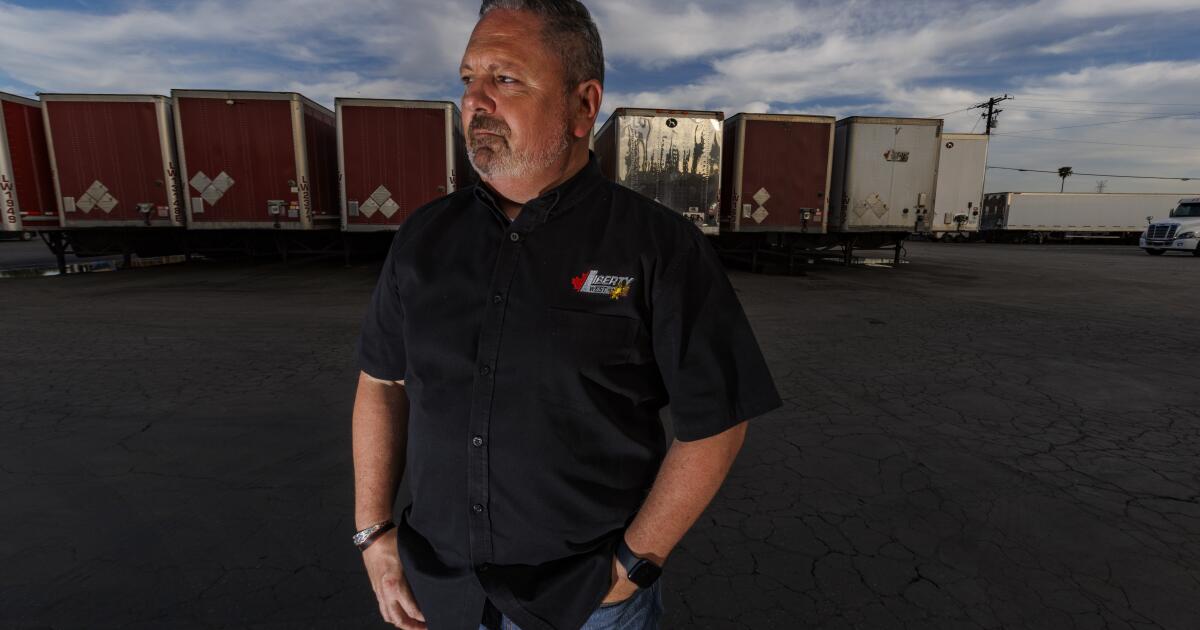
Record diesel prices are crushing California’s truckers, forcing them to adjust to avoid losses as they grapple with the most expensive pump prices in the country.
Greg Dubuque’s 40 drivers are in a constant diesel-devouring loop. Their big rigs pick up loads of electronics, office furniture and other goods around Los Angeles. They drive close to 1,000 miles through the Mojave Desert and over the Rocky Mountains to Denver. They bring back containers full of everything from pinto beans to home remodeling products.
One tank of gas for his vehicles cost $600 a couple of months ago. Today it costs $1,000. That’s a record high and more than 35% above the country’s average.
“California sets itself apart from the rest of the country when it comes to pricing,” said Dubuque, a third-generation trucker and general manager of Liberty Linehaul West. “Now it’s really out of control.”
The average price of a gallon of diesel in California got close to $7.75 this week, up 50% from a month ago, according to the American Automobile Assn. The national average of diesel is closer to $5.65 at recent peaks.
Dubuque, general manager of Liberty Linehaul West, says small truckers are hurting with out-of-control gas prices.
(Gina Ferazzi / Los Angeles Times)
The trucking industry was already reeling from a prolonged freight recession, a crackdown on immigrant drivers, and the adverse impacts of tariffs, all of which contributed to a significant increase in bankruptcy filings in the industry.
Now, the price shock from the war with Iran has become yet another headache for the beleaguered industry that hauls 70% of all freight in America.
“It’s got a tremendous impact on the industry,” said Eric Sauer, the chief executive of California Trucking Assn.
And it is not just truckers being affected. The rising prices of ground and air transportation will eventually be paid for by consumers.
The biggest companies are already passing the extra transportation costs on to consumers. FedEx, United Parcel Service, the U.S. Postal Service and Amazon said they will all start charging an extra fee. Amazon said it would apply a 3.5% charge to merchants for its fulfillment service. USPS will charge an 8% delivery fee for certain packages.
“The longer energy prices remain elevated, the more households will need to confront tradeoffs,” said Philip N. Jefferson, vice chairman of the Federal Reserve, at a recent lecture.

Liberty Linehaul West trucking company keeps a daily list of fuel prices to help its truckers on April 3 in Montebello, Calif.
(Gina Ferazzi / Los Angeles Times)
This could eventually dampen demand for other products and further hurt the economy, Jefferson noted.
“Families who depend on petroleum products to commute to jobs and school and to heat their homes may need to pull back on more discretionary forms of spending,” he said. “That could potentially result in lower spending at restaurants or retailers. It could also result in households carrying elevated levels of debt.”
Truckers often rely on fuel surcharges to cover rising fuel costs. It’s an industry practice for customers to pay a fuel surcharge, on top of the base freight rate, to offset unexpected fuel price increases. The fee is calculated based on a weekly diesel price index.
Sukhdeep Singh, who owns Merced County-based Cali Brothers Truck Lines, said standard surcharge policies are insufficient when there are wild swings in fuel prices.
“It’s killing everything,” he said.
Singh’s business faced challenges earlier this year when a crackdown on immigrant drivers led to sudden departures, shrinking the available labor pool and leaving 15 of his trucks unused. Despite the diminished fleet, his weekly fuel expenses have surged from $80,000 to $130,000.
Smaller trucking companies are getting hit first.
Major carriers with thousands of trucks have different ways to hedge against price fluctuations that insulate them from temporary volatility. They have long-term shipping contracts and have greater flexibility in surcharges.
Smaller carriers are often paid at a flat rate and have no certainty about whether they will recover the higher fuel costs.
On a recent trip to Denver, one of Dubuque’s trucks had to consider returning empty, as the going rate barely covered gas to get back to Los Angeles.
“I wouldn’t be able to cover my cost,” he said.
He has been instructing drivers to save on fuel by planning their routes, finding truck stops with the best rates, and avoiding California when possible.
“Where we’re trying to avoid buying fuel is here in the state of California,” he said.
He is also asking his regular customers to pitch in.

A Roadies Inc. truck, right, leaves for a delivery in Bakersfield on Nov. 29.
(Myung J. Chun / Los Angeles Times)
Liberty Linhaul West’s fleet also works with L.A.’s entertainment and event industries, transporting staging, lighting and other equipment for events such as the Oscars, Grammys and Country Music Awards. He’s started calling customers with whom he had flat rates to renegotiate prices.
“We started calling customers, saying, ‘Okay, we need some emergency help here,’” Dubuque said.
While he appreciates that the extra fees and restrictions on fuel help build roads and protect the environment in California, he would love to see more support from the state.
“I think the government needs to interact with the oil and fuel world and talk about how they can take this pain away from us, or at least try to lessen this blow,” he said.
Without an end to high oil prices or some help from the government, customers can expect the same sticker shock the trucking industry is struggling with.
“Whether you’re a grocer, a meatpacking plant, a vegetable grower, that cost has to be factored in, because it doesn’t matter who you are, you’re faced with it,” Dubuque said. “The impact was so hard and so fast, I would think we’re going to start seeing just another increase to the cost of goods for people.”

Cruise companies to Alaska are avoiding a popular excursion to Tracy Arm after a massive landslide

Arizona Lottery Powerball, The Pick results for April 11, 2026

Alabama Suffers 15-5 Loss to No. 22 Arkansas After Allowing 11 Runs in Final Three Innings – Tuscaloosa Today

California Republicans face off for party’s endorsement ahead of spring primary

Deion Sanders says he’s in good health during Colorado’s spring game

Florida High School Football Rankings: Top 25 teams – Oct. 21

How old is Bo Nix? What to know about Oregon quarterback ahead of 2024 NFL Draft

Cleary's 21 help Le Moyne down Central Connecticut State 69-64 in OT

99th annual Pony Swim held in Virginia

Indiana Members Credit Union announced as new anchor tenant at Bottleworks District

Video: Police Fatally Shoot Man After Stabbings at Grand Central Subway Station

Trump blasts Spanberger ahead of Virginia meetings, says state faces tax base exodus like New York, California

Pope Leo urges world leaders to reject war and negotiate peace

Manhattan DA’s office to investigate Swalwell sexual assault allegation

NASA’s Artemis II mission in 20 minutes
-

 Atlanta, GA1 week ago
1 teenage girl killed, another injured in shooting at Piedmont Park, police say
-

 Movie Reviews1 week ago
Vaazha 2 first half review: Hashir anchors a lively, chaos-filled teen tale
-

 Georgia5 days ago
Georgia House Special Runoff Election 2026 Live Results
-

 Pennsylvania5 days ago
Parents charged after toddler injured by wolf at Pennsylvania zoo
-

 Arkansas2 days ago
Arkansas TV meteorologist Melinda Mayo retires after nearly four decades on air
-
 Milwaukee, WI6 days ago
Potawatomi Casino Hotel evacuated after fire breaks out in rooftop HVAC system
-
 Entertainment1 week ago
Inside Ye’s first comeback show at SoFi Stadium
-

 Indianapolis, IN1 week ago
Fighting Illini begin Final Four preparations in Indianapolis