Business
After years of rapid growth, California's almond industry struggles amid low prices

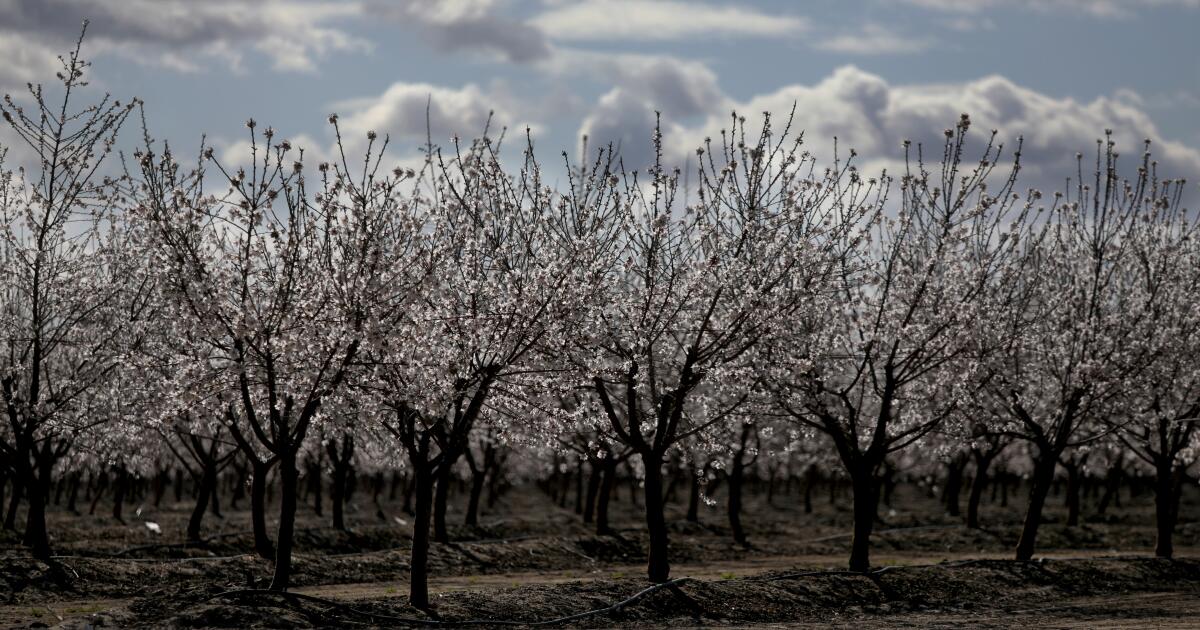
For much of the last decade, almonds have been such a lucrative crop that growers and investment firms have poured money into planting new orchards across vast stretches of California farmland.
Now, the almond boom has fizzled and the industry has entered a slump. Prices have dropped over the last several years, and the state’s total almond acreage has started to decrease as growers have begun to tear out orchards and plant other crops.
Aggressive and impactful reporting on climate change, the environment, health and science.
In a sign of the troubles besetting the industry, one large almond-growing conglomerate has declared bankruptcy.
In a series of Chapter 11 filings in federal bankruptcy court, Trinitas Farming and other affiliated companies said that record-low almond prices and high interest rates contributed to their “serious liquidity constraints.”
The group of companies said in a court document filed Feb. 19 that they own 7,856 acres of almond orchards in five counties, including Solano, Contra Costa, San Joaquin, Fresno and Tulare. As part of the bankruptcy proceedings, these orchards are expected to be put up for sale.
“When the price is low, now we start seeing the results of it. And certainly the fear is that Trinitas is the tip of the iceberg,” said Jake Wenger, general manager of the Salida Hulling Assn., which runs an almond-hulling plant in Modesto.
Prices for premium almonds have dropped from nearly $4 a pound a decade ago to about $2 a pound or less, Wenger said. Though the low prices are affecting all growers, those that are being hit especially hard are the many investor groups that bought land when prices were high and now have large debts, he said.
“The question becomes, do some of these banks call on some of these loans? And that’s really going to be a concern for a lot of people in the industry,” Wenger said. “Nobody got more indebted to the banks than a lot of these investor groups.”
A highway in Buttonwillow, Calif., bisects Kern County growing fields, with a large almond orchard on the left.
(Brian van der Brug / Los Angeles Times)
The group that filed for bankruptcy includes Trinitas Advantaged Agriculture Partners IV, LP, an investment fund that was formed and managed by Redwood City-based Trinitas Partners, a private equity investment company. It also includes the investment fund’s subsidiary Trinitas Farming, based in Oakdale, and 17 other subsidiaries.
The group’s lawyers said in court documents that the investment fund was organized by Trinitas Partners in 2015 to develop and operate almond farms in the Central Valley. It said the companies were ”well-positioned to become profitable ventures” but that they were ultimately “unable to raise necessary capital” through investments or from potential sales of assets. The entities’ reported debts total approximately $180 million.
Trinitas Partners itself was not among the companies that filed for bankruptcy. Representatives of the companies did not respond to requests for comments about the matter.
“I really firmly believe they’re not going to be the only ones facing financial struggles,” Wenger said.
The low prices appear to be making it difficult for some investments to pencil out. Wenger and others in the almond business have noticed some orchards abandoned in parts of the Central Valley over the last year, with rows of unkempt trees now filled with weeds.
“We’re already seeing people walk away,” Wenger said.
He said he believes almond prices will eventually rebound, but it’s not clear when that turnaround might come.
“I certainly don’t think we’ve seen the worst of it yet,” Wenger said.
While various factors have contributed to the situation, Wenger and others say some of the issues weighing on prices include an oversupply of almonds after years of rapid growth.
A grower examines a cluster of almonds in a Manteca, Calif., orchard in June 2022.
(Paul Kuroda / For The Times)
California produces about 80% of the world’s supply of almonds. And according to federal data, the state’s harvested almond orchards skyrocketed from 760,000 acres in 2011 to more than 1.3 million acres in 2022.
In the last two years, though, annual mapping of orchards has shown that California’s total almond acreage has started to decline.
Over the last decade, the almond boom coincided with growing concerns about water in California. When growers and investment companies bought land and drilled wells to pump groundwater in the Central Valley, the expanding nut orchards locked in long-term water demands and added to the strains on the state’s declining aquifers.
Wenger said he thinks it’s possible that if some of these orchards come out of production, groundwater levels could rise in places.
“It depends on what cropping patterns come in, and what happens next,” he said. “But it does have a potential that we could see benefits to groundwater.”
Critics who have questioned the amount of water dedicated to growing almonds include Bill Maher, who recently drew laughs on his show when he urged Gov. Gavin Newsom to “take on Big Almond.”
The environmental group Food and Water Watch has also urged the state to limit the expansion of almond orchards and other water-intensive crops such as alfalfa. Chirag Bhakta, the group’s California director, said the expansion of almonds has “locked us into a situation where we’re growing way too many of these thirsty tree nuts in parts of California,” adding to the problems of overpumping of groundwater.
Bhakta said it’s hard to know if the bankruptcy case points to more trouble ahead in the industry. But he said it represents an “opportunity for us to shift what’s been grown on that land to actually reflect what’s best for California” and the state’s water needs.
Representatives of the almond industry have defended the crop’s water use, pointing to agricultural statistics showing almonds cover 21% of irrigated agricultural land in California but account for 14% of agricultural water use. They have also noted that in addition to the nuts, almond hulls are used for cattle feed.
In the coming years, California’s agriculture industry will face water limits under the requirements of the state’s 2014 Sustainable Groundwater Management Act. The law requires local agencies in many areas to develop plans to curb overpumping by 2040.
Researchers with the Public Policy Institute of California have estimated that addressing the groundwater deficit in the San Joaquin Valley will probably require taking at least half a million acres of farmland out of production, and they’ve called for expanding efforts to help convert farmland to other uses, such as solar development or habitat areas.
Aside from water constraints, the almond industry has faced other challenges, including tariffs in China and other countries, as well as shipping bottlenecks during the COVID-19 pandemic.
“There has just been a glut in the almond market for a couple of years now,” said Caity Peterson, associate director of the Public Policy Institute of California’s Water Policy Center.
“It’s possible that we have hit peak almond,” Peterson said. “The industry will probably right-size itself to where the supply better meets the demand and it’s not oversupply, like we’ve got right now.”
Some experts say the almond industry is likely to bounce back. Analysts with Rabobank wrote in an analysis this month that “a strong rebound in almond prices is expected over the next 12 to 18 months.”
International markets have a big influence. According to the most recent crop data for the 12 months that ended in July 2023, 72% of the state’s almonds were exported, while 28% were sold domestically.
California’s total almond acreage has gone down the last two years mostly because of decreases in new plantings, said Rick Kushman, a spokesperson for the Almond Board of California.
“Orchards last about 25 years, then growers replant, if they decide to. It’s possible that financing has been harder to get and it is surely more expensive right now,” Kushman said in an email. “Shipments have been strong in recent months, but we are a long way from seeing if that will affect planting decisions.”
There are roughly 7,600 almond farms in the state, and about 70% of the state’s orchards are under 100 acres, according to the Almond Board of California.
Wenger said those who are better suited to weather this sort of downturn are family-run businesses that own their land debt-free.
Almond growers aren’t the only ones in agriculture who have been dealing with tough economic conditions.
“Walnut prices are terrible. Grape prices are terrible,” Wenger said. “Pistachios are not doing great. So we have all these crops that are starting to suffer.”
The fall of the Trinitas almond business follows the recent news that the large fruit grower Prima Wawona also filed for bankruptcy.
Some growers in the San Joaquin Valley have chosen to replace almond trees with pistachio orchards.
Blossoms fill an almond tree branch in an orchard near Sanger. California produces about 80% of the world’s supply of almonds.
(Gary Coronado / Los Angeles Times)
Still, most of California’s almond orchards remain, and almond trees have been blooming with white and pink flowers in the Central Valley.
“Agriculture in general is seeing some very difficult times,” said Bill Lyons, a farmer in Stanislaus County who once served as state agriculture secretary under Gov. Gray Davis.
On his family’s century-old ranch, they have a cattle operation and grow a wide variety of crops.
“We’ve been in the almond business for over 25 years, and we’re seeing unprecedented low prices for multiple years, and very high expenses,” Lyons said. “And when you combine the two, it’s extremely difficult for any almond farmer to make a profitable living.”
He said where some landowners have abandoned their trees, it’s a problem for neighboring growers because the untended orchards can harbor pests — such as navel orangeworm — that can spread to nearby orchards.
Lyons said his family plans to keep growing almonds.
“Hopefully, the almond price will gain momentum,” Lyons said. “I have confidence in the almond industry, but it’s definitely going to be a serious bump in the road as we travel through to next year or so.”
Times staff writer Kevin Rector contributed to this report.


Sony Pictures will invest $100 million and take a minority stake in virtual reality venue operator Cosm, as the studio continues to build a business in communal experiences.
As part of the investment, Sony Pictures Chief Executive Ravi Ahuja will also join Cosm’s board of directors, the studio said Wednesday. The size of Sony’s minority stake was not disclosed.
The El Segundo-based Cosm currently operates three venues — one at Hollywood Park in Inglewood, and the others in Dallas and Atlanta. The company plans to open additional venues in Detroit and Cleveland.
Cosm bills itself as a “shared reality venue,” and its facilities center around a massive, wraparound screen that is intended to envelop viewers with additional digital effects. The company has largely focused on sports, though it has also shown Cirque du Soleil shows and done several collaborations with Warner Bros., including recent screenings of 2001’s “Harry Potter and the Sorcerer’s Stone” in honor of the film’s 25th anniversary.
“Cosm sits at the intersection of several trends shaping the future of entertainment,” Ahuja said in a statement. “We’ve followed Cosm since before launch and have been impressed with the quality of the experience and the enthusiasm it’s generating with audiences.”
The investment is Sony’s latest venture into experiential entertainment. In 2024, the Culver City-based studio acquired dine-in theater chain Alamo Drafthouse Cinema.

The Los Angeles City Council on Tuesday unanimously advanced an ordinance to halt new oil and gas drilling and phase out all existing production over the next 20 years. L.A. is home to more than 2,000 active oil wells.
The measure revives a similar ban passed in 2022, which was struck down by a judge following legal challenges from the oil and gas industry.
It must pass a second vote before final adoption later this summer, and would make L.A. the largest city in the United States to phase out existing oil wells.
“Today, Los Angeles is making a decision that aligns with our need to turn the page on urban oil drilling,” Councilmember Katy Yaroslavsky said during Tuesday’s council meeting. “The absence of an enforceable oil ordinance has had real consequences for our communities.”
The ban in 2022 was seen as a historic move for a region built on the petroleum industry.
But in 2024, a Los Angeles County Superior Court judge invalidated the law, ruling that the state, not the city, has jurisdiction over petroleum production. The legal challenge was brought by oil companies including Warren Resources, which operates a large oil field in Wilmington. Much of the field is beneath the city of Long Beach, but it also extends under Los Angeles.
Shortly after that, state legislators advanced Assembly Bill 3233, which reaffirmed city and county authority to regulate oil and gas activity. It was largely seen as the missing piece that made the original ordinance vulnerable.
“It’s now unequivocal that cities have the authority to regulate, limit and prohibit oil and gas operations within our jurisdiction,” Yaroslavsky said.
The new ordinance, written by the Department of City Planning, prohibits new oil and gas extraction, including drilling, redrilling or deepening existing oil wells for the purposes of production. It also designates all existing and active idle wells as “nonconforming uses,” meaning they may only operate during the phaseout period and are no longer compliant with current zoning.
Warren Resources, which led the lawsuit against the previous ban, did not immediately respond to a request for comment. The company previously argued that the 2022 ban was rushed and would lead to more oil imports to the area, causing increased emissions from tankers and trucks and other environmental consequences.
Many wells in the city operate near schools, homes and parks. Most are concentrated in low-income areas and communities of color, such as Wilmington and the harbor district, West L.A. and South L.A., where residents have long reported respiratory issues, headaches, throat irritation and other health problems. Studies have found oil wells can emit carcinogens and are linked to adverse health effects.
“This ordinance is such an important step toward giving every frontline community in Los Angeles access to clean air,” Silvia Esparza, a South L.A. resident and member of environmental justice group Stand-L.A., said in a news conference ahead of Tuesday’s vote.
Ashley Hernandez, a Wilmington resident and organizer with the nonprofit Communities for a Better Environment, said bloody noses and noxious fumes were a regular part of life in the neighborhood growing up.
She noted that in addition to oil drilling, L.A. residents continue to face other environmental hazards, such as the recent oil pipeline rupture that sent crude into the L.A. River or the ongoing cold storage warehouse fire in Boyle Heights that is spewing toxic smoke.
“I’m here to remind L.A. city and these toxic neighbors that Wilmington residents are more important than any ‘black gold’ under their homes,” Hernandez said. “We need our city to protect our families now and to stop the oil industry’s reign of power in our city. A passage of the oil phaseout ordinance today gives the city a chance to correct this wrong.”
Times staff writer Dakota Smith contributed to this report.

Shares in Elon Musk’s rocket company SpaceX halted their three-day slide that had erased roughly $600 billion off its market value.
SpaceX shares closed at $156.11 with a nearly 1% gain on Tuesday, a slight recovery from a 16% fall on Monday.
That loss dropped the stock below $160.95, where it ended the day June 12 after a 19% surge during its record initial public offering. The IPO gave it a market cap of $2.2 trillion, making SpaceX one of the world’s most valuable public companies.
It also turned Musk into the world’s first trillionaire, a status he retains despite the sell-off.
The downturn probably reflects investor unease over the company’s spending plans and potential debt load, analysts say.
SpaceX raised a total of $86 billion after underwriters exercised their right to sell additional shares, on top of the $75 billion initially raised. It was the largest IPO in history.
A little more than half a billion shares were distributed to institutional and retail investors at a price of $135, with the stock opening at $150 as some holders immediately flipped shares for a profit.
Shares rose as high as $176.52 during the IPO before settling at the $160.95 price. In the weeks since, shares reached a high of $225.64, meaning that some investors lost money or are underwater with paper losses.
Since the IPO, SpaceX has dropped some big bucks.
It announced last week that it was acquiring AI coding startup Cursor for $60 billion in a deal expected to close in the third quarter. The San Francisco company, founded in 2022, enables engineers to instruct software in English to run coding tasks autonomously.
It also sold $25 billion in bonds on Tuesday , unusual for a company that just went public, much less for one that just raised a record sum.
The IPO surpassed the 2019 offering by Saudi Aramco, Saudi Arabia’s state-owned oil giant, which raised $29.4 billion, the prior record holder.
S&P Global issued a report last week that assigned SpaceX a “BBB” credit rating, the lowest possible rating to qualify as an investment grade credit risk. It noted the company will have “elevated capital expenditure” through 2029.
SpaceX rivals OpenAi and Anthropic filed this month for initial public offerings that, while not expected to be as large as Musk’s company, will be large in their own right.
Wedbush analyst Dan Ives, who has been bullish on SpaceX stock, said the market is digesting “massive debt and equity raises from Big Tech players” in the coming years.
“This is part of an industry wave of debt offerings on Wall Street, like Alphabet and SpaceX among others,” he wrote in an email.
With the stock already giving up gains since the IPO, it will be further tested when tranches of locked-up shares held by current and former employees are released.
At least 20% of the shares will be released after second-quarter results are disclosed sometime in the coming months, with all the lockups expiring in December.
SpaceX, based in Texas, is the leading launch services company in the world, with its Falcon 9 rocket accounting last year for the vast majority of satellites sent into space.
It is also the leading satellite-based broadband provider with its Starlink service. But the extraordinary interest in the IPO was driven by Musk’s plans to make the company an AI leader — including plans to launch orbiting satellite data centers powered by the sun that crunch AI data.
He merged his xAI artificial intelligence company into SpaceX this year, with the combined entity recently announcing it was leasing computer power to rivals Anthropic and Google at two terrestrial data centers it has constructed.
Musk moved the company’s headquarters from Hawthorne to Texas in 2024, but it retains large operations in the South Bay city and blasts off regularly from Vandenberg Space Force Base in Santa Barbara County.
Investment research firm Morningstar placed a $780-billion valuation on SpaceX, focusing on its core rocket and Starlink broadband satellite businesses. It suggested investors wait a few months for the stock to settle before buying in.
“I think the day-to-day stock price movements are usually based on market sentiment,” said report co-author Nicolas Owens, an equity analyst at Morningstar. “So I was not surprised when it went way up right after the IPO — and I’m not surprised it [came down]. Not much has really changed in the fundamentals.”
Mike Alves, founder of Pasadena’s Vida Vision Fund, has a stake in SpaceX that accounts for 46% of his AI and robotics fund.
He said he was not perturbed by the stock drop, noting that Facebook fell under $18 a share just months after its May 2012 IPO closed at $38 a share. It has since risen more than 1,000% above its offering price.
“The volatility doesn’t really matter because you’re going to multiply your best investment many times, so I’m not so worried about it,” he said, adding that investors seeking shares could now “scoop them up at a good deal.”
-

 Washington, D.C19 seconds ago
Trump kicks off America’s 250th celebration with campaign-style rally
-

 Cleveland, OH7 minutes ago
2 people killed in multi-vehicle crash on SR-176 crash in Cleveland
-

 Austin, TX10 minutes ago
Texas insurance costs surge 79% in six years as lawmakers question AI impact on rates
-

 Alabama15 minutes ago
Two Alabama laws target Mobile blight by speeding sales and giving neighbors first bid
-
 Alaska17 minutes ago
Crews continue making progress on Delta Fires
-

 Arizona22 minutes ago
Arizona State parts ways with head track and field coach Dion Miller
-

 Arkansas25 minutes ago
Arkansas basketball stars Meleek Thomas, Trevon Brazile selected in NBA Draft second round | Whole Hog Sports
-

 California30 minutes ago
First look: Space Shuttle Endeavour in ready-to-launch position at California Science Center

