Business
A comeback for California manufacturing? Trump 2.0 raises hopes — and some worries

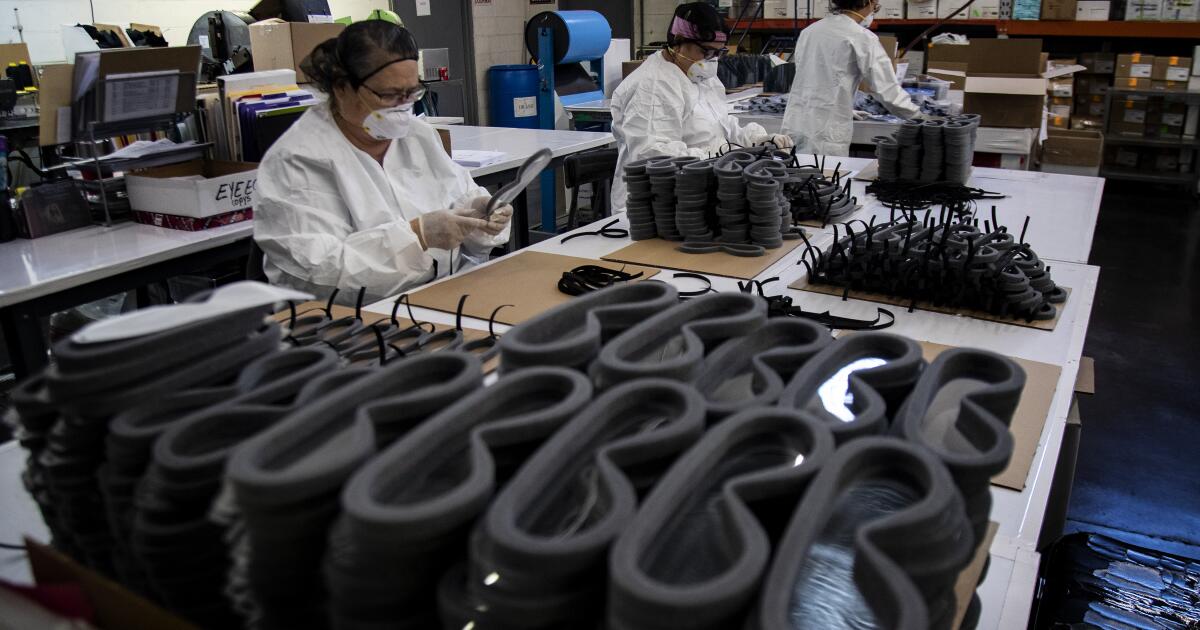
WASHINGTON — Miriam Mesina de Gutierrez was 19 years old when she got hired at Paulson Manufacturing in Temecula. It was the summer of 2001 and the job was only part time: on an assembly line, applying an anti-fog, anti-scratch coating to face shields for workers in other industries.
Never in her wildest dreams could she have imagined where that $6.75-an-hour job would lead. In 2009, Mesina de Gutierrez became Paulson’s human resources manager. Two years later, she moved to international sales. Two more years and she was promoted to vice president of operations.
Then, last fall, Mesina de Gutierrez went all the way to the top: president of the 200-employee company that had been headed by a member of the Paulson family for 75 years.
“Oh, it was a big deal,” said the 42-year-old, who came to California as a middle schooler from her native Colina, Mexico. And to Roy Paulson, 66, the company’s longtime president who sold the business last year and stepped down to be its technical director, Mesina’s elevation spoke volumes about manufacturing’s unique value:
“It offers job opportunities at every level in society, and for people to rise up in the organization,” he said.
American manufacturing had its heyday in the 1950s when workers making things accounted for more than 30% of all employees. But despite Mesina de Gutierrez’s meteoric success story, the landscape is vastly different today. Beginning decades ago, corporations found cheaper places to produce around the world, China turned into an exporting giant, and machines took over hundreds of thousands of well-paid human jobs.
Today, manufacturing’s share of all U.S. payrolls is just 8%. In California, it’s only 7%, though the Golden State is still home to 1.3 million factory workers — the most in the nation — who make products as diverse as computer chips and tortillas, blockbuster drugs and ordinary nuts and bolts, electric vehicles and toy cars.
Now, President-elect Donald Trump has vowed that his return to the White House will bring about a resurgence of blue-collar work across the country. As in his first term, Trump has promised to gear his “America first” policies to spur domestic production and jobs, whether by changing foreign trade rules, imposing tariffs, cutting taxes and government regulations, or all of the above.
“If we want to return to higher levels of growth and innovation, more broadly distributed prosperity, higher wages, so forth, we’re going to have to get that right,” said Oren Cass, founder and chief economist of the right-leaning think tank American Compass, referring to efforts to reindustrialize the U.S. economy.
Exactly what Trump does, and whether it succeeds, will probably have dramatic consequences for the nation’s economy, its politics, its workers and almost everyone else in the country.
Although most economists don’t see domestic manufacturing as likely to prove a major source of new jobs, it still provides among the best opportunities for people without college degrees.
Manufacturing, on average, offers more hours of work and better wages and benefits than private-sector jobs overall, although the pay premium isn’t as big as it used to be. In California, the average earnings for all manufacturing workers was $42 an hour in October, about 5% more than for employees overall.
Expanding the “Made in USA” economy would be especially important for Trump and other Republicans, who have sought with some success to rebrand themselves as the party of the middle class and working people.
“Democrats have been terribly out of step culturally with the working class,” said Harry Holzer, a Georgetown University public policy professor and chief economist in President Clinton’s Labor Department. “They have got to let go of these crazy identity politics and go back to practical issues like creating good jobs and building more houses.”
That realization may be one factor in Gov. Gavin Newsom’s announcement this week of a blueprint for creating better job opportunities for Californians without a college degree.
“Since the election, both the governor and the Democratic state legislative leadership have talked mainly of a new commitment to blue-collar California,” said Michael Bernick, an employment attorney in San Francisco and former director of California’s Employment Development Department.
California’s blue-collar woes and hopes
Over the last half-century, California’s manufacturing employment has fallen more sharply than in the nation as a whole. The end of the Cold War erased more than half of the state’s 200,000-plus aerospace jobs in the 1990s. The next decade saw a similarly steep decline in electronics manufacturing, as China and other Asian countries moved up the value chain.
On the lower end of skills and pay, apparel employment shriveled as Southern California garment makers focused on fashion and small quantities, eliminating tens of thousands of manual labor jobs. California’s furniture industry followed a similar path.
Manufacturing employment overall has been more stable since the end of the Great Recession in 2009, although the last year has seen further cuts,because of layoffs at corporations such as Boeing, Intel and Tesla.
Today, computer-related and electronics producers, including semiconductors and navigational equipment, make up the state’s largest manufacturing sector, employing about 285,000 people. That’s followed by food manufacturing, with 175,000 jobs; and fabricated metal companies, which employ some 120,000 workers who forge, stamp and make products such as cutlery, hand tools, boilers and springs.
All told, more than 30,000 manufacturers operate in the state, mostly small firms, many of them family-owned, according to the California Manufacturers & Technology Assn. The larger ones have business offices in California but tend to manufacture elsewhere, including in low-cost, less-regulated states such as Texas and Arizona.
MGA Entertainment, the Chatsworth-based maker of Bratz dolls and Little Tikes toys, sources mainly from China. In recent years it’s moved some production to Vietnam and elsewhere. And it closed its Mexico operations because of infrastructure issues, said Isaac Larian, MGA’s billionaire founder and chief executive.
The company has one U.S. manufacturing plant in Hudson, Ohio, with about 700 employees. With automation, Larian said, MGA has cut the production cost difference in Ohio from China 8% to 10%. “But even with that,” he said, “we’re having difficulties. We don’t get the skilled labor. They work for two to three months” and leave.
Larian is hopeful that the incoming Trump administration will be good for business. He said Trump generally was in his first term. Lowering taxes again will help, Larian said, as they did after Trump’s 2017 big tax cuts. His biggest concern is what will happen if Trump follows through on his proposal to slap 10% to 20% tariffs on all imports and raise the levy on Chinese goods to 60%, from 10% to 25% that Trump imposed in his first term. Those tariffs were kept in place by President Biden.
(Trump last month threatened 25% tariffs on Canada and Mexico, and an additional 10% on imports from China, saying he wanted them to curb the inflow of drugs and migrants.)
Toy makers and importers such as MGA were exempt from Trump’s first-term tariffs. “I believe common sense will apply,” Larian said. If not, he said, he would have no choice but to pass on the higher costs to consumers. Annual sales at Larian’s company, which he founded in 1979, have reached $2.5 billion.
Economist Jerry Nickelsburg, director of UCLA’s Anderson Forecast, also is generally bullish on manufacturing, noting that “California has a deep pool of technical talent.”
Paulson’s new boss, Mesina de Gutierrez, is optimistic too. Though trade friction would probably crimp the company’s exports, she wouldn’t talk about what may come down the pike. Instead, she said: “My team is strong.”
Paulson has benefited from multiple patents and its occasional research and development partnership with UC Riverside and other universities. Skilled workers have sustained burgeoning industries such as space exploration, advanced chips and electric vehicles despite recent slumps in tech and aircraft manufacturing and a flight of some businesses, including the headquarters of Elon Musk’s Tesla and SpaceX.
Northrop, Raytheon, Boeing, Lockheed, Tesla and SpaceX have thousands of employees in the state.
What will Trump do?
In his first term, Trump pressured individual manufacturers planning to move production out of the U.S., ultimately with little success. And he often threatened countries with tariffs, sometimes as a bargaining chip, though the tactic often upset financial markets and created uncertainty about what might happen next.
Trump’s tariffs on China prompted many businesses, including Chinese-owned ones, to shift production elsewhere, and the overall U.S. trade deficit didn’t shrink. Trump targeted steel and aluminum imports, which gave a small boost to the domestic metal industry but hurt other American manufacturers, including makers of beer, bicycles and other goods; they ended up paying more for raw materials.
This time will be different, say Trump’s current and former advisors. They say policy won’t be so chaotic as key members of the incoming administration are more aligned and have a more skeptical view of corporate power. Trump backers say they expect him to do what he said in imposing universal tariffs and increasing taxes on China to thwart transshipments of Chinese goods to the U.S. and spur manufacturers to open plants and create jobs on American soil.
Most economists, however, say across-the-board tariffs of 10% to 20% will almost certainly prompt reciprocal measures by other countries, resulting in slower trade and economic activity and higher prices for businesses and consumers.
“The disruptive force of a tariff is much greater today than even in the early 1930s,” said Douglas Irwin, an economics professor and trade historian at Dartmouth College, noting how much bigger and more connected trade and supply chains are today. Broad-based tariffs on imports deepened the Great Depression.
“If we’re trying to reshore manufacturing, tariffs are very blunt and they raise costs for other industries,” he said. “And you have to think about other policies that won’t adversely affect exports to help out manufacturing.”
Whatever Trump does, he will be starting out with a strong American economy and may get a good jobs boost as new semiconductor factories, electric vehicle and parts plants and other green energy projects come online, thanks to the Inflation Reduction Act and the CHIPS and Science Act enacted during the Biden administration. Intel, for example, is getting billions to help pay for a pair of new leading-edge chip factories in Ohio and other projects.
Such government subsidies will help, but it’ll take a lot more to reinvigorate manufacturing, such as cutting red tape and supporting skills training for workers, especially at the state and local level.
“What we know from our and others’ research is that manufacturing is most likely to get a boost from customized assistance to workers and firms rather than large-scale, blunt federal policies,” said Brad Hershbein, a senior economist at the Upjohn Institute for Employment Research in Kalamazoo, Mich.
Hershbein isn’t counting on a resurgence of manufacturing jobs.
“Manufacturing is important for the American consciousness, more so than it may be for the American economy,” he said. “I think a lot of people had in mind that for a large number of people, it was an accessible job [that] you didn’t need that much education or training for that paid relatively well. And there aren’t that many jobs like that available today. People yearn for that.”


The luxury shopping center in Pacific Palisades will reopen next month after more than $100 million in renovations forced by the January 2025 wildfire that devastated the Los Angeles neighborhood.
Palisades Village will reopen Aug. 15, owner Rick Caruso announced Wednesday. The outdoor center survived the blaze that destroyed homes and other businesses but needed refurbishment to eliminate contaminants that the fire could have spread.
Crews are putting finishing touches on mall buildings after tearing them down to the studs, treating the wood and rebuilding the walls, Caruso said.
“Everybody’s working, and stores are moving their products in,” he said. “It’s a really cool feeling that people have really locked arms and are working together.”
An electrician installs lighting for a restaurant at Rick Caruso’s Palisades Village on Thursday. The shopping center is scheduled to reopen mid-August.
(Myung J. Chun / Los Angeles Times)
Pacific Palisades resident Allison Polhill, who is rebuilding the home of 30 years that her family lost in the blaze, said she is “thrilled” at the prospect of returning to the mall she used to frequent. Its comeback is a boost for the community, she said.
“Every single step that we make to reopen our commercial corridors is going to bring more people back into the Palisades,” said Polhill, who expects to move back into her home at the end of August.
A total of 6,822 structures were destroyed in the Palisades fire, including more than 5,500 residences and 100 commercial businesses, according to the California Department of Forestry and Fire Protection.
Caruso previously attributed the mall’s survival to the hard work of private firefighters and the fire-resistant materials used in the mall’s construction.
The $200-million shopping and dining center opened in 2018 with a movie theater and a roster of upmarket tenants, including Erewhon, which may be the only grocer in the heart of the fire-ravaged neighborhood when it opens.
Caruso’s company was able to fill the mall with tenants despite the long shutdown.
Palisades Village is 99% leased, with the majority of tenants returning, said Jackie Levy, chief financial and revenue officer. Nearly one-third of the shops and restaurants are new to the property.
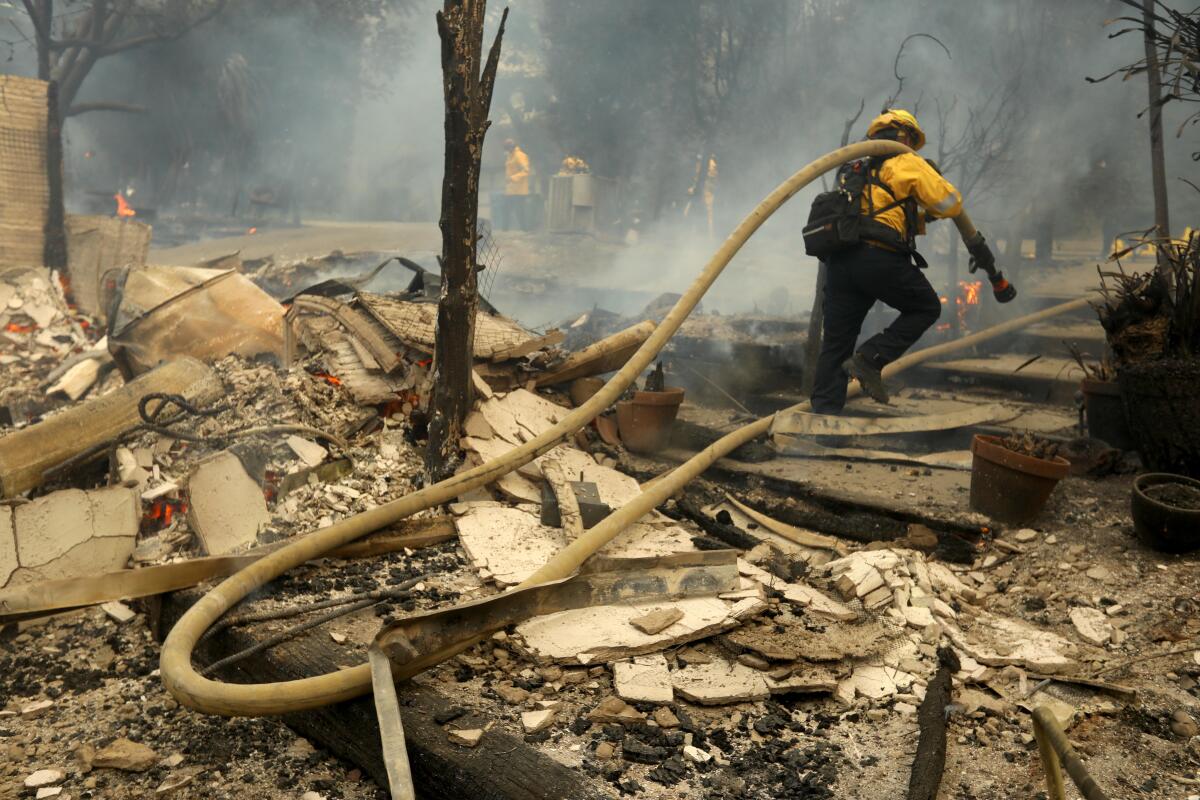
A firefighter carries a hose back to his rig while walking through a destroyed home from the Palisades fire in Pacific Palisades on Jan. 7, 2025.
(Genaro Molina / Los Angeles Times)
Last year, Pacific Palisades-based fashion designer Elyse Walker said she would reopen her eponymous store in Palisades Village after losing her 25-year flagship location on Antioch Street to the inferno.
Other neighborhood shops destroyed in the fire that are reopening at the mall include K Bakery and Loomey’s Toys, which caters to children up to age 12 and used to be across the street from Palisades Elementary Charter School.
“It’s been a journey and I’m excited because I wasn’t sure that there was going to be a place to come back to,” said toy store owner Amanda Rastegar. “Hopefully we can bring some of that magic back.”
Rastegar’s home in the Palisades survived but was damaged by the fire. The family returned about eight weeks ago. Her last memory of the fire was a burning supermarket.
“I just couldn’t wrap my brain around what was happening,” she said. “By the time I left, Gelson’s was on fire.”
Among the returning tenants is Angelini Ristorante & Bar. Well-known Los Angeles chef Gino Angelini said he will be in the kitchen next month for a return of the Italian restaurant.
“We won’t do a big celebrity open,” he said. “We want to have a very soft opening and see our customers come back.”

Construction takes place at Rick Caruso’s Palisades Village on Thursday. The shopping center is scheduled to reopen mid-August.
(Myung J. Chun / Los Angeles Times)
An elaborate celebration would not feel “correct for me,” Angelini said, because the devastation has been “very sad” for so many.
Other new tenants include local chef Nancy Silverton, who has agreed to move in with a new Italian steakhouse called Spacca Tutto. Women’s activewear retailer LESET will open its first West Coast location.
Caruso said he is optimistic that customers will return to the center, even though many Pacific Palisades residents are still dispersed. One tracking system estimated that about 30% of the Village’s customer base was impacted by the fire, he said.
“That means 70% did not get impacted, so there’s a lot of customers still left out there,” Caruso said. Historically, the center drew customers from as far away as Beverly Hills and Calabasas, as well as Malibu, Brentwood and Santa Monica.
He also hopes many will be inspired to visit the revived mall.
“I believe in the goodness of people and I believe that people are going to want to support the Palisades,” he said. “They’re going to want to be there and support the businesses that have had the courage and the heart to reopen.”

Walmart is rapidly expanding its network of electric vehicle chargers designed for customers to use while they shop.
The network could help fill gaps in EV infrastructure in states with greater need for chargers. Walmart, which has more than 5,000 locations in the U.S. and hundreds in California, says more than 90% of Americans live within 10 miles of one of its stores.
The chargers also offer an incentive for customers to choose Walmart — Walmart Plus members will receive a 10% discount off an average price of $0.46 per kilowatt-hour of energy at the company’s chargers.
Walmart chargers are already available at more than 75 locations in 17 states, with Texas boasting the most charging stations, followed by Florida and Arizona.
Matthew Nelson, Walmart’s director of energy policy, said last week on LinkedIn that the network will soon reach 29 states, including California.
“We are delivering on the promise of affordable, reliable and convenient charging,” Nelson said in his post.
According to Walmart’s website, six charging stations are coming to California soon, though the company did not offer a specific timeline.
The chargers will be installed at stores in Antelope, Brea, Fresno, Stockton, Suisun City and Vallejo.
Most charging sites in California will include eight to 16 fast-charging stalls, said Walmart spokesperson Kelsey Bohl.
The company first announced plans in April 2023 to install its own EV chargers at Walmart and Sam’s Club stores, with a goal of installing thousands of chargers by 2030. Partnering with ABB E-Mobility and Alpitronic, it added 25 new charging sites this past May and six more in June.
“Walmart is building a leading retail-integrated EV fast-charging network, focused on delivering an affordable, reliable and convenient charging experience where customers already shop,” Bohl said in an emailed statement. “Customers can charge while they shop, access stations through the Walmart app they already use, and benefit from affordable pricing.”
The charging stations already available include 612 individual charging stalls using 400-kilowatt chargers. Each stall has a dual charging cord with both Combined Charging System and North American Charging Standard connectors. The standard connectors, designed by Tesla, are smaller and lighter than the combined systems.
The primary way to pay for the chargers is through the Walmart app, but the company is also experimenting with built-in credit card readers to allow those without the app to use the stations.
Customers can check charger availability on the Walmart app. The company said the chargers will be available 24 hours a day.

Robotaxis could be turning into robocops.
A self-driving Waymo reported two teens to San Mateo, Calif., police on Monday after they were found drinking alcohol and shooting toy guns in the back of the vehicle.
According to a social media post from the San Mateo Police Department, officers detained two 15-year-olds after the Waymo they were riding in contacted the department and stopped in a parking lot until law enforcement arrived.
“Parents do you know where your teens are?” the San Mateo Police Department wrote on Facebook following the incident. “Waymo does!”
Officers removed both teens from the vehicle and determined they were using toy guns to shoot Orbeez out the windows. Orbeez are small, water-absorbing beads sold at toy stores.
“Toy guns, water guns, and BB guns all pose real dangers, especially to an untrained eye,” the Police Department said. “The simple handling of them can cause fear in [passersby].” “
A video posted on Facebook shows at least five officers and a police dog responding to the scene and approaching the Waymo with their weapons raised.
Waymo did not immediately respond to a request for comment.
Waymo vehicles have internal cameras and microphones that may be used in an emergency or to “promote safety and security,” according to Waymo’s online support page.
The cameras are also used to ensure the vehicles are clean and to help find lost items, according to the support page.
The company said it does not use facial recognition or other biometric identification technologies to identify individuals.
“In more urgent circumstances, support may access live video during a trip,” the Waymo page said.
The San Mateo Police Department’s Facebook post has garnered nearly 60 comments, with one user accusing Waymo of “snitching.”
“At least they got a designated driver?!” one user commented.
-
 Lifestyle31 minutes ago
We unpack the 2026 Emmy nominations : Pop Culture Happy Hour
-

 Technology39 minutes ago
Get a $30 credit when you reserve Samsung’s upcoming Galaxy phones
-

 World46 minutes ago
Critics say Turkey’s verbal attacks on Israel have crossed into antisemitism
-

 Politics48 minutes ago
WATCH: Dana White drops 2028 hints while raving about his favorite Trump cabinet secretary
-

 Health54 minutes ago
Katie Couric couldn’t remember the year or the president during frightening brain episode
-

 Sports1 hour ago
Justin Verlander announces he will retire after this season: ‘I’ve realized that time has come’
-

 Technology1 hour ago
Apple AI security update proves hackers move fast
-
Business1 hour ago
Fire-damaged Pacific Palisades shopping center sets reopening date

