San Francisco, CA
The U.S. Government Secretly Tested Biological Weapons. The Citizens of San Francisco Paid the Price.


Here’s what you’ll learn when you read this story:
- During the early decades of the Cold War, the U.S. government conducted 239 open-air germ warfare tests around the country to assess to dangers of a possible chemical attack on civilian populations.
- One of the most infamous, known as Operation Sea-Spray, purposefully pumped aerosols of the bacteria Serratia marcescens and Bacillus globigii—both believed to be harmless to humans—over the San Francisco Bay Area.
- While the operation itself was a success, it’s likely that the test resulted in the death of one man and the sickening of at least 10 others.
San Francisco is known for its fog. Sitting at the intersection of warm air flowing from California’s interior and cool air moving in from the Pacific, low-lying fog and clouds are a common sight. But in 1950, from September 20 until September 27, a different kind of cloud descended on the city of some 800,000 people—a cloud that had been purposefully released by the U.S. government as a secret bioweapons test.
No, this wasn’t some dastardly plan by the government to conduct a macabre experiment on its own citizens. Rather, it was a measure intended to safeguard against other rival nations trying to poison an American city. The government selected San Francisco for its ideal dispersal conditions, tall buildings, and large population, and to pull this off safely, the government relied on the bacteria Serratia marcescens and Bacillus globigii—both believed to be harmless to humans.
“They needed something that was, first of all, thought to be harmless,” Matthew Meselson, a molecular biologist from Harvard, told KQED last year, “because they certainly didn’t want to kill everybody in San Francisco or Oakland. And [they also needed something] that could easily be detected by simple methods.”
Since the Second Battle of Ypres during World War I, when the German army killed thousands of French Algerian colonial troops by unleashing chlorine gas on April 22, 1915, followed by a second gas attack on Canadian troops two days later, nations had been grappling with the threat of unconventional weapons. With its illusion of geographic imperviousness shattered by the attack on Pearl Harbor on December 7, 1941, the United States moved to address its own vulnerabilities. In 1942, President Franklin Roosevelt authorized the creation of the first U.S. biological weapons program. Part of the mission of this program was to determine just how vulnerable U.S. cities could be to a biological attack.
In 1948, the Committee on Biological Warfare—led by University of Wisconsin bacteriologist Ida Balwin—suggested simulating chemical attacks through air, water, and infrastructure (such as subway systems) with non-harmful organisms to understand the threat under real environmental conditions. So, two years later, the stage was set for Operation Sea-Spray, and the entire operation almost went without a hitch. Almost.
Serratia marcescens is found naturally in water and soils, and it’s known to be harmless to humans. But it isn’t typically sprayed in the air in large quantities, and unfortunately, one of those bacteria-filled clouds descended on Stanford University Hospital on Clay Street in San Francisco. There, eleven patients developed inexplicable Serratia marcescens infections. In the case of a 75-year-old Irish American named Edward Nevin, who was recovering from prostate surgery, the bacteria found its way to his heart, killing him. Doctors at the hospital were so puzzled that they even published a scientific paper regarding the infections in October of the following year.
President Richard Nixon ended U.S. research into bioweapons in 1969, and a treasure trove of information about that research was declassified in the 1970s. It revealed that the U.S. had performed 239 open-air germ warfare tests around the country, including in the subway in New York City, on the Pennsylvania turnpike, and in the national airport in Washington D.C. According to KQED, Edward Nevin III—the grandson of the man who died during the faux attack—read these reports and decided to sue the U.S. government, even though he accurately foresaw that he’d eventually lose.
“But we still had to tell the story,” he told KQED. “To have a citizen submitted to that kind of risk is awful.”
Darren lives in Portland, has a cat, and writes/edits about sci-fi and how our world works. You can find his previous stuff at Gizmodo and Paste if you look hard enough.



San Francisco, CA
San Francisco Resident’s Tour of Surveillance Infrastructure Shows System ‘Greater Than Sum of Its Parts’ | KQED

Independent writer Larry Kubin toured the city to find a wide network of surveillance.
In an aerial view, an automated license plate reader is seen mounted on a pole on June 13, 2024, in San Francisco, California. Independent writer Larry Kubin of The Fogline toured the city to find a wide network of surveillance, including Flock Safety cameras. (Justin Sullivan/Getty Images)
He found around 700 San Francisco Police Department drone flights in February alone, a rundown of city-owned tech, separate private cameras and a push for even more surveillance.
Among the tech are around 400 Flock Safety automated license plate readers used by SFPD. Police Chief Derrick Lew said this week that out-of-state and federal law enforcement agencies had “improperly” accessed the data, after the Northern California Regional Intelligence Center queried the system hundreds of times.
The incident prompted SFPD to stop sharing Flock data with NCRIC and another agency, the Western States Information Network.

It wasn’t the first of the city’s problems with Flock. In 2025, an investigation by The San Francisco Standard revealed that SFPD had allowed out-of-state agencies to search its system 1.6 million times, a possible violation of state law. Some SFPD personnel also appeared to make searches on behalf of federal agencies.
The Bay Area cities of Santa Cruz, Mountain View, El Cerrito and the town of Los Altos Hills have canceled Flock contracts over worries of improper data sharing, all of which learned their own data had been searched in similar ways. Santa Clara County also iced the company out, and Berkeley council members last month approved a contract extension but not an expansion.
Flock’s attention in the media, plus a 2019 look at Seattle’s surveillance infrastructure, was part of Kubin’s inspiration for the tour.

“I wanted to look more into that because my initial reaction was, like, ‘Oh, reading a license plate, that’s not so bad,’” Kubin said. But then he started spotting cameras in “postcard views” of the city and places where people chill. He said it feels like a much different world than when he was growing up.
“We shouldn’t have to need this much technology. We shouldn’t need a police surveillance technology inventory that’s continuing to expand,” Kubin added.
For that, he in part blames the city’s voter-approved Proposition E. The 2024 ballot measure allows SFPD to roll out new surveillance technology for a full year without an official policy.
“I’m just picturing where we are now and whether it can become like a sci-fi TV show, right? They’re not doing this now, but you can see with these new powers of things like Proposition E,” Kubin said. “The checks and balances are a bit looser.”
Proponents of the measure have defended it, with a former spokesperson for the Yes on E campaign saying officers are “highly trained and should be trusted to make smart decisions” about the use of drones in high-speed chases.
SFPD’s surveillance network has increased in recent years. The Department opened its fully operational Real Time Investigation Center at its headquarters last year. Mayor Daniel Lurie touted it as an important resource in his efforts to keep the city safe and clean.
The center houses a central hub that synthesizes real-time data from Flock cameras, drones and other public safety cameras. As of the reopening, the center helped make at least 800 arrests, according to ABC7.
But the San Francisco-based Electronic Frontier Foundation is a critic of the center and how it came to be.
EFF said that these centers, which other cities like San Jose have too, are “basically control rooms that pull together all feeds from a vast warrantless digital dragnet.”

SFPD’s center was funded partly through Prop. E, with later additional backing from crypto billionaire and Ripple CEO Chris Larsen. Larsen, through Ripple and his nonprofit San Francisco Police Community Foundation, gifted $9.4 million to the new headquarters.
Larsen’s support was another inspiration for Kubin’s deep-dive into surveillance. He said that, while Larsen’s “crypto billionaire” title was not enough for him to be upset, his name had come up a lot in funding increasing police technology.
Kubin said that the introduction of each surveillance tool in isolation — Flock automated license plate reader cameras, drones, ShotSpotter technology and so on — might’ve made sense at the time for safety. But he worries that it soon evolves into something else.
“The fact that all those different modalities are coming together into this Real-Time Investigation Center – the whole of that is now greater than the sum of its parts,” Kubin said.

The San Francisco Giants have been around for more than 125 years. It’s hard to find something they haven’t done before.
It’s not quite as hard to find something they haven’t done since the team moved from New York to San Francisco before the 1958 season. But, on Saturday, the Giants managed it.
San Francisco lost to the Miami Marlins, 6-3, in the sloppiest game the Giants have played this season. That sloppiness was defined by two things. San Francisco pitchers hit four batters. San Francisco fielders committed four errors.
Per Justice delos Santos of the San Jose Mercury-News (subscription required), the Giants had never done that since they moved from New York. It was just the third time in franchise history, dating back to 1883 that the franchise had ever done that.
What Happened in Miami?
Rafael Devers committed a fielding error, which was his fifth of the season. Pitcher Trevor McDonald committed his second error of the season on a missed catch. Catcher Eric Haase had it worse. He had two errors, one on catcher’s interference and another on a throw.
As for hitting batters, McDonald dominated there. He hit three of them — Kyle Stowers, Leo Jimenez and Esteury Ruiz. Matt Gage also hit Jimenez.
Much of that action came in the fourth inning, when the Giants gave up four runs in game in which they were tied with the Marlins. Ruiz was hit by a pitch, stole second and then went to third on Haase’s throwing error. He scored on a single by Jakob Marsee.
Otto Lopez singled and that ended the day for McDonald, who took the loss. Gage walked Stowers to load the bases. Gage then got Xavier Edwards to ground into a double play, which scored a run but got the Giants two outs. It didn’t help.
Heriberto Herandez homered off Gage, making it 6-2. Gage allowed a single to Owen Caissie and then hit Jimenez with a pitch before San Francisco went to JT Brubaker. He got the final out, inducing a flyout by Joe Mack.
Only four of the six runs the Giants gave up were earned.
Now 14 games under .500, the Giants (31-45) will return home after Sunday’s finale with the Marlins and get a day off. After that, San Francisco renews its rivalry with the Athletics from Tuesday-Thursday, followed by a three-game series with the NL East-leading Atlanta Braves.
San Francisco is moving toward July and likely determining which players it wants to put on the trade market to either trim payroll or arrange its roster to try and turn things around in 2027.
Follow
San Francisco, CA
San Francisco celebrates Black freedom at weekend Juneteenth parade: ‘We’re all people’

SAN FRANCISCO (KGO) — Under bright blue skies, large crowds gathered Saturday to celebrate Juneteenth in San Francisco, dancing, cheering and waving flags in a day of joy marking the end of slavery in the United States.
The holiday commemorates June 19, 1865, when Union troops arrived in Texas and announced that enslaved Black people were free — more than two years after the Emancipation Proclamation. Some view Juneteenth as America’s second Independence Day.
“I think for the greater community to see that Juneteenth is a national holiday and that we represent it, everyone can understand what it means to African American people, what it means the day we were freed from slavery,” said Tamara Walker, an event coordinator.
Now recognized as a federal holiday for the past five years, Juneteenth also represents a broader pursuit of justice.
“I had the pride and honor of voting for this Juneteenth holiday in Congress,” said Rep. Nancy Pelosi, speaker emerita.
MORE: What is Juneteenth and why is it celebrated? What to know for 2026
Festivities included a parade and performances, with participants celebrating community and culture.
Rev. Ishmael Burch of Glide Memorial Church said he has marked the occasion for decades.
“Juneteenth, I’ve been doing it for 35 years: the parade and the festivals. We need Juneteenth. It’s growing in Oakland, Richmond, San Jose — all around,” Burch said.
Organizers and participants emphasized that the holiday also highlights ongoing efforts for equity and opportunity.
“Juneteenth represents us being here, us growing small businesses, us kids having access to safe places to be in the future, being able to have the same access to good schools,” Walker said.
Eighteen-year-old Mekai Smith, the parade’s grand marshal, called the day meaningful.
“It’s truly a blessing to be here. I feel part of my culture is part of Juneteenth,” Smith said.
For attendees like Emeryville resident Trey Green, the celebration was also a chance to share history across generations.
“I just explained to him yesterday what the meaning of Juneteenth is about: for me and him and how it’s a part of our history and now he gets to experience it first-hand,” Green said of his young son.
As the festivities continued, many reflected on the holiday’s importance as both a historical milestone and a moment of unity.
“We’re all people. Doesn’t matter what color we are. We all experience different things. But at the end of the day, we’re all people,” Green said.
Copyright © 2026 KGO-TV. All Rights Reserved.
-
 Sports2 minutes ago
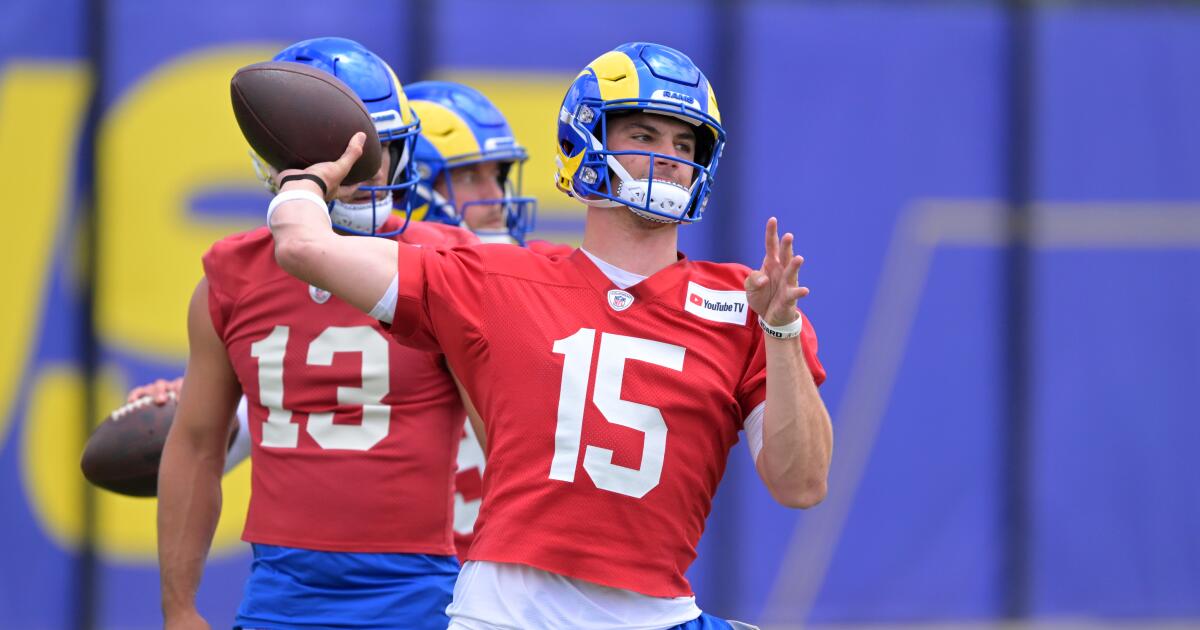
Rams QB Ty Simpson embracing an unusual bedtime routine to spur his development
-

 World12 minutes ago
Lebanon Latest: Israeli attacks surge despite ceasefire efforts
-
 News39 minutes ago
Supreme Court allows a ruling that ends a tool to protect minority voters in 7 states
-

 New York2 hours ago
How a Security Guard Lives on $46,000 a Year in the East Bronx
-

 Los Angeles, Ca2 hours ago
L.A. Tenants Union trying to save business owner given eviction notice ‘without reason or discussion’
-

 Detroit, MI2 hours ago
Grace Hanke crowned Miss Michigan 2026
-

 Dallas, TX2 hours ago
3 Cowboys Entering Training Camp With Plummeting Stock
-

 Miami, FL3 hours ago
Florida’s Alligator Alcatraz shutting down permanently, sources say

