Business
L.A. drivers are finding ways to adjust to the country’s highest gas prices


As inflation rates rise to their highest in years, Californians are again getting hit the hardest at the gas pumps, with a regular tank costing upwards of $100 at some stations in Los Angeles.
Inflation figures released this week show consumer and producer price rises at more than three-year highs, driven by the energy crisis stemming from the war with Iran.
Gasoline prices took the biggest bite out of consumer spending power, with prices up 41% in May from a year earlier.
While the national average for gasoline prices is a little above $4 per gallon, in California, it is near $6 per gallon. In a small number of gas stations in Los Angeles, it is even tipping toward $7.
When asked about inflation in the Oval Office on Wednesday, President Trump told reporters the numbers looked great.
“I love inflation,” Trump said. “The numbers are going to be phenomenal because what’s showing is that despite the fact that we’re in a war, the numbers are much lower than anticipated, and when we’re out of that war, the numbers will be at lower numbers than they were even before it started.”
Consumers aren’t feeling the love.
Workers in front of a crude oil storage container at Sable Offshore Corp.’s Santa Ynez Unit in Santa Barbara on Friday, June 5, 2026. California producer Sable Offshore Corp. expects to restart a platform capable of pumping 10,000 barrels of oil a day some time in the third quarter this year, the company said in an investor presentation Monday.
(Caroline Brehman / Bloomberg)
The Costco gas pumps in Inglewood were busy Thursday morning, with a constant flow of cars looking to save money on its relatively low per-gallon price of about $5.50.
Inglewood resident Eddin, who chose to not give his last name, said even though his Honda Civic isn’t a big gas guzzler, he has switched to using his girlfriend’s hybrid for longer trips.
“We just take her car now just because it’s more cost-effective,” he said as he filled his tank. “I wish there was more the government could be doing for not just gas prices, but for prices in general. It seems like prices have gone up for everything.”
The unforgiving prices at the pump are set to make everyone’s summer more expensive. After gas, the largest price rise for consumers was in airline tickets, which jumped 27%.
Even staying home doesn’t shelter shoppers — the beef they might want to put on their backyard barbecues is up 15%.
Virginia resident Mario, who also opted to not give his last name, got hit twice with the inflation tax as he left Los Angeles this week. He was paying more to refill his rental as he headed for a flight home, after having paid much more for the ticket than earlier in the year.
“All of the flights are way more expensive than they used to be,” he said as he paid almost $5.80 per gallon at the 76 on Century Boulevard near Los Angeles International Airport.
The average price for a gallon of gas is around $3.90 in Virginia.
While the surge in prices is happening around the world, gas costs more in California than almost anywhere else because of higher taxes, fees and cleaner-fuel requirements.
The state’s gas supply is also particularly vulnerable because it has lost much of its drilling and refining capacity in recent years, making it more dependent on fuel from other states and countries.
As gas prices continue to climb in L.A., locals are forced to adjust their lives to the price at the pump. For some, that includes cutting back on other necessities such as food, budgeting strictly to afford half a tank of gas a week and rethinking side hustles such as food delivery service.
Public transit has become a more favorable option for some — weekday commutes on the Metro increased by nearly 8% from January to May.
Recent reports have shown a decline in spending on expensive household goods, and credit card data show that both luxury and discount shoppers spent less than usual recently on lodging, groceries, clothes and theaters to accommodate a larger gas budget.
Another Inglewood native who opted to not give her last name, Liz, is putting off filling up her gas entirely because it is so expensive. Instead, she makes more frequent visits, putting a little gas in her car at a time.
“I have to budget and do half a tank now, and half a tank later, or ask for an advance on my paycheck just to get gas,” she said.
Most people at the pumps agreed: Something needs to change.
Wayne Faulkner is from Los Angeles but now lives in Indiana, where gas is about $3.50 per gallon. He complained as he filled up his rental at the LAX stand.
“Our gas situation is much better than here,” he said.


Anthropic PBC has disabled access to its most advanced artificial intelligence models, including Mythos, following an unprecedented order by the Trump administration to keep the technology out of the hands of all foreign nationals.
The U.S. government told Anthropic to suspend access to the Fable 5 and Mythos 5 models by any foreign national “whether inside or outside the United States,” citing national security concerns, the company said in a statement.
A U.S. official confirmed that the Commerce Department sent the letter. The model developer has since shut off access to both systems to all customers to ensure compliance.
Never before has the U.S. government taken such sweeping measures to rein in foreign access to frontier AI models developed by an American company. The Trump and Biden administrations have limited access abroad to other consequential technologies such as semiconductors and supercomputers, and some have debated the merits of blocking access to AI models. But restrictions on the software itself have raised constitutional and commercial concerns.
Anthropic said it believes the U.S. government issued the order after discovering that it’s possible to “jailbreak,” or bypass the guardrails, of Fable 5, a recently released version of Mythos that the company blocked from carrying out cybersecurity tasks.
“We disagree that the finding of a narrow potential jailbreak should be cause for recalling a commercial model deployed to hundreds of millions of people,” Anthropic said in its website post. “If this standard was applied across the industry, we believe it would essentially halt all new model deployments for all frontier model providers.”
Researchers at Amazon.com Inc. had conducted jailbreak research that revealed some vulnerabilities in Anthropic’s model, according to a report in the Wall Street Journal.
Amazon and the U.S. government were in contact about the vulnerability before the controls were imposed, according to people familiar with matter who were granted anonymity to discuss sensitive conversations. Amazon Chief Executive Andy Jassy was involved in those exchanges, one of the people said. The Information reported earlier that Jassy raised concerns to senior U.S. officials.
An Amazon spokesperson said it’s not uncommon for governments to consult with the company on security risks, but declined to share details of any such discussions.
The government’s move to so widely restrict access to a set of AI models in the name of national security threatens to set a precedent for all major AI model developers including OpenAI, Alphabet Inc.’s Google and Meta Platforms Inc. Industry leaders such as Nvidia Corp. Chief Executive Officer Jensen Huang and OpenAI CEO Sam Altman have in the past encouraged the US government to instead promote worldwide adoption of American AI systems and protect the nation’s lead.
“For anyone who was naive and perhaps hoping that this leverage wouldn’t be exerted, it’s a massive wake-up call,” Aidan Gomez, the co-founder of Cohere Inc., a Nvidia Corp.-backed AI startup, said Saturday in an interview. “No one can deny it any more.”
Anthropic said it received the government order at 5:21 p.m. New York time on Friday. The end-of-day directive runs counter to earlier statements, as well as an executive order recently signed by President Trump, which suggested the administration wouldn’t pursue a licensing regime for model reviews.
Friday’s directive also threatens to escalate long-standing tensions between Anthropic and some within the Trump administration. Earlier this year, the AI developer clashed with the Pentagon over the use of its technology for military and surveillance purposes. The administration declared the company a U.S. supply-chain risk as a result of the blowup and ordered U.S. agencies to phase out the use of its products.
Privately held Anthropic, which has long positioned itself as a more responsible AI developer, first released its Mythos model in April to a very limited group of companies and institutions, warning that its ability to find cybersecurity vulnerabilities made it too risky to distribute more widely.
There were signs that the limited release was working to ease tensions between Anthropic and the Trump administration: In April, the U.S. government was preparing to make a version of Mythos available to major federal agencies, Bloomberg previously reported.
Mythos also accelerated the Trump administration’s efforts on AI policy, which included the recent executive order that called for voluntary model review. That order explicitly said that nothing in it should be construed as creating a mandatory licensing regime.
David Sacks, Trump’s former AI czar and current co-chair of the President’s Council of Advisers on Science and Technology, said that Anthropic refused to fix a jailbreak of the guardails in its Fable model.
“The Admin’s hope now is that Anthropic remediates the safety issue, the export control is lifted, and Fable goes back into general release,” he wrote in a post on X. “The Admin wants all of this to happen as soon as possible. It is frankly bewildered that Anthropic hasn’t wanted to comply with safety requests that it previously said were its highest priority.”
The latest government restriction is colliding with a race among U.S. developers to deliver the most advanced AI models and prove to their investors that the technology can turn a profit. Both OpenAI and Anthropic are seeking initial public offerings as soon as this year, following SpaceX’s own historic IPO.
The rush to deliver the most cutting-edge AI models spurred Anthropic itself to post a lengthy blog earlier this month, calling for the creation of a system in which governments and AI developers collectively decide when to slow work on the technology to stave off the risks it may pose.
“It would be good for the world to have the option to show or temporarily pause” AI work that may be dangerous, the company said in the post at the time. AI is advancing to the point where the technology can make human work thousands of times more efficient or even replace it, creating a new set of risks, the company said.
The European Union’s executive arm said that it’s assessing Anthropic’s statement and is continuing to talk to allies about the potential risks and cybersecurity concerns related to powerful new AI models. The European Commission added that the latest developments underline Europe’s need for technological sovereignty.
‘“s a person in the field, I’m not particularly thrilled to see this,” said Cohere’s Gomez. “I don’t think this is partnerly, I don’t think this is the right thing to do for the broader technological alliances that have developed over the course of the past 80 years.”
Eastland and Lowenkron write for Bloomberg. With assistance from Shirin Ghaffary, Yi Wei Wong, Gian Volpicelli, Spencer Soper and Thomas Seal.

Los Angeles has one of the deadest downtowns in the world, according to a new survey.
Out of 75 of the top cities around the world, L.A. ranked among the lowest for vibrancy in Gensler’s 2026 City Pulse report released this week.
Around 65% of those surveyed found DTLA vibrant compared to more than 80% vibrancy scores for New York, Chicago, Sydney and Shanghai.
The urban planning and consulting company surveyed 35,000 city residents on how they ranked their city for a variety of statements. Los Angeles ranked 20th-lowest globally and 11th-lowest among 34 U.S. cities in vibrancy.
Downtown Los Angeles needs more people to return to downtown to work, shop and eat if it wants to boost its scores, said Kelly Farrell, the managing director of Gensler’s L.A. office
“L.A.’s kind of central problem is that businesses have left L.A. We need them to bring the offices back in,” she said. “Bring the people back in so they’re staying after work and interacting with those businesses that are in the area.”
While there are pockets of downtown that are thriving and local residents say life is improving, Los Angeles’ downtown suffers from an image problem that is weighing on how it is perceived.
Gensler’s report highlights key factors that contribute to a thriving downtown area. Downtowns should have a blend of shops, offices, and housing, walkability, and a role as a cultural and entertainment hub.
Despite its status as the city’s historic seat of government, finance, arts and sports, downtown L.A. has experienced a trend of offices leaving post-pandemic, leading to fewer visitors and the remaining stores and restaurants struggling.
The Los Angeles Office of Finance showed that the number of businesses reporting leaving downtown has increased greatly over the last two years, following a lull post-pandemic. Similarly, downtown has accounted for a growing share of overall exits from the region in the last five years.
According to a Times data analysis, downtown has regularly accounted for the highest number of closures. Among the neighborhoods hit the hardest by closures, South Park, the Fashion District, Central City and Pico-Union had the highest number of closures from 2024 to 2025. Nearly 40% of the office space in the Financial District is functionally empty, and 30% of retail space is vacant, according to CBRE.
Another important factor is whether or not people linger there. Rather than the number of visitors, Gensler said in the report, the amount of time spent downtown matters more in cultivating a thriving downtown area.
L.A. has consistently struggled to get locals back into downtown in recent years.
Perceived safety issues downtown are one major reason businesses are leaving downtown, and locals won’t go there.
Vandalism, assaults and robberies downtown have driven businesses out, and a noticeable lack of police presence makes people reluctant to return. Still, Los Angeles Police Department Capt. Kelly Muniz said in April that crime is down 10% from last year.
Gensler’s L.A. director says that as people flood back into downtown, crime will continue to decline.
“One of the best things we can do for safety is have an abundance of population,” said Farrell. “You will see right now that we have a lot of great ground-floor retail that’s empty. As that gets fuller, we typically see that crime starts to go down with it.”
Farrell said results can change dramatically between each year of the survey, and as L.A. sees more offices return to downtown, perception of vibrancy will increase with it.
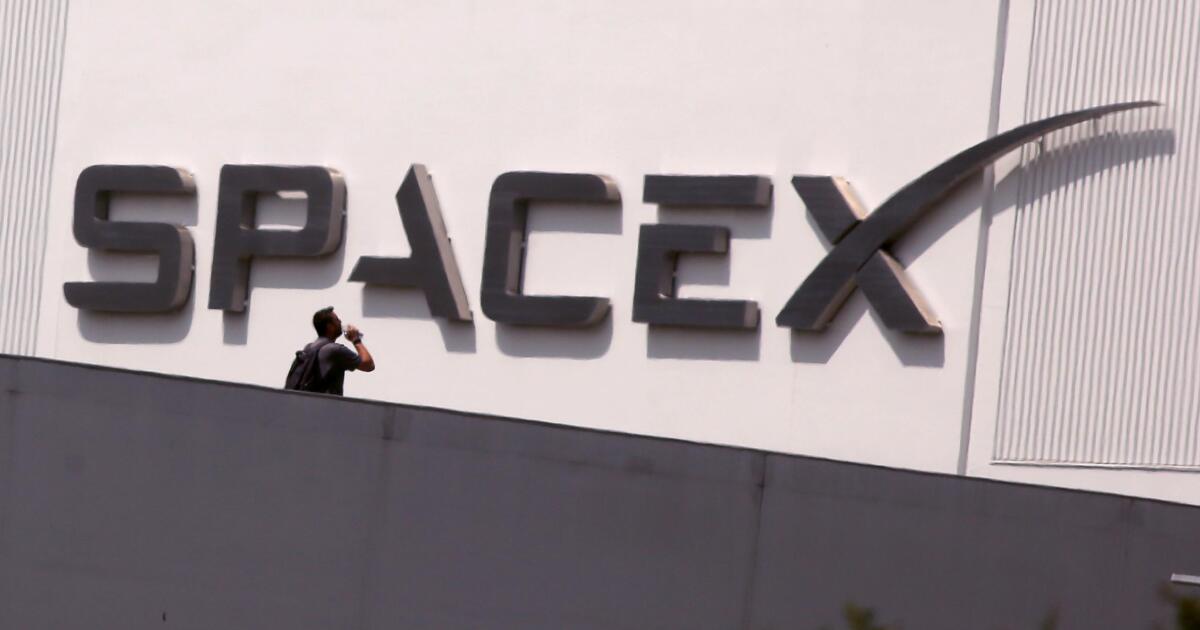
SpaceX, the once fledgling aerospace company that Elon Musk predicted had a slim chance of survival, reached new heights on Friday with a historic initial public offering.
Shares of SpaceX, trading under the ticker SPCX, closed the day at $160.95, 19% above the offering price, transforming it into one of the world’s most valuable companies with a $2.2-trillion market cap. The IPO also made the 54-year-old Musk the world’s first trillionaire.
The IPO capped a remarkable journey for a 24-year-old company that nearly shut down after a series of failed launches until its Falcon 1 rocket in 2008 orbited the earth and clinched a crucial NASA contract.
“It is certainly hard to believe that a little company that started in a warehouse in El Segundo is now going public with the largest IPO ever,” Musk told cheering employees at the company’s Texas headquarters.
The company raised $75 billion in the offering after selling 555 million shares at $135 to institutional and retail investors. With the shares in high demand, SpaceX could raise even more money.
It granted the nearly two dozen underwriters of the IPO, led by Goldman Sachs and Morgan Stanley, an additional 83 million shares, which could raise its total take to $86 billion.
The IPO is easily the largest on record, surpassing the 2019 offering by Saudi Aramco, Saudi Arabia’s state-owned oil giant, which raised $29.4 billion.
“They clearly priced it right, at least for one day. It should just make you optimistic for the markets for, especially for growth stocks,” said Robert Gruendyke, senior portfolio manager at Allspring Global Investments.
Musk has big plans for the company, which already dominates the world’s rocket launch business and is the leading satellite-based broadband provider with its Starlink service. It also has spent billions to buy spectrum for satellite-based mobile communications service.
Key to its efforts is Starship, a rocket being tested that is larger than the Saturn V that took astronauts to the moon. NASA is relying on it to return Americans there, while Musk eventually wants to fly it to Mars.
Musk sees it as crucial to his AI ambitions. Musk merged his xAI artificial intelligence company into SpaceX this year, with the combined entity recently announcing it was leasing computer power to rivals Anthropic and Google at two terrestrial data centers it has constructed.
Musk contends the future of AI lies in launching thousands of satellite data centers into space, where they will perform computer calculations while orbiting the Earth powered by a continuous supply of solar energy — a vision critics see as far-fetched.
However, Musk has proved skeptics wrong in the past, especially those who bet against Tesla when it conducted its $1.7-billion IPO in 2010. At the time, CNBC personality Jim Cramer called the $17 shares a “sell, sell, sell.”
While it took until 2020 for the stock to really take off as Model 3 sales grew, shares of the electric vehicle maker closed Friday at $406.43, giving Tesla a market capitalization of $1.5 trillion.
The SpaceX IPO was a gold mine for Musk’s venture capital backers in Silicon Valley, including Peter Thiel’s Founders Fund, Andreessen Horowitz and Sequoia Capital, which reportedly had stakes now valued at $10 billion or more.
It also made an estimated 4,000 current and former SpaceX employees millionaires, with another 400 achieving a net worth exceeding $100 million, said Andrew Benson, chief executive of Hill.com, an investment platform for trading stock in pre-IPO tech companies.
SpaceX is currently headquartered in south Texas after moving there in 2024 from Hawthorne, where it had its executive offices for years after expanding from its original El Segundo warehouse.
However, the company retains large operations in the South Bay city, where it has more than 6,000 employees out of at least 22,000 companywide. And it blasts off its Falcon 9 rocket regularly from Vandenberg Space Force Base in Santa Barbara County.
Benson said that he estimates the “vast majority” of current and former employees with more than $100 million in stock are in Southern California due to a stock awards plan that has favored length of tenure over an employee’s role.
“It’s just great to see employees be able to convert their labor into capital,” he said.
Even before Friday’s IPO, former employees of SpaceX have helped seed an aerospace and defense boom largely in Southern California, starting some 70 companies, including well-known startups Relativity Space, Impulse Space and K2 Space, according to the alumnifounders.com tracking site.
Van Espahbodi, co-founder of Generational Partners, a Los Angeles venture capital fund, expects the IPO will result in even more employees taking a crack at their own firms.
“It will allow many of them to pursue their vision,” he said. “I am aware of extreme cases where people took on credit card debt to maximize preserving their shares and not having to sell off, so that they can go and do their thing.”
Demand for the IPO shares was feverish on Wall Street.
The offering was reported to be oversubscribed four times over by big institutional investors. Blackrock, the New York money manager that is the world’s largest, was seeking to buy as much as $5 billion of the stock, Bloomberg reported.
That was despite concerns by critics that the company was overvalued and skepticism of a governance structure that puts few constraints on Musk. He holds special shares with 10 times the voting power of common shares that put him in control of the company’s board.
Investment research firm Morningstar placed a $780 billion valuation on SpaceX, focusing on its core rocket and Starlink broadband satellite businesses. It suggested investors wait a few months for the stock to settle before buying in.
With AI leaders OpenAi and Anthropic next lined up to conduct initial public offerings, Jim Chanos, a veteran short seller, likened the era to the first dot.com boom, which ended with a tech bust — except more extreme.
“This is much bigger,” he said, in a Bloomberg News interview.
Whatever the hype or unease about the offering, SpaceX reached the IPO after an impressive record of achievements that transformed the space business.
After outgrowing its original El Segundo space and moving into a massive former Northrop facility in 2007, the next year it launched its first successful rocket and set about developing its now workhorse Falcon 9.
The rocket, first launched in 2010, is partially reusable and is estimated to have lowered launch costs by some 95% compared to traditional single-use rockets.
It’s estimated the Falcon 9 accounted for more than 80% of the mass sent up into space last year — giving rise to the new generation of aerospace companies that rely on it.
It also has been key to the company’s Starlink business, which sent up its first satellites in 2019. SpaceX even launched 29 Starlinks on Friday. There are now more than 10,000 in orbit with plans for thousands more as demand grows.
Paul Habibi, a real estate lecturer at UCLA and principal of Grayslake Advisors in El Segundo, said he believes the IPO should boost the South Bay real estate market, as insiders granted stocks spend some of their newfound wealth.
“A lot of those folks are probably going to line up around the block to buy into neighborhoods like Manhattan Beach,” he said.
Meanwhile, retail investors placed more than $100 billion in orders, far more than had been reserved for them in the IPO, Bloomberg said. It was expected individual investors would end up with a 20% share of the offering.
Many of those retail buyers are devoted Musk fans and are assumed to want to hold the stock, but others were expected to have flipped the stock Friday for a quick profit.
Angela Lee, a professor at Columbia Business School, thinks the individual investors who think they will strike it rich could be mistaken — though she doesn’t entirely discount the possibility.
“I think they think it’s a golden ticket, when it’s more likely they are holding a lottery ticket,” she said.
Bloomberg News contributed to this report.
-

 Wisconsin7 minutes ago
Wisconsin beats conference rival for class of 2027 seven-foot center
-

 West Virginia10 minutes ago
West Virginia Strikes Big in Transfer Portal, Lands Speedy OF Jack Cannon
-

 Wyoming15 minutes ago
More sunny, mild conditions for Sunday
-

 Crypto22 minutes ago
Rosen Law Firm Encourages FLOW Cryptocurrency Investors to Inquire About Securities Class Action Investigation
-

 Finance24 minutes ago
Man who built Guernsey finance charity retires
-

 Fitness30 minutes ago
Fitness: Beyond exercise, move more and live longer
-
 Movie Reviews40 minutes ago
‘Never Change!‘ from TRIBECA 2026 – Film Review | RIOTUS
-
World52 minutes ago
Georgia’s vote-counting method will soon be banned. Lawmakers will try to find a fix this week


