Entertainment
Ronald LaPread, Commodores’ co-founder and bassist, dies at 75

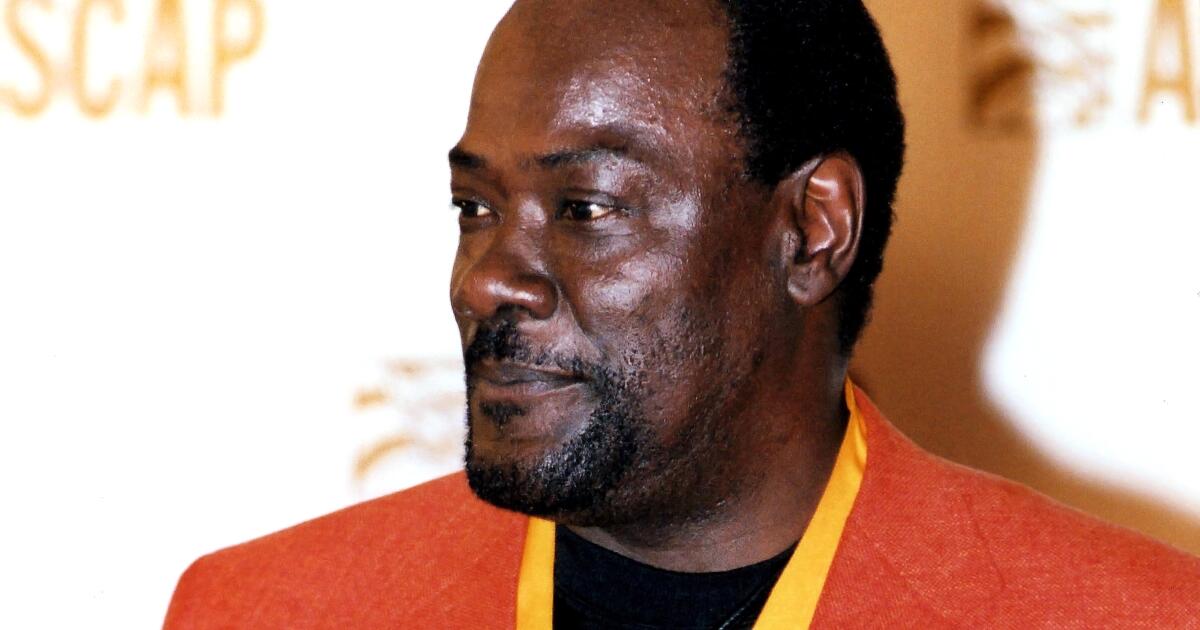
Ronald LaPread, a co-founder and former bassist of the funk and soul group the Commodores, has died. He was 75.
“It is with a very heavy heart that I must announce that my father Ronald LaPread has passed,” LaPread’s daughter Soraya LaPread shared on her Instagram story. “If you know me you know my dad. I am devastated. A piece of me is gone from this world.”
Soraya did not share details about her father’s death, but the New Zealand Herald reported that the longtime resident died of a “sudden medical event.” The Commodores took to Instagram to share their condolences, writing that LaPread “will always be a Commodore.”
Thomas McClary, Milan Williams, William King, Ronald LaPread and Walter Orange in 1986 — the year LaPread left the group.
(BSR Entertainment / Gentle Look / Getty Images)
“Ronald was a phenomenal musician, an accomplished songwriter and a vital part of the Commodores’ sound and success. His contributions to our music and his friendship enriched our lives beyond measure. We were grateful to perform with him again last fall in New Zealand,” the Commodores shared on Instagram. “His legacy lives on through the music he helped create and the countless people he inspired.”
LaPread began playing with the Commodores in 1970 alongside Lionel Richie, William “WAK” King, Milan Williams and Thomas McClary while they were students at Tuskegee Institute. The band initially played shows around campus, performing covers and a handful of original songs.
Their manager Benny Ashburn spent his summer organizing shows for the Commodores on Martha’s Vineyard to test-market the band. In 1971, the group opened for the Jackson 5, helping them gain national exposure and leading them to sign with Motown Records in 1972.
The band released their debut album, “Machine Gun,” in 1974 and reached No. 22 on the Billboard Hot 100. They released a quick succession of albums — “Caught in the Act,” “Movin’ On” and “Hot on the Tracks” — catapulting the band to mainstream success. LaPread played bass on the band’s most memorable songs, including “Easy,” “Three Times a Lady” and “Brick House,” the latter a song that LaPread insisted they put on the album.
“They say, ‘Oh man, it’s too Black.’ I said, ‘Wait a minute. I tell you what, I will give this song to the group. Just put it on the album.’ They say, ‘Okay,’ and they put ‘Brick House’ on the tape recorder,” LaPread explained in a video recently shared on his personal Instagram. “They went crazy. When you hear a hit song, it sends goosebumps all over your body. Before anything happens, you feel it, and that’s the history.”
After working on 11 albums with the band, LaPread left the Commodores in 1986 and moved to New Zealand. During his time with the Commodores, the group earned nine Grammy nominations and won an award for their song “Nightshift.”
LaPread joined the Commodores onstage last October during a tour stop in Auckland, New Zealand. On Instagram, the band called performing with LaPread the “highlight” of their shows in Australia and New Zealand.
In addition to his daughter, LaPread is survived by his wife, Farideh; and children Mark and Ronald Jr.


I watched Christopher Nolan’s Insomnia before I watched the original. I was in my early twenties. I thought the film was fine and I moved on. It took me until Second Sight dropped this 4K edition to find out what fine had been covering up for twenty four years. I feel pretty bad about that. Not bad enough to not tell you to skip Nolan and start here, but bad.
Erik Skjoldbjærg’s 1997 original is a Norwegian thriller about a Swedish detective named Jonas Engström who goes to Tromsø to investigate a teenage girl’s murder and instead dismantles himself in daylight. Stellan Skarsgård plays Jonas. He is not a good man doing a bad thing. He is a man who was already doing bad things who then does a worse one, and the film is about watching him hold that together under a sun that will not go down.
The Sun Is the Monster Here
Skjoldbjærg called it “a reversed film noir with light instead of darkness as its dramatic force,” and that is exactly right, and also a polite way of saying the Arctic summer is doing something genuinely horrible to this movie. Tromsø in June means no night. No dark corner. No 3am where you can tell yourself it was a dream.
Cinematographer Erling Thurmann-Andersen shoots the whole thing overexposed and grey, and in the new 4K restoration that greyness lands like a fist. Every interior feels too bright. Every window is a problem. Jonas cannot sleep, cannot hide, cannot find a single hour that looks different from the one before it. That is the film’s horror, and it is more effective than it has any right to be.
What Skarsgård Actually Does
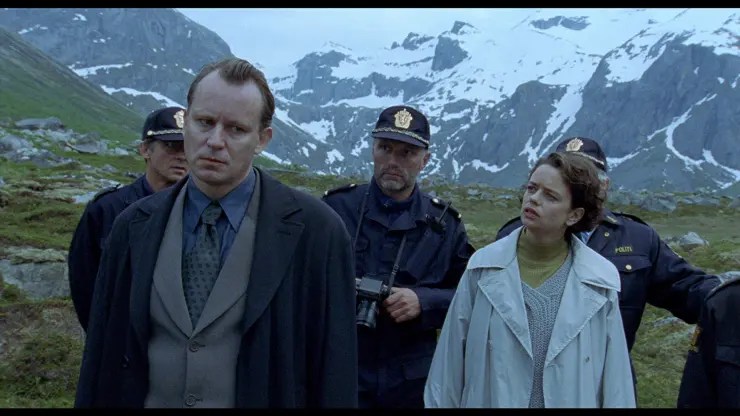
The performance does not announce itself. That is the whole thing. Skarsgård plays Jonas going still when he should flinch, pausing a half-beat too long before answering simple questions, watching every room he enters with the focus of a man who needs to know who in it already knows. He is calculating. He is also dissolving.
Roger Ebert compared the film to Dostoevsky when it opened stateside in 1998. The Crime and Punishment parallel is real, with one difference, Raskolnikov is tormented almost immediately. Jonas keeps choosing not to be. That is the colder read and the better film.
What Nolan Did With It

The 2002 remake moved everything to Alaska, added about 20 minutes, and made the detective a fundamentally decent man destroyed by circumstance. Al Pacino does the thing Pacino does. Robin Williams is genuinely unsettling in a way the film earns. Hilary Swank does more with her role than the script deserves. It is a competent Hollywood thriller and I have not thought about it since I watched it.
The key structural difference, in Nolan’s version, the detective dies. Some weight lifted. In the original, Jonas lives. Goes home. Carries it. That is the correct ending and the more disturbing one, and I will not call it a spoiler because you needed to know.
About This Release

Second Sight did not cut corners. The 4K restoration carries a director-approved HDR grade with Dolby Vision, and Thurmann-Andersen’s washed-out oppressive whites have never looked this punishing. The dual format edition puts the feature and bonus material on both the UHD and Blu-ray, which is a small detail that collectors notice and appreciate.
The physical package is a rigid slipcase with new art by Peter Strain, a 120-page book with essays from Jenn Adams, Mitchell Beaupre, Barry Forshaw, Francesco Massaccesi, Priscilla Page, and Travis Woods, and six collector art cards. The book reads like it was commissioned from people who actually watched the film. That sounds like a low bar. It is not.
What Is on the Discs

The audio commentary with Skjoldbjærg and co-writer Nikolaj Frobenius is the feature you will come back to. A director revisiting his debut nearly thirty years out has usually dropped the defensiveness and kept the honesty, and this one has that quality. Two new interviews accompany it: “Running on Instinct” with Skjoldbjærg, and “Falling Into It” with producer Petter J. Borgli. The producer interview fills in context the film itself never bothers to explain.
Alexandra Heller-Nicholas contributes a piece called “Private Prisons” that treats the film analytically without treating it as a sacred object. Three of Skjoldbjærg’s short films are included: Spor, Close to Home, and Near Winter. Watch those first if you want to know where Insomnia came from.
Buy It or Don’t

If you have never seen this film, the answer is yes. Full stop.
If you own the Criterion edition and you are doing upgrade math. The restoration is the definitive visual presentation and the commentary is new material unavailable anywhere else. Whether that moves the needle depends on you.
Insomnia is a Norwegian film about guilt dressed as a detective story. Jonas Engström did not need the midnight sun to lose his mind. He was already most of the way there.

Surrealism is not my favorite film genre, but I will make a massive exception if it’s in the hands of Boots Riley. Not unlike his debut, Riley’s latest feature, I Love Boosters, is a weird, vibrant, funny, thoughtful, hopeful thesis on collective action and workers’ rights. At a time when satire is almost impossible (an episode of The Boys where the key villain announced that he was God aired just days after the president of the United States posted an AI meme of himself as Jesus), Riley manages to create something just bonkers enough actually feels like it has something to say, and is bright and colorful enough to demand your attention.
Corvette (Keke Palmer) is struggling to get where she wants to be in life, so poor that she’s squatting in a closed chicken restaurant. She and her friends, Sade (Naomi Ackie) and Mariah (Taylour Paige), steal clothes from the high-end boutique Metro and resell them at a lower price to people in their community. As part of their desire to get better at boosting, the three take jobs at Metro, hoping to figure out how to clear out an entire store.
But one day, while they are being reprimanded by Grayson for wearing last year’s Metro line from designer Christie Smith (Demi Moore), they leave the meeting to discover that someone has beaten them to emptying the store. They track down Jianhu (Poppy Liu), a Chinese woman who has a teleporting device that allows her to send the clothes back to China, where they are manufactured, hoping to force Christie to give them better wages and safer working conditions. They realize that they need to work together if they are going to see the changes they are striving for.
Also, LaKeith Stanfield plays a character who is so sexy, I can never watch this movie with my family.
At a time when so many trailers give away the entire movie, I Love Boosters is so wholly unique that if someone explained every plot point to you, you would still need to see it in order to fully grasp everything happening on screen. Like Corvette’s full-to-bursting pink tracksuit, this movie is stuffed with ideas and colors and characters, but it somehow all manages to stay together, creating an absolute feast for your eyes and ears.
The performances in this are absolutely spectacular from top to bottom. Keke Palmer sparkles, even as we see her running away from a literal ball of her problems. Demi Moore gets to play the opposite side of her role in The Substance, this time as the person trying to amass more wealth at the expense of those beneath her, primarily other women, and she tears it up. Don Cheadle is almost unrecognizable as Dr. Jack, a man Sade idolizes for his Friends Being Friendly pyramid scheme. Will Poulter is absolutely hilarious as Grayson, a Metro manager who has fully embraced everything Christie Smith is selling.
One thing you can glean from the trailer is the film’s overall look. Christie works in monochrome, so each location is filled with a single color. But even so, the colors are bright, not like the relentless desaturation that we are cursed with right now. Even when we are taken to the sweatshops in China, everything is bright and colorful. We are drenched in color and unique styles in I Love Boosters, but it is always singular, which is a fascinating way to show the uniformity that is often the hallmark of a hyper-capitalist society that is torn between conformity and individuality.
What makes this movie special is that in the midst of all of the hilarity, bright-but-monochromatic costuming, and a sex demon, there lies a deep philosophical examination of capitalism through the lens of dialectical materialism. This complex ideology isn’t dumbed down in any way, but is instead told to us through a magical device that is able to show us the world beneath the glitz and glamor of the fashion world. And sometimes what is underneath the literal skin of some of the people seeking to prop up the system as it is.
There are some issues with this film that don’t quite come together. The whole LaKeith Stanfield arc is very funny, but doesn’t quite fit with the rest of the movie. Taylour Paige is fantastic in her role, but there is more depth between Sade and Corvette, leaving less for Paige’s Mariah to do. But the messiness is so minor compared to the rest of I Love Boosters that it tends to get swept away in the maximalist filmscape that Riley has created.
Throughout the movie, Christie Smith has a lot to say about creating art and how her clothes allow people to become art themselves. At one point, someone tells her that people don’t want to be art, they want to make art. And that feels very much at the heart of this film. Most people want to create something beautiful that helps their community, but are constantly chased by the pressure to simply survive. To put a roof over your head, food on the table, clothes on your back. I Love Boosters says this dream is possible, but we might have to significantly change how we look at things and recognize that we’re stronger together than apart.
I Love Boosters is now in theaters.
Learn more about the film at the IMDB site for the title.
You might also like…

Two years ago, Gary Oldman found himself in Yorkshire for the wedding of his oldest son, Alfie. As Oldman’s other sons, Gulliver and Charlie, were there too, along with his wife, Gisele Schmidt, and his stepson, William, Oldman thought it’d be a lark to make the hourlong drive through the countryside to the York Theatre Royal, where he began his acting career in 1979.
The boys were intrigued, as they had heard stories over the years. Before Oldman burst on the film scene in the 1980s playing punk rocker Sid Vicious in “Sid & Nancy” and British playwright Joe Orton in Stephen Frears’ “Prick Up Your Ears,” he had turned heads in a run of plays throughout England. Then he was, as he puts it, “kidnapped by cinema.” Wanting to see their father’s career origin story, the family piled into a couple of cars and headed out.
“It was a lovely kind of homecoming, a debt paid, really,” Oldman tells me in a Zoom conversation from London. We’ve talked a great many times over the years, and while I wouldn’t call him nostalgic, Oldman most definitely is a sentimental man, especially when it comes to family.
That day, walking around the York Theatre Royal, thinking he needed to pinch himself because, really, how could it be 45 years since he first took that stage (“It all feels last week,” he thought), Oldman met Paul Crewes, the theater’s chief executive. “Do you think you might want to ever return to the stage,” Crewes asked Oldman, “and if so, where might that be?” Oldman thought for a moment and replied: “I think I’m standing on it.”
Sure enough, last year, in between filming seasons of his acclaimed Apple TV spy series “Slow Horses,” Oldman starred in Samuel Beckett’s “Krapp’s Last Tape,” playing a 69-year-old man who sits alone and listens to the recorded memories of his younger self. Everyone was so happy with it that Oldman was asked to reprise the role at London’s Royal Court Theatre this May, which is why he stayed in England after wrapping the seventh season of “Slow Horses.”
Gary Oldman as Jackson Lamb in “Slow Horses.”
(Jack English / Apple TV)
“It all fell into place,” Oldman says of his return to the theater, “and once we started, I was really champing at the bit to have the first preview. I was that wound-up. And it was a very nice thing for the family to come and see their papa up there onstage. It all feels quite harmonic.”
Having just celebrated his 68th birthday, Oldman is only a year removed from Krapp, though unlike Beckett’s character he isn’t disillusioned or lonely.
“I don’t know if I’ve worked out who I am, but I feel a little easier in my skin and happier than I’ve ever been,” he says. He attributes much of that bliss to his marriage to Schmidt, an art curator, writer and photographer whom he wed in 2017. “At this point in my life, I’m with someone who gets me and understands what I do. You have to incubate, and Gisele doesn’t take it personally. It’s a big part of who I am, the quiet and isolation needed to work on a character. I’m very lucky to have found someone.”
Musing about couples who have been together for decades, Oldman brings up Kevin Bacon and his long marriage to Kyra Sedgwick. “That’s a fantastic love story,” he marvels.
Everyone’s journey is different, I offer. For Oldman, sober since 1997 and married five times (“Maybe I’m a romantic or an optimist or just ‘never say never,’” he once told me), he found his own love story. And the feeling appears mutual.
“I might be the fifth one, but I am the one,” Schmidt says playfully off-camera. Oldman smiles and repeats it in case I didn’t hear her. “It’s a lovely thing,” he adds.
Oldman feels the same way about “Slow Horses,” which has broken through at the Emmys the last two years, winning awards for writing and directing. Its fifth season aired in the fall. Two more seasons are in the can. And as author Mick Herron continues to write new books in the Slough House series, there’s no immediate end in sight.
“I mean, if I go to Book 10, 11 or 12, I’ll have to be in a walker,” Oldman jokes. “They’ll have to get a stair lift.”
He’s still sporting the facial scruff we associate with “Slow Horses’” unkempt master spy, Jackson Lamb, and as he noted last year at a SAG-AFTRA Foundation event I moderated, he still carries a few extra pounds around the midsection, the consequence of having to portray Lamb’s greasy, takeaway-container diet onscreen.
“I hadn’t seen Gary — I’d seen him on the telly — and it happened that we were filming around the same time, and I went into the makeup trailer and I [said], ‘Bloody hell!’” jokes Oldman’s “Slow Horses” co-star, Jonathan Pryce. “I thought he had a fat suit on. I didn’t realize his dedication to his craft.”
“You have to realize it’s five seasons, and it’s murderous,” Oldman answers. “It’s French fries and hot dogs and hamburgers and ice cream. It’s disgusting, isn’t it?”
The menu hasn’t changed, and neither has Lamb, still cynical and lazy, but also brilliant when he puts his mind to it, abrasive and cruel to his team, but also loyal and protective of the “losers” in his charge. Yes, outwardly, Lamb is, as Herron writes, a “sentient grease stain,” but Oldman believes he possesses a “strong moral and ethical compass.”
Over the years, Oldman has compiled what he calls a “small bible,” a journal of things that he believes may have happened to Lamb that aren’t found in Herron’s books. In fact, the most memorable scene in Season 5, where Lamb recalls a harrowing story of one of his “joes” being tortured by the East German secret police, alongside a pregnant woman, wasn’t in the book. Lamb later insists he made the whole thing up, though we learn at least some of what he said was true in the season finale.
“When you do something like that, I have to decide whether it’s true or false and then just play the scene with enough sincerity,” Oldman says. “Remember, Lamb’s a spy and a very good liar. The thing that struck me about it came at the very end. He says, ‘Well, they never got any information out of him. They wanted a name. But he never knew the f— name.’ That always struck me as an honest declamation.”

Gary Oldman.
(Jennifer McCord / For The Times)
Oldman loves returning to “Slow Horses” every year and says that as long as Apple is willing to “keep writing those checks, I’m not ready to hang up my dirty raincoat just yet.”
“Most people I meet, including one of the royals, ask me, ‘Are you going to be doing more?’” he says. “They can’t get enough of it.”
One of the royals?
Oldman pauses. “Her majesty Queen Camilla is a keen viewer.”
How do you know this?
Another pause. “She … told me,” Oldman offers. “Long story for another time, perhaps.” Schmidt then fills in the blanks. They met the queen two years ago when Oldman performed at a Shakespeare celebration for the Queen’s Reading Room charity.
So perhaps there will be a Season 8, though with two unaired seasons still to come later this year and next, asking for more feels greedy. In the meantime, there are grandchildren to dote on. Last week, Oldman and Schmidt spent the day with their 18-month-old granddaughter, Ottilie.
“I do miss the baby stage, their character developing,” Oldman says. “Ottilie is already such a character. We just had a day of laughing with this innocent little soul.”
“But it’s that old story,” Oldman adds, smiling. “As a grandparent, you know you can love them and spoil them and then give them back.” He laughs. “It’s a good gig.”

(Jennifer McCord / For The Times)
-

 Wisconsin4 minutes ago
Is Wisconsin violating the rights of disabled voters? Court hears arguments
-

 West Virginia7 minutes ago
Starting Lineups + Live Score Updates for West Virginia vs. Kentucky — Regional Final
-

 Wyoming12 minutes ago
Wyoming man imprisoned for sexually assaulting girl at Colorado water park
-

 Crypto19 minutes ago
Davidson County warns of phone scammers calling for payments via cryptocurrency, gift cards or mobile apps
-

 Finance22 minutes ago
Budgeting apps can help track spending, but habits still matter
-

 Fitness27 minutes ago
I’m feeling my best ever at 80: these are my daily habits – and the one thing I never do
-

 Movie Reviews37 minutes ago
Second Sight’s Insomnia 4K UHD Review: The Film That Beat Nolan to It
-

 World49 minutes ago
Video: Dozens Killed by Explosion in Rebel-Held Myanmar Territory

