Science
5 Great Stargazing Trains


Stargazing, it turns out, doesn’t have to be a stationary activity.
On railway lines around the world, from the Arctic Circle to New Zealand, a select set of evening train excursions take riders deep into dark-sky territory — some en route to remote station stops decked out with telescopes, others featuring onboard astronomers.
These five rail journeys (all of which are accessible) range from two- to three-hour desert outings to a hunt for the northern lights. One route even has a planetarium on rails. All promise a renewed appreciation of train travel — and of our pale blue dot’s improbable place in the cosmos.
Nevada
The Great Basin Star Train
Any stargazing train worth its salt requires one thing: a dark sky. The Star Train resoundingly checks that box, traveling through a part of eastern Nevada that is one of the least-populated places in the lower 48.
Run by the Nevada Northern Railway in partnership with nearby Great Basin National Park, the train departs the historic East Ely Depot, in Ely, Nev., early enough in the evening to catch the sunset over the Steptoe Valley, and then cruises through darkening skies to its destination: a remote corner of the desert appropriately called Star Flat, where a stargazing platform outfitted with telescopes awaits. There, riders disembark (equipped with red-light necklaces to help preserve their night vision) and take turns viewing the cosmos, guided by professional astronomers. (Last year’s onboard stargazing guides came from Caltech; in previous seasons, the National Park Service’s Dark Rangers, who specialize in night-sky activities, accompanied trips.)
The Star Train makes its two-and-a-half-hour round-trip journey most Friday evenings between mid-May and mid-September, and tickets ($65 for adults) can sell out almost a year in advance — though members of the Nevada Northern Railway Museum get early access. Alternatively, the railroad’s more frequent Sunset, Stars and Champagne excursions trade telescopes for desert sundowners but feature the same expert stargazers and the same Nevada night sky, which is often dark enough to see the Milky Way with the naked eye.
New Mexico
The Stargazer
While plenty of heritage railroads across the United States offer twilight rides and nighttime excursions, at the moment there’s only one other dedicated, regularly scheduled stargazing train in North America besides the Star Train: the Stargazer, operated by Sky Railway, in Santa Fe, N.M.
Much like its Nevada counterpart, the Stargazer makes a two-and-a-half-hour round trip through dark-sky country, though in this case, the journey really is the destination, because it doesn’t make any stops. More of a rolling night-sky revue, the Stargazer features live music and professional astronomers who share their celestial knowledge and stories as the train rumbles into the vast Galisteo Basin south of Santa Fe. Sky Railway’s colorfully painted trains feature heated, enclosed passenger cars to stave off the evening chill and flatbed cars open to the night sky.
Departing from the Santa Fe Depot downtown, the train normally runs once a month (adult tickets from $139, including a champagne welcome toast). Sky Railway also occasionally schedules excursions for special celestial events.
New Zealand
Matariki Rail Experience
With its alpine landscapes and rugged coastline, New Zealand’s South Island is practically tailor-made for scenic daytime train journeys. But when night falls, the sparsely populated island — home to the Southern Hemisphere’s largest International Dark Sky Reserve — is heaven for stargazers, too.
This year, Great Journeys New Zealand, which operates the country’s tourist-centric long-distance trains, is offering a special nighttime run of the Coastal Pacific, whose route skirts the South Island’s northeastern coast. Timed to Matariki, the Maori new year, which is heralded by the first rising of the Pleiades star cluster, the eight-hour round trip from Christchurch is a cultural and astronomical celebration.
After the first half of a four-course onboard dinner, the train arrives in Kaikoura, in dark-sky country, for a guided stargazing stop with a range of telescopes — and fire pits and a night market. (The rain plan involves a virtual stargazing session at the local museum using virtual reality headsets.) Dinner resumes back on the train as it returns to Christchurch. This is a strictly limited engagement, on the rails for one night only: July 11, for 499 New Zealand dollars, about $295, per person.
In the far northern reaches of Norway, inside the Arctic Circle, you can ride a train that chases another wonder of the night sky: the aurora borealis. Twice a week from October to March, the Northern Lights Train takes its riders into the dark polar night in pursuit of the aurora’s celestial light show.
From the remote town of Narvik, the train travels along the Ofoten Railway, the northernmost passenger rail line in Western Europe. The destination on this three-hour round-trip excursion (1,495 kroner, or about $160) is Katterat, a mountain village accessible only by rail and free of light pollution, making it an ideal place to spot the aurora. At the Katterat station, local guides and a campfire cookout await, as does a lavvu, the traditional tent used by the Sami people of northern Scandinavia, offering a respite from the cold (as well as hot drinks and an open fire for roasting sausages).
And aboard the train, the lights stay off, which means that on a clear night, you might even catch the northern lights on the way there and back.
Leave it to Japan to take the stargazing train to another level.
The High Rail 1375 train — so named because it runs along Japan’s highest-elevation railway line (the high point is 1,375 meters, or roughly 4,500 feet, above sea level) — is one of JR East’s deliberately unhurried Joyful Trains, which the railway company describes as “not only a means of transportation, but also a package of various pleasures.” This astronomy-themed train certainly packs plenty of joy into its two cars, with seat upholstery inspired by constellations, a snack bar, a souvenir shop and a planetarium car with a library of astronomy books and images of the night sky projected onto its domed ceiling.
The train makes two daytime runs along the mountainous Koumi Line, taking a little over two hours to travel between Kobuchizawa (accessible by express train from Tokyo) and Komoro. But the main event is the High Rail Hoshizora (“Starry Sky”) evening trip, which includes an extended stop at Nobeyama Station (the highest in the country) for a guided stargazing session. A one-way ride on High Rail 1375, which runs on weekends and occasional weekdays, requires a seat reservation if you’re traveling on a Japan Rail pass, or a stand-alone ticket plus seat reservation (2,440 yen, or about $15). And remember to preorder a special “Starry Sky” bento box.
Follow New York Times Travel on Instagram and sign up for our Travel Dispatch newsletter to get expert tips on traveling smarter and inspiration for your next vacation. Dreaming up a future getaway or just armchair traveling? Check out our 52 Places to Go in 2026.



Scientists hoped for years to make a machine that could emulate the movements of diving birds, such as puffins, and offer an affordable, unobtrusive way to monitor fragile marine ecosystems. A team of researchers at M.I.T. has been able to create such a waterproof winged robot, according to a study published July 9 in the journal Science.
Nearly one month after a fire destroyed a massive cold-storage facility in Boyle Heights, the neighborhood has been overcome by the stomach-churning stench of rotting food.
As facility operator Lineage works to remove more than 85 million tons of weeks-old food from its 500,000-square-feet warehouse, the rancid odors have attracted throngs of rats and swarms of flies, as a foul-smelling brownish liquid pours from the seams of the building.
Now, with a heat wave descending over much of Southern California, residents worry the odor could get even worse and scores of residents have called air quality regulators to complain. At the same time, environmental groups are accusing Lineage representatives and emergency responders of downplaying the risks pose by chemicals released during the fire.
Boyle Heights, a neighborhood that has been subjected to decades of toxic pollution from rail yards and other industries, has again become the center of attention in another environmental disaster. Already, the official response to the Lineage fire has eroded trust in government agencies, residents say.
Remediation work continues at a Lineage facility in Boyle Heights, where residents and nearby businesses have complained of a rotting food odor for weeks.
(Allen J. Schaben / Los Angeles Times)
On Tuesday, Sen. Alex Padilla (D-Calif.) visited the gutted warehouse alongside L.A. Fire Chief Jaime Moore and representatives of the South Coast Air Quality Management District and a contingent of environmental organizations. Padilla, along with Sen. Adam Schiff (D-Calif.) and Rep. Jimmy Gomez (D-Los Angeles), wrote a letter to the U.S. Environmental Protection Agency, calling on the agency to return to the cleanup zone to monitor air and water quality.
“Given the materials present in the warehouse, we are concerned about the long-term health and environmental impacts from contaminated smoke and water runoff on communities surrounding the warehouse,” the letter read.
Joe Lyou, president of nonprofit Coalition for Clean Air, told Padilla that he has heard of people becoming sick in the weeks after the event.
“I think that pointed to a problem with the messaging while the event first happened,” Lyou said. “It wasn’t consistent [with] if you smell smoke, see ash to get out and protect yourself — make sure you’re not exposed to it. There were different messages coming from different people, and we need to fix that.”
“The whole community was completely overwhelmed … and concerned about the ammonia, concerned about burning plastic, concerned about all sorts of other [emissions] that are really hard, difficult, expensive to measure. But … we’ll just never know some of those things,” Lyou said.

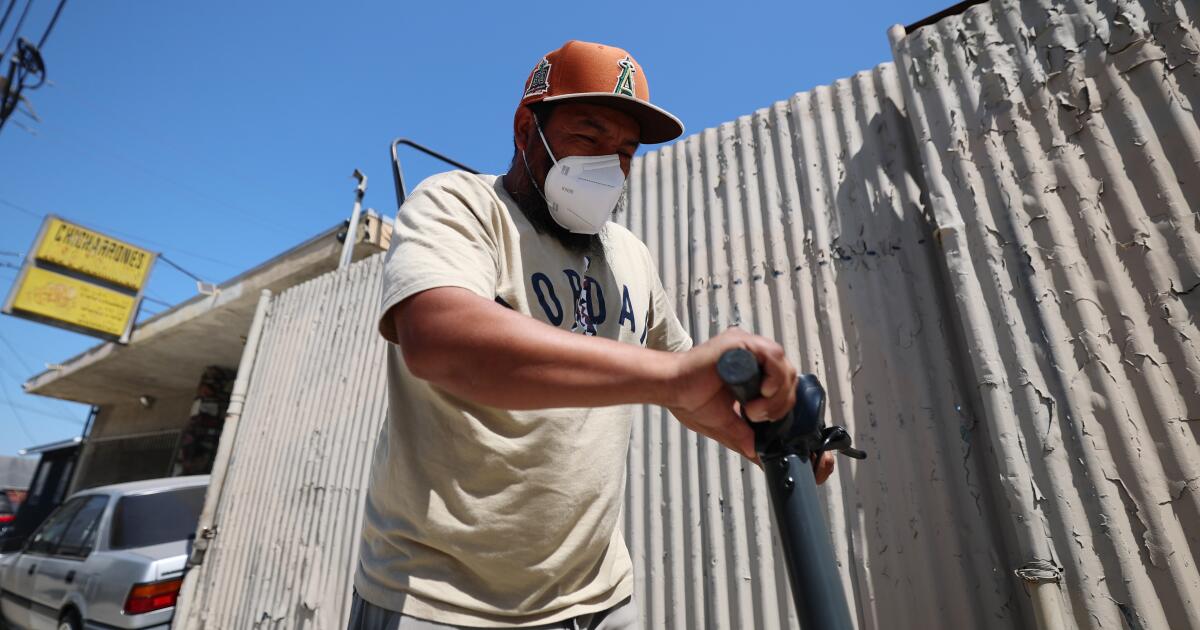
Street vendor Lupe Gonzalez pushes her cart away from a gutted warehouse in Boyle Heights.
(Allen J. Schaben / Los Angeles Times)
Chief Moore has faced criticism for his decision to advise residents to shelter indoors rather than to evacuate during the blaze. That stood in sharp contrast with Orange County fire officials, who evacuated tens of thousands of residents near an overheating chemical tank in Garden Grove in May.
On Tuesday, Moore told Padilla that the two incidents were very different. Moore said he had discussed the dilemma with TJ McGovern, the interim fire chief for the Orange County Fire Authority.
“He says everybody got mad at him because he evacuated everybody and nothing blew up,” Moore told Padilla. “But everybody’s mad at you because of the shelter-in-place [order] and it smells.”
Moore said that “there was nothing in the air that was hazardous” and that firefighters “never had a threat of an explosion.”
However, environmental experts said 14,000 pounds of flammable anhydrous ammonia were stored in tanks and used as refrigerant at the Lineage warehouse and posed a significant risk of explosion until it was removed days into the fire.
Environmental and community groups said L.A. fire officials also repeatedly emphasized the risks from ammonia in their radio communications. On the first day of the fire, a group of firefighters was hit by a plume of ammonia gas, and fire command quickly organized medical help.
“The majority of my division got exposed to ammonia gas. We’ll need to get them assessed.”
On Tuesday, Moore said no amount of ammonia was detected.
“When [firefighters] opened those doors, there was what looked like a big vapor cloud that came out,” Moore said. “That was the cold air mixing with the hot air that caused a vapor. It wasn’t ammonia.”
But residents remain skeptical.
Padilla’s visit follows a notice of violation that the South Coast Air Quality Management District issued to Lineage. The notice of violation was issued on July 12, after the agency received more than 40 public complaints of rotten, sour, garbage-type odors in the area. Inspectors confirmed the odors with community members and traced them back to cleanup operations at the facility, according to the air quality agency.
Boyle Heights residents are calling on Gov. Gavin Newsom to declare a mandatory evacuation of their community, saying the fire and the toxic aftermath are continuing to pose health risks. Without an evacuation order, they said, insurance companies won’t help residents who want to relocate with rent or mortgage relief.
“For nearly a month, a cold-storage warehouse fire has poisoned the air over the Eastside and Los Angeles County and City officials have refused to issue a mandatory evacuation,” read a statement from the community group Protect LA Now. “That refusal forces victims to pay their own way out, and leaves those who can’t afford to leave trapped in gases and toxins that no agency will name.”

Joe Lyou, president of the Coalition for Clean Air, explains how smell is affecting his health while talking to the media near a fire-gutted Lineage facility Tuesday.
(Allen J. Schaben / Los Angeles Times)
Tensions have been building in the community since the fire broke out on June 17 and burned for days.
At a contentious town meeting last week, Los Angeles Mayor Karen Bass struggled to open the meeting over the loud boos and yelling of community members, actions that were repeated as other elected officials took the microphone. The crowd grew even louder when Lineage Chief Operating Officer Jeff Rivera took to the stage and was met with shouts of “Liar!”
Air quality has been a constant concern for the community since the incident began. Beyond the health hazards of breathing in smoke from a building fire, there was a brief, temporary scare when an ammonia line that helped keep the building refrigerated was compromised, though Lineage has said the chemical was not detected in the air. Additionally, 85 million pounds of food thawed, burned and spoiled inside, creating a terrible smell that emanated from the property.
Nora Saenz, a resident of Bell, said she believed local leaders when they said there was no threat. During the fire, she took her niece and nephew to a community event in La Mirada, which was downwind of the fire.
Now Saenz fears what they might’ve breathed in.
“The day of the fire, we were told that the air was safe to breathe,” she recalled. “To this day, I don’t know what I exposed my niece and my nephew to.”
Times staff writers Salvador Hernandez, Clara Harter and Seamus Bozeman contributed to this report.
Video released by Chinese state media shows a state-owned aerospace company launching a rocket and recovering part of it on Friday. The successful launch of a reusable rocket was a major step for China toward challenging SpaceX’s satellite internet dominance.
-

 North Carolina4 minutes ago
Massive great white shark spotted off NC coast. See where its headed
-

 North Dakota10 minutes ago
Neighbors, not competitors
-

 Ohio16 minutes ago
Former Powell residents indicted in $9.3M Ohio Medicaid fraud scheme
-

 Oklahoma22 minutes ago
J.D. PicKell: ‘Oklahoma is going to be a wagon once again’
-

 Oregon28 minutes ago
Oregon Ducks’ Big Ten Championship Chances Entering Fall Camp
-

 Pennsylvania34 minutes ago
Lawmakers break without addressing unconstitutional murder sentences, leave 1K Pa. lifers in limbo
-

 Rhode Island40 minutes ago
Providence mayor, City Council dispute over RENT fund program
-

 South-Carolina46 minutes ago
Could SC’s election rules shape who decides to run for Graham’s US Senate seat?

