Entertainment
These Gen Z and millennial readers are reimagining L.A. book clubs

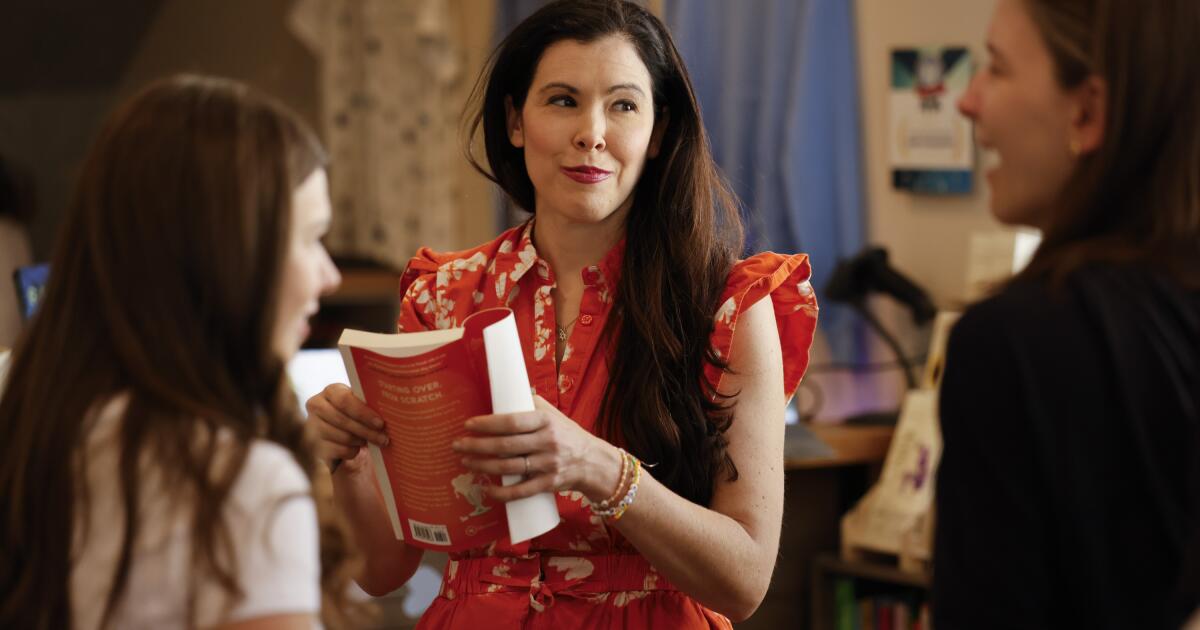
At first glance, the horde of pedestrians — mostly young women — circling the streets of Santa Monica in late January appeared to be a run club. Indeed, many were dressed for it, wearing tennis shoes and baseball caps to evade the sweltering sun.
Upon closer inspection, though, the clues were visible: the group’s relaxed pace, the bountiful tote bags, the occasional flash of a paperback. This was no run club, but instead the Preoccupied literary social calendar’s Walking Book Club, a monthly L.A.-based event where readers take a 40-minute (or so) stroll with a featured author, followed by discounted shopping at a local bookstore.
The Preoccupied Walking Book Club allows readers and authors to connect in a more flexible format.
(Carlin Stiehl / For The Times)
January’s pick was Ali Rosen, who was promoting her romance novel, “The Slow Burn,” at one of the more unconventional stops on her book tour. Although these days, as many fan-facing authors know, the “unconventional” book event is becoming increasingly, well, conventional. Driven by Gen Z and millennial organizers eager to shed the isolation of the pandemic era, events ranging from book crawls to silent reading parties are successfully turning time spent with literature into happening social occasions.
The book crawl
When Allison Ambili Kumar moved to L.A. in 2023, she said she was “overwhelmed in a good way” by the sheer volume of local bookstores and authors. But she also noticed that the market was saturated with author panels and conversations while lacking spaces where book lovers could interact with each other more organically.

“I feel like it expands my love for reading and expands my understanding of the stories that I’m reading when I do that in community,” says Allison Ambili Kumar, who coordinates book crawls across L.A.
(Genaro Molina / Los Angeles Times)
This led Kumar to launch a book crawl, inspired by her reading of “The Art of Gathering: How We Meet and Why It Matters” by Priya Parker. In Kumar’s book crawls, a traveling party of literary buffs bookstore hop, usually visiting at least three in one L.A. area. The idea is that readers can connect in a casual, welcoming environment, all the while increasing visibility for independent bookstores.
Kumar hosted her first book crawl in 2024 in Culver City and has since taken the event to Long Beach, Hollywood and Pasadena. Selected bookstores included legacy shops like Chevalier’s Books and Vroman’s as well as newer ventures like Village Well Books & Coffee and Bel Canto Books. (Book crawls are also a national trend beloved by many a TikToker, with last April marking the first synchronized Global Book Crawl.)
Some of Kumar’s favorite parts of the events are the “book hauls,” when, after each stop or at the end of the day, participants share what they picked up, show-and-tell style.
“I definitely think there’s a heightened joy in sharing what we love about the stories we love, and it also allows us a deeper level of understanding, given that you and I could read the same book and love it, hate it, feel differently about it, have different things that resonated with us from it,” Kumar said.
While Kumar’s book crawls on average draw about 20 attendees each, she said the community that’s formed around them is much larger.

“A lot of our walkers are coming every month, regardless of who the author is,” says the Preoccupied Walking Book Club co-host Morgan Messing.
(Carlin Stiehl / For The Times)
“Events are wonderful,” she said, “but it’s also taken on a life of its own, where people who’ve met on the book crawls are sharing a hotel room together for a romance conference this weekend, and we have our group chat, where people ask if anyone’s going to events at Village Well or the Ripped Bodice, so they can sit together.”
Danielle Dutta, who attended Kumar’s first book crawl in Culver City, began multiple friendships that way: messaging mutual social media connections about whether they were attending an upcoming book event.
“I mean, how else do you make friends as an adult?” Dutta said with a laugh.
The Walking Book Club
Samantha Dockser and Morgan Messing of the Preoccupied launched their literary platform in 2024 to provide a centralized resource for book lovers and authors to keep track of all the “bookish” events, as they call them, happening around L.A.
The duo started their monthly event as an audiobook walking club — a structure which has seen success in other L.A. locales — but quickly realized their attendees were too invested in chatting with their fellow book lovers to maintain the imposed quiet.
“We were trying to think of a structure for an event that would be a low lift for an author and also encourage potential new readers of an author to join,” Dockser explained. With a casual setting and minimal enforced structure, the walking book club format felt right.

Messing, left, and Samantha Dockser, right, interview author Ali Rosen before January’s Walking Book Club.
(Carlin Stiehl / For The Times)
Messing said she sees the reading community as “age-blind,” and the club’s attendance reflects that. Still, many regulars fall in the Gen Z to millennial range.
“I 100% agree that the strongest voices in shaping what the book space looks like are people that are in their 20s currently or were when TikTok popped off in 2020,” Dockser said, at least when it comes to fiction.
To that demographic, self-identifying as a reader is about more than “the literal act of reading a book,” she said. It means you see book-buying as a hobby, frequent book events and share a social circle with other readers.
Ironically, those most invested in the in-person elements of the reading hobby often had their first exposure to the book community online.
Early in the reign of social media, Messing said, there was much fearmongering about how these digital platforms spelled the death of reading.

“It’s honestly beautiful the way that TikTok and Instagram book spaces have taken something that people felt shy about and made it a space where they feel comfortable being themselves and connecting with other people,” Dockser says.
(Carlin Stiehl / For The Times)
“It’s actually done just the opposite,” the co-founder said. “It’s given readers community and introduced non-readers to books and even brought people to physical bookstores because people want to post their books on their social media.”
L.A.-based author Joss Richard, who promoted her swoony second-chance romance “It’s Different This Time” with the Preoccupied’s Walking Book Club in October, said events like Dockser and Messing’s are great for reader engagement and bring a welcome dose of fun. And while it can be tricky to navigate these more atypical formats, especially ones that involve parading down local streets with a swarm of buzzing fans at your back, Richard said most attendees of the Preoccupied’s club knew the drill.
“Rarely is it anyone’s first time going to one of those things,” the author said. That’s especially true of romance readers, who are generally regarded as the social butterflies of the book community.
Richard is sure to see many book event frequenters when she speaks on a romance panel at the L.A. Times Festival of Books April 18.
The silent reading party
The first meeting of Martha Esquivias’ reading club LB Bookworms consisted of the club founder and one of her friends casually reading together at a coffee shop. In the months that followed, Esquivias’ pet project grew into a series of what she called “reading picnics.” She and a few others would read outside in a format she credited to the international Silent Book Club, which has several chapters across L.A.

Martha Esquivias of LB Bookworms regularly co-hosts silent reading parties in collaboration with Cool Cat Collective in Long Beach.
(Juliana Yamada / Los Angeles Times)
Esquivias liked that the structure diverted from that of a traditional book club, which requires significant commitment and coordination.
“With this option, it feels like it’s less pressure and more ‘come and go,’” she said.
Coming of age during the social media boom, Esquivias said she always felt like she wasted her childhood on screens when she should have been playing outside or exploring hobbies. In many ways, plugging into the literary community and falling in love with reading again have healed that sense of loss.
“After the pandemic, there’s been huge talk about finding third spaces or community spaces. I think people crave that more,” she said, adding that she’s proud LB Bookworms has provided that to so many people.

“This is why I started this bookstore: I love community. I want to create a space where people connect with each other,” Sunny’s Bookshop owner Sanaz Tamjidi said.
(Malia Mendez / Los Angeles Times)
Sanaz Tamjidi, owner of Sunny’s Bookshop in Tarzana, last year hosted a silent reading event in collaboration with the L.A. chapter of “reading party” organizer Reading Rhythms.
Tamjidi, a self-proclaimed “zillennial,” said her bookstore’s events are popular among younger customers, who are increasingly seeking out social gatherings that don’t involve drinking or partying.
When Tamjidi told some older customers about the silent reading party, she said they were perplexed, asking, “Wait, so they would come and sit with each other, not talk, but just read silently?”
“They were like, ‘Times have changed,’” Tamjidi said, “and that’s the beauty of it.”

Entertainment
Review: ‘Sugar,’ with Colin Farrell as an alien private eye, gets a new and improved second season

For whatever reason, I never reviewed the first season of “Sugar,” which I’d stopped watching before its late-season big reveal — the detective (Colin Farrell as John Sugar) is an alien. Had that happened earlier in the story I might have hung on, but strictly as a production, I’d found its brand of neo-noir to be mannered, gimmicky, obvious, overdirected (by Fernando Meirelles, the Brazilian director of the fine “City of Men”) and, as you may have surmised, off-putting.
This is by way of announcing that the second season arrives Friday on Apple TV and that I like it very much. The stylistic eccentricities have been dialed back, including the use of old Hollywood film clips to reflect the action and possibly the thoughts of its main character, a cinephile from space, who is both practicing and enacting the work of a private detective. He reads American Cinematographer; he takes the Paramount studio tour, then takes it again.
One might navigate the new season without having watched the first, though at least reading an online synopsis. Sam Catlin (“Preacher”) has taken over as showrunner from series creator Mark Protosevich; the tone is lighter, the plot less perverse. Under new director of photography Marshall Adams, the camerawork, formerly too quirky by half — a mishmash of lenses and film stocks and canted angles — has settled down, as has the editing, enhancing the story by letting it breathe and staying out of the way of Farrell’s singular performance — the series’ distinguishing feature and warm heart.
For all his influences, Det. Sugar is the one character who can’t easily be traced back to an earlier model. As detectives go, he’s unusually sweet, optimistic, diplomatic, willing to give a villain a way out, closer to the Man Who Fell to Earth than to Sam Spade. He loves animals, and they love him.
Farrell, who also narrates in a soft voice, often wears a look of shy incomprehension, as if a beat behind in translating the world around him, a stranger in a strange land.
Using his mild telekinetic powers, Det. John Sugar (Colin Farrell) makes a tennis ball float in the air, to the delight of some dogs in “Sugar.”
(Apple TV)
As aliens go, he is also something of a lightweight, demonstrating some mild telekinetic abilities (making a tennis ball float to entertain a pack of dogs, stirring the ice cubes in his drink) and the ability to speak any language, which underscores his empathetic nature. He makes friends with cab drivers, tour guides and security guards; as an “immigrant,” he appreciates immigrants. He’ll do the dishes for a woman too grief-stricken to attend to them, explain to a man who hates his own name that it’s a reference to Bogart’s character in “Casablanca” and a sign of his mother’s love. He can drink as much alcohol as he likes — his metabolism keeps him from getting drunk — which makes him indefatigable company in a bar, but he is horribly allergic to cinnamon. Remember that, if you’re ever forced to defend yourself from an ET.
Where classic noir detectives tend to be middle-class sorts a job or two ahead of losing their office, Sugar has a lot of money, whether saved up from earlier high-priced cases — his Season 1 client is a rich old man ripped from “The Big Sleep” — or piped down from space. He wears expensive suits, lives in a bungalow in a high-end Los Angeles hotel but also buys a house in the Hollywood Hills because its view allows him to spy on a dodgy character from Season 1; and drives a Nassau Blue 1966 convertible Corvette that he blithely parks in bad neighborhoods with the top down. When the car actually is stolen in this season’s opening episode, it brings him into contact with Val (Sasha Calle, Supergirl in “The Flash” movie), a spunky, punky petty criminal who negotiates its return and whom Sugar makes his assistant; I wouldn’t say Calle is underused, but I would have liked to see more of her.
Sugar came to Earth as part of a group of “thousands,” mixing among humans incognito just to observe them, for benign alien reasons, like Starship Enterprise on its five-year mission. (We get a flashback to Sugar’s first days on Earth, before he acquired the suits and the car and settled on a profession.) At the end of Season 1, their cover being blown, and humans being famously weird when it comes to extraterrestrials — you’ve seen the movies — they return home en masse, except for Sugar. He’s still working a missing persons case of his own, looking for his sister, hopefully alive, somewhere on the planet. And he’s becoming more of an Earthman — the dangers of assimilation are a specific Season 1 plot point. On top of that, like a lot of people, he just loves L.A.

Laura Donnelly as flirtatious Charlotte in “Sugar.”
(Jason LaVeris / Apple TV)
And then there’s Charlotte (Laura Donnelly), whom he meets in the bar of his hotel; it doesn’t take a degree in postwar genre fiction to recognize that there may be something fishy, perhaps “fatale,” about her. But like Sugar, we’re content to put that question off as long as possible, in the hopes that maybe this relationship will be as uncomplicated as we’d like it to be, and a tonic for Sugar’s loneliness. (He no longer has his dog, even.) He regularly gets on the subspace shortwave looking for any others of his kind left on Earth.
The new season will get around to that question, though the alien and earthly plot lines are kept on separate tracks. Most of the time “Sugar” functions as a straightforward compelling detective story, as the protagonist hunts for Ji Moon (Raymond Lee), the missing junkie brother of Danny Moon (Jin Ha), a talented young Korean American prizefighter on the first rung of the ladder to success. (Sugar is working pro bono, not needing the money but very much needing something to do.) It brings him into the orbit of drug dealers and crooked police officers and through an array of Southland locations, including the Beverly Center — finally, a good use for that place — Koreatown, the Vista Theater and the Huntington Gardens.
While there’s nothing particularly novel about that plot, it pulls you along, and the series as a whole is orchestrated to make one care about the characters and worry over their fates. Vivid minor characters — there are pro turns from Shea Whigham, Laura San Giacomo and Mireille Enos — make the story live. All in all, a good meal that leaves no bitter aftertaste.
Movie Reviews
Movie Review: ‘Leviticus’ makes a demon out of desire in an auspicious debut for Adrian Chiarella – Sentinel Colorado

What if the object of your desire was also the thing that’s trying to kill you? Not slowly irritating you to death for leaving the toilet seat up again. We mean actively trying to strangle you.
That’s the intriguing premise behind the horror-satire “Leviticus,” an auspicious feature film debut for writer-director Adrian Chiarella that’s both deeply scary and a queer revolt.
Named for the book of the Old Testament often used to justify homophobia, the movie explores the burgeoning relationship between two young men that is shattered when so-called “conversion therapy” — a scientifically discredited practice — unleashes a demon that stalks them. Some have called the movie “It Follows” meets “Heated Rivalry,” but that’s a disservice to Chiarella’s ambition.
The film centers on Naim (Joe Bird, the breakout star of A24’s “Talk to Me” )and Ryan (newcomer Stacy Clausen), who we watch fitfully, awkwardly fall for each other, slowly exploring their sexuality and stutter-stepping into their true selves. Wrestling turns to flirtation, which becomes longing and tenderness.
That doesn’t go over well in the small Australian town where the movie is set, a blue-collar community with belching smoke stacks, low-slung houses, barking dogs and a Christian pastor — with a “deliverance healer” — who prefers his flock much more heterosexual.
Chiarella is leaning not only into the notion that sexual desire makes you vulnerable, but also the harm that repressing who you are can do. In this case, the demon takes the form of your crush. It has weaponized lust.
“You shouldn’t be near me. I shouldn’t be near you, either,” one of the would-be lovers says to the other.
Chiarella starts his movie with a nod to Alfred Hitchcock — a shower scene worthy of “Psycho” — and nods to others in the genre, like “A Nightmare on Elm Street.” He can be a bit clunky with his images — a frog being eaten by a snake — but his pacing is flawless and his ramping up of terror is sure. “Leviticus” might be an indie film, but it’s got the blessing of Frank Ocean, who gave the filmmakers the right to use his song “Self Control.”
The monsters — in addition to the nasty one only the boys can see, of course — are the adults: the parents and caregivers and friends who turn on vulnerable, scared young men and make them scared of each other. Mom might kindly take some disliked olives off her son’s pizza, but she won’t accept him kissing another boy.
Chiarella’s pro-queer filmmaking extends to his ability to perfectly capture the fumbling ecstasy of new love, the fierce longing of stolen kisses and how scary it is to submit to a new partner. Kudos to Bird and Clausen for capturing that universal feeling.
With his film, Chiarella forms a triumvirate of young filmmakers making horror brilliant in summer 2026, alongside Curry Barker with “Obsession” and Kane Parsons’ “Backrooms.” The future of movies is in good hands.
“Leviticus,” a Neon release that’s in theaters Friday, is rated R by the Motion Picture Association for “bloody violent content, language, some sexual content and teen drug use.” Running time: 88 minutes. Three and a half stars out of four.
Related
Over eons of mythmaking, the 13th century bandit Robin Hood has evolved from a scamp adored by King Henry VIII to a symbol of sticking it to the rich. He’s been called a thief, a benefactor, a commoner, a lord, a killer and a hero. During the Great Depression, Robin was a dashing champion of the people. At the height of the Red Scare, he was a Communist threat; then, in the ‘70s, a sexy cartoon fox. But never until Michael Sarnoski’s “The Death of Robin Hood,” which imagines the folk legend as a benumbed mass murderer, has this outlaw been duller than the rock piles he builds to bury his corpses.
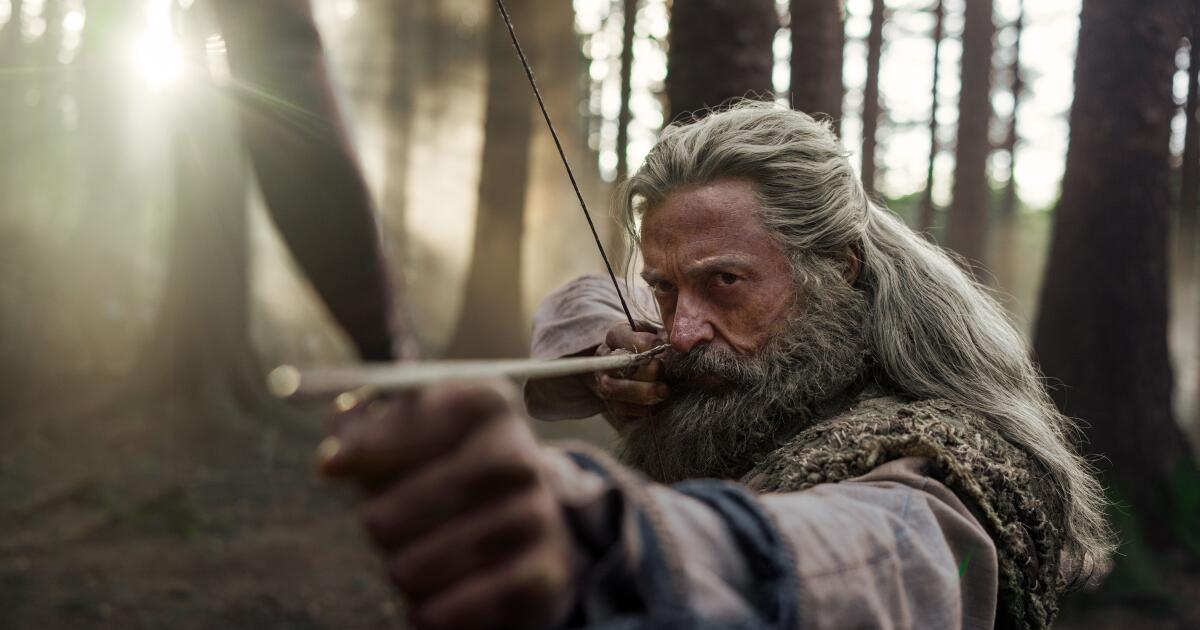
Hugh Jackman plays Robin Hood in his final days, a loose retelling of a 500-year-old ballad, and seems to have ancient dirt creased into his wrinkles. Injuries and exhaustion have him aching to retire. Yet the family members of his casualties won’t let him quit. Out of duty to their bloodlines, these vengeful mourners — even the grandchildren of his victims — continue attempting to assassinate him even though he doesn’t remember, or care about, their beloved dead. Robin is enduring a nightmare version of a party at which every unfamiliar face huffily claims they’ve met you before. It’s relatable, except for the throat-slitting.
This savage, amoral and unfeeling Robin Hood has been written to invert everything modern fans like about him. He doesn’t wear green. He doesn’t sport a feather. He’s never loved a Maid Marian. He doesn’t even romp around a forest with a pack of merry men. Instead, he starts the film on a barren mountaintop, alone. (Similarly, Jim Ghedi’s transporting score has the sound of traditional ballads like “Silver Dagger” splintering apart mid-verse to reassemble as funeral hymns.)
From his gray hair to limping stride, Jackson’s Robin is so battered by decades of violence and outdoor camping that, at first glance, I thought his bare feet were a pair of alligator boots. Filmed in Northern Ireland, the landscapes are cold, green and formidable (if muted by too much mist). The first shot has a miserable grandeur: a frigid landscape, frozen berries and wind so strong it nearly blows a starving traveler sideways. Shortly after, cinematographer Pat Scola’s overhead view of a makeshift cemetery is a stunner.
Sarnoski has D.W. Griffith’s flair for visceral imagery. His favorite trick is to have us empathize with a close-up of a desperate, vulnerable character and then have Robin brutally mow them down. There’s even a scene of Robin crushing a bunny. You can hear the crunch.
“I robbed and killed for the joy of it, nothing more,” Robin grunts to strangers who hail him as the protector of the meek. Over the course of the running time, he’ll reconnect with Little John (Bill Skarsgård) and befriend a leper (Murray Bartlett), a traumatized young man (Noah Jupe), an angry little girl (Faith Delaney) and a kindly nun-slash-nurse (Jodie Comer) who is so blindingly clean that it’s distracting. He also visits a religious commune and witnesses actual generosity only to remain apathetic about repentance or emotional growth.
It’s a tedious spin on a Wolverine movie Jackman has already made, 2017’s “Logan,” in which his mythic anti-heroic X-Man fosters a ferocious moppet en route to the grave. Lately, I’ve come to prefer Jackman as a showman over a savage. (Many stars can scowl, few can tap dance.) But he looks the part — Jackman has a commendable willingness to recede inside himself — even though after the rousing opening, the script gives him almost nothing to do.
The screenplay’s dirge-like momentum is ironic as Sarnoski has set out to make a movie itself about storytelling. You can tell because of the multiple monologues that kick off with someone asking Robin if he’s ever heard that story about so-and-so and forcing the movie to halt while we listen.
From Robin’s experience, he thinks that “stories can make men do terrible things,” perhaps thinking of all those bereaved family members who were honor-bound to chase after him and get themselves killed. Violence metastasizes. In the medieval era, blood feuds carried on for generations; likewise, today’s wars are often rooted in centuries of pain. Robin doesn’t tell tall tales himself except once and when he does, you can understand why, but not why one listener in particular goes along with it.
But he does have an opinion on how to spin a good yarn. When Little John struggles to describe his dream girl, Robin instructs his protegee to sketch an image with words.
“She had red hair like —” Robin prompts in the manner of a stern third-grade teacher.
“Fresh blood!” Little John blurts.
A hyperactive psychopath, Skarsgård’s Little John is one of the movie’s rare treats. The other is the agonizingly good stunt coordination by Julian Spencer that makes men slide in the mud frantically trying to grab and snap each other’s fingers.
“The Death of Robin Hood’s” one big idea is compelling: History gets written and erased in real time. Characters rarely agree on what happened to whom and frankly, I’m still unsure if one of the father-daughter relationships in here is biological or just pretend. (The cast’s mush-mouthed accents don’t help.) Even today, a time where the slipperiness of facts is a known risk, sticky fables endure — pizza-parlor cabals, dog-eating immigrants, gerbils stuck wherever.
We still hail Robin Hood as an inspirational hero who stole from the rich to give to the poor, forgoing alternate versions in which Robin robs a monk, keeps the money, then kills a dozen men to cover up the crime. But during a week when the canted economy just created its first trillionaire, I can’t fathom why Sarnoski felt we needed this version of Robin Hood now. Disillusionment aside, what’s the point of a Robin Hood who insists on standing for nothing?
Sarnoski is a promising talent with two previous features on his resume: “Pig,” a feral $3-million thriller starring Nicolas Cage, and “A Quiet Place: Day One,” a smart franchise prequel. It’s understandable he wanted to split the difference and make a midsize indie that feels all his, to prove himself with the kind of solemn period picture that people take seriously. He’s earned the right to ask financiers and his building fan base for their trust.
But “The Death of Robin Hood” feels like a director thinking only of his ambitions and not whether he’s making a movie anyone wants to bother to see. The lesson is right there in the film: Audiences decide what gets remembered.
‘The Death of Robin Hood’
Rated: R, for strong bloody violence
Running time: 2 hours, 3 minutes
Playing: Opening Friday in wide release
-
Entertainment1 minute ago
Review: ‘Sugar,’ with Colin Farrell as an alien private eye, gets a new and improved second season
-
 Politics11 minutes ago
Political watchdog fines Newsom for failing to report $5.5M in solicited donations on time
-
 Sports23 minutes ago
Goalkeeper Raúl Rangel’s elite play and South Korea’s mistake help Mexico advance
-

 World31 minutes ago
US-Iran talks postponed as Israel attacks Lebanon
-
 News56 minutes ago
Luigi Mangione’s lawyers withdraw plans for psychiatric defense
-

 New York2 hours ago
Video: Knicks Fans Celebrate With Ticker-Tape Parade
-

 Los Angeles, Ca2 hours ago
Armed, dangerous CHP pursuit suspect tied to double homicide in Pomona
-

 Detroit, MI3 hours ago
First responders honored after rescuing 12 people from capsized sailboats near Belle Isle

