News
Popes have spoken out on politics before. But with Trump and Pope Leo it’s different


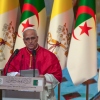
Pope Leo XIV addresses the Algerian community in the Basilica of Our Lady of Africa, in Algiers on Monday. Religious experts say President Trump’s attacks on the pope are a break from how previous popes interacted with American presidents.
Alberto Pizzoli/AFP via Getty Images
hide caption
toggle caption
Alberto Pizzoli/AFP via Getty Images
The ongoing war of words between President Trump and Pope Leo XIV is unparalleled in modern history. It’s not new for popes to speak out on political issues, historians of religion say, but Trump’s insults toward the pope are without precedent.
The direct nature of Pope Leo’s responses as well as him being the first American pope are also playing a role in how the exchange is being interpreted by the public.
The recent back and forth started with Leo’s calling for peace in response to the war in Iran, and continued with him warning of the “delusion of omnipotence” and writing that “God does not bless any conflict.”
It escalated this past weekend when Trump accused Leo of being “WEAK on Crime, and terrible for Foreign Policy,” a potential response to Catholic leaders’ calling for more humanity in the Trump administration’s immigration policies. Trump also claimed Leo was in favor of Iran having nuclear weapons. Trump continued his attacks Tuesday night with another social media post, saying, “Will someone please tell Pope Leo that Iran has killed at least 42,000 innocent, completely unarmed, protesters in the last two months.”
“I have no fear of neither the Trump administration nor of speaking out loudly about the message in the Gospel,” Leo told reporters on Monday at the start of an 11-day Africa tour.
Vice President Vance, who is Catholic, also weighed in on the controversy on Tuesday night, saying the pope should “be careful when he talks about matters of theology.”
“What we saw … is an unprecedented, unhinged attack by the president of the United States on the pope,” said Christopher White, associate director of the Initiative on Catholic Social Thought and Public Life at Georgetown University. “It was clearly meant to intimidate the pope,” but, he added, “the pope’s response shows he is undeterred by the president’s broadside and won’t be distracted from his efforts to push for peace.”
The charged nature of the exchange is new, but many popes have been known for their political critiques. Here’s a brief overview of times when modern popes spoke out on politics, and how Pope Leo is different.
Popes have had political opinions before, but the response was diplomatic

Pope Paul VI talking to President Lyndon Johnson during a special audience at the Vatican City, Rome, on Dec. 23, 1967. Pope Paul famously said: “No more war, war never again.”
Keystone/Getty Images/Hulton Archive
hide caption
toggle caption
Keystone/Getty Images/Hulton Archive
Modern popes have never shied away from voicing political opinions, sometimes running contrary to world leaders.
“When the pope speaks, it’s not that he’s taking sides. He’s really pointing out the objective moral law,” said Michele Dillon, a professor of sociology at the University of New Hampshire whose research focuses on the Catholic Church.
But prior interactions were much more diplomatic.
In 1965, Pope Paul VI was the first pope to speak before the United Nations, urging an end to the Vietnam War and famously saying, “No more war, war never again.” Paul VI pushed President Lyndon Johnson to “increase even more your noble effort” to negotiate for peace in Vietnam in 1967. Later that year, Johnson released a cordial statement after meeting the pope, saying “I deeply appreciate the full and free manner” of the pope’s opinions.
In 1979, Pope John Paul II spoke before the United Nations, focusing on human rights and peace. He advocated an end to conflicts in the Middle East, with a “just settlement of the Palestinian question” and the “territorial integrity of Lebanon.” John Paul II visited President Jimmy Carter in the White House, where they talked about the Philippines, China, Europe, South Korea, and the Middle East, according to Carter’s notes.
John Paul II, a Polish pope, was also involved in less-public political influence. He supported Polish opposition to the Soviet Union and has been credited with helping to bring down the Berlin Wall in 1989. Later, in 2003, he spoke against the U.S. invasion of Iraq and also sent representatives to Washington and Baghdad to make appeals to avoid the war. Those appeals were ignored, but he correctly predicted decades of unrest in the Middle East, according to White.

Pope John Paul II and President Jimmy Carter in October 1979.
AFP/via Getty Images
hide caption
toggle caption
AFP/via Getty Images
John Paul II also voiced opinions on social issues with presidents — disagreeing with Bill Clinton on abortion and pushing George W. Bush to reject stem cell research — but neither president escalated the situation and both remained respectful.
More recently, in 2013, Pope Francis called an impromptu vigil to plead for peace in the civil war in Syria and wrote to Russian President Vladimir Putin to oppose military intervention there. Francis responded to a chemical attack that left some 70 people dead in Syria in 2017, saying he was “horrified,” and he appealed “to the conscience of those who have political responsibility” to end the violence.
In 2015, Francis released a document saying the church accepted the scientific consensus on climate change and urged world leaders to act.
“Many of the world’s leading climate activists have said that no one has done more to shape public opinion on [climate change] than Pope Francis,” White said.
Francis was also a tireless advocate for peace in Gaza, and would call Gaza’s Church of the Holy Family nightly during the war between Hamas and Israel.
Francis also went head to head with Trump in 2016 before Trump’s first election. When Francis visited the U.S.-Mexico border, he said a person “who thinks only about building walls, wherever they may be, and not building bridges, is not Christian.” Trump called the pope’s comments “disgraceful,” but he quickly smoothed over the situation and called Francis a “wonderful guy.”
Popes have been reluctant to name names before now
Popes have historically been hesitant to name the person their criticism is directed at outright. A hotly contested example is Pope Pius XII’s decision to not directly name and denounce Adolf Hitler during World War II.
Pope Francis also faced criticism for his ambiguous references to Russia’s invasion of Ukraine.
This makes Leo’s directness all the more relevant, according to White, who is also the author of Pope Leo XIV: Inside the Conclave and the Dawn of a New Papacy. Leo referring to Trump by name, though still a rare occurrence, was a “new tact” for the papacy, he said.
“There’s just kind of a reflex on the Vatican’s behalf to want to be perceived as neutral as possible in a conflict,” he said. Leo, however, “appealed to [Trump] directly and in a sense, pointed the finger to say: ‘You started this war, you have the power to end this war.’”
The pope does not want to get involved in a political back and forth, said Dillon, the UNH professor, but his job is to preach the Catholic teachings.
“That’s the last thing any pope wants to do, because they do want to be a pope for the universal church and for all people,” Dillon said. “A pope of peace.”
The Trump administration is frequently invoking religion
Another reason for Leo’s outspokenness may be the Trump administration’s continued religious rhetoric and imagery, experts said.
On Sunday, Trump shared an AI-generated image that depicts him as a Jesus-like figure, wearing a white robe and red sash and laying his hands on a sick, bedridden man as light appeared to radiate from his hands. The post was later deleted and Trump claimed the image was of him as a doctor.
Robert Orsi, a professor of religious studies and history at Northwestern University, said he was alarmed by the post’s connotations. He called the whole exchange with Leo “unprecedented,” and “never in U.S. history has this happened.”
On Wednesday, Trump shared a post on social media with an image of him being embraced by Jesus. Trump told reporters last week that he believes God supports the U.S. military action in Iran because “God is good and God wants to see people taken care of.” Last year, the White House posted an image of Trump as the pope.
“We have an administration, not just a president, but an administration that is speaking out in more overtly religious terms than even somebody like Jimmy Carter,” said Margaret Thompson, a professor of history and political science at Syracuse University. Carter was an evangelical Christian.
Dillon, the UNH professor, said that because of this, Leo may have felt a duty to personally reference and respond to Trump’s attacks, because he recognizes that “appeasement has a moral price.”
Jesuit priest and author James Martin told Morning Edition that “pretty much every Catholic I spoke to, from progressive Catholics to traditional Catholics, were appalled,” at Trump’s words toward the pope. “The pope is, you know, the representative of the whole church. So it’s an attack on the church.”
How Pope Leo is viewed, being an American pope

Pope Leo XIV leads a mass at the basilica of St. Augustine in Annaba on the second day of an 11-day apostolic journey to Africa, on Tuesday.
Alberto Pizzoli/AFP via Getty Images
hide caption
toggle caption
Alberto Pizzoli/AFP via Getty Images
Pope Leo is the first American pope, but he does not think of himself as just an American. “He’s the Holy Father for everyone,” said Peter Martin, a former U.S. diplomat accredited to the Holy See.
Still, that doesn’t stop people from looking at the saga from an American angle.
Dillon said the fact that the pope is American could allow him to have greater influence. Americans may have seen popes such as Francis, who were “pointed in their criticism of a great power like America,” as just “anti-America,” she said.
“But if you have a pope who was born and raised in Chicago and really a true out-and-out American criticizing in pointed terms, I actually think that carries more weight,” Dillon said.
In early April, Leo appealed to the American people “to seek ways to communicate. Perhaps with congressmen, with authorities, saying that we don’t want war, we want peace.”
“It doesn’t get more American than that,” White said. “I mean, I don’t think there’s any precedent for a pope saying, ‘call your congressman.’”

News
As Supreme Court expands Trump’s immigration power, experts warn of steeper U.S. population decline

President Trump holds up a bill funding immigration enforcement after signing it in the Oval Office of the White House, Wednesday, June 10, 2026, in Washington.
Julia Demaree Nikhinson/AP
hide caption
toggle caption
Julia Demaree Nikhinson/AP
Even before the Supreme Court ruled Thursday that President Trump has broad power to deport hundreds of thousands of migrants living legally in the U.S. under temporary protected status, David Bier feared the U.S. was slipping toward a demographic cliff.
“We’re destined to be there, in short order, there’s no question,” Bier said. “We’re already seeing a situation where most counties in the United States had more deaths than births.”
An expert on population and immigration at the libertarian Cato Institute, Bier believes the U.S. is beginning to look more like China, Italy and South Korea — nations that face rapid aging and population decline are seen as a crisis.

U.S. birthrates have been declining for decades. There are far too few children born each year to maintain a stable population.
Until last year, high rates of foreign immigration largely offset that trend. But for the first time since the 1930s, during the Great Depression, the U.S. now faces record low birthrates and low numbers of migrants at the same time.
“Our higher birthrates of a century ago are not coming back. There’s no way to have a sustainable fiscal and economic situation that doesn’t involve immigration,” Bier said.
Trump’s legal fight to end temporary protected status for hundreds of thousands of Haitians, Syrians and others living in the U.S. legally is only one part of a wider administration effort to squeeze immigration.
The Supreme Court also ruled this week that the administration has authority to block most asylum seekers from entering the country. Federal agents have also conducted raids in cities across the U.S., to accelerate deportations.
Last month, Trump issued an executive order that could make it harder for many migrants living in the U.S. without full legal status to use banking and financial services.
Many immigration opponents see these changes as progress. In a statement following this week’s Supreme Court decisions. A spokesman for the Federation for Immigration Reform said Trump should have full authority to direct who enters the U.S.
“Our immigration laws are written to be pro-enforcement, not anti-enforcement,” said FAIR’s Christopher Hajec.
But according to Cato’s Bier, Trump’s policies are already reshaping the demographics of communities, meaning there are fewer workers, consumers, taxpayers, and children in schools.
“If you’re not allowing immigration, you’re going to have [an aging and] a declining population and that creates all kinds of problems,” Bier said.
Economists say that without migrants, the number of young workers paying into Social Security will fall more rapidly; schools in many areas will close; and the number of young families having children will decline.
Census data already shows big changes to U.S. population
The immigration decline under Trump is dramatic. In 2024, roughly 2.7 million foreign migrants entered the U.S., according to the Census Bureau. This year, census experts predict that number could drop as low as 300,000. Some demographers believe the U.S. may be reaching a point where more migrants are leaving than entering.

Impacts of this massive shift on America’s wider population are already emerging. Studies by the Census Bureau, the Congressional Budget Office, and the Federal Reserve all point to a more rapidly aging national population under Trump.
Population growth in the U.S. fell by half in 2025 from the previous year, with five states losing population. Census data shows the total number of young Americans, those under age 25, is already falling nationwide.
William Frey, a demographer at the liberal-leaning Brookings Institution, described last week’s Supreme Court rulings as “alarming.” He believes without robust foreign immigration, more states will quickly see their populations stagnate or decline.
“Not just in big immigration states, but in places that have relatively small numbers of immigrants, you know, Iowa, Kansas, Nebraska — those states require immigrants to get any population growth,” Frey said.
Even before Trump’s policies curbed immigration, the U.S. population was expected to decline later this century. Experts say low immigration rates will cause that downward trend to happen much sooner.
According to Frey, the U.S. has time to reverse course. But he believes the Trump administration is committed to lowering both legal and illegal immigration over the long term, a policy he described as dangerous.
“This is as clear as the nose on your face,” he said. “You’ve got to have this growth in the younger population if you’re going to survive. Immigration is a key part of that going forward.”
“America’s doors are closed”

Stephen Miller, White House deputy chief of staff for policy, speaks with reports at the White House, Thursday, June 25, 2026, in Washington.
Jacquelyn Martin/AP
hide caption
toggle caption
Jacquelyn Martin/AP
The Trump administration sees this very differently, describing foreign migrants not as people who sustain state populations and economies, but as a social burden and a threat.
“America’s doors are closed fully to asylum seekers,” Stephen Miller, one of Trump’s top White House policy advisors, said on Thursday.
Speaking with reporters, Miller described the Supreme Court rulings as a victory and said ending birthright citizenship for the children of migrants born in the U.S. is the next step.
“This country doesn’t have a future if we don’t end birthright citizenship,” Miller said. Justices are expected to rule on birthright citizenship as early as next week.
This kind of opposition to both legal and illegal immigration is now widespread among conservatives, said Cato’s David Bier, who worked as a Republican congressional staffer on immigration policy.
He told NPR that when he talks to conservatives about the economic and demographic risks of closing the country’s doors to migrants, many answer with a cultural argument. “[They] would rather have a declining population of ‘true Americans’ than have an economy kept afloat by people who don’t share [their] values,” Bier said.
But if extremely low or zero-level immigration does become the new normal for the U.S., experts say it would swiftly remake the fabric of the country. The Census Bureau estimates that without robust migration in the coming years, total population loss by the end of this century could exceed 107 million people.

UTAH COUNTY, Utah (ABC4) — Utah County has declared a state of emergency.
According to an announcement from the Utah County Commissioner Skyler Beltran, the county is in a dire position due to the extensive wildfires in the area and high fire risk.
The announcement states that declaring the State of Emergency will allow the county to access additional resources, and notes there is no imminent threat to Utah County residents.
“We have utilized a tremendous amount of our resources (very early in the traditional fire season schedule) responding to the Iron Fire and continue to face ongoing recovery concerns,” the statement read. “This was even before the Maple Peak and Cherry fires, which have now merged and are moving toward the Iron Fire.”
The Iron Fire, which started last week, has burned over 40,000 acres. Around 22,830 of those acres were in Utah County. Reportedly, the county has limited resources available to help those who are evacuating from Juab County, including the 600 residents in the Town of Eureka.
Due to the influx in evacuees, the Utah County Commission says that more resources are necessary to help the evacuation shelters in Elberta, Utah. Additionally, due to the Iron Fire and other wildfires, Utah County is facing immense repair needs to avoid future flooding, loss of homes, and disruption to local economies and ecosystems.
There is “imminent threat” to public safety due to the damage.
The commission also asks the public to be vigilant when handling heavy equipment, using campfires or barbecues, and discharging fireworks, to avoid preventing fires.
Their statement added, “Our firefighters are exhausted, our resources are stretched thin and we are in a very vulnerable position.”
News
A day after Alito’s testy response to Sotomayor’s dissent, court says it was a ‘misunderstanding’

The justices of the U.S. Supreme Court, with Justice Sonia Sotomayor (seated left) and Justice Samuel Alito (seated second from right).
Alex Wong/Getty Images
hide caption
toggle caption
Alex Wong/Getty Images
As the Supreme Court heads into the announcement of its final and hugely important opinions next week, there are reverberations from this week’s announcements, and Justice Samuel Alito’s public rebuke of his colleague Justice Sonia Sotomayor.
On Thursday, Justice Alito summarized from the bench three very big opinions he authored for the court’s six justice conservative majority. Alito, unlike most of his colleagues, doesn’t spend much time on these summaries. And it is rare that a justice has three big opinions to announce, but it is almost the end of the term, and there are a lot of big cases still outstanding.
The first case he announced came and went. Alito then moved on to a second case, this one tests whether migrants may apply for asylum in the U.S. by going to one of several ports of entry along the U.S.-Mexican border, and presenting themselves for admission. This entails presenting documents that persuade an asylum officer that applicants’ fear of persecution in their home country is credible enough to allow them to enter the U.S. while their asylum application is processed. Alito’s opinion ruled in favor of the Trump administration’s policy of refusing all such applicants by blocking them at the border. It was a policy also followed at one time by the Obama administration until it was blocked by the lower courts.
After Alito finished his summary of the opinion, he paused, at which point Justice Sotomayor read a summary of her contrary views in dissent. When she finished, however, Justice Alito did not move on to the announcement of his third opinion. Instead, he did something that nobody in the press corps ever remembers happening before. Looking much as if he had just bitten into a lemon, Alito said, “There is much that I would have added to my bench statement had I known there would be a dissent read.” And he then went on to a short extemporaneous rebuttal.
What caused the hissy fit? Did Sotomayor really fail to tell him she would have an oral dissent? That really would have been a breach of the court’s practices. A justice typically notifies the chief justice and the author of the majority opinion in writing if there is to be an oral dissent.
In response Friday to an inquiry from NPR came this terse statement from the court’s public information office.
“Justice Alito was notified in advance by Justice Sotomayor’s chambers that she would be reading a dissent from the bench. It was a misunderstanding on Justice Alito’s part.”
-
 Entertainment46 seconds ago
Review: A mesmerizingly vulnerable Angelina Jolie fails to fully redeem ‘Couture’
-
 Lifestyle8 minutes ago
He turned his one-bedroom West Hollywood apartment into an entertainer’s paradise
-
 Politics11 minutes ago
Quicker count, bigger turnout: L.A. County certifies 2026 primary election ballots
-
 Science16 minutes ago
Water from Boyle Heights warehouse fire carries foam into L.A. River, sparks testing
-
 Sports23 minutes ago
Cameron Carr on Lakers acquiring him draft night: ‘It didn’t feel real’
-

 World31 minutes ago
Why is Crimea critical to the Russia–Ukraine war?
-
News56 minutes ago
As Supreme Court expands Trump’s immigration power, experts warn of steeper U.S. population decline
-

 Los Angeles, Ca2 hours ago
About 20 detained after armed suspect call sparks LAPD response in Koreatown

