Lifestyle
Here’s how to have the most fun at the L.A. Renaissance Faire

I decided that, just this once, I was rooting for evil to win — mainly because I liked their energy more.
The wereboar growled next to Black Pudding, a hulking vicious monster, both focused on ripping Puck and Cordelia to shreds. Oberon, an Archfey god, stood alongside them, concerned. But only one thing would decide the fate of everyone on stage: the D20, a 20-sided die.
For 45 minutes on Saturday morning, a rambunctious audience of elves, fairies, gnomes, wizards and more was transported to another land, far away from any concern for modern life, as they watched the “Dungeons & Shakespeare” live show at the Renaissance Pleasure Faire at the Santa Fe Dam Recreational Area in Irwindale.

Lynx the Sword Swallower prepares the audience for his show.
Before Saturday, I’d never attended a renaissance fair, a reenactment of the English Renaissance in the form of an immersive festival (i.e. why the Irwindale fair is based in the 16th century village of Port Deptford). Although I was not entirely new to fanciful make-’em-ups. My family had been members of the Society for Creative Anachronism, a medieval-era living history organization. We frequently dressed up to visit our local kingdom. Once, a wizard gave me a cape. Another time, I won a plague-themed frog toss.
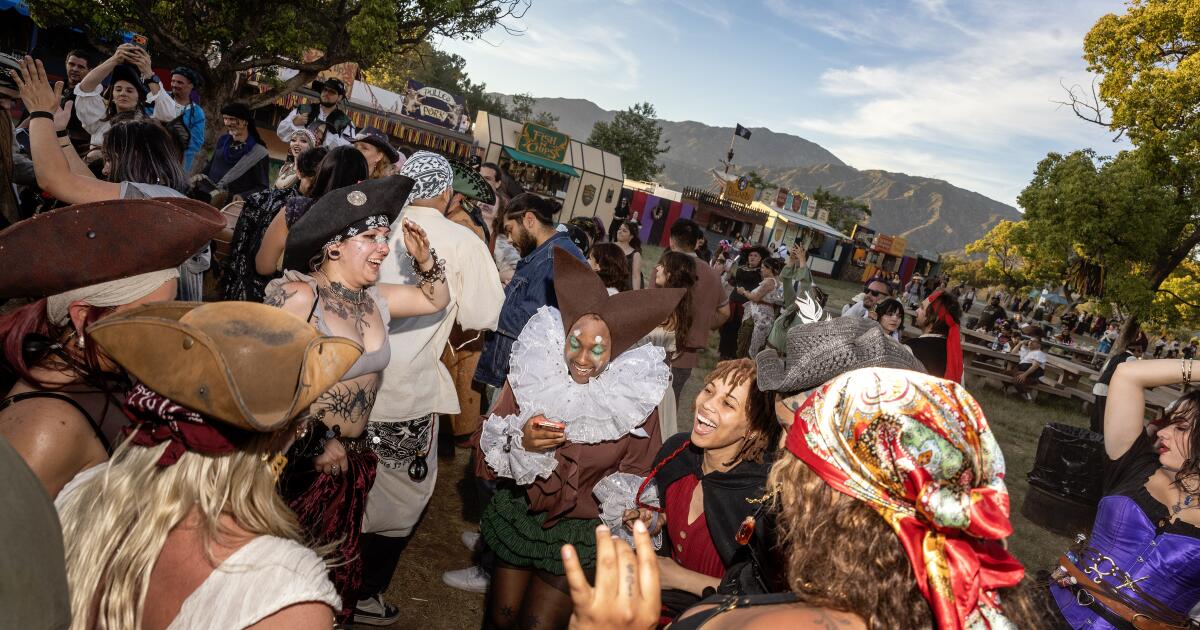
I’d long forgotten what a blissful escape those weekends had been for a young queer kid living in rural America — until Saturday, when I looked around the fair and realized it was a diverse crowd in every sense of the word.
At the “Dungeons & Shakespeare” show, host Willy Nilly encouraged us to lean into the welcoming atmosphere we found among our fellow outcasts.
“Let’s stop worrying about whether we seem weird and make our stories amazing,” the actor, who grew up in conservative Midland, Texas, told the crowd.
And with that same energy, my wife and I trodded further into the fair in hot pursuit of merriment and wonder.
I should note: The Irwindale fair is packed full of opportunities to spend a day. It can, at times, feel overwhelming (and dusty). Here’s what we learned that will set you up for success, should you fancy a trip back in time.

Guests make their way out of the Renaissance Pleasure Faire at sunset.
1. Thou must plan thy morrow
Translation: You must plan your day.
The best way to have the perfect day?
It depends!
Before your visit, I would recommend loosely plotting out your day using the fair’s map. First, you’ll want to discern which performances you’d like to see. Each weekend’s entertainment schedule is released the prior Wednesday, although it can change due to “weather, illness or Her Majesty’s whim,” as the fair website notes.
There are 12 stages and performance areas, each with their own programming. And it’s a real range.
For example, you’ll find MooNie the Magnif’Cent, a fair staple who mixes clowning, stunts and comedy, all without speaking. Supernova the Strongwoman will dazzle the crowd with risky tricks and demolition. And Dora Viellette teaches her audience about an array of music, from medieval to folk favorites, as she plays the hurdy-gurdy (which is very fun to say aloud).
I’d recommend attending the performance you want to see the most early in the day, as the fair seems to get more crowded as the day progresses.
Similarly, if you’d like to focus the day on playing games and experiencing human-powered carnival rides, I’d recommend doing that first. We originally wanted to practice our archery skills, but because we’d waited until after noon, the line was long every time we checked. That said, I did quickly get to throw 10 javelin for $10 later in the day, and I noticed the lines for the “big swing” — aptly named — and the dragon swing were both short. Additionally, it looked like a fairly quick wait to learn from the teachers at St. Jude’s School of Fencing and the Sword Master’s Challenge, where a worker told my wife, “You look like you’d like to hit someone!” (Trust, it wasn’t me, despite my perpetually high anxiety.)
There are also additional paid activities, like having tea with the queen or imbibing via a pub crawl. And then there are the jousting competitions (more on those below).

Her majesty the queen is seen with her court.
2. The Queen doth nay require fanciful garb
Translation: Costumes are not required but very fun.
About five minutes into the fair, I realized I could entertain myself for probably the entire day by simply people watching. Entertainers and guests’ costumes alike were incredible.
Woodland fairies carrying giant daffodils or wearing hats covered in mushrooms. Knights in real armor. Every version of Merlin the wizard, spanning an expansive gender spectrum. Gnomes in tall red hats. And at least one pickle pope blessing people with herbs. You might say they were kind of a big dill. (Hold your applause.)
There are multiple themed weekends, too, including the first weekend when guests were encouraged to strut out in their best pirate garb.
1

2

3

4

1. Stephanie Divinski looks down at her shoulder puppet. 2. Trilainna Stanton, also known as Prince Rain, of San Diego. 3. Partners Reese Pei, left, and Mariner Song are pictured. 4. Meisha Mock, left, and Aimey Beer both wear wolf masks created by Meisha.
3. Parley with the guildfolk
Translation: Talk to the townspeople.
Around the fair, you have the opportunity to interact with several guilds and performance tropes. “The most fun you’ll get at the fair is from talking to people,” my friend Matthew, who has several years of renaissance fair experience, told me. “As someone who volunteers with a guild, we aren’t just there to sit around and look pretty. Come talk to us.”
I loved watching the fae creatures of the Fantastikals frolic around, getting into mischief. I kept an eye out for Danse Macabre, whose members dance away the threat of the plague to the fair. But I was most starstruck when I met her majesty Queen Elizabeth I. (Note: The actors do not break character, even to tell a journalist their given name outside of their fair life.)
As I waited in line, I observed the diligently trained actors of the Queen’s Court. The lord high treasurer bent down and handed a gold coin to a toddler doddling around as his family waited to meet the queen. He tried to eat it, but was bested by his mother.
1

2

3

1. The Fantastikals, representing nature and the elements, provide a sense of wonder and mischief. 2. Royal guard member Maria DeSilva, left, stands by Anna of Austria, the queen of Spain, and her sister Elisabeth of Austria as they read their Bibles together. 3. A maid of honor to the queen passes the time with canvas work.
“You must be quicker if you are to be successful,” Sir Thomas Heneage, the court’s gentleman usher, told him.
I asked the queen what a newbie like me should know about visiting her village.
“I would tell them that at the fair, there is all the world to be had,” she said. “And no matter what you find that will set your heart alight, you will find it here.”
(I also asked her if it was as fun as it looked to be carried around in a basket by the Yeomen of the Guard, and after a good laugh, she affirmed, “It is truly a highlight of our day.”)

The crowd cheers as the jousters charge one another during the final bout of the day.
4. Hark! What a clatter!
Translation: Prepare for shouting
But it’s the fun kind!
When the fair opens at 10 a.m., guests shout, “Open wide the gates!”
“Huzzah!” is commonly shouted out in celebration, like when you tip someone, or when your trusty javelin strikes the target (mine did not).
And “God save the queen!” is exclaimed during the parades and just about any time the queen is around.
5. By hook and crook, ready thyself for a joust
Translation: It’s essential to attend a joust.

A jousters charges toward his opponent during the final bout of the day.
Attending a joust is one of the quintessential renaissance festival experiences.
At the L.A. fair, there are generally three joust performances per day: the Deptford tournament joust, the queen’s joust and the “joust to the death.”
It’s best to arrive 45 minutes early to get a seat, as the performance space fills to capacity. You will be turned away if it is full.
And it’s competitive. Immediately after sitting down, my seatmate informed me that we were rooting for green and blue, and the other team was our mortal enemies. I hooted and hollered accordingly.
6. There is much fine belly-timber
Translation: There is so much good food.

OK, here’s a confession: I eat a vegan diet. But, I can still appreciate the wide range of food options available — including the iconic turkey leg.
After securing our marinated tofu nachos and poke bowl, my wife and I sat down among other guests. Our tablemates had purchased a litany of fried options, including scotch eggs from the Quail Inn, which also serves bacon-wrapped jalapeño peppers, cheese fritters and “whole, partially deboned quail.”
I personally regret not heading over to Scoops on Tap, where I could have ordered vegan lemon blueberry swirl and mint chip ice cream. Their spirit-infused offerings include buttery beer, mocha stout crush and drumstick stout (which is not turkey-flavored, but rather a vanilla base).
7. Pray thee pay full mind to the merchants
Translation: Take time to learn about the artisans.

Drabbits, hand-crafted and one-of-a-kind shoulder puppets, at the Imagination Adoptorium booth.
Throughout the fair, you can easily find unique and colorful birthday gifts, like dragon eggs or a buy-your-own-fairy house, that would make your nieces, nephews and little cousins quickly proclaim you their favorite relative.
Beyond that, you can speak to artisans who’ve been honing their craft, in some cases, for decades. I asked glass artist Stuart Abelman, who has regular glass-blowing demonstrations during the fair, how his artistry fits into the renaissance fair.
“They’ve been blowing glass for 5,000 years,” Abelman, whose studio is based in Van Nuys, said. “Through the Renaissance, there were incredible glass blowers at Murano, Italy, incredible glass blowers. The queen drank [out of] beautiful glassware. They were the best.”

An assortment of masks are seen in the Mischief Masks booth.
8. Fret not if the winds of fate blow you elsewhere
Translation: Don’t worry if you can’t attend this specific fair.
California has several renaissance fairs and similarly themed events throughout the year. And, for the most adventurous, there are other fairs across the country and world, including the Texas Renaissance Festival, said to be the largest in the U.S.
Fairs scheduled this year in California include: Escondido Renaissance Faire (spring event: April 25–26, May 2–3; fall event: TBD); Summer Renaissance Fantasy Faire in Idyllwild (June 13–14); Central Coast Renaissance Festival in San Luis Obispo (July 18–19); Idyllwild Renaissance Faire (Sept. 12–13); and the Northern California Renaissance Faire in Hollister (Sept. 19–Oct. 25).
I spoke to Deptford’s lord mayor, Sir Barnubus Bliss, about what’s most important to him about folks experiencing the fair closest to L.A.
The Original Renaissance Pleasure Faire
When: Saturdays and Sundays through May 17
Where: Santa Fe Dam Recreation Area, 15501 Arrow Highway, Irwindale. Note: The fair’s organizers advise you to not put the address in your GPS. It’s recommended that you take the 210, exit off Irwindale Ave (#38) and follow the signs to the fair. Upon arrival, you will pay the $15 entrance fee to the park, and then be directed to a large parking area.
Tickets: $53 for adults and children 13 or older, $28 for children 5 to 12, and free for kids 4 and younger. Although you can buy tickets at the fair, it’s logistically easier to buy them online at renfair.com.
“Every time someone comes through those doors, I always wish them a ‘Welcome home,’” he said, “because it is my understanding that no matter where you are from, no matter what your life has been, when you come within these gates, when you are within our walls, you are at home, no matter where you were beforehand.”

Nik Frey, far left, and his partner Joanna Dominguez, far right, sword fight with Bexleigh Kilker, 9, and Bexleigh’s dad Kevin, as they all wait out traffic after opening day at the Renaissance Pleasure Faire.
And I felt that as I watched adults gallivant around with childlike glee. As my wife and I left the fair, I did not find myself immediately reaching for my phone. I wanted to stay, just a while longer, in a world where seemingly everyone is welcome to be just as they are.


Stacy Clausen and Joe Bird in Leviticus.
NEON
hide caption
toggle caption
NEON
Summer movies aimed at high-schoolers — comedies, romances, horror flicks — have been a tradition for ages. Think Fast Times at Ridgemont High, Dirty Dancing and the original Friday the 13th, which all drew hot-weather crowds back in the 1980s.
This summer, the movies are queer — not just in casting, but in method and purpose. These three teen flicks transform familiar movie styles by bringing them an LGBTQ sensibility.
A raunchy comedy: She’s the He
YouTube
You know the drill: a bonkers lose-my-virginity plan is hatched by inseparable high-school best buds who are so eager to get girls to notice them, they can hardly think straight.
So, they don’t think … straight. For reasons that could only make sense to horny 17-year-olds, Ethan and Alex decide the way to catch the attention of the school’s hottest girls is to pretend to be trans.
Filmmaker Siobhan McCarthy uses that premise to tell a sweet story about Ethan (who realizes mid-scam that she really is trans), while also mocking some of the more ridiculous transphobic notions — “bathroom scare,” anyone? — that have been politically weaponized recently.
When the whole football team decides that donning women’s attire is a small price to pay to get access to the girls’ locker room, McCarthy prompts boisterous laughs while also establishing how idiotic and unlikely this scenario would be in real life. Casting trans men — say, team captain played by Emmett Preciado — as the cis male characters allows McCarthy to further poke at conservative anxieties.
As leads Alex and Ethan, Nico Carney (a sharp trans comic whose read on toxic masculinity proves hilarious), and Misha Osherovich (sweetly affecting as Ethan discovers her true self) head a terrific, mostly trans and non-binary cast. And a similarly queer team behind the camera helps make She’s the He a raucous, touching, seriously fun charmer — think Some Like It Hot meets American Pie with a Heartstopper vibe.
The romance: Girls Like Girls
YouTube
This gentle teen love story sprang from a hit song Hayley Kiyoko released in 2015. The music video that accompanied the song pictured a budding lesbian romance and has since racked up over 160 million YouTube views. In 2023, Kiyoko penned a young adult book version, which debuted at the top of bestseller lists. Now, she’s brought all of those elements together in a movie about Coley (Maya da Costa) and Sonya (Myra Molloy), two 17-year-old girls navigating a summer romance that takes both of them by surprise.
First-time filmmaker Kiyoko seems content to honor teen romance conventions in a more or less by-the-book tale of first love that has been through enough permutations to feel vaguely workshopped. Still, she’s gotten engaging performances from her leads, as well as from a supporting cast that includes Zach Braff as a loving dad, and Levon Hawke (son of Ethan Hawke and Uma Thurman) as Sonya’s jealous boyfriend.
The horror thriller: Leviticus
YouTube
First-time feature writer/director Adrian Chiarella uses horror conventions in this Australian thriller to explore the trauma caused by a particularly callous strain of homophobic cruelty. The story is centered in a small mill town where high school boys Naim (Joe Bird) and Ryan (Stacy Clausen) fall for each other, only to run afoul of the conservative teachings of their religious community.
Chiarella imagines a Christian sect that has put conversion therapy on steroids, curbing queer desire with a scare-away-the-gay ritual that conjures supernatural demons. The boys smirk as church leaders conduct the ritual, but later discover that when they’re left alone, they’re attacked by murderous entities that take the form of the person they love — each other. Soon, reaching out to — even just seeing each other in school hallways fills them with anxiety. This is, of course, the design: the church leaders want them to be scared. And it will never end.
It’s a conversion therapy metaphor as apt for gay kids as the metaphor in Jordan Peele’s thriller Get Out was for victims of racial bigotry.
Breathtakingly well-crafted, Leviticus clearly has queer teen audiences in mind — all three of these films do — but not exclusively. Yes, Leviticus fills a representation gap. It’s also freakin’ scary.


Lifestyle
L.A. Affairs: Would taking a trip with this new guy finally push us out of the ‘polite’ phase?

Sometimes compatibility unfolds over long conversations at coffee shops or even on the dance floor. Mine and Fernando’s became apparent on our seventh date, standing on a dark corner in downtown L.A. After a short flight, a day at Venice Beach and the fastest glow-up ever for a mom of three, my date opened his hands, sighed and canceled the glorious evening I’d planned. It was supposed to start with a jazz club and end with a tour of late-night sushi bars, until Fernando said, “I feel like a bummer.”
I hooked my arm through the crook of his, turning back toward the empty streets and our stuffy Airbnb.
A few weeks before, on one of our first dates, I’d told Fernando I was presenting at a conference in L.A. “You should join me,” I said, half joking.
“Really?” he asked. “You don’t know me at all.”
He was right. We were in the polite phase. We bonded over being transplants to Seattle — him from the Dominican Republic, me from Florida, but we were still figuring out the basics. I hadn’t learned yet that he never touches coffee but totally loves cake, my least favorite treat. And for me, espresso is a daily requirement.
Fernando didn’t say yes to my invitation right away. We continued to date, playing the questions game. “What’s your favorite snack?” he asked me.
“Mole tacos,” I said. “What’s your biggest flaw?”
“Follow through,” he said. “Yours?”
“I’m annoyingly persistent.”
“Perfect match,” he said.
The more we talked, the more we realized that our shortcomings, which made us look like exact opposites, came from the same root. His father had been barely present during childhood, and my father had died when I was a teenager. We both wrestled with trying to find agency inside of moments in our adult lives that felt like abandonment. Although we’d each been in therapy for years before we met, we also struggled to deal with disappointment.
“Maybe we should go on this wild trip together,” he said.
“Make-it-or-break-it style,” I said.
When we stepped through the door of our downtown L.A. Airbnb after a long, hot day walking the boardwalk, we had our first chance to manage a letdown, together.
“I think people actually live here,” he said.
“Like it’s 2015,” I said.
We’d made a commitment before we flew out to keep things light. If one of us complained, the other was supposed to say something fun. But the apartment was muggy, the surfaces covered in dust. We made exaggerated, positive comments about the vintage decor as I waited for the water to warm in a huge, clawfoot tub.
Fernando said something about getting in while the shower was still cold, so we could preserve water for the good people of California. I noted the fatherly tone — and realized I probably seemed wasteful for resisting the chilly stream during a drought.
While I bathed, he shaved. Then we switched. “I feel shy but not shy,” Fernando said, and I agreed. I wondered if this would be the first of many small, sweet moments — or if it was the only time we’d ever share this kind of intimacy.
We were finally ready for our night on the town, but we only walked six blocks before Fernando turned to me and told me that he was too tired to keep going.
“I owe you,” he said, as we walked back, but I was wiped too and relieved he said it first.
“What if we do something different and call it exciting?” I asked.
We talked about the absolute thrill of ordering takeout in a city that was 30 degrees warmer than the one where we both lived, listing every little thing that was totally amazing around us. All those closed-down garages that would open in the morning selling fabric? Gorgeous.
The dark streetlights on one side of the road that made the shadows look like a modern noir film? Fabulous.
The fact that we were about to fall asleep in the same city as dozens of celebrities we both adored? Relatively meaningless but still badass.
As we ate our to-go sushi in downtown L.A., I realized I wasn’t disappointed at all. My drive to follow through was all about the mission, and our mission had changed. Instead of wooing my new date with a super swanky night on the town, I had the opportunity to connect with him in a real way.
Our trip to L.A. had become a kind of test, way more intense than agreeing on a sofa or building an IKEA shelf. We were stuck spending time with each other without performing, in a strange city, for days.
After I presented at the conference the next morning, Fernando and I moved to a new rental in the Hollywood Hills, where we found our way to endless taco stands and two speakeasies, Good Times at Davey Wayne’s and Adults Only. The only landmark we saw was Muscle Beach, and the only quintessential L.A. thing we did was accidentally find ourselves in front of the Last Bookstore an hour before we needed to head to the airport, so we spent that hour walking around inside.
“Let’s keep traveling,” we said to each other on the way home.
Seven years and dozens of trips later, I engraved “I will travel with you” on the inside of our wedding rings. The night before our wedding, we stood together in a tiny bathroom in his sister’s house in the Dominican Republic, washing our faces. I looked at him in the mirror. He turned and looked at me. “I’m really glad you invited me to Los Angeles,” he said.
“It was a risk,” I said, “and the best trip ever.”
The city isn’t ours, but it made us who we are, together.
The author is a journalist and illustrator working on a memoir about Florida. She splits her time between her Seattle, L.A. and the Deep South. Her Instagram is @adjsbb and website is AshaDore.net.
L.A. Affairs chronicles the search for romantic love in all its glorious expressions in the L.A. area, and we want to hear your true story. We pay $400 for a published essay. Email LAAffairs@latimes.com. You can find submission guidelines here. You can find past columns here.

What freedom looks like today.
Getty Images/Viktoriia Miroshnikova/Photo illustration by NPR
hide caption
toggle caption
Getty Images/Viktoriia Miroshnikova/Photo illustration by NPR
What does freedom mean today?
Happy Juneteenth! For those not in the know, today commemorates when U.S. federal troops arrived in Galveston, Texas in 1865 to take control of the state and ensure that all enslaved people were freed – a full two and a half years after the signing of the Emancipation Proclamation. Since then, Juneteenth has been celebrated all over the country, especially in Texas and across the South, where Juneteenth parades, cookouts, festivals and pageants happen every year. Two weeks from now, the country will celebrate the Fourth of July – and its 250th anniversary. For many Black Americans, there’s always been a tension between these holidays – and their two different ideals for what it means to be free. As voting rights protections are rolled back and Black history is being scrubbed from government websites, what does freedom look like for Black Americans today?
To get into it, Brittany is joined by Dr. Kellie Carter Jackson, chair of Africana Studies at Wellesley College.
For more episodes about the quality of Black life in America, check out:
Jesse Jackson & the end of the civil rights superhero
Is the economy slowing? Ask Black women.
What to expect when you’re expecting racism
Support Public Media. Join NPR Plus.
Follow Brittany on Instagram: @bmluse
For handpicked podcast recommendations every week, subscribe to NPR’s Pod Club newsletter at npr.org/podclub.
This episode was produced by Corey Antonio Rose and Liam McBain. It was edited by Neena Pathak. We had engineering support from Josephine Nyounai. Our Supervising Producer is Cher Vincent. Our Executive Producer is Barton Girdwood. Our VP of Programming is Yolanda Sangweni.
-

 Delaware27 seconds ago
All lanes open after I-69 closure in Delaware County
-

 Florida5 minutes ago
Pilot program aims to build $200K homes in Central Florida to help low-income families buy, not rent
-

 Georgia13 minutes ago
Georgia farmers on alert as New World Screwworm confirmed in Texas, New Mexico
-

 Hawaii15 minutes ago
Principal honors Obama as ‘Child of Hawaii’ at library opening – AsAmNews
-
 Idaho21 minutes ago
Mountain Home neighbors kickoff Juneteenth celebrations as Idaho marks 25 years of recognition
-

 Illinois27 minutes ago
Illinois has already broken the record for number of tornadoes in a year — and it’s only June
-

 Indiana30 minutes ago
Hamilton County teen is youngest delegate at Indiana Republican convention
-

 Iowa36 minutes ago
Reynolds orders flags lowered for funeral of Iowa Sen. Julian Garrett

