Entertainment
Politics take center stage as Paramount submits new offer for Warner Bros. Discovery


As Paramount moved Monday to sweeten its bid for Warner Bros. Discovery, a high-stakes political battle is playing out behind the scenes.
Paramount’s latest offer enhanced its earlier $30-a-share bid, valued at $108 billion, said a person familiar with the process who was not authorized to comment publicly. Details of the revised proposal, first reported by Bloomberg, were not immediately available.
The firm is leveraging both the dynastic wealth of Larry Ellison’s empire and his ties to the Trump administration to dismantle Netflix’s rival $82.7-billion deal for Warner, which owns CNN, HBO and the premier Hollywood film and television studios, according to people close to the auction.
Over the weekend, President Trump turned up the heat, demanding that Netflix “IMMEDIATELY” fire Susan Rice — a former Obama and Biden administration official — who serves on Netflix’s 13-member board or “pay the consequences.”
Trump, in a Saturday night social media post, called the former ambassador “deranged … She’s got no talent or skills — Purely a political hack!”
Trump previously said he would not get involved in the pivotal Warner Bros. auction, instead leaving the matter to the Department of Justice, which is investigating whether a Netflix takeover, or Paramount’s alternative bid, would harm competition. Trump has been an outspoken critic of CNN and many of its on-air hosts.
Netflix won the bidding for the storied studio and HBO in December, prompting the spurned Paramount executives to launch a multipronged strategy to scuttle the Netflix deal.
Netflix co-Chief Executive Ted Sarandos sought to downplay the latest controversy, saying during a BBC interview Monday: “This is a business deal, it’s not a political deal.”
But Paramount, which declined to comment for this article, has not been shy about playing its political cards.
Warner Bros. Studio in Burbank.
(Myung J. Chun/Los Angeles Times)
The company, overseen by Larry Ellison’s son, David, is trying to convince Justice Department regulators and Warner Bros. shareholders that the Netflix deal is too dicey and that they should instead side with Paramount, said sources who were not authorized to comment publicly.
Paramount has attempted numerous maneuvers to gain the upper hand.
“This deal was never going to be decided on the merits of the offer or rigid antitrust considerations,” said Gabriel Kahn, a professor at the USC Annenberg School for Communication and Journalism. “This was a classic Trump administration deal where proximity to the president counts a lot more than financial terms.”
Trump’s Saturday night outburst came after Rice, during a podcast interview last week, said that “it is not going to end well” for corporations, media outlets and law firms that “bent the knee” to Trump should Democrats regain control in Washington.
The comments of Rice, a Netflix director for eight years, came as Paramount-owned CBS was involved in a headline-grabbing dust-up with late-night talk-show host, Stephen Colbert, over Trump’s Federal Communications Commission chair‘s threat to modify a rule requiring that broadcasters to give political candidates equal time. Colbert has accused his company of kowtowing to Trump, which CBS has denied.
Netflix’s Sarandos and Paramount’s David Ellison have made separate treks to the White House.
In October, Paramount hired a former Trump administration official, Makan Delrahim, who oversaw the Justice Department’s antitrust division during Trump’s first term, to quarterback Paramount’s campaign to win over regulators and politicians.
A formidable ally — Sen. Ted Cruz (R-Texas) — recently visited Delrahim on Paramount’s Melrose Avenue lot in Los Angeles. While there, Cruz said he was a fan of the CBS show “NCIS,” which prompted Paramount executives to put together an impromptu tour of the “NCIS Origins” soundstages, according to a person familiar with the visit.
In December, Delrahim made a tactical move to apply for Justice Department approval of Paramount’s deal — despite the absence of a signed agreement with the Warner Bros. board and the consent of its shareholders. The gambit was meant to speed the agency’s approval should the Netflix deal crumble. Warner stockholders are expected to vote March 20.
Last week, Paramount announced that a major deadline had passed without pushback from the Justice Department. “There is no statutory impediment in the U.S. to closing Paramount’s proposed acquisition of WBD,” Paramount said in a regulatory filing.
Paramount faces a separate deadline late Monday to improve the finances of its proposed takeover to shake the support of Warner Bros. Discovery’s board members for the Netflix deal.
Paramount wants to buy all of Warner Bros. Discovery, including CNN.
Netflix, in contrast, does not want the bulk of cable TV channels beyond HBO, and has offered $27.75 a share. It has the right to match any improved Paramount proposal.
Warner is planning to spin off the bulk of its channel portfolio, including HGTV, TBS and Cartoon Network, in a separate company. Its shareholders will receive stock in that entity, slated to be called Discovery Global.
Concerns over Netflix’s deal have been mounting.
Department of Justice regulators have sent inquiries to the three companies, according to one senior executive who was not authorized to speak publicly. The department is said to be looking at Netflix’s historic business strategy of steering most of its film releases to its streaming platform, often bypassing movie theaters. Sarandos has promised to maintain a 45-day theatrical window for Warner Bros. films.
Bloomberg has reported that regulators also are trying to determine whether Netflix has exerted leverage over creators in negotiations when acquiring programming to build its catalog.
This month, Republican lawmakers blasted Sarandos during a Senate Judiciary Subcommittee on Antitrust, Competition Policy, and Consumer Rights hearing to explore antitrust implications of the Warner Bros. sale. Sen. Mike Lee (R-Utah) sent Netflix a series of pointed follow-up questions, including: “If allowed to proceed, what effect will the merger have on future competition?”

Ted Sarandos, left, and David Zaslav at the 2026 Golden Globes.
(Allen J. Schaben / Los Angeles Times)
The hearing also veered into culture wars, with Sen. Josh Hawley (R-Mo.) suggesting Netflix was promoting a “transgender ideology” to children, which Sarandos denied.
Another Missouri Republican, Sen. Eric Schmitt, accused Netflix of making some of “the wokest content in the history of the world.”
“Netflix has no political agenda of any kind,” Sarandos told the lawmakers.
David Ellison also was invited to appear at the Feb. 3 hearing, but he declined — which raised the eyebrows of some members of the panel.
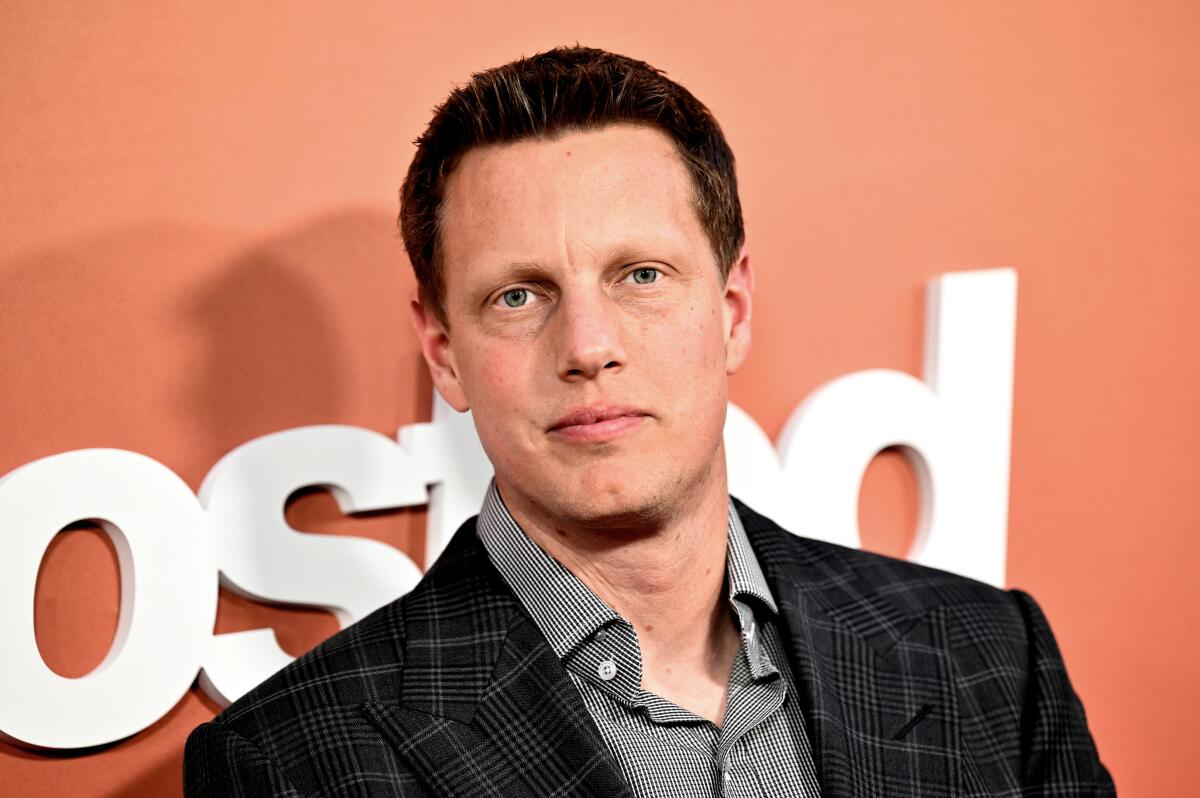
Skydance Media founder and Chief Executive David Ellison, who leads Paramount, is shown in 2023 in New York.
(Evan Agostini / Invision / Associated Press)
Sen. Cory Booker (D-N.J.) challenged Ellison for failing to answer lawmakers’ questions under oath, including about his dealings with the president.
Ellison instead responded with a statement but Booker and other lawmakers wrote back, saying Ellison’s statement “failed to address” the issues raised by Booker.
“The pattern of evasion, combined with Paramount’s apparent confidence that a politically sensitive transaction will clear without difficulty warrants serious scrutiny,” Booker, Senate Minority Leader Chuck Schumer and others wrote in the Feb. 19 letter.
The Democrats instructed Ellison “to preserve records related to the proposed Paramount-Warner Bros. Discovery transaction.”
The move came days after Gail Slater, the Justice Department’s antitrust chief, was bounced from her job, reportedly after becoming a thorn in the side of some business interests. Slater’s former top deputy, who also left the Justice Department, publicly warned that antitrust decisions are being influenced by corporate lobbyists — not in the interest of ordinary Americans.
“We see this happen again and again,” USC’s Kahn said.
“Let’s not forget that Larry Ellison’s Oracle was part of the consortium that purchased the U.S. operations of TikTok. Repeated complaints from the FCC about content at CBS have been heeded by the Ellison regime,” Kahn said, adding: “This is the reality of trying to do any business in the Trump administration: It’s about payoffs and proximity.”


Cut to a seedy alley behind a Chinese restaurant in Rome: A dozen mobsters menace a slight young man who suddenly pulls out a pair of nunchucks. He swings the traditional stick-and-chain weapons and makes quick work of his enemies, who fall one by one, groaning in pain.
The comedic, legendary action scene is from the 1972 film “The Way of the Dragon,” written, directed and starring Bruce Lee. The martial arts star was a trailblazer, allowing Asian Americans to see themselves represented in a strong, positive light on-screen.
And now he has secured a place in California history, becoming the first Chinese American in state history to have a day designated in his honor.
Lee was born in 1940 in San Francisco. His mother was of European descent and his father was a Cantonese opera star who was on tour in the city, affording his son birthright citizenship.
Lee grew up in Hong Kong, where he followed his father’s path as a performer, acting in more than a dozen films as a child and studying the close-quarters southern Chinese martial art Wing Chun.
On May 17, 1959, an 18-year-old Lee returned to San Francisco and eventually made his way to Hollywood. He went on to influence an industry that was at the time bereft of Asian American talent, and helped to popularize the genre of martial arts films and ignite Western interest in Hong Kong action cinema.
In recognition of his contributions, state Assemblymember Matt Haney (D-San Francisco) introduced a bill designating May 17 as “Bruce Lee Day” in California. The bill, signed into law Tuesday by Gov. Gavin Newsom, encourages schools and communities to honor Lee’s life and cultural impact.
Haney has described Lee as a “symbol of pride, resilience and possibility for generations who rarely saw themselves reflected with strength and dignity.”
Lee, who saw himself not only as an actor but also as a poet and philosopher, encountered repeated barriers. Up for the main role in the 1970s television series “Kung Fu,” for example, he was rejected in favor of white actor David Carradine.
In 2020, filmmaker Bao Nguyen sought to show how Lee dispelled anti-Asian sentiment and long-held stereotypes of emasculated Asian men in his ESPN documentary “Be Water.”
“The Asian male was the face of the enemy to many Americans,” Nguyen told The Times in 2020. “It was this vicious cycle of society reflecting media and culture, and media and culture reflecting society. There had to be some kind of intervention there and Bruce, in a way, was that intervention. He was the hero that we hadn’t seen before.”
Lee learned much about the systemic oppression that Black Americans faced from his first student, Jesse Glover, who had been a victim of police brutality.
And scholars have pointed out that, although his films had far-from-perfect politics, they touched on themes of fighting oppression. The 1971 movie “The Big Boss” showed Lee battling alongside laborers. “Fist of Fury” saw him opposing Japanese colonialism and discrimination.
Lee died young in 1973, at age 32 — before he was able to witness the full extent of his stardom. He died just one month before the release of “Enter the Dragon,” which was a box-office sensation and is considered a masterpiece of martial arts filmmaking.

Starring: Kansas Bowling, Jessa Jupiter Flux and Julie Kashmanian
Directed by: Jason Zink
Rated: NR
Running Time: 80 minutes
Our Score: 3.5 out of 5 Stars
The found footage serial killer subgenre is surprisingly crowded with films like “Man Bites Dog,” “Maniac,” and the “Creep” franchise. So while it can be difficult to stand out, 2025’s “Looky-loo” and now “looky-loo: PART II” carve out their own identity by trapping us with very little dialogue and a killer who sees the camera as a creative tool rather than a simple recording device.
For the uninitiated (like I was a month ago), “Looky-loo” follows an aspiring filmmaker whose obsession with cameras evolves into voyeurism, stalking, and eventually murder. Not just one murder, either. He begins staging his victims like actors preparing for a scene, finding as much satisfaction in the production as the killing itself. That’s important because “PART II” picks up almost immediately afterward, with the killer seemingly releasing “Looky-loo” to the public like a drive-in snuff film. He even scrawls “PART II” in blood across a refrigerator, as if he’s proudly unveiling the title card for his next masterpiece.
My perspective may be slightly skewed because I watched both films within a 36-hour span. I never really had time to sit with the first film before diving into the sequel. While I think the original is a solid exercise in restraint, “PART II” noticeably improves on many of its quieter shortcomings. The first film feels a bit like “In a Violent Nature.” Instead of marinating in dense forests and ambient sound, “Looky-loo” lingers in sweaty breathing, uncomfortable silence, and victims blissfully unaware that a killer is standing in the closet. I think it works, but I can also understand why some viewers find it painfully slow.
“PART II” replaces much of that restraint with confidence. The killer stomps upstairs without hesitation, casually raids victims’ refrigerators, drinks their beverages, and only occasionally bothers wearing gloves, as if DNA evidence simply stopped existing. None of these moments feel like plot holes. They’re deliberate choices that suggest someone who either no longer fears getting caught or genuinely believes he’s untouchable. It’s difficult to know which because the film still reveals remarkably little about who he actually is.
What we do learn is perhaps the most interesting development of the sequel. I think our killer is creating incel art. The first film hints at it, but “PART II” pushes the idea much further. While he expands his victims to include men, the murders aren’t treated equally. The men often become victims of blunt rage. The women become productions. They’re staged, framed, and lingered upon with a disturbing artistic obsession. Even more revealing is his growing fixation on female artists. It’s almost as if he can’t tolerate the idea that women might be more creative, more fulfilled, or more talented than he is. The murders begin feeling less like random acts of violence and more like warped attempts to prove he’s the only true artist in the room.
That’s ultimately what elevates the “Looky-loo” series. Like “The Poughkeepsie Tapes,” it invites you to revisit it because so much of the story exists between the scenes rather than inside them. Every repeated viewing uncovers another clue about the psychology hiding behind the camera. Unlike charismatic fictional killers like Hannibal Lecter or Dexter Morgan, this murderer isn’t interested in charming us. He wants us to appreciate the process: the stalking, the waiting, the intrusion, and finally the kill. In his mind, we’re his audience. He believes we should admire his work just as much as he does. And if we don’t, we might as well become part of his next production.
“looky loo: PART II” will have its Midwest premiere at Hysteria Fest in St. Louis on Thursday July 9th.
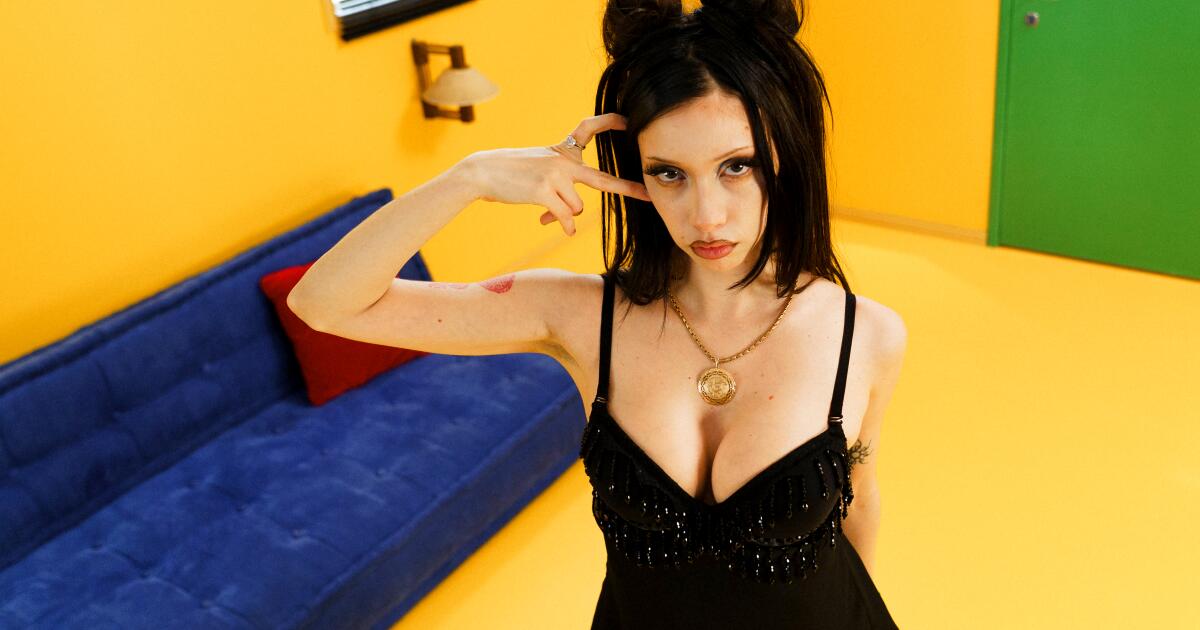
In an era hallmarked by what experts call a “sex recession,” Six Sex is a symbol of liberation.
The Argentine baddie fashions herself as a baby-voiced, bikini-clad fembot, beamed in from the clubs of Buenos Aires — and has become known for cheeky, instructive celebrations of desire. Her songs are designed to galvanize like-minded club rats into Dionysian revelry, or, in the case of the song “How to Make Your Ass Bigger,” squats.
To a certain subset of the Latine underground, she represents a pure-hearted hypersexuality. Yet, for the artist behind the persona, Francisca Agustina Cuello, this wasn’t always the intention.
“I don’t know if it was because I still had to keep my innocence or what, but I didn’t envision the project that way,” she said, calling from a hotel room in Barcelona. “That response sort of came about from the people, towards me. So, I said OK, I’m making it my own.”
In doing so, Cuello has churned out six thumping EPs as Six Sex, a campy character that she describes as a “fable” — a mix of “fantasía y hedonismo.”
That dynamic is taken to extremes on her debut album, “Ultra”, released June 6. It’s a dark and propulsive journey through decades of electronic dance music, best described by its own opening words portending “ultra terrorific fantasy.” (The phrase conjures up images of grandeur, but really, it evokes that “Blades of Glory” quote: “no one knows what it means, but it’s provocative.”)
“I feel like nothing I say is all that serious,” she said about her lyrics. “It’s a thing about my personality to be silly and goof around.”
“Ultra” centers Cuello’s winking, suggestive sense of humor. “Not Your Mom” features a conversation with a garbled, omnipotent voice akin to the parents in Charlie Brown; “FUchi!” features schoolyard taunts about “low dickie energy;” the album ends with “No More Porn,” a playful yet powerful subversion of sexual expectations.
“At the same time, for me, that acts as a filter,” she added with a laugh. “Weeding out the people who get scandalized by it, and identifying the people who get it and say: ‘Yas, yo también quiero tener cuatro novios.’”
Earlier this year, Cuello took the stage at Don Quixote, performing in front of a sold-out crowd for her Los Angeles debut. The smell of sweat permeated the air as she ripped through several of her hits — including collaborations with Reysha Rami and German producer MCR-T. Every single one of her signature ponytail flips sent the room into hysterics. The audience screamed every word at the top of their lungs; it was the loudest, most raucous show I’d been to in years.
Cuello took a breather in the middle of her world tour to chat with De Los over Zoom about all things Six Sex: her new record, her writing style and how it feels to connect with fans spun into febrile intensity.
This interview has been condensed for clarity and was translated from Spanish to English.

“[I’m] weeding out the people who get scandalized,” says Six Sex of her provocative music.
(Catalina Jacobo)
I was really taken by the “Ultra” album cover. You’re wearing a white bikini and in this “come to Jesus” pose. What was the goal?
[laughs] It was hard, because I wanted the cover to represent what the entire journey of the album meant to me. I was looking for something strong and heavy in visual terms, because with “Ultra”, this is the first time I’ve finished a long, heavy project and I see the start of something. It’s like something new was unlocked. I found a new way to convey feelings, and a new way to create as well. It’s not like I just finished, and it is what it is. Rather, it is the beginning of something bigger.
Is there an element of separation at all between the artistry and you as a person?
I think they’re pretty close. It’s as if Six Sex was sort of a fable, or like a hentai or comic [version of] my life. It’s also happened that things I wrote as a joke later became reality. But generally, I draw inspiration from things that actually happened to me.
Is it weird to put those intimate experiences on an album?
No, not for me. Because I’m not speaking so seriously, I don’t feel exposed. Even though my persona and my character are very close to one another, I don’t have to prove anything to anyone. I’m not trying to make you believe in something. The songs stop being about me as soon as someone else listens to them. There are certain things we can all see ourselves represented in, and I think my music aims for that, too.
I want to ask about your performance style. I saw you live in Los Angeles and was really taken by the energy exchange between yourself and the crowd. How do you approach live performance?
Nowadays, I’m in a balance between performance and being a human being that connects with people and can pause to look in the eyes of the audience to register how they feel. I like being in a showgirl role, and at the same time, knowing when to step out of it.
Sometimes I go up there after having a crappy day, thinking that I’m gonna screw it up. And when I get up there and connect with the people, everything flows in a perfect way.

Does the music transform when it’s performed live, versus on a record? A lot of your music seems designed to be played in the club.
I think it’s very personal. For me, I’m a bit autistic; sometimes when I’m at a show, I get different sensations. It really depends on the person. I like seeing people’s reactions live when I start playing these songs for the first time. People were super hyped. They were enjoying them and jumping around a lot. It feels really fresh.
You reference ‘90s club classics all over “Ultra,” including by U.K. band the Prodigy on “Bitch Up.” How did these sounds come into your life?
These sounds evoke a special kind of nostalgia for me. Even though I hadn’t been listening to them lately, they sounded like something I wanted to bring back to the table — songs my uncle used to listen to when I was really young. Like a CD [of] pirated songs that somehow ended up at my house, and at the time I was like, “Wow, what is this music?”
There’s an element of Six Sex that gives “fembot,” like a female, sexy robot. I’m curious if you feel that playing out in your work.
[laughs] I didn’t know about the fembot thing. I don’t use Twitter. I [keep] a bubble… against some things that I don’t know. But I’ve always liked the idea that people have that perception of me, to some extent.
How do you feel about the rise of AI as a musician, especially considering your persona adopts that perception?
I mean… I don’t have a formed opinion on the matter. I do think that, I don’t know, it’s all very relative. For one thing, I obviously feel like it strips away the human value, but at the same time, it’s also a tool for humans. So it’s kind of contradictory. I feel weird about it…. I don’t know.
Zooming out, I’ve noticed Argentina has been having a musical moment over the last few years between yourself, Ca7riel y Paco Amoroso, Juana Rozas… How do you feel Argentina being represented or even challenged in your music?
I feel that culturally, Argentina is a very rich country. However, I do feel like, over generations, a paradigm was broken, and new sounds have been created that don’t necessarily abandon the roots of our music, but were created out of counterculture.
That same kind of counterculture is what makes Argentina be in such turmoil. It’s also the context of our country. Economic, political, social. The key Argentinian figures we refer to nowadays are constantly changing. And that allows you to listen to a variety of genres from Argentina, from people doing different things, and at the same time raising the flag and saying: “Yo soy argentino.” And we love that.
-

 Health4 minutes ago
Big Medicare change slashes weight-loss drug costs for eligible seniors
-

 Sports7 minutes ago
VAR denies Croatia’s game-tying goal as Cristiano Ronaldo leads Portugal to Round of 16
-

 Technology12 minutes ago
New sodium-ion battery could reshape grid storage
-
 Business19 minutes ago
Home insurer surcharges for wildfires is legal, judge rules
-
Entertainment22 minutes ago
California designates Bruce Lee Day, first such honor for a Chinese American
-
 Lifestyle27 minutes ago
Ahead of America’s 250th birthday, a photographer finds unity in tarnished state quarters
-
 Politics34 minutes ago
Facing setbacks and resistance, Trump presses bid to reshape elections on multiple fronts
-
 Sports42 minutes ago
Dodgers overcome Roki Sasaki’s poor performance to rout Padres

