Business
Commentary: Yes, California should tax billionaires’ wealth. Here’s why

That shrill, high-pitched squeal you’ve been hearing lately? Don’t bother trying to adjust your TV or headphones, or calling your doctor for a tinnitis check. It’s just America’s beleaguered billionaires keening over a proposal in California to impose a one-time wealth tax of up to 5% on fortunes of more than $1 billion.
The billionaires lobby has been hitting social media in force to decry the proposed voter initiative, which has only started down the path toward an appearance on November’s state ballot. Supporters say it could raise $100 billion over five years, to be spent mostly on public education, food assistance and California’s medicaid program, which face severe cutbacks thanks to federal budget-cutting.
As my colleagues Seema Mehta and Caroline Petrow-Cohen report, the measure has the potential to become a political flash point.
The rich will scream The pundits and editorial-board writers will warn of dire consequences…a stock market crash, a depression, unemployment, and so on. Notice that the people making such objections would have something personal to lose.
— Donald Trump advocating a wealth tax, in 2000
Its well-heeled critics include Jessie Powell, co-founder of the Bay Area-based crypto exchange platform Kraken, who warned on X that billionaires would flee the state, taking with them “all of their spending, hobbies, philanthropy and jobs.”
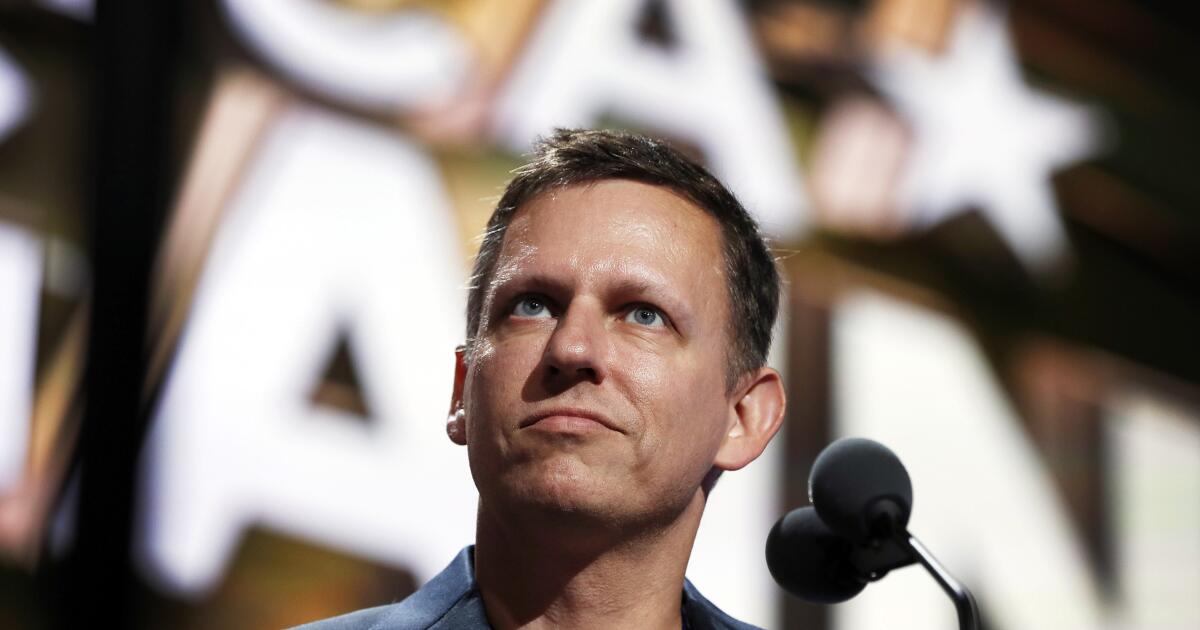
Venture investor Chamath Palihapitiya claimed on X that “$500 billion in wealth has already fled the state” but didn’t name names. San Francisco venture investor Ron Conway has seeded the opposition coffers with a $100,000 contribution. And billionaire Peter Thiel disclosed on Dec. 31 that he has opened a new office in Miami, in a state that not only has no wealth tax but no income tax.
Already Gov. Gavin Newsom, a likely candidate for the Democratic nomination for president, has warned against the tax, arguing that it’s impractical for one state to go it alone when the wealthy can pick up and move to any other state to evade it.
On the other hand. Rep. Ro Khanna (D-Fremont), usually an ally of Silicon Valley entrepreneurs, supports the measure: “It’s a matter of values,” he posted on X. “We believe billionaires can pay a modest wealth tax so working-class Californians have Medicaid.”
Not every billionaire has decried the wealth tax idea. Jensen Huang, the CEO of the soaring AI chip company Nvidia — and whose estimated net worth is more than $160 billion — expressed indifference about the California proposal during an interview with Bloomberg on Tuesday.
“We chose to live in Silicon Valley and whatever taxes, I guess, they would like to apply, so be it,” he said. “I’m perfectly fine with it. It never crossed my mind once.”
And in 2000, another plutocrat well known to Americans proposed a one-time tax of 14.25% on taxpayers with a net worth of $10 million or more. That was Donald Trump, in a book-length campaign manifesto titled “The America We Deserve.”
“The rich will scream,” Trump predicted. “The pundits and editorial-board writers will warn of dire consequences … a stock market crash, a depression, unemployment, and so on. Notice that the people making such objections would have something personal to lose.” (Thanks due to Tim Noah of the New Republic for unearthing this gem.)
Trump’s book appeared while he was contemplating his first presidential campaign, in which he presented himself as a defender of the ordinary American. His ghostwriter, Dave Shiflett, later confessed that he regarded the book as “my first published work of fiction.”
All that said, let’s take a closer look at the proposed initiative and its backers’ motivation. It’s gaining nationwide attention because California has more billionaires than any other state.
The California measure’s principal sponsor, the Service Employees International Union, and its allies will have to gather nearly 875,000 signatures of registered voters by June 24 to reach the ballot. The opposition is gearing up behind the catchphrase “Stop the Squeeze” — an odd choice for a rallying cry, since it’s hard to imagine the average voter getting all het up about multibillionaires getting squoze.
The measure would exempt directly held real estate, pensions and retirement accounts from the calculation of net worth. The tax can be paid over five years (with a fee charged for deferrals). It applies to billionaires residing in California as of Jan. 1, 2026; their net worth would be assessed as of Dec. 31 this year. The measure’s drafters estimate that about 200 of the wealthiest California households would be subject to the tax.
The initiative is explicitly designed to claw back some of the tax breaks that billionaires received from the recent budget bill passed by the Republican-dominated Congress and signed on July 4 by President Trump. The so-called One Big Beautiful Bill Act will funnel as much as $1 trillion in tax benefits to the wealthy over the next decade, while blowing a hole in state and local budgets for healthcare and other needs.
California will lose about $19 billion a year for Medi-Cal alone. According to the measure’s drafters, that could mean the loss of Medi-Cal coverage for as many as 1.6 million Californians. Even those who retain their eligibility will have to pay more out of pocket due to provisions in the budget bill.
The measure’s critics observe that wealth taxes have had something of a checkered history worldwide, although they often paint a more dire picture than the record reflects. Twelve European countries imposed broad-based wealth taxes as recently as 1995, but these have been repealed by eight of them.
According to the Tax Foundation Europe, that leaves wealth taxes in effect only in Colombia, Norway, Spain and Switzerland. But that’s not exactly correct. Wealth taxes still exist in France and Italy, where they’re applied there to real estate as property taxes, and in Belgium, where they’re levied on securities accounts valued at more than 1 million euros, or about $1.16 million.
Switzerland’s wealth tax is by far the oldest, having been enacted in 1840. It’s levied annually by individual cantons on all residents, at rates reaching up to about 1% of net worth, after deductions and exclusions for certain categories of assets.
The European countries that repealed their wealth taxes did so for varied reasons. Most were responding at least partially to special pleading by the wealthy, who threatened to relocate to friendlier jurisdictions in a continent-wide low-tax contest.
That’s the principal threat raised by opponents of the California proposal. But there are grounds to question whether the effect would be so stark. For one thing, notes UC Berkeley economist Gabriel Zucman, an advocate of wealth taxes generally, “it has become impossible to avoid the tax by leaving the state.” Billionaires who hadn’t already established residency elsewhere by Jan. 1 this year have missed a crucial deadline.
The initiative’s drafters question the assumption that millionaires invariably move from high- to low-tax jurisdictions, citing several studies, including one from 2016 based on IRS statistics showing that elites are generally unwilling to move to exploit tax advantages across state lines.
As for the argument that billionaires could avoid the tax by moving assets out of the state, “the location of the assets doesn’t matter,” Zucman told me by email. “Taxpayers would be liable for the tax on their worldwide assets.”
One issue raised by the burgeoning controversy over the California proposal is how to extract a fair share of public revenue from plutocrats, whose wealth has surged higher while their effective tax rates have declined to historically low levels.
There can be no doubt that in tax terms, America’s wealthiest families make out like bandits. The total effective tax rate of the 400 richest U.S. households, according to an analysis by Zucman, his UC Berkeley colleague Emmanuel Saez, and their co-authors, “averaged 24% in 2018-2020 compared with 30% for the full population and 45% for top labor income earners.” This is largely due to the preferences granted by the federal capital gains tax, which is levied only when a taxable asset is sold and even then at a lower rate than the rate on wage income.
The late tax expert at USC, Ed Kleinbard, used to describe the capital gains tax as our only voluntary tax, since wealthy families can avoid selling their stocks and bonds indefinitely but can borrow against them, tax-free, for funds to live on; if they die before selling, the imputed value of their holdings is “stepped up” to their value at their passing, extinguishing forever what could be decades of embedded tax liabilities. (The practice has been labeled “buy, borrow, die.”)
Californians have recently voted to redress the increasing inequality of our tax system. Voters approved what was dubbed a “millionaires tax” in 2012, imposing a surcharge of 1% to 3% on incomes over $263,000 (for joint filers, $526,000). In 2016, voters extended the surcharge to 2030 from the original phase-out date of 2016. That measure passed overwhelmingly, by a 2-to-1 majority, easily surpassing that of the original initiative.
But it may be that California’s ability to tax billionaires’ income has been pretty much tapped out. Some have argued that one way to obtain more revenue from wealthy households is to eliminate any preferential rate on capital gains and other investment income, but that’s not an option for California, since the state doesn’t offer a preferential tax rate on that income, unlike the federal government and many other states. The unearned income is taxed at the same rate as wages.
One virtue of the California proposal is that, even if it fails to get enacted or even to reach the ballot, it may trigger more discussion of options for taxing plutocratic fortunes. One suggestion came from hedge fund operator Bill Ackman, who reviled the California proposal on X as “an expropriation of private property” (though he’s not a California resident himself), but acknowledged that “one shouldn’t be able to live and spend like a billionaire and pay no tax.”
Ackman’s idea is to make loans backed by stock holdings taxable, “as if you sold the same dollar amount of stock as the loan amount.” That would eliminate the free ride that investors can enjoy by borrowing against their holdings.
The debate over the California wealth tax may well hinge on delving into plutocrat psychology. Will they just pay the bill, as Huang implies would be his choice? Or relocate from California out of pique?
California is still a magnet for the ambitious entrepreneur, and the drafters of the initiative have tried to preserve its allure. Those who come into the state after Jan. 1 to pursue their ambitious dreams of entrepreneurship would be exempt, as would residents whose billion-dollar fortunes came after that date. There may be better ways for California to capture more revenue from the state’s population of multibillionaires, but a one-time limited tax seems, at this moment, to be as good as any.


Ferrari’s first-ever fully electric vehicle triggered some fans who said it looks more like an iPhone than an Italian supercar.
The $640,000 Ferrari Luce, which was unveiled on Wednesday, looks like a distant relative of many Apple products. It was built with the help of Jony Ive, the person who designed the look and feel of the Cupertino company’s iPhone, iPod and Macintosh through 2019.
“Legend has it that if you pull the Ferrari badge off the side of the new Luce you see an Apple logo underneath,” one user wrote on X.
A meme circulated portraying the Luce with iPhone applications photo-shopped onto the top, and another showing the car upside down and plugged into an iPhone charger.
To accommodate more batteries and seats, the new EV is bigger and boxier than most classic Ferraris. Ive’s design firm, LoveFrom, which he started in San-Francisco after leaving Apple, was brought in to try to meld the traditions of Ferrari with the new functionality and form allowed by a battery-powered engine.
In a marketing video, Ferrari’s chief design officer, Flavio Manzoni, said he sees the Luce “acting as a bridge between San Francisco and Maranello,” the northern Italian city where Ferrari is headquartered.
The four-door, five-seat car comes onto the scene at a difficult moment for electric vehicles, an industry that has been battered by President Trump’s policies.
Trump has cut EV incentives for manufacturers and customers, prompting several major automakers to move away from EV efforts and focus on gas-powered options.
A luxury EV effort from Sony and Honda, a high-tech vehicle dubbed Afeela, was shut down before it ever hit the road due to Honda paring back its EV offerings.
Legacy automakers such as Ferrari face a particularly difficult landscape for launching an EV, as die-hard fans are attached to traditional, gas-powered models.
Ferraris are known for roaring engines and bold, angular designs, a far cry from the smooth, rounded exterior of the Luce.
To be sure, aggressive redesigns often attract ridicule. The early electric Mustang models were shunned by some but have become popular.
One X user posted a meme with a photo of fictional Italian gangster Tony Soprano saying, “I don’t want any California bulls—.”
The online launch page for the car emphasizes that the Luce is “100% Ferrari.”
Still, Luca di Montezemolo, Ferrari’s former chairman, told reporters on Tuesday that the automaker is “risking the destruction of a legend.”
Ferrari shares have fallen about 8% since the launch of the Luce, signaling investors’ concerns that the car won’t resonate with customers.

NEW YORK — Donald E. Newhouse, president of one of the largest family-controlled publishing companies in the nation and a former board chairman of the Associated Press, died Tuesday. He was 96 and died at his home in New Jersey, his family said.
During his career, Newhouse served as president of the Star-Ledger in Newark, N.J., and head of Advance Publications’ newspaper group, which he navigated into the internet age.
“You reveled in his company. He filled you with energy and humor when you felt doubtful and weak,” said Anna Wintour, the global editorial director of Vogue and Conde Nast’s chief content officer.
“He was scrupulous about not interfering in editorial business, but if you turned to him for counsel, he invariably offered judicious advice,” she said in an obituary released Tuesday night by the Newhouse family.
Newhouse, who lived in New York, spent nearly 50 years overseeing the 35 newspapers of Advance Publications, the media business started by his late father, Samuel Irving Newhouse Sr., in 1922. His older brother, S.I. Newhouse Jr., was chairman of the company and oversaw Conde Nast magazines. He died in 2017.
Louis D. Boccardi, retired president and chief executive of the AP, said Newhouse was an extraordinary chairman for the cooperative.
“His voice was never the loudest in the room, but it was often the wisest,” Boccardi said. Newhouse was instinctively private, but behind that, Boccardi said, was a generous man, at home anywhere and curious about everything.
“He could come across as self-effacing and deferential, but in Don’s skilled hands those were qualities that made him an enormously strong and effective leader,” Boccardi said. “You don’t often see the adjective ‘warm’ attached to a titan of industry, but it applied to him.”
A man who didn’t chase the spotlight
Newhouse, born in 1929, was known for staying out of the public eye. A reporter once asked him to list the biggest chances he took in his career. The answer: “Inviting your questions.”
The usually reserved Newhouse did step into the spotlight when he took on the role of chairman of the Newspaper Assn. of America from 1993 to 1994 and then chairman of the AP board of directors from 1997 to 2002. He had served on the AP board for nine years before becoming its chairman.
“He was a smart and shrewd businessman but as thoughtful and kind a man as you’ll find. Being in his presence was always a joy,” said Doug Clifton, editor of one of Newhouse’s papers, the Plain Dealer in Cleveland, from 1999 to 2007.
Newhouse attended Syracuse University but never graduated, heading into the family’s newspaper business instead. He would regularly visit his newspapers but left the ultimate authority of running them to his publishers.
“Each of our newspapers operates independently, with publishers who are strong, who set policy for their individual organizations and who have the authority and responsibility of carrying out the policies they set,” he said in 1993 when taking over as chairman of the newspaper association.
Newhouse was known for spending money to make sure that papers got the best stories. Jim Willse, editor of the Star-Ledger in Newark, N.J., from 1995 until 2010, said he would give “us all the resources we needed to make the Ledger really special.” Willse said Newhouse loved newspapers and newspaper people.
“He especially enjoyed it when we’d have a story about some politician caught with his hand in the cookie jar, or a spicy feature about stuffed shirts behaving badly,” Willse said.
Newhouse’s philosophy of spending money to produce quality coverage and a hands-off approach toward his editors led to many successes, including multiple Pulitzers.
Many of those newspapers were able to thrive and remain profitable because they dominated their market, but Newhouse said he was very much aware of what he called the “dramatically changing media landscape” and how people get their news.
“The 15th-century revolution was epitomized by the printing of the Gutenberg Bible; ours by Ted Turner’s cable news network and by web-based news sites — news in real time from anywhere to everywhere,” he said in 2004 at the rededication of a communications school named after his father at Syracuse University.
Three years later, he told one of his papers, the Post-Standard of Syracuse, N.Y., that newspapers can survive “by producing content that is relevant, interesting, accurate and entertaining for newspapers and the internet.”
He steered through financial struggles
Yet the papers did ultimately struggle financially.
Advance was known in the industry for a pledge that employees who weren’t in a union would have jobs regardless of economic downturns or technological advances. In 2009, the company announced that the pledge would be withdrawn.
The company also moved away from daily publishing of several papers. In 2012, it announced that the Post-Standard; the Times-Picayune in New Orleans; the Patriot-News in Harrisburg, Penn.; and the Birmingham News, the Press-Register of Mobile and the Huntsville Times, all in Alabama, would cease daily publication and would only offer print editions on Wednesdays, Fridays and Sundays. Those changes were accompanied by hundreds of layoffs.
“His conservative approach left both the papers and its employees somewhat unprepared for the realities of the internet,” said Thomas Maier, who wrote a 1994 biography of the family.
Newhouse’s eldest son, Steven, spearheaded the company’s growth on the internet and on mobile devices. Steven Newhouse is currently co-president of Advance Publications.
“My dad spent his life in the newspaper business and was devoted to it, built it up and enjoyed many good years. When it became more challenging, he was first in line to work through, finding solutions to keep the local journalism franchise going,” he said.
Newhouse is also survived by another son, Michael, daughter Katherine Mele and grandchildren. His wife, Susan, died in 2015.
Mayerowitz writes for the Associated Press.

Child safety advocates say the massively popular gaming platform Roblox could be bad for kids.
Fairplay and the National Center on Sexual Exploitation have requested the Federal Trade Commission to investigate if the games on Roblox are designed to make kids spend an unhealthy amount of time and money on their screens.
Roblox’s core users are young kids.
In a letter submitted to the FTC, the groups argue that Roblox’s engagement-maximizing design features, virtual currency system, and voice and text chat communication features are inappropriate for the platform’s user base and pose a substantial risk of harm.
“Alone and in combination, these three components capitalize on young users’ developmental vulnerabilities, exploit their desire for authentic self-expression, monetize their lack of impulse control, and turn in-game purchasing power into a form of social status,” the groups noted in the letter submitted Thursday to the FTC.
Roblox allows the purchase of virtual assets — clothing and dance moves, for example — which can only be purchased with the platform’s in-game currency, Robux. The platform obscures the exchange rate between dollars and the in-game currency, leaving young players to navigate a complex system of fluctuating conversion rates that increases the amount of real-world money players spend, according to the letter.
For instance, players can receive more Robux per dollar by purchasing larger bundles of currency or buying a “Roblox Premium” subscription, making it harder for children to perform financial calculations on how much they are spending on the platform.
The letter pointed to instances of unexpected Roblox charges, as one parent discovered that his daughter spent more than $5,000 on Roblox without understanding that she was spending real money.
The letter also outlined examples of “scarcity marketing” techniques that increase demand through limited-quantity assets and time-based reward to drive sales of virtual items, driving a false sense of urgency. Some see it as a strong-arm sales technique that should not be used on children:
“Items only available for a limited time encourage both rapid purchases and returning to the platform frequently — sometimes multiple times per day — to avoid missing out on items,” the letter said.
A Roblox spokesperson said that the company “strongly disputes these claims. Our platform is designed to provide a positive, healthy and enjoyable experience — we build for fun and connection, not short-term engagement. While no system can be perfect, we have a set of safeguards designed to support a safe and civil environment, and clear policies for game creators that require fair treatment of players.”
The groups pointed out that third-party games developed on Roblox are designed to profit from in-game purchases, and have “gambling-like” engagement mechanisms such as lootboxes, in which players cannot see what’s inside until after they have purchased it — and the items vary in value.
“We have clear policies prohibiting both actual and simulated gambling, and a set of rules governing how game creators can use gameplay mechanics like paid random items,” the Roblox spokesperson said. “Most games on Roblox are free to play and no one is required to purchase Robux. In the first quarter of 2026, only 1.4% of our 132 million daily active users were payers on the platform.”
The letter also alleged that the voice and text chat features on the platform expose children to sexual content, and argue that recent changes to age checks have not eliminated opportunities for adult-minor contact.
-

 Florida3 minutes ago
Florida Highway Patrol responds to major Turnpike crash near Exit 133 in Stuart
-

 Georgia9 minutes ago
Josh Brooks defends Georgia football’s ‘sweet spot’ scheduling model
-

 Hawaii15 minutes ago
Honolulu Fire Department to open firefighter recruit applications
-

 Idaho21 minutes ago
Idaho AAA, ITD urge drivers to watch for motorcycles as summer travel ramps up
-

 Illinois27 minutes ago
Illinois Lawmakers Just Passed America’s Strongest AI Safety Bill
-

 Indiana33 minutes ago
South Bend muralist’s work could be on new Indiana Fever Sports Performance Center
-

 Iowa39 minutes ago
Former Iowa State star Milan Momcilovic withdraws from 2026 NBA Draft
-

 Kansas45 minutes ago
On the road again: Arkansas baseball heads to Kansas after brief stop in Fayetteville | Whole Hog Sports

