West
Runner fought off mountain lion with stick just weeks before fatal attack on same Colorado trail

NEWYou can now listen to Fox News articles!
Weeks before a hiker was killed in a suspected mountain lion attack in Colorado, a man was nearly attacked by another big cat on the same trail.
Gary Messina said he was rushed by a mountain lion while running along the same northern Colorado trail on a dark morning in November.
Messina said he threw his phone at the animal while it kept circling behind him and was able to get away after a couple of minutes when he broke a stick off of a log and hit the mountain lion over the head with it.
“I had to fight it off because it was basically trying to maul me,” Messina told The Associated Press. “I was scared for my life, and I wasn’t able to escape. I tried backing up, and it would try to lunge at me.”
OREGON CHILD ATTACKED BY COYOTE DURING GAME OF HIDE-AND-SEEK IN BACKYARD, STATE OFFICIALS SOUND ALARM
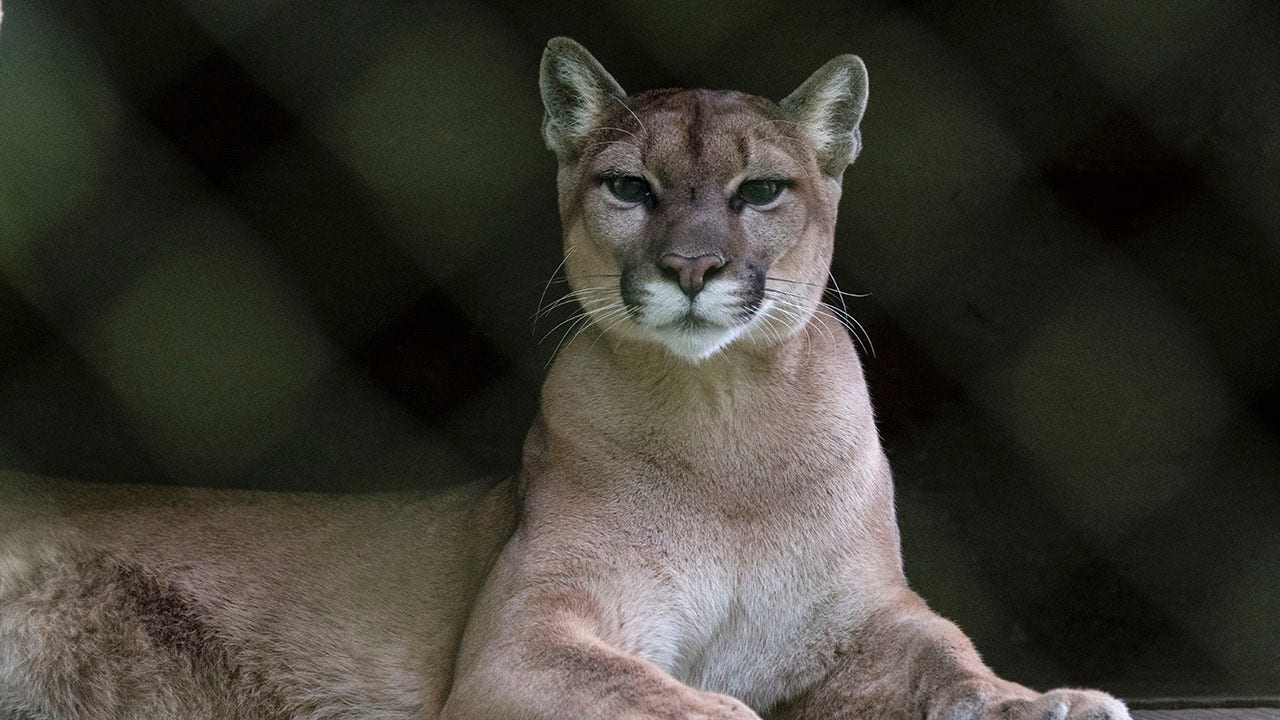
A mountain lion at the Wildlife Rescue Center in Alajuela, Costa Rica, Sept. 16, 2024. (Ezequiel Becerra/AFP via Getty Images)
A woman who was found dead on the same trail on New Year’s Day had “wounds consistent with a mountain lion attack,” a Colorado Parks and Wildlife spokeswoman said.
“Around 12:15 this afternoon, hikers on the Crosier Mountain trail in Larimer County observed a mountain lion near a person lying on the ground from about 100 yards away,” Kara Van Hoose said during a news conference Thursday.
After the suspected attack, wildlife officials killed two mountain lions and are searching for a third to determine if the animal had rabies or another disease.
BEAR REMAINS UNDER CALIFORNIA HOME AFTER WEEKS OF FAILED REMOVAL ATTEMPTS
The attack was the first suspected fatal mountain lion mauling in more than 25 years, with the last one occurring in 1999.
This photo provided by Gary Messina shows a mountain lion in the brush between two trees along the Crosier Mountain trail in the Arapaho and Roosevelt National Forests near Glen Haven, Colo., Nov 11, 2025. (Gary Messina via AP)
Messina said he reported his incident days later, and officials posted warning signs about mountain lions that were later taken down.
He said he believes the animal that attacked him may have been the same one that killed the New Year’s hiker.
Mountain lion sightings in that area of Rocky Mountains National Park are common, but the animals are rarely aggressive.
The New Year’s Day attack would be the fourth fatal one in North America in the last decade and the 30th since 1868, according to the Mountain Lion Foundation.
“As more people live, work and recreate in areas that overlap wildlife habitat, interactions can increase, not because mountain lions are becoming more aggressive, but because overlap is growing,” the organization’s chief conservation officer, Byron Weckworth, said.
Authorities suspect a lone woman hiker in Colorado was killed in a rare mountain lion attack on New Year’s Day. (AP Digital Embed)
CLICK HERE TO DOWNLOAD THE FOX NEWS APP
To avoid risk of an attack, experts tell nature seekers to avoid dawn and dusk, when mountain lions are most active and to travel in groups.
During an encounter, experts suggest maintaining eye contact with the animal, trying to appear as large as possible, slowly backing away without turning your back on the animal and not running.
The Associated Press contributed to this report.
Read the full article from Here



Montana
Montana State doctoral student awarded national research service grant for gut microbiome, arsenic research


LAS VEGAS (FOX5) — Caltech researchers are preparing to build a radio telescope that will be the most sensitive ever constructed and survey the sky 100 times faster than any other radio telescope worldwide.
Schmidt Sciences has greenlit construction of the Deep Synoptic Array after the project completed its final design review. The milestone paves the way for construction to begin on the telescope, which is planned for a remote valley in Nevada.
MORE ON FOX5: Conservation groups oppose potential sale of federal lands highlighted in land mapping tool
The array will consist of 1,650 radio dishes, each slightly more than 6 meters in diameter. The array will span an area of about 20 by 16 kilometers. The team plans to build the telescope by 2029, with science operations commencing soon after.
Survey capabilities
“The DSA will survey the entire visible sky several times in its first five years at unprecedented speeds,” said Gregg Hallinan, principal investigator of DSA, professor of astronomy at Caltech, and director of Caltech’s Owens Valley Radio Observatory. “While all other radio telescopes combined have so far found about 20 million radio sources, the DSA will match that in the first day of operations. By the end of its initial survey, it will have discovered about 1 billion new radio sources.”
The telescope will discover radio emission from millions of stars, galaxies, and other cosmic objects. It will address the mysteries of black holes, pulsars and fast radio bursts. It will also probe the physics of dark matter and gravity, and it will measure the structure and expansion of the universe.
“Radio astronomy is about to go from sketch to photograph,” said Vikram Ravi, the co-principal investigator of the DSA and a professor of astronomy at Caltech. “The DSA is looking at a far larger volume of the universe far more often than any other telescope.”
Real-time imaging
The DSA will be capable of making images in real time. The numerous radio dishes will feed into a supercomputer that creates images instantly. The images will be immediately accessible to the worldwide astronomical community.
“Without the radio camera, we would have to store 100 exabytes of data to complete our survey,” Hallinan said. “This would require 5 million hard drives in a multi-billion-dollar facility the size of multiple football fields. The radio camera solves this problem.”
The DSA’s radio camera will convert the raw data to images in real time with the help of an off-site supercomputer built from Graphics Processing Units built by Nvidia. The radio camera images will be given freely to the public with no proprietary period.
“We want the whole world to also have access to the data just as quickly as we do,” said Katie Jameson, the DSA lead project manager.
The DSA will have the ability to detect more than 100,000 intensely powerful flashes of radio light from fast radio bursts and to localize them to their home galaxies. The DSA will also reveal more than 20,000 new pulsars.
“The science that can be done is endless,” Hallinan said. “There will be enough discoveries to occupy every radio astronomer on the planet.”
The DSA is led by Caltech and funded by Schmidt Sciences. It is part of the Eric and Wendy Schmidt Observatory System. Two pathfinder projects that led to the DSA, the DSA-110 and the OVRO Long Wavelength Array, were funded by the National Science Foundation.
Copyright 2026 KVVU. All rights reserved.

SANTA FE, N.M. – Santa Fe County and Edgewood approved a new agreement and ordinance that secures ongoing fire and EMS services for Edgewood residents.
According to a joint announcement from the Town of Edgewood and Santa Fe County on June 19, the two governments negotiated and adopted a new Joint Powers Agreement and ordinance to keep the Santa Fe County Fire Department serving the town.
County and town representatives drafted the agreement together. The town adopted the ordinance unanimously at a special meeting on June 16, putting an end to weeks of uncertainty.
Santa Fe County District 3 Commissioner Camilla Bustamante said, “I believe we are all relieved to know that the people of Edgewood will continue to have the fire and EMS services necessary to protect their homes, their families, and their community. This community deserves nothing less.”
The announcement said the ordinance takes effect five days after final publication. The statement also said no further action or approval is needed to guarantee continued fire suppression, fire prevention, and EMS services for Edgewood residents.
Both governments noted the agreement will continue indefinitely unless either side ends it with five years’ notice.
-

 Illinois6 minutes ago
Illinois has already broken the record for number of tornadoes in a year — and it’s only June
-

 Indiana9 minutes ago
Hamilton County teen is youngest delegate at Indiana Republican convention
-

 Iowa15 minutes ago
Reynolds orders flags lowered for funeral of Iowa Sen. Julian Garrett
-
Kentucky24 minutes ago
Louisville celebrates Juneteenth with parade honoring history and culture
-

 Louisiana30 minutes ago
From ‘not pageant people’ to Miss Louisiana stage: Addison J…
-

 Maine37 minutes ago
Maine gubernatorial candidates trade barbs on first day of general campaign
-

 Maryland40 minutes ago
Maryland governor celebrates Juneteenth in historically-Black Montgomery County community – WTOP News
-

 Michigan45 minutes ago
West Michigan celebrates Juneteenth


