


⚽ Get the latest World Cup news
Receive updates on the 2026 FIFA World Cup

NEWYou can now listen to Fox News articles!
As Clement Moore’s “‘Twas the Night Before Christmas” tells it, families sleep soundly as Santa approaches.
As the new year nears, several election contests may prove just as quiet – until close results suddenly come into focus. Here are five potential sleeper races to watch in 2026:
Rep. Bennie Thompson, the top Democrat on the House Homeland Security Committee, has not often had to worry about a general election challenge since he won a special election on April 13, 1993.
Predecessor Mike Espy, who recently unsuccessfully ran for Senate in a narrow runoff with Sen. Cindy Hyde-Smith, R-Miss., had resigned to accept President Bill Clinton’s appointment as Secretary of Agriculture.
Thompson’s closest race was that one – against Republican Hayes Dent – at 55% to 45%.
Since then, Thompson has never looked back, and instead made himself a nationally-recognized figure later in his tenure.
He chaired the House Select Committee on January 6 and recently went viral for calling the shooting of West Virginia National Guardsmen allegedly by an Afghan refugee an “unfortunate accident.”
Thompson’s district, spanning from Jackson west to Yazoo City and Vicksburg on the Mississippi River, is one of the poorest in the country – landing at 3rd out of 435 with a median income of $37,372, according to data published by the office of Rep. Marcy Kaptur, D-Ohio.
CONGRESSIONAL DEMOCRATS WIDEN 2026 BATTLEFIELD, ZERO IN ON NEW HOUSE REPUBLICAN TARGETS
Rep. Glenn Ivey (D-MD) speaks to Rep. Bennie Thompson (D-MS) at the Butler Farm Show in Butler, Pennsylvania, on Monday, July 22, 2024. (Derek Shook for Fox News Digital )
Only Rep. Hal Rogers, R-Ky., and Ritchie Torres, D-N.Y. preside over a poorer population.
Last week, an attorney and former counsel to Sen. Charles Schumer, D-N.Y., mounted a surprise primary bid against Thompson.
Evan Turnage, 33, who has been alive just about the same time Thompson has been in Congress, made the idea of fighting the region’s persistent poverty paramount to his new campaign, according to Black Press USA.
“I’ve dedicated my life to leveling the playing field so people can not only get by, but get ahead, and raise a family right here,” Turnage said, according to the outlet.
On the Republican side, retired Army captain and Vicksburg cardiothoracic surgeon Ron Eller will fight an uphill battle to unseat the winner of the Thompson-Turnage bout.
Connecticut is another state that is typically not in political conversation as hosting nail-biter partisan elections.
During the Bush-Clinton years, however, the state was competitive if not outright Republican-favored.
Former Gov. John Rowland was the first in decades to be elected to more than two terms. He ended up resigning in 2004 amid the threat of impeachment over accusations contractors with the state were doing work on his vacation home.
CALL TO DUTY: IN BATTLE FOR HOUSE, REPUBLICANS AND DEMOCRATS LOOKING TO VETERANS
After he resigned, his wife famously wrote a poem critical of the media’s coverage of Rowland’s case, based on Moore’s holiday favorite and called “A Lump of Coal for All the Reporters.” Rowland’s lieutenant, Gov. M. Jodi Rell, took over and was re-elected once before retiring in 2010.
Since then, the state has been reliably Democratic – save for former Sen. Joe Lieberman changing his affiliation to independent.
In 2022, then-State Sen. George Logan – the first Black man elected to Hartford’s upper chamber – mounted a bid against Rep. Jahana Hayes and lost by less than one percentage point.
DOUBLING DOWN: TOP HOUSE DEMOCRAT SAYS FOCUS ON HIGH PRICES ‘ABSOLUTELY GOING TO CONTINUE’
Jahana Hayes, D-CT (left) and her 2024 GOP challenger George Logan (right). (Getty & AP )
Logan tried again in 2024, but lost by a slightly wider margin.
While Logan is not on the ballot at least yet for 2026, recent history shows Republicans could have an outside chance of ending Democrats’ full control of New England’s congressional delegation.
Republicans have wanted to win back Maryland’s sixth congressional district ever since partisan gerrymandering was blamed for booting 20-year incumbent Rep. Roscoe Bartlett, R-Md., from office in 2012.
Bartlett, an eccentric conservative who later relocated to the West Virginia wilderness to live off-the-grid, is now 99, and was known for addressing various topics that were sometimes ignored but have received newfound attention at present, including warnings about the strength, reliability and hardening of the U.S. power grid.
Bartlett won his last reelection by 28 points but then lost by about 20 the following cycle after the rural district encompassing the entire Maryland Panhandle was adjusted to incorporate the edges of densely-populated Washington, D.C., suburbs.
SHOWDOWN FOR THE HOUSE: DEMOCRATS, REPUBLICANS BRACE FOR HIGH-STAKES MIDTERM CLASH
He was defeated in 2013 by then-Rep. John Delaney, a finance executive – before Delaney was replaced by Total Wine mogul David Trone, who has largely self-funded his campaigns to the tune of millions of dollars.
Trone won re-election before opting in 2024 to pursue retiring Sen. Benjamin Cardin’s, D-Md., seat – which was ultimately won by Democrat Angela Alsobrooks.
He announced this year that he would challenge Rep. April McClain-Delaney, D-Md., the wife of former Rep. John Delaney, in the district.
Meanwhile, former longtime state Del. Neil Parrott, R-Antietam, is mounting his fourth consecutive bid for the seat. McClain-Delaney beat Parrott 53-47 in 2024.
The closest that Republicans have gotten to taking back the seat since Bartlett was defeated came in 2014, when now-FBI Deputy Director Dan Bongino narrowly lost to Trone by about a point.
Bongino notably sought to nationalize the race, pulling in endorsements like Sen. Rand Paul, R-Ky., and rebuking Delaney as someone who could “write himself a check for a million dollars” if he needed to in order to win.
HOUSE GOP CAMPAIGN CHAIR WANTS TRUMP ‘OUT THERE ON THE TRAIL’ IN MIDTERM BATTLE FOR MAJORITY
Del. Neil Parrott, left., former Rep. Roscoe Bartlett, R-Md., right. (Tom Williams/Getty Images)
The future G-man suggested at the time he would rather knock on doors in far-flung communities like Oakland and Grantsville, where he said, “nobody seems to know who [John Delaney] is,” according to the Maryland Reporter.
Given newly-drawn, friendlier maps following litigation over O’Malley-era gerrymandering, Republicans may have a chance to surprise in a district in one of the most Democratic-majority states in the country.
While not typically considered a swing state, or one that gets much attention in federal elections, Nebraska’s only urban-leaning district may decide the future of the House of Representatives if the overall contest is as close as it has been in recent years.
Rep. Don Bacon, R-Neb., one of few in his party who have publicly lambasted President Donald Trump, is retiring. The district – centered in Douglas and Saunders counties, including Omaha and Ashland – already has a slew of candidates on both sides hoping to take the moderate’s seat.
Omaha City Councilman Brinker Harding leads state Sen. Brett Lindstrom, R-Omaha, in fundraising, while on the Democratic side, at least five people, including congressional staffer James Leuschen and state Sen. John Cavanaugh, D-Omaha, have tossed their hats in the ring, according to the Nebraska Examiner.
HEADED FOR THE EXITS: WHY 3-DOZEN HOUSE MEMBERS AREN’T RUNNING FOR RE-ELECTION
Bacon, who hails from suburban Sarpy County, won his last race against former state Sen. Anthony Vargas, D-Omaha, by less than one percentage point.
After a recent wave of GOP losses in Florida, Pennsylvania, Virginia and New Jersey, the district shapes up as a tough hold for Republicans in a state that hasn’t elected a Democrat statewide since Ben Nelson retired in 2012.
While Nebraska is a red state that doesn’t often garner national attention, on the blue ledger lies New Mexico.
Topographically and culturally similar to red neighbor Texas and formerly red neighbor Arizona on the other side, the Land of Enchantment is often one that enchants the observer that looks closer at its politics.
Notably, its mountainous border with Mexico has largely kept it out of politically-contentious Trump-wall debates focused on the flatter, desert and river boundaries of its neighbors.
REPUBLICANS HAVE CHANCE TO SECURE GOVERNORSHIPS IN KEY BATTLEGROUND STATES NEXT YEAR
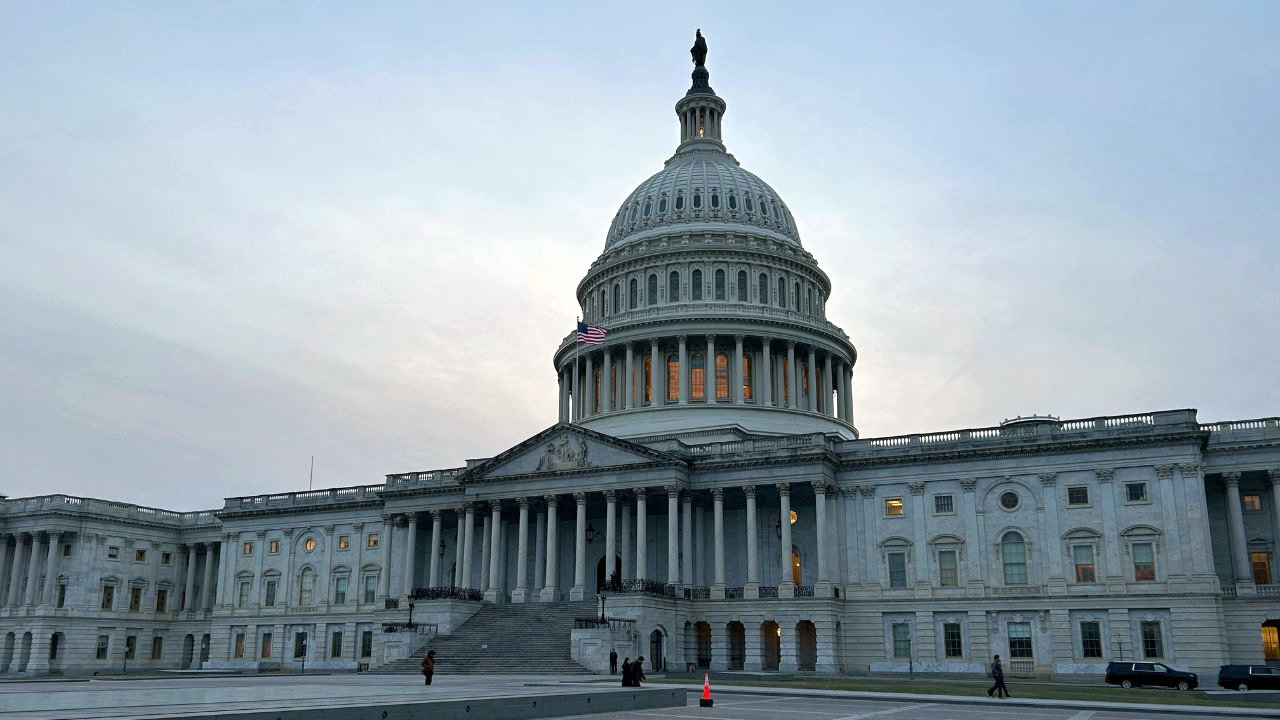
U.S. Capitol Building at sunset on January 30, 2025. (Emma Woodhead/Fox News Digital)
While it lacks the urban population that is typical of most blue states like New York, California, New Jersey and Maryland, Republicans have been increasingly out of power there for years.
Former Sen. Pete Domenici, R-N.M., was the last such lawmaker to represent the state in the upper chamber.
He retired in 2008 and was replaced by Sen. Tom Udall, D-N.M., whose surname is the Mountain West’s equivalent of Cuomo or Casey. The Interior Department headquarters is named after Udall’s father.
Gov. Michelle Lujan Grisham is term-limited. While she was preceded by a Republican, Susana Martinez, her state has been trending more toward Democratic reliability otherwise.
CLICK HERE TO DOWNLOAD THE FOX NEWS APP
Deb Haaland, a former New Mexico congresswoman who was also former President Joe Biden’s Interior secretary, is the biggest name in the Democratic field, while Greggory Hull, the longtime mayor of Rio Rancho, is such for the GOP.
Rep. Gabe Vasquez held off a challenge from predecessor Yvette Herrell in the 2nd congressional district, which spans the southwestern part of the state including Alamogordo and Las Cruces, in what was seen as the GOP’s best chance to make inroads again in the border state.
Read the full article from Here


Local News
Boston is preparing for a significant combination of major events this summer, from the FIFA World Cup to the return of Tall Ships and America’s 250th anniversary celebrations. Millions of visitors are expected to pass through the city, many of them navigating Boston for the first time. Here are answers to some of the most common questions visitors may have before they arrive.

Passengers using a rideshare app can only be picked up in designated areas for ride app vehicles. Look for signs to your terminal’s designated Ride App pickup area before requesting your ride.
Taxis are available at designated stands on the Arrivals level at Terminals A, B, C and E. Taxi dispatchers are located in all terminals to help you. Taxis are priced per mile, according to the Boston Police Department: for the first ⅛ of a mile, you pay $3.80, then, for each ⅛ mile after, you pay $0.40. Passengers also pay a $2.75 toll for all trips from Boston proper to Logan Airport and communities on the North Shore. However, passengers don’t have to pay a toll from Boston proper to East Boston (not including the airport).
No, you don’t need a CharlieCard to ride the train (the T). Most MBTA subway and bus riders can pay directly with a credit card, debit card, smartphone, or smart watch. If you’re riding the Commuter Rail, you’ll need to download the MBTA mTicket app before your trip to purchase and scan Commuter Rail tickets directly from your phone.
However, if you’d like to purchase a CharlieCard, you most certainly can. In fact, the MBTA launched a special edition collectable CharlieCards featuring iconic Boston landmarks to celebrate the summer’s slew of major events. As of Tuesday, cards are available at fare kiosks at Park Street, Downtown Crossing, and Forest Hills stations. Cards will be rolled out at over a dozen more stations throughout the subway system this week.

Boston Stadium (Gillette Stadium) is located in the town of Foxborough, which is about 22 miles (35 km) south of Boston.
The Boston Host Committee for the FIFA World Cup 2026 suggests fans leave plenty of time to travel to the stadium. If you’re driving from Boston, allocate between 60 to 90 minutes to get to the stadium, and 45 to 50 minutes if you’re driving from Providence.
If you’re taking the Commuter Rail to the stadium, you must buy a Boston Stadium train ticket in advance ($80 roundtrip) from the MBTA mTicket app. The train will take you directly to and from each World Cup match. Arrive at South Station at the time shown for your boarding group (you can see all Boston Stadium train ticket schedules here). The train ride is about an hour long. All Boston Stadium train tickets include a return trip after the match, with trains starting to leave Foxboro Station 30 minutes after the final whistle and roughly every 15 minutes until all trains have departed.
If you’re taking the Boston Stadium express bus ($95 roundtrip), you must buy tickets in advance. Bus service starts three to four-and-a-half hours before kickoff. Arrive at your bus pickup (there are over 90 locations across Greater Boston plus from the Rhode Island Convention Center in Providence) no later than 30 minutes before your scheduled departure time. After the match buses will start leaving 30 minutes after the final whistle.
Boston Stadium’s gates open three hours before kickoff. Parking (which must be booked in advance) will be open to fans fours hours before kickoff. FIFA encourages fans to arrive early for security screening, ticket scanning, and entry before kickoff. For more information on getting to and from the stadium, see the Boston Host Committee’s fan travel guide.
There are plenty of World Cup watch parties hosted at local bars and restaurants across Boston’s neighborhoods. Standout spots include Boston’s only Scottish bar, The Haven, which is the de facto home base for Scottish fans; and The Lansdowne Pub in Fenway, which will offer World Cup-themed cocktails and food tied to specific games. There will also be a FIFA Fan Festival at Boston’s City Hall Plaza from June 12 through 27 featuring live match broadcasts and a cultural showcase highlighting local artists, musicians, and performers.
From July 11 through 16, a fleet of tall ships will sail into Boston as part of Sail250, a global gathering of tall ships to celebrate the 250th anniversary of the founding of the United States. Most Sail Boston activities are expected to be concentrated along Boston’s waterfront. If you’re coming from outside of Boston, take the Commuter Rail into South Station. From there, take the Silver Line to the Seaport District and Boston Waterfront, where you can visit the Tall Ships. If you’re coming from North Station, it’s about a 0.6-mile walk to Christopher Columbus Waterfront Park in the North End, where you can enjoy a great view of the ships. Other spots to see the Tall Ships include Castle Island, East Boston and Charlestown. You can find a schedule of free events here, and can use Sail Boston’s interactive harbor map to see the Parade of Sail route through Boston Harbor, recommended viewing locations along the waterfront, and public access to piers and Tall Ship berthing areas.
The Boston Pops Fireworks Spectacular will take place on Saturday, July 4 at the DCR Hatch Shell on the Esplanade from 7 to 9:30 p.m. The event features the Boston Pops led by Keith Lockhart, guest performances by Lainey Wilson and Chance The Rapper, and a fireworks show starting at 9:15 p.m. There are several places to watch the fireworks, including the Charles River Esplanade near the Hatch Memorial Shell; Castle Island Beach in South Boston; and Memorial Drive in Cambridge. The Hatch Shell is accessible via the Arthur Fiedler Footbridge. The Esplanade is accessible via a footbridge at the intersection of Silber Way and Back Street near Boston University’s campus; a footbridge at the intersection of Fairfield and Back Streets in Back Bay; a pedestrian ramp where the Harvard Bridge goes over Storrow Drive; the Frances Appleton Pedestrian Bridge in Beacon Hill; and from the Charles River/MGH T stop on the Red Line.
Walk. Boston was ranked as the second-most walkable city in the world, according to a 2025 Time Out survey. Downtown Boston is approximately 1.5 square miles, making it easy to access many points of interest in a short amount of time.
There are many public restrooms hidden in plain sight in Boston. From libraries and to firehouses, here’s a running list of public restrooms.
Yes. In addition to subway and bus service, the MBTA also operates ferry service from Boston to several coastal neighborhoods, islands, and even Logan airport.
In Boston, the main ferry terminals are located along Atlantic Ave, just outside of the Aquarium Station on the Blue Line. Each MBTA ferry terminal is marked with a T sign. Fares depend on the route you take, but range from $2.40 to $9.75 each way. Ferries operate year-round and include both indoor and outdoor seating. They also offer a fantastic view of Boston and the Boston Harbor Islands. You can find schedules and maps here as well as a beginner’s guide here.
If you see a “Resident Parking Only” sign in a neighborhood, it means you need a resident parking permit sticker for that space. However, metered parking and garage parking is available throughout the city.
Most meters operate from 8 a.m. to 8 p.m. Monday through Saturday (on Sundays and City holidays you can park for free). You can generally only park in a metered spot for two hours before needing to move your car. You can pay your meter with quarters, credit cards, and by using the ParkBoston app (if a ParkBoston decal is on the meter where you parked). Metered parking ranges between $2.50 and $3.75 per hour, depending on the neighborhood.
Downtown Boston has more than 6,300 parking spaces in thirteen public parking garages, according to the Downtown Boston Alliance, with most garages offering discounted parking rates on nights and weekends. Garage parking typically ranges from $10 to $20 for the first hour, with daily maximums up to $75.

Receive updates on the 2026 FIFA World Cup

Acrisure Stadium is buzzing with excitement ahead of the back-to-back Morgan Wallen concerts. Except it’s not the fans generating all the excitement — it’s about 5 pounds of honeybees.
The Fine Family Apiary in Monongahela said it was contacted on Wednesday about a swarm of bees clustered on the stage scaffolding. The apiary put the swarm in a “nuc box” and took them home before moving the bees into full-size equipment.
Owner Al Fine estimates the swarm weighed about 4 to 5 pounds and consisted of 12,000 to 15,000 bees. All said, it took less than two hours to get the job done.
Swarming is how honeybees propagate, Fine explained. According to Penn State Extension, during swarming, the queen and about half the workers leave their home to establish a new nest. The bees will form a temporary cluster, hanging out while scouts search the surrounding area for a more permanent home in hollow spaces like tree cavities or, occasionally, the walls of a home.
Swarms can stick around for several hours or days until they’re ready to move, Penn State Extension says. Meanwhile, the colony left behind is temporarily without a leader until a new queen is established.
With the swarm at Acrisure Stadium removed, Morgan Wallen’s show is ready to go on. The country music megastar will bring his I’m The Problem Tour to Pittsburgh on June 5 and June 6, along with multiple acts like Brooks & Dunn and Ella Langley.


Visiting Boston this summer? Here are 8 navigation tips you need to know.


Denver-ish Central Market? RiNo food hall vendors claim they’ve been pushed out


New Ben & Jerry’s location opening at Seattle waterfront’s Pier 54


Padres designate Nick Castellanos for assignment


21 Things to Do During Pride Month in Milwaukee


Miguel Almirón: World Cup profile | Paraguay & Atlanta United midfielder | MLSSoccer.com


Cantus vocal ensemble takes on Dolly Parton hits


That trail you walk downtown? It’s generated $3 billion for Indianapolis, study finds


