News
Marijuana rescheduling would bring some immediate changes, but others will take time

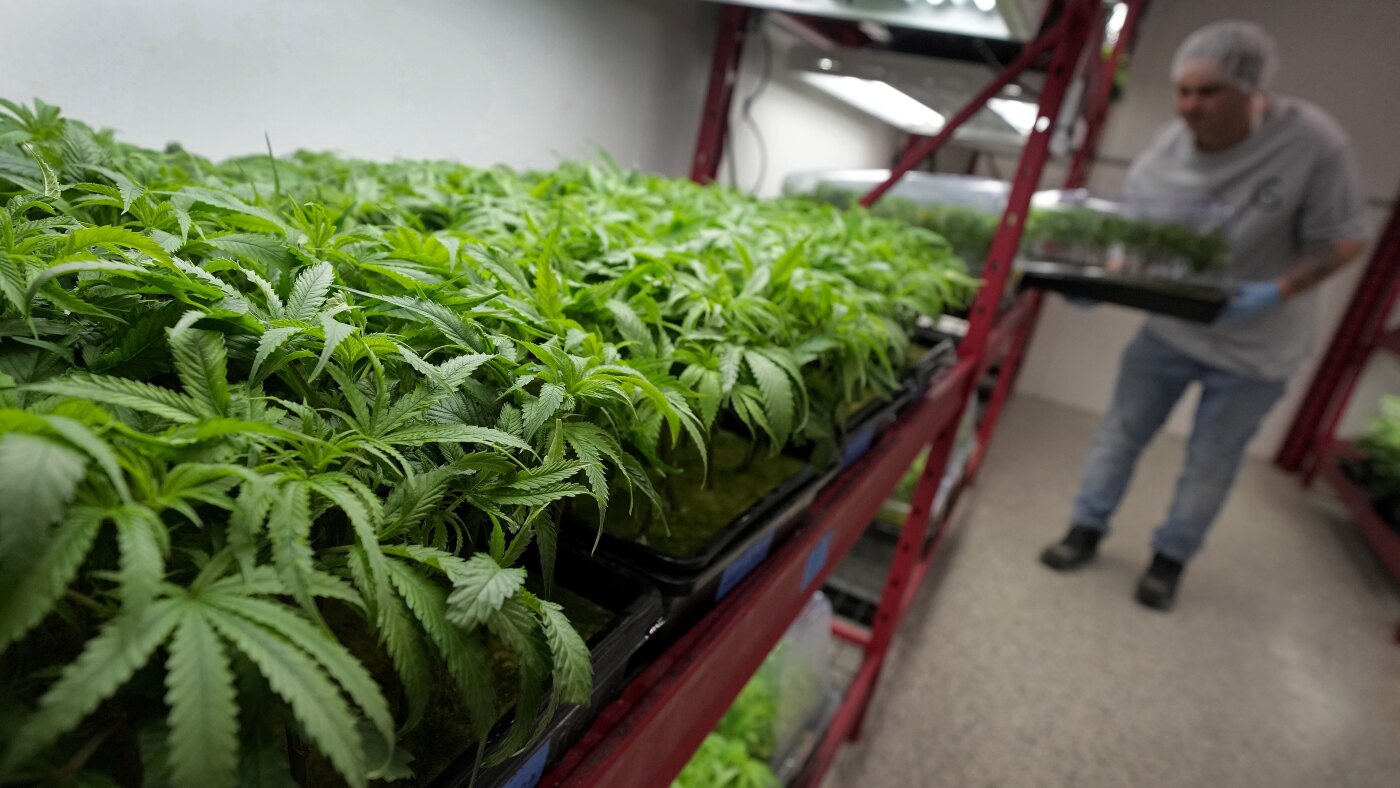
Michael Stonebarger sorts young cannabis plants at a marijuana farm in Grandview, Mo., in 2022. President Trump set the process in motion to ease federal restrictions on marijuana. But his order doesn’t automatically revoke laws targeting marijuana, which remains illegal to transport over state lines.
Charlie Riedel/AP
hide caption
toggle caption
Charlie Riedel/AP
President Trump’s long-anticipated executive order to loosen U.S. restrictions on marijuana promises to bring immediate relief for cannabis businesses — but only in some respects. And although rescheduling it as a lower-risk drug is touted as opening a new era for cannabis research, experts say it’s not as simple as flipping a light switch.
“It’s hard to see the big headlines of, ‘Marijuana rescheduled to [Schedule] III; marijuana research will open,’” says Gillian Schauer, executive director of the nonpartisan Cannabis Regulators Association, which includes agencies from 46 states. “You know, those things are not true as of now.”

That’s because on its own, Trump’s Dec. 18 order isn’t enough to rewrite federal drug policy that has stood for more than 50 years.
“The Controlled Substances Act [of 1970] does not grant any president the authority to unilaterally reschedule a drug,” Schauer says. Such changes are historically made through either a rulemaking process, or an act of Congress.
Many details will shape how the administration enacts Trump’s order, affecting the timeline and scope for easing marijuana restrictions. But when it does happen, rescheduling won’t automatically revoke federal laws targeting marijuana, and interstate marijuana commerce would remain illegal, Schauer says.
It’s not yet known how other policies might change.
“We don’t know what will happen to federal drug testing requirements,” Schauer says, until agencies issue guidance.
Here’s a rundown of other key questions raised by the rescheduling order:
The time frame depends on which path the DOJ takes
Trump’s order directs Attorney General Pam Bondi to “take all necessary steps to complete the rulemaking process related to rescheduling marijuana to Schedule III” of the Controlled Substances Act “in the most expeditious manner in accordance with Federal law … “

The directive evokes the process that started under former President Joe Biden. Under his administration, both the Department of Health and Human Services and the Justice Department advanced a proposal to reclassify pot from Schedule I, meaning it has no medical use and a high potential for abuse, to the lower-risk Schedule III, which includes ketamine, Tylenol with codeine, and anabolic steroids.
The Trump administration could resume the process that was already underway under Biden. But the new executive order’s mention of the Controlled Substances Act’s Section 811 hints at a potential shortcut.
“That allows the attorney general to move a drug to whatever schedule they deem is best, without going through the usual steps that are needed to reschedule a drug,” Schauer says.
The streamlined process was meant to ensure the U.S. can do things such as complying with international drug treaty obligations. But a historic precedent also links it to cannabis: In 2018, it was used to schedule the CBD epilepsy drug Epidiolex, months after it became the first U.S.-authorized purified medicine derived from marijuana. The drug was placed in Schedule V, the least restrictive schedule.

President Trump displays an executive order reclassifying marijuana as a less dangerous drug in the Oval Office on Dec. 18.
Evan Vucci/AP
hide caption
toggle caption
Evan Vucci/AP
Will the DOJ call for public comment?
The Trump administration’s approach to administrative hearings and public comment periods would also help determine the pace of rescheduling.
“I would anticipate, if they use that [expedited] option, that we would not see a comment period,” shortening the process, Schauer explains.
But rescheduling could take longer if the Justice Department follows the traditional, and lengthy, notice-and-comment process.

Again, Bondi has options that could speed things up. She could choose to issue a final rule after a public comment period, for instance, or do so without a comment period.
“Some of the calculation for that may be on the legal end,” Schauer says. Noting that some anti-marijuana groups are vowing to file legal challenges to block rescheduling, she adds that the DOJ will likely have to balance Trump’s call for expedience with the need to defend its actions in court.
If the rule is published for comment, interest would likely be intense: In 2024, the DEA’s earlier proposed rescheduling rule for marijuana attracted more than 43,000 comments.
Cannabis firms would get tax relief, but credit cards remain forbidden
Sam Brill, CEO of Ascend Wellness Holdings, a multistate dispensary company, says rescheduling could bring a cascade of positive changes to his industry. But one benefit could come immediately, he says.
“The biggest thing that happens overnight is the 280E, the restrictive punitive tax code that is set on us,” would no longer apply to marijuana businesses, he says.
Like other businesses, Brill’s company is obligated to pay taxes on income. But because their core product is a Schedule I drug, the IRS says that under Internal Revenue Code Section 280E, they’re blocked from claiming common tax deductions, exposing them to a higher effective tax rate.
Section 280E “does not allow us to basically deduct normal expenses that everyone else can deduct,” Brill says. “I can’t deduct the rent for my stores, the cost of my employees in those stores, my interest expense.”
Brill says that some cannabis companies, including his, say 280E should not apply to them — but the IRS disagrees. As a result, Brill says, his company sets aside a large reserve fund in case the IRS comes after them.
“For 2024 alone, the value of this reserve” was about $38 million, Brill says, “which includes interest and penalties.”
Brill hopes marijuana’s changing status might also eventually lead to other restrictions falling, especially the inability of cannabis operations to accept credit cards. Most financial institutions refuse to provide basic banking services to state-authorized marijuana businesses, due to potential liability.
“The lack of the use of a credit card is really one of the biggest challenges for customers,” he says. Citing the importance of payday, Brill says: “For us, Friday by far is the biggest day every single week because this is a cash business.”
Medical research
Scientists welcomed news in 2023 that the Biden administration was moving toward reclassifying marijuana, and Trump says his move will boost medical research. But both then and now, there are caveats.
One benefit of the new rules is that they wouldn’t require marijuana researchers to go through the onerous process of obtaining a Schedule I license, and they would also ease rigorous laboratory regulations.
“You have very stringent requirements, for example, for storage and security and reporting all of these things,” neuroscientist Staci Gruber, of McLean Hospital in Massachusetts and Harvard Medical School, told NPR last year.
But another obstacle promises to be more stubborn: finding marijuana to study. The U.S. requires researchers to obtain marijuana from a handful of sources, which is itself an improvement over decades in which they were compelled to use one facility based at the University of Mississippi.
And, as Schauer notes, federal rules about sourcing marijuana have been decided separately from the controlled substances schedule.
“This does a little to make research easier,” Schauer says of the current rescheduling effort. “But there’s a lot that will still be challenging in researching cannabis unless we see a lot of agency policies change and adjust.”


Note: Map shows the area with a shake intensity of 3 or greater, which U.S.G.S. defines as “weak,” though the earthquake may be felt outside the areas shown. The New York Times
A moderately strong, 5.1-magnitude earthquake struck in the North Pacific Ocean on Wednesday, according to the United States Geological Survey.
The temblor happened at 5:45 a.m. Pacific time about 40 miles west of Petrolia, Calif., data from the agency shows.
As seismologists review available data, they may revise the earthquake’s reported magnitude. Additional information collected about the earthquake may also prompt U.S.G.S. scientists to update the shake-severity map.
Subsequent quakes have been reported in the same area. Such temblors are typically aftershocks caused by minor adjustments along the portion of a fault that slipped at the time of the initial earthquake.
Aftershocks detected
Quakes and aftershocks within 100 miles
Aftershocks can occur days, weeks or even years after the first earthquake. These events can be of equal or larger magnitude to the initial earthquake, and they can continue to affect already damaged locations.
The New York Times
When quakes and aftershocks occurred
Sources: United States Geological Survey (epicenter, aftershocks, shake intensity); LandScan via Oak Ridge National Laboratory (population density) | Notes: Shaking categories are based on the Modified Mercalli Intensity scale. When aftershock data is available, the corresponding maps and charts include earthquakes within 100 miles and seven days of the initial quake. All times above are Pacific time. Shake data is as of Wednesday, June 3 at 6:03 a.m. Pacific time. Aftershocks data is as of Wednesday, June 3 at 8:01 a.m. Pacific time.

Xavier Becerra, Democratic gubernatorial candidate for California, and Steve Hilton, Republican gubernatorial candidate for California, shake hands while arriving for a gubernatorial debate at KRON Studios in San Francisco in April.
Jason Henry/Getty Images North America
hide caption
toggle caption
Jason Henry/Getty Images North America
SAN FRANCISCO — The primary election for California governor is too close to call, with vote counting continuing Wednesday. Democrat Xavier Becerra and Republican business executive Steve Hilton lead the field with Democrat Tom Steyer in third place.
In California’s unusual primary system, all candidates, regardless of party, appear on a single ballot open to any registered voter. The top two candidates then move on to the general election, even if they’re from the same party. This year, voters had 60 names for governor to choose from.
The winner will lead the country’s most populous state, where leaders often take on national political prominence. Incumbent Gov. Gavin Newsom is at his two-term limit and could be a Democratic contender for president.
Becerra, former Health and Human Services secretary under President Joe Biden, pitched himself to voters as an experienced political leader who isn’t afraid of President Trump, but his lead caps one of the most surprising and dramatic comebacks in recent state political history. As recently as April, polls were showing Becerra — also a former member of Congress and California attorney general — languishing in single digits in a crowded field.
In his remarks at his watch party in Los Angeles, Becerra noted his underdog status.
“Here in Hollywood’s hometown, we love a good underdog success story,” he said, drawing parallels between his campaign and his immigrant parents’ success story in California. “Guess what? The underdog stayed in the fight. Like my parents, I never gave up. Never stopped putting one foot in front of the other. Never stopped believing in the beacon-like goodness of California. And thankfully, neither did you.”
Hilton is a former Fox News commentator who also served as a political adviser to former British Prime Minister David Cameron. He was endorsed by President Trump in April, helping him to pull ahead of Riverside County Sheriff Chad Bianco, the other major Republican in the race. Hilton has campaigned on the idea that California needs change after 16 years under total Democratic control.
The race is narrowing down after a tumultuous campaign
At his watch party in Huntington Beach, the British-born candidate — who became an American citizen five years ago — said it was the “honor of his lifetime” to receive over 1 million votes so far.
“Change is coming to California and it’s long overdue,” Hilton said. “We’re not there yet, but it’s looking good. It looks very much as if Californians really will have the chance to vote for change in November and take our state in a new direction.”
Democratic billionaire activist Steyer spent more than $213 million of his own money to boost his candidacy and push a progressive, populist message. While he was trailing Becerra and Hilton on Tuesday night, he said at his watch party in San Francisco that he remains confident he can close the gap in the days ahead.
“Together, we’ve scared the hell out of the corporate interests used to getting their way,” Steyer said. “It might take some time to figure out where this is going. We’re going to wait until every ballot is counted. We’re gonna give democracy a time to work. And we know we finished really strong.”
The early results are not certain to hold, in part because of unusual voting patterns in this primary election: Ballot-tracking data heading into Tuesday evening showed that Republicans were more likely to vote early by mail, while Democratic voters in this deep-blue state held onto their mail-in ballots or chose to vote in person. That’s the reverse of recent elections, which saw more Democrats voting by mail and Republicans tending to vote in person on Election Day.
The uncertainty on election night capped a race that remained crowded and unsettled to the end. To some extent, the race was defined by who wasn’t running.
Some of the state’s most high-profile Democrats — former Vice President Kamala Harris, U.S. Sen. Alex Padilla and California Attorney General Rob Bonta — all passed on a potential bid to succeed Newsom.
The race was disrupted in April when then-U.S. Rep. Eric Swalwell’s campaign for governor imploded amid allegations of sexual assault and harassment. Swalwell resigned from Congress shortly after the accusations surfaced and has denied assault allegations.
Swalwell had been gaining in polls and racking up high-profile endorsements, and his exit seemed to primarily benefit Becerra, who had been stuck in single digits in many polls. Ultimately, it quieted fears among Democrats who worried that the messy Democratic field could result in Bianco and Hilton winning the top spots in the June primary.
Marisa Lagos covers California politics at KQED and co-hosts the Political Breakdown show and podcast.

The U.S. Supreme Court
Tasos Katopodis/Getty Images
hide caption
toggle caption
Tasos Katopodis/Getty Images
The Supreme Court on Tuesday cleared the way for Alabama to use a congressional district map favored by Republicans.
The court, in an unsigned order, overturned a three-judge district court panel that found that the map is “tainted by intentional race-based discrimination.” The court’s three liberals publicly dissented.
The ruling means that Alabama’s 2026 midterm elections will feature six Republican-leaning districts and one Democratic-leaning one, as opposed to a map with only five safe Republican seats. Democrat Shomari Figures, who represents Alabama’s Second District, will likely lose his seat as a result of the high court’s ruling.
The story of Alabama’s congressional map is long and tortured. It began in 2021, when the state implemented a new map to account for population changes in the census. The map featured only one majority-black district out of seven, even though the state is more than one-quarter Black.
Voters immediately sued, claiming the map illegally diluted minority votes in violation of the Voting Rights Act and the Constitution. Lower court judges agreed, ruling that the state must draw a map with two districts where Black voters have a realistic chance of electing their candidate of choice. The Supreme Court more than once has ordered Alabama to draw a compliant map.
But the state has refused and instead continued to litigate the case. On Tuesday, that tactic paid off.
What changed? In April, the Supreme Court’s conservative supermajority all but gutted what remains of the Voting Rights Act, ruling that states cannot purposefully draw districts that are majority-minority.
Alabama then asked the high court to reinstate the state’s old map, under the theory that this new ruling meant that it was permissible to use a map with only one majority-Black district. In an unsigned, unexplained order in May, the high court essentially reversed its previous opinions, and allowed Alabama to use the old map for the upcoming midterm elections.
This set off a flurry of activity in Alabama. By the time the Supreme Court issued its May order, absentee balloting had already begun, using the court-drawn map. So Republican Governor Kay Ivey cancelled elections and scheduled a special primary for August for the affected congressional races.
The case, however, was not over.
In its ruling, the Supreme Court had ordered a lower court panel to continue evaluating Alabama’s map in light of its recent Voting Rights Act decision. And just 15 days after that order, the panel, composed of three Republican judges—two of them Trump appointees—concluded unanimously that even under the Supreme Court’s new standards, the plan for a single black district was “intentionally discriminatory.”
So, once again, Alabama returned to the Supreme Court, arguing that the map was partisan, not racially discriminatory. In short, that the Republican legislature simply drew the map to elect more Republicans. And that under the Supreme Court’s new interpretation of the Voting Rights Act, the GOP map should be allowed to stand.
The court’s conservative agreed, writing that the lower court “did not heed the presumption of legislative good faith.”
The court’s three liberals publicly dissented, castigating the conservative majority for failing to abide by its 2006 decision in the case of Purcell v. Gonzalez. That decision declared that courts should not change election rules too close to an election.
Justice Sonia Sotomayor, in her dissent, said the court “debases the democratic process” and “corrodes the rule of law by rewarding Alabama’s gamesmanship and outright defiance of court orders.”
Tuesday’s decision is the latest in a series of Supreme Court rulings that could well reshape the 2026 midterm elections, making it much harder for Democrats to prevail.
-

 Indiana6 minutes ago
Indiana extends gas tax suspension: ‘Cheapest gas in the country’
-

 Iowa9 minutes ago
Trump's primary endorsement winning streak just ended in Iowa
-

 Kansas14 minutes ago
Where to watch Kansas City Royals vs Cincinnati Reds: TV channel, start time, streaming for June 3
-
 Kentucky21 minutes ago
Fayette County school board chair, KEA sue to block Kentucky law that would oust current members
-

 Louisiana24 minutes ago
Louisiana insurance officials to announce retirement of Katrina, Rita bonds
-

 Maine36 minutes ago
Maine’s abrupt plan to cut $400M in construction projects roils the industry
-

 Maryland39 minutes ago
Man found dead in South Carolina after shooting ex-girlfriend in Maryland
-

 Michigan44 minutes ago
Gotion wants Michigan township to pay the $23.7M it owes in incentives

