Lifestyle
When a loved one dies, where do they go? A new kids’ book suggests ‘They Walk On’

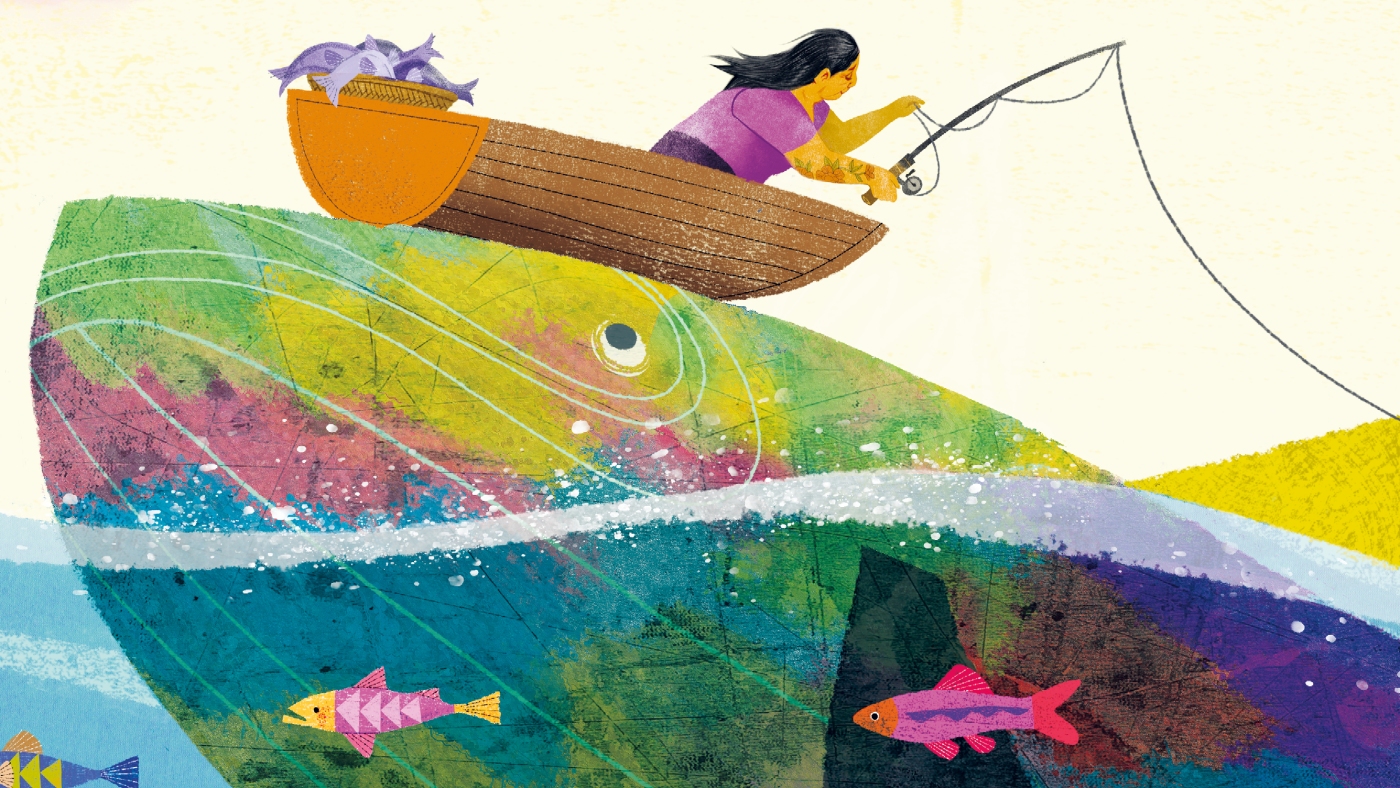
Rafael López / Roaring Brook Press
A couple of years ago, after his mom died, Fry Bread author Kevin Maillard found himself wondering, “but where did she go?”
“I was really thinking about this a lot when I was cleaning her house out,” Maillard remembers. “She has all of her objects there and there’s like hair that’s still in the brush or there is an impression of her lipstick on a glass.” It was almost like she was there and gone at the same time.
Maillard found it confusing, so he decided to write about it. His new children’s book is And They Walk On, about a little boy whose grandma has died. “When someone walks on, where do they go?” The little boy wonders. “Did they go to the market to thump green melons and sail shopping carts in the sea of aisles? Perhaps they’re in the garden watering a jungle of herbs or turning saplings into great sequoias.”

Rafael López / Roaring Brook Press
Maillard grew up in Oklahoma. His mother was an enrolled member of the Seminole Nation. He says many people in native communities use the phrase “walked on” when someone dies. It’s a different way of thinking about death. “It’s still sad,” Maillard says, “but then you can also see their continuing influence on everything you do, even when they’re not around.”
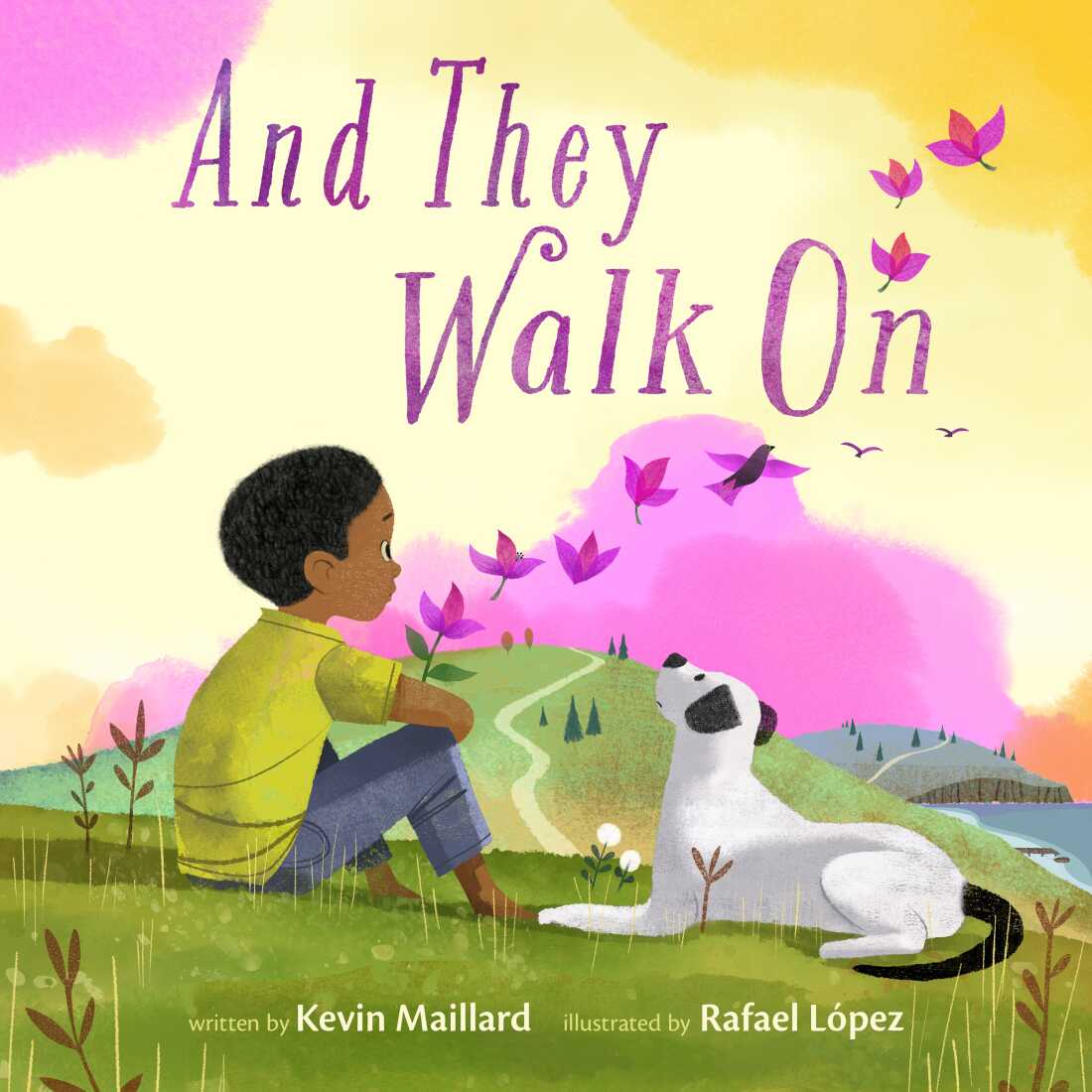
Rafael López / Roaring Brook Press
And They Walk On was illustrated by Mexican artist Rafael López, who connected to the story on a cultural and personal level. “‘Walking on’ reminds me so much of the Day of the Dead,” says López, who lost his dad 35 years ago. “My mom continues to celebrate my dad. We talk about something funny that he said. We play his favorite music. So he walks with us every day, wherever we go.”
It was López who decided that the story would be about a little boy: a young Kevin Maillard. “I thought, we need to have Kevin because, you know, he’s pretty darn cute,” he explains. López began the illustrations with pencil sketches and worked digitally, but he created all of the textures by hand. “I use acrylics and I use watercolors and I use ink. And then I distressed the textures with rags and rollers and, you know, dried out brushes,” he says. “I look for the harshest brush that I neglected to clean, and I decide this is going to be the perfect tool to create this rock.”
The illustrations at the beginning of the story are very muted, with neutral colors. Then, as the little boy starts to remember his grandmother, the colors become brighter and more vivid, with lots of purples and lavender. “In Mexico we celebrate things very much with color,” López explains, “whether you’re eating very colorful food or you’re buying a very colorful dress or you go to the market, the color explodes in your face. So I think we use color a lot to express our emotions.”

Rafael López / Roaring Brook Press
On one page, the little boy and his parents are packing up the grandmother’s house. The scene is very earthy and green-toned except for grandma’s brightly-colored apron, hanging on a hook in the kitchen. “I want people to start noticing those things,” says López, “to really think about what color means and where he is finding this connection with grandma.”
Kevin Maillard says when he first got the book in the mail, he couldn’t open it for two months. “I couldn’t look at it,” he says, voice breaking. What surprised him, he said, was how much warmth Raphael López’s illustrations brought to the subject of death. “He’s very magical realist in his illustrations,” explains Maillard. And the illustrations, if not exactly joyful, are fanciful and almost playful. And they offer hope. “There’s this promise that these people, they don’t go away,” says Maillard. “They’re still with us… and we can see that their lives had meaning because they touched another person.”

Rafael López / Roaring Brook Press


Comedian Richard Pryor performs on stage at the Los Angeles Hollywood Bowl on Sept. 19, 1977.
Lennox McLendon/Associated Press
hide caption
toggle caption
Lennox McLendon/Associated Press
Historian Elizabeth Stordeur Pryor has spent much of her career tracing the N-word through slavery, Jim Crow, the civil rights movement and hip-hop. But what she didn’t tell her audiences was that her father, Richard Pryor, was the comedian who put the word at the center of American comedy in the 1970s.
“I was a scholar of the N-word — and so was he,” Pryor says of her father.
As the child of a white mother and a Black father, Pryor describes her own relationship to the N-word as a “super complicated” one. She remembers teaching a college class in which one of her white students used the word while quoting Blazing Saddles — a film her father co-wrote. Pryor froze: She had vowed never to use the word in her classroom, but suddenly there it was.

“I [was] just kind of like like a deer in the headlights,” Pryor says. “I was really worried about the Black students. … Something I had never considered when I thought about teaching is what happens when the racism that we study and we teach comes in? … How do I work through that in the moment?”
Pryor’s new book, Something We Said: Richard Pryor, A Notorious Word, and Me, is part memoir and part history of one of the most divisive words in the English language. Late in his career, after spending time in Kenya, Richard Pryor vowed never to use the word again.
“One of the things I admire about that moment when he disavows the word is he said, ‘This is for me. I’m not telling you what to do,’” she says. “There is a piece [of him] where he understood that the word had a function in Black culture. He does talk about, though, as an artist, losing control of what the word was doing.”
Interview highlights
On her father’s use of the N-word
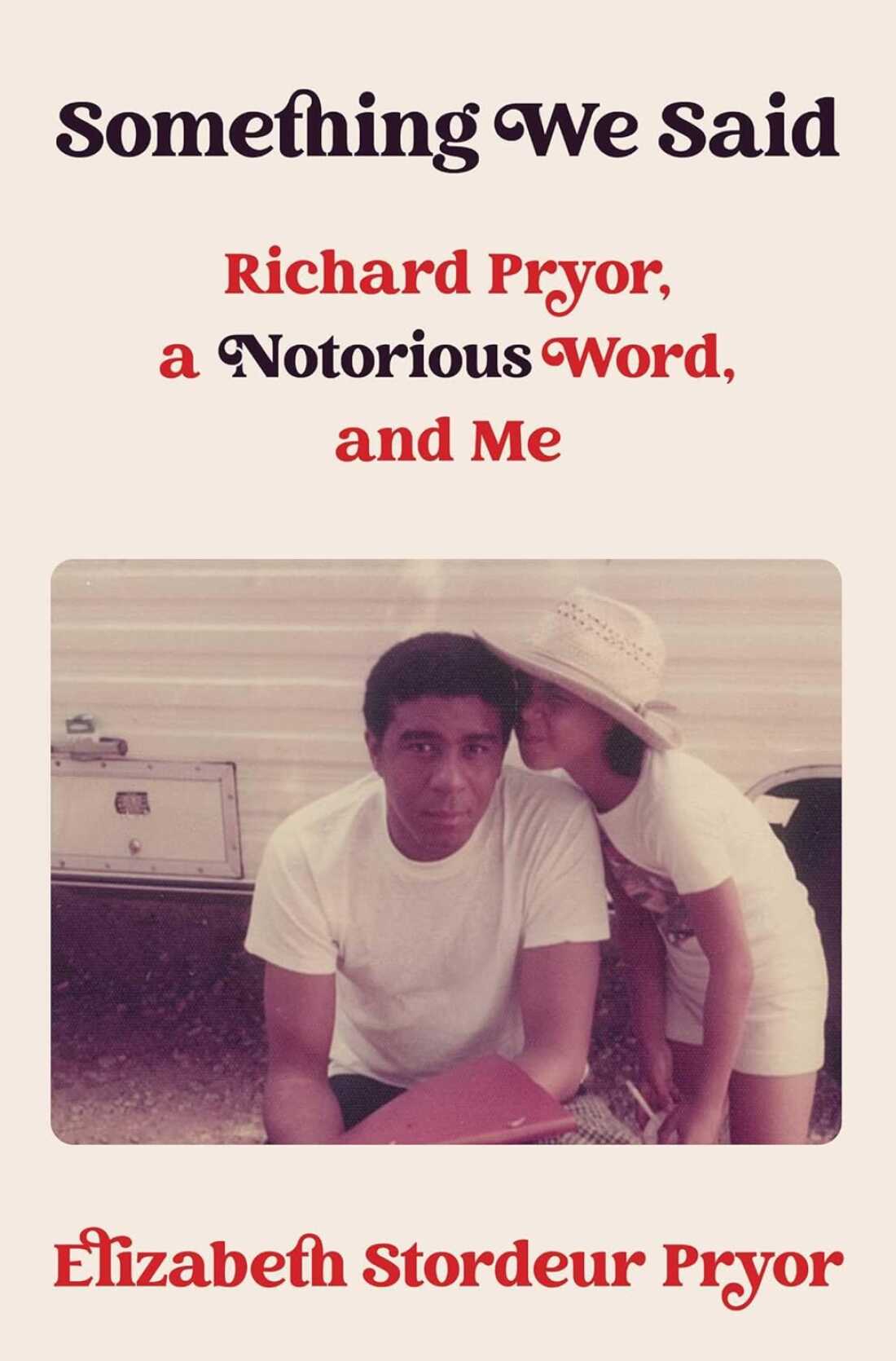
[In] one of the first meaningful conversations I ever had with [my dad] as a little girl, he told me, “Don’t let nobody ever call you that.” And then he used it, and then his friends used it. …
I think it’s really important to emphasize that when I’m saying that he used the word that it was in the subversive way, that it was the language of protest, and that he was building on a Black tradition of protest, that Black people had used this word kind of as a slap in the face to white racism. You know, “We know how to take our punches and our knocks, and we’re not afraid of this thing that you’re trying to demean us as.” And so bringing that use, the way that Black people perceived of the N-word, onto stage was really powerful in the 1970s.
On talking about the N-word with her college students
Teaching the word is still incredibly difficult. I have to say, the conversations are always hard, but I feel like it’s important because my students walk away knowing that this is not a conversation, like I said, about free speech. It’s really about how how we interact, how we want to bring as many people as we can to the table. And if we do that, that means that we’re going to be thinking about who we’re sitting at the table with and how things will impact them.
On meeting her dad for the first time when she was 6
We were in Newark, New Jersey, … and my mom is acting kind of … nervous. And we knocked on the door of a hotel room, and he opened in a towel. And I was like, this is my father. Like, not only do I get a father, but I get this guy. What? I just felt like I won. I loved him immediately. Instantly. His eyes were so warm, and he was so handsome. And I just fell head over heels. … I saw my face [in his face]. … He created a bridge immediately between us and invited me to cross over.
On vying for her father’s attention as a kid

I wanted to be smart enough and creative enough, and I would try to show off. I did theater. I did improv. He would come to my plays and come to my performances. [I] tried to get intellectual with him, like when I was in college. And I had a Black awakening and he basically, like, sent me some stuff so I could awake Blackly, I guess. … He sent me the documentary on Malcolm X that had been filmed, I think, in 1972. And then he sent me The Last Poets’ [song] … “N-words are Scared of Revolution,” to listen to. And I did. I felt like he was inviting me into a secret world, and I wanted to go there. …
At the end of his life, when he couldn’t speak anymore, I would go over and read from the narrative of Frederick Douglass to him, and I could see that he was feeling proud … of being read Frederick Douglass by me.
On Richard Pryor’s upbringing with a sex worker mother and the first laugh that changed everything.
Oh, my dad. He told me a story about being 5 years old and, I don’t know why, but he’s wearing a little cowboy suit, and he was in front of the house and all the people were there, his grandmother, all the sex workers, and his father and his uncle. And he slipped in dog poop and they just start cracking up. And so he got up and he made himself slip in it again, and they couldn’t stop laughing. And so he did it again and again. And it’s pretty painful to think of the lengths that he felt that he needed to go to get their adoration and attention.
Anna Bauman and Thea Chaloner produced and edited this interview for broadcast. Bridget Bentz, Molly Seavy-Nesper and Meghan Sullivan adapted it for the web.

Nope, it’s not AI. It’s just a really big flag with bright lights, draped on Hoover Dam for the next several weeks.
As a display to mark the 250th anniversary of U.S. independence, the states of Nevada and Arizona and the federal Bureau of Reclamation teamed up to hang and illuminate an enormous American flag on the dam on Memorial Day.
The display, scheduled to be in place through July 4, is visible to anyone crossing between Arizona and Nevada on U.S. Route 93, which goes across the top of the dam. The flag is 150 feet tall and 300 feet long, spread on the south-facing side of the dam and lit by 550 LED lights (powered by dam-generated electricity).
A wider view of the illuminated U.S. flag at Hoover Dam.
(Michael Bittle)
It’s a spectacle that comes at a challenging moment for Hoover Dam, as experts warn that Lake Mead’s dwindling water levels could threaten the dam’s ability to generate hydropower. “Slap a flag on it, that’ll fix it,” suggested one of several Reddit commenters who were moved to snarkiness by the flag image.
The dam, a frequent day-trip destination from Las Vegas, stands 35 miles east of the Las Vegas Strip, about 295 miles northeast of Los Angeles. The site features a visitor center and overlook, and guided and self-guided tours.
Installation of the display involved dozens of riggers and two cranes. The flag, which is roughly the dimensions of a football field, has been previously used for celebrations at Indianapolis Colts and Las Vegas Raiders football games.
Within two days after it was hung, gusts of wind up to 50 mph prompted organizers to lower the flag last Wednesday as the National Weather Service declared a wind advisory for the area. Organizers raised the flag again late Friday.
Strong winds are not uncommon in the area. Organizers said weather “may periodically require the flag to be temporarily lowered.” Updates on the flag’s status can be found on the Hoover Dam Facebook page.
The Las Vegas Convention and Visitors Authority paid for the display. A spokeswoman said the cost, including flag, production, installation costs and six weeks of lighting, will be between $750,000 and $1 million.
The dam, a five-year construction job that was completed in 1936 during the depths of the Great Depression, is often hailed as one of the nation’s most impressive works of infrastructure. Though this is not the first time a flag has been draped on it, organizers have called the display “the most ambitious long-duration installation ever attempted at Hoover Dam.”

Is dog poop a scourge in your area?
borisz/simplehappyart/Getty Images/Photo Illustration by NPR
hide caption
toggle caption
borisz/simplehappyart/Getty Images/Photo Illustration by NPR
Left-behind dog poop is annoying. But it’s also a sign of anti-sociality.
Spotting unidentified poop outside is an unfortunate and unavoidable part of being alive, but in some cities, there’s a scourge being left behind by some people’s four-legged friends. Manuela López-Restrepo, writer and producer at All Things Considered, couldn’t stop noticing it – and she wondered if it might be a sign of something deeper going on. Paired with dogs popping up in places they maybe shouldn’t be – she wondered: can dogs be a vector for anti-social behavior? And what would it look like for people – and their pets – to share space more harmoniously?
Manuela shares her reporting with Brittany and they get deeper into the story of the dookie.
For more episodes about culture and how we share public space, check out:
The Coldplay kiss cam & moral surveillance
Crime is down. Why don’t people feel safe?
In search of a safe place to cry…
Support Public Media. Join NPR Plus.
Follow Brittany on Instagram: @bmluse
For handpicked podcast recommendations every week, subscribe to NPR’s Pod Club newsletter at npr.org/podclub.
This episode was concepted and reported by Manuela López-Restrepo. It was produced by Liam McBain. It was edited by Neena Pathak. We had engineering support from David Greenburg. Our Supervising Producer is Cher Vincent. Our Executive Producer is Barton Girdwood. Our VP of Programming is Yolanda Sangweni.
-

 Louisiana6 minutes ago
Louisiana’s disappearing coast could shape Baton Rouge’s future
-

 Maine9 minutes ago
‘Malicious gossip’: Wife of Senate candidate Graham Platner responds to texting claims
-

 Maryland14 minutes ago
Your Voice Your Future | Town Hall
-

 Michigan21 minutes ago
Fifth Third Bank to close 75 Michigan branches, including former Comerica locations
-

 Massachusetts23 minutes ago
Winners’ circle: Tracking every 2026 spring high school championship – The Boston Globe
-

 Minnesota29 minutes ago
Minnesota Medicaid crisis: Thousands of care providers cut off from funding after state revalidation deadline
-

 Mississippi36 minutes ago
Mississippi LB Devontray Brewer committed to Stanford and broke down his decision
-
 Missouri39 minutes ago
Kansas City, Missouri, police investigating Monday evening homicide near 12th, Askew

