Montana
Understanding the Pesticide Problem in Montana’s Waterways – Flathead Beacon


Are pesticides a problem in Montana’s waters? How many of these chemicals, which include insecticides, herbicides, fungicides and more, commonly used on lawns and farms alike, have made their way into our waterways? How can we still control pests and keep our waters clean for future generations? The Pesticide Stewardship Partnership Program (PSPP) is an ambitious initiative led by assistant research professor Dr. Rachel Malison at University of Montana, Flathead Lake Biological Station (FLBS) and is funded by a U.S. Environmental Protection Agency grant. The PSPP is working to answer these questions in western Montana — the headwaters of the Columbia River Basin. To chart a course for sustainable pest management in Montana’s future, Malison said, the program aims to build a network of partners, collect data to detect if pesticides are in Montana waterways, and to provide education on sustainable pesticide practices and alternatives, and more.
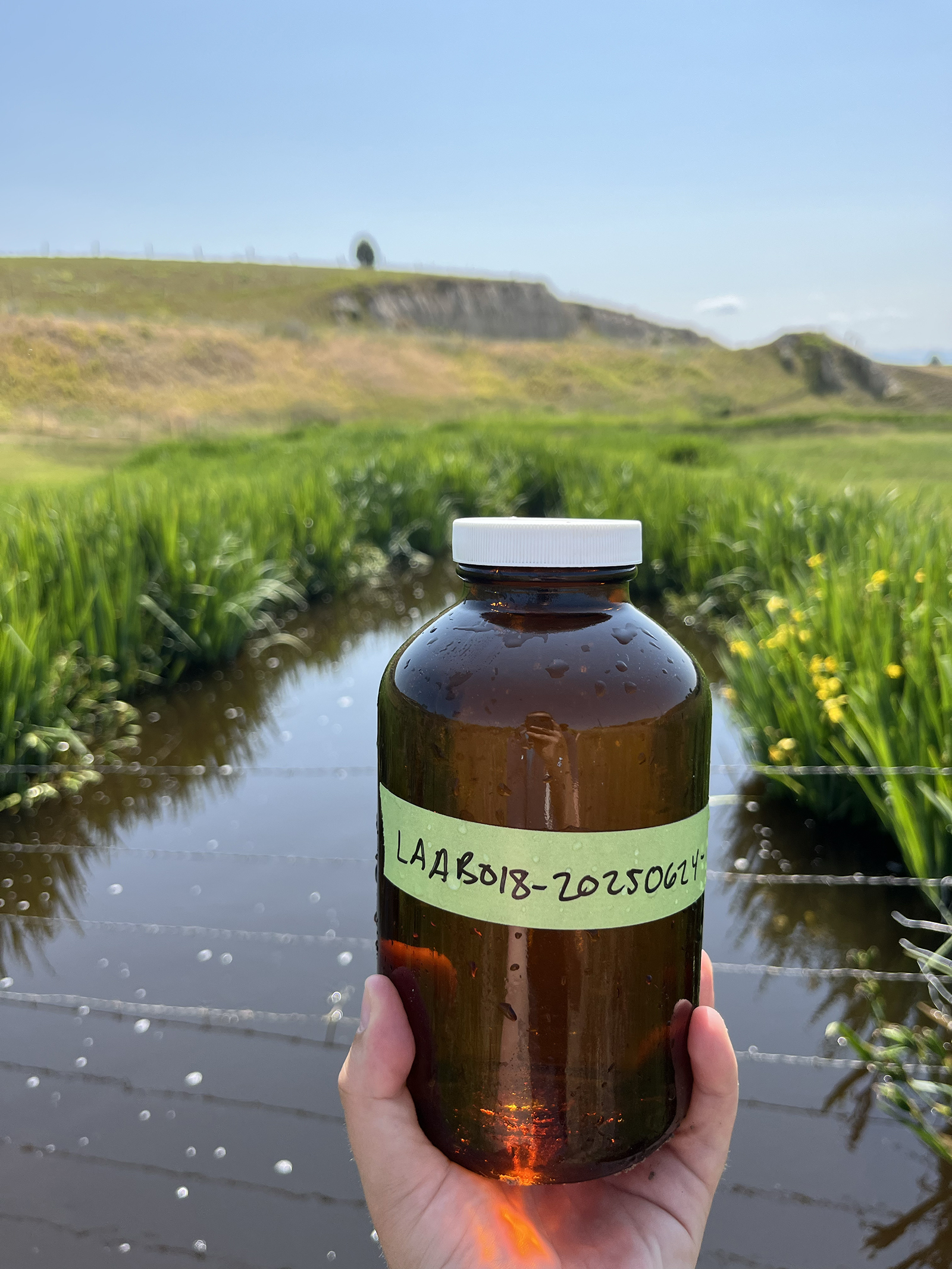
This story starts in the field. Big Sky Watershed Corps member Chloe Czachor, who is serving her term at FLBS with PSPP, carefully pulls her weathered FLBS expedition off a gravel road near Ronan, Montana. The nearby irrigation ditch will be her fifth sampling stop of the day, another step in her largely solitary journey to collect samples from western Montana waterways that will be used to test for the presence of pesticides. In its first year of sampling, the PSPP is aiming to collect around 650 samples from rivers, streams and other waters in Montana’s portion of the Columbia River Basin. Most of these waterways have never been sampled for pesticides before, Czachor said, and whether they are contaminated with pesticides is unknown.
Czachor unloads her gear from the back of the vehicle, including an instrument that measures water characteristics like temperature and pH, a large glass bottle and water-resistant notebooks, and carries the gear over to the ditch which eventually flows back into the river. The instrument’s probe goes in the water to start measuring while Czachor wades into the stream and fills the bottle with water. After writing in the site name and location, Czachor enters the instrument’s readings into the notebook before pulling it out of the water. Then, she hauls her gear back to the vehicle, finds the next stop on Google Maps and starts driving again.
Later, at the PSPP team’s base at the FLBS, Czachor unloads the coolers filled with water sample bottles from her latest sampling run. These samples will join hundreds of others that the PSPP has gathered so far from across western Montana. Samples are delivered once a week to the Montana Department of Agriculture Analytical Laboratory in Bozeman, which analyzes each sample for 103 pesticide compounds. This is only a fraction of the number of different pesticides used in Montana, Czachor said, but detecting the presence of these chemicals can also indicate that other chemicals might also be present.
Czachor’s sample collecting work started in April. As the team’s main sample collector, she said that she has driven all over western Montana while sampling. Staff from FLBS and other volunteers are able to help Chloe sample part of the time, but she is leading the effort.
The travel takes a physical toll, Czachor said. “It’s long hours and I definitely need to be doing more yoga after how wrecked my body feels after being that long in the car. … These cars are so old, there’s no sort of lumbar support in the seats.” However, she said that she doesn’t mind when she is alone for so long on sampling runs. “I’m an introvert at heart,” she said. “I have my music and I have my podcasts and my audiobooks.” Sometimes, Czachor said that she calls friends while on long sampling drives. On the longest days, she said she focuses on the value of the experience for her career in conservation and on the unique opportunity of helping build a large-scale pesticide monitoring program where none existed before. “I’ve seen some pretty incredible places through this work, places that I would have never known existed. As someone new to Montana, I can’t think of a better way to see so much of the state. And to be seeing these beautiful places and know that I’m helping to protect them in some way is very rewarding,” Czachor said.
Czachor’s travels are guided by Research Coordinator Janelle Groff and Research Scientist Diane Whited. Together, they developed the maps of pesticide sampling sites the program uses and create the routes that Czachor and others travel each week on sampling trips. Whited used a variety of geospatial data to create maps of how likely waterways are to be contaminated with pesticides, based on different land uses and their proximity to surface water. Using these risk maps, the team then randomly created a roster of potential sampling locations on waterways with varying risks of pesticide contamination and near a range of land uses, from agriculture to residential areas to National Forests.
The sampling effort is divided into different types of sites, Groff said. Even though the program will collect many samples, the large area and variety of land uses the program aims to monitor mean that a limited number of samples can be collected at each site. However, pesticide concentrations can change over time as different pests emerge on nearby lawns and farms, stream flows rise and fall, and other seasonal changes shifts occur. PSPP monitors a broad area while also tracking changes in pesticide concentrations over time by dividing monitoring into three types of sites, Groff said. At a small set of focal sites, samples are collected every two weeks or once a month to detect potential changes over time. The larger set of baseline sites are only visited once or twice a year but span a much broader area. Focal and baseline sites are located on waterways at high risk of pesticide contamination. Together, these sites allow the program to monitor a large geographic area and understand changes over time, Groff said. In addition to testing focal and baseline sites, she said the program also tests reference sites, which are located in areas with low chances of pesticide contamination, like stream locations in National Forest or near remote headwaters. The results from these samples, which should show very low levels of pesticides, help substantiate that the testing regimen is accurate and provide data on baseline pesticide levels in the environment, Groff said.
Using this roster of potential sampling sites, Groff builds routes for Czachor to follow on her weekly trips. She said that building these routes involves Google Maps and “a lot of zooming” since she must ensure that Czachor can safely park her vehicle near each site and can physically reach the water. Groff also provides a list of alternative sites for each of Czachor’s trips, in case a site is inaccessible or the stream or ditch is dry when she reaches it.
The sampling effort just launched in the spring of 2025, Groff said, and extensive data will likely not be available for some time. In the future though, she said that this data will help Montana residents understand and address pesticide contamination in their waters by identifying where it is occurring and what pesticides are involved. The fate and transport of pesticides from land to water is very complex because there are so many pesticides and they have different characteristics, which means that some reach water more easily than others. The data collected will help individuals understand the water conditions around them and guide larger scale collective efforts to reduce the amounts of pesticides in the water, Groff said. She also said that knowing where pesticides are common in the water will help guide education about pesticide use, another key part of PSPP’s mission.
On a rainy and cold day on Flathead Lake, Rachel Malison stands by the rail of the boat and speaks to the small crowd about the PSPP program and the importance of using good stewardship practices to control pests. Malison is speaking at the annual FLBS Research Cruise, where people from neighboring communities can learn about research at the station and see demonstrations while cruising Flathead Lake on the chartered boat. Malison explains to the group that the available tools for controlling pests are like a Swiss Army knife, and that people tend to pull out the pesticides first to tackle a pest problem, like they pull out the knife first even though another tool might be just as or more effective. She says that sustainable pest management requires using all the tools available in a careful and judicious manner, including proper use of pesticides, to keep pests controlled and waters clean.
Opportunities like this are part of the PSPP’s broader educational project, Malison said. PSPP uses both direct outreach, like speaking at the Research Cruise or giving presentations to homeowner’s associations, and indirect outreach through partners like the Montana Watershed Coordination Council to spread information about proper pesticide use and best stewardship practices, she said. The education work also covers important water science concepts, like the idea that water moves pollutants, including how large rain events or excessive lawn watering can move chemicals on the land into the groundwater or nearby streams. “For a lot of the outreach and education, we’ve been realizing that we need to start by sharing more about how water moves and how our actions influence what is carried with that water when it’s moving” she said. This education is “trying to help people know that there are more options to pest management and that their actions can make a difference,” Malison said.
“That part of the program is going to grow and continue to get bigger as the program progresses,” Malison said, with PSPP being only in its second year. She said that the program is developing more outreach materials and going to more events, like the Northwestern Agricultural Research Center Field Day or the Bigfork Monday Market. The pesticide sampling work will help guide this outreach, she said, letting the team identify areas with particularly high levels of pesticides and target outreach to the have the maximum impact. “If we find pesticides in waters near different land uses, we can share that information with people and also provide ideas on how land uses could be modified to help protect our waters,” Malison said.
These outreach efforts have already had impacts, said Malison, such as one homeowner’s association that it now considering a buffer strip between its lawns and nearby ponds to reduce the movement of pesticides into the water after hearing a talk from her. Although reaching everyone or making large changes to pesticides use may be difficult, Malison said that even small changes, like spraying lawns twice a year instead of four times, can reduce the amount of chemicals that enter the water.
For Malison, this work has personal meaning. “We live here, I have children, I want their children to have healthy rivers and functioning ecosystems too. We produce chemicals and we use them, it’s not just going away, so we need to make the best decisions we can to protect our waters.”
Josh Pike is a Missoula-based environmental journalist with a focus on water issues. He works as a journalism intern for the Flathead Lake Biological Station.


Where Khloe Kardashian Stands With Ex French Montana More Than 10 Years After Breakup
French Montana is done keeping up with reality TV.
In fact, he only agreed to appear on Keeping Up With The Kardashians and Kourtney & Khloé Take the Hamptons over a decade ago as a favor to then-girlfriend Khloe Kardashian.
“She said to get on the show,” he exclusively told E! News at the BET Awards on June 28. “And I got on the show. Shout out to Khloe.”
The “Ever Since U Left Me” rapper, who split with Kardashian in December 2014 after eight months of dating, said the experience was “fun” because her family kept it real.
“They filmed their real life,” he continued. “And we were part of something together that one time. So it felt great. It didn’t feel like work because they film what they do everyday.”
As for his future in reality TV, the 41-year-old said those days are over, shutting down any prospective offers with a simple, “Negative.”
Although the “Unforgettable” artist—whose real name is Karim Kharbouch—may not be returning to television anytime soon, he has no problem hanging out with his ex-girlfriend these days.

French Montana, Rick Ross & Max B Turn the BET Awards Into “
06/28/2026
More

GREAT FALLS — For Staff Sgt. Brianna St. Lawrence-Brody, service does not only happen in uniform.
Outside the gates of the base, she works at Benefis as a nurse, Great Falls Public Schools as a school nurse, and comes home as a wife and mom of four. For the Montana Air National Guard, she serves as a command post controller with the 120th Airlift Wing in Great Falls.
(WATCH: Montana nurse and Guard member earns national Air Force recognition)
Montana nurse and Guard member earns national Air Force recognition
This year, St. Lawrence-Brody was named the U.S. Air National Guard’s Outstanding Airman of the Year in the Non-Commissioned Officer category.
She said the recognition came as a surprise, especially because her path into the Guard started later than others.
“I joined very late in life,” St. Lawrence-Brody said. “I joined the Guard right before I turned 40. So for me, every opportunity that’s presented, I want to take the bull by the horns and just run with it and do the best of my ability.”
During the COVID-19 pandemic, she joined the Guard after finishing nursing school. She said she went straight from nursing school into helping open a COVID unit, while also working at Benefis.
She said that experience was the start of one journey, but not the whole of what she wanted to accomplish.
St. Lawrence-Brody joined the Guard for the opportunities, the challenge and to help build a future for her four children.
“It’s a little bit of a competition for myself,” she said. “Like, if I can do it, why not try my best to achieve it?”
120th Airlift Wing Public Affairs
As a command post controller, she assists in helping move information during emergencies and major events.
“Outside, obviously, I’m a nurse. Inside the Guard, I have nothing to do with the medical field, which is kind of amazing,” St. Lawrence-Brody said. “It keeps me on my toes.”
She explained balancing the Guard, two civilian jobs and four children takes support from her family, her employers and her unit. She said Benefis and GFPS have been supportive of her military service.
Her nomination included her deployment experience, training work overseas and involvement across the wing. St. Lawrence-Brody said she deployed to Ramstein Air Base in Germany, where she worked with an operations center supporting entities connected to Africa.
But, she says this recognition is not the finish line.
“This award, it’s not necessarily a landing pad for me,” St. Lawrence-Brody said. “I want to use it as a springboard.”
120th Airlift Wing Public Affairs

St. Lawrence-Brody hopes her story encourages others to keep taking on new opportunities, even when they feel uncertain.
“Get comfortable with being uncomfortable and be okay with doing things afraid,” she said. “I think when you get to be okay with doing things afraid, that’s where you’re going to find the growth.”
She has already won at the Air National Guard level, but she recently traveled to Washington, D.C., as part of the broader Air Force Outstanding Airman of the Year process, which includes nominees from the Guard, Reserve and major commands across the Air Force.
-

 Technology2 minutes ago
T-Mobile is booting customers from its oldest plans
-

 World7 minutes ago
Gunman kills 6 at youth welfare facility in suspected child custody dispute: reports
-

 Politics14 minutes ago
Emotion and feelings: How Democratic Socialists’ congressional insurgency could come back to bite them
-

 Health17 minutes ago
Rare tick-borne virus turns deadly fast as US cases reach record high, experts warn
-

 Sports22 minutes ago
Lions release Terrion Arnold after bond set at $1 million in armed robbery, kidnapping case
-

 Technology29 minutes ago
Texas data breach hits 3M license customers
-
 Business31 minutes ago
Rocket Lab enters satellite communications market with $8-billion deal
-
 Entertainment37 minutes ago
Jesús Ortiz Paz and Jimmy Humilde took their legal dispute to Instagram. Here’s the breakdown

