Lifestyle
These fans have sung their way to the National Women’s Soccer League finals


The Washington Spirit and Gotham FC face off in the National Women’s Soccer League finals on Saturday in San Jose. Left: Marge Liguori and Nat Lazo cheer on Gotham FC. Right: The crowd cheers at the Washington Spirit’s semifinal match last weekend.
Luke Chávez/Hannah Foslien/Getty
hide caption
toggle caption
Luke Chávez/Hannah Foslien/Getty
As the National Women’s Soccer League finals kick off on Saturday in San Jose, Calif., fans of the Washington Spirit and Gotham FC are bringing more than jerseys and banners. They’re bringing an entire culture of singing and chanting that has become central to the league’s game-day experience.
For supporters of the Washington D.C. team, that energy has been building all season. The Spirit Squadron, one of the club’s major fan groups, has spent months preparing the repertoire they’ll unleash from the stands on Saturday.
“We have a chant just for when we score,” said Squadron president Meredith Bartley, of a raucous, snare drum-laced chant celebrating getting the ball into the back of the net. It’s set to the nursery song “The Animals Went in Two by Two.” There’s a chant (with the endearing refrain “You’re my favorite soccer team!”) for when fans are simply having a blast.
And there’s one rooted in local politics. “This season, we’ve started in the 51st minute a ‘Free D.C.’ chant,” Bartley said. The chant nods to the long-standing push for D.C. home rule and statehood, and grew out of heightened tensions earlier this year, when the Trump administration took control of the district’s police force and deployed National Guard troops to the city.
Borrowing from the global soccer canon
Spirit supporters also borrow from the global soccer canon. When the energy in the stadium dips, they’ll sometimes launch into a playful chant appropriated from English Premier League crowds. “Let’s pretend we scored a goal,” they repeat.
New York and New Jersey-based Gotham FC supporters — who will be cheering on the Spirit’s opponents in the championship match — have similarly embraced U.K. soccer songs. One in particular has become an anthem.
John Denver’s “Take Me Home, Country Roads,” famously sung by Manchester United fans at their stadium, Old Trafford, has taken on a new life in the tri-state area. In 2023, Gotham FC fans reworked the song into “Gotham Roads,” a tribute to the team and the region.
“To use ‘Country Roads’ was actually my idea,” said Marge Liguori, who leads Cloud 9, a big Gotham FC supporters group. “I do also happen to be a Manchester United fan. So I kind of borrowed that, but worked with other fans to adapt the lyrics.”
All in it together
For Liguori, the song resonates because it evokes a sense of home. “I think that’s what we find in our arena and in our community with our team,” she said.
This feeling of belonging is paramount to understanding why singing and chanting are such an integral part of sports events.
“Really, the team is more of just a metaphor for the community,” said Max Jack, an ethnomusicologist and anthropologist at Indiana University who has studied the intersection of sports and music. He said singing and chanting allow fans to go through the emotional journey that is a soccer game together.
“It creates a sense of stranger intimacy that is incredibly deep and fulfilling,” Jack said. “It offers something that most people won’t access in their day-to-day life.”
That intimacy extends beyond fan-to-fan relationships. Chants also help build bonds between supporters and the players they root for. After Gotham FC’s 2023 NWSL championship, fans serenaded defender Mandy Freeman as she approached the stands. Freeman wiped away tears as she hugged fans across the railings.
Those interactions — along with the fans’ overall enthusiasm — matter to the team, Jeff Greer, Gotham FC’s vice president of communications, told NPR. “When we hear them chanting, we know that they are at our backs pushing us to victory,” he said.
The Spirit feel the same way. Their home matches at Audi Field in Washington D.C. are known for their high-octane atmosphere. “Our players regularly credit ‘Rowdy Audi’ for being the 12th player on the field,” said Spirit director of communications Ben Kessler. “And a lot of that is because of how creative their chants and cheers are.”




Sunday Puzzle
NPR
hide caption
toggle caption
NPR

On-air challenge
As you probably know, the N.B.A. finals are going on right now. Game 3 between the Knicks and the Spurs is tomorrow night. So today I’ve brought a puzzle based on N.B.A. team names.
1. The name of what N.B.A. team is an anagram of PARROTS?
2. The name of what N.B.A. team is an anagram of THRONES
3. The name of what N.B.A. team is an anagram of SCRAPE?
4. Name two N.B.A. franchises that are birds.
5. You can remove the consecutive letters UGG of one N.B.A. team to get another. What teams are these?
6. The name of what N.B.A. team sounds like what they try to do for home games?
Last week’s challenge
Last week’s challenge comes from Mike Reiss, a longtime writer and showrunner for “The Simpsons.” Name a classic song with a two-word title. Drop the first letter. Add an R after the new first letter. The result will be the names of two countries one after the other. What song is this?
Answer: “Piano Man” by Billy Joel –> Iran, Oman
Winner
This week’s winner is Jocelyn Tutak of Portland, Oregon.
This week’s challenge
Rearrange the letters of “NECESSARY MISPRINT” to spell a familiar phrase.
If you know the answer to the challenge, submit it here by Thursday, June 11 at 3 p.m. ET. Listeners whose answers are selected win a chance to play the on-air puzzle. Important: include a phone number where we can reach you.

When I saw the headlines that flames were ravaging Santa Rosa Island, sadness washed over me.
Many of the news stories highlighted the threat to the unique plants and animals inhabiting the island off the coast of Santa Barbara, from plucky, pint-sized foxes to the rarest pine trees in North America.
To me, the loss wasn’t theoretical. I saw these and many other otherworldly species while on a life-changing backpacking trip to the island five years ago, which I chronicled for this newspaper. Looking at the fire map, I could see much of the path I charted was now seared.
That includes my first wilderness campsite near Ford Point, where a several-thousand-pound elephant seal roused me from slumber with its jarring bark. It wasn’t pleasant moving a tent after hiking for 10 hours, but seeing the behemoth (and his mate) in the gauzy morning light made it worth it.
The fire also passed through a grove of critically endangered Torrey pines, which I had hiked up to and gazed down on the island’s crystal blue water. It burned through Water Canyon Campground, where I spent my final night in relative comfort after roughing it in the backcountry. Beyond the sights, the trip brought me closer to my husband, who had transformed into a bona fide outdoorsman during the pandemic.
Crystal clear waters of Santa Rosa Island.
(Lila Seidman / Los Angeles Times)
Now fear clouds the memories: Does the rugged, magical place of my mind’s eye still exist? As The Times’ wildlife and outdoors reporter, I felt immediate concern for the island’s critters and plants. I was a visitor, but this is their home. Would it still be hospitable?
Among the good news is that the fire is now fully contained, after igniting three weeks ago. But before it was vanquished, the blaze chewed through about a third of the island, one of five that comprise Channel Islands National Park. While the cause remains under investigation, the U.S. Coast Guard initially reported a shipwrecked sailor may have sparked the blaze after firing flares for help. Coast Guard images showed the 67-year-old man had carved “SOS” into what looked like charred ground before being rescued by helicopter.
The Channel Islands, an archipelago that includes three additional islands outside the park, are nicknamed the “Galapagos of North America” for the flora and fauna found only there. Fires of such magnitude are rare on Santa Rosa so its inhabitants haven’t evolved with them.


Speaking to fire officials and scientists, the prevailing sentiment is there’s much we don’t know about the fire’s impact and how long recovery will take — or if it will ever even look the same. Starting Friday, specialists will begin assessing where everything stands. Until then, researchers can take educated guesses.
“There will be winners and losers for sure,” said Heather Schneider, director of conservation at the Santa Barbara Botanic Garden, whose work includes studying and protecting rare plants on the island.
Take the Hoffmann’s slender-flowered gilia, a federally endangered wildflower found only on the island and much of it within the area that burned. It’s possible the blaze incinerated the dainty purple-and-white flowers before they could drop seeds this year. But Schneider and her colleagues believe there’s probably a healthy collection of seeds in the soil from previous years that hasn’t germinated yet that could help it recover when conditions are right.
Some glimmers of hope have emerged from what we do know. It’s believed the island’s Torrey pines are largely intact and much of the campground survived. The pinnipeds that crashed my first night on the island were probably not affected much. Certain areas I visited, like the historic South Point Light Station, were spared.
Greg Pauly, curator of herpetology for the Natural History Museum of Los Angeles County, who has researched the island’s reptiles and amphibians for 14 years, highlighted that the web of life is interconnected — and certain effects may play out over time.
“It’s sort of a one-two punch,” he said. “You’ve got to survive the fire, and then you’ve got to be able to figure out how to make a living in a landscape that looks very different than it did a week ago.”
In many parts of the island, the soil’s high clay content causes deep fractures to form as it dries. He expects many animals, like the gopher snake, made it through the fire by hunkering down in the cracks.
When the snake emerges, it should find enough mice to chow down on. But a lack of seeds and other food for mice might mean that prey dwindles over time.
He worries about other ripple effects, too.
Non-native grasses that have taken hold “create a carpet of highly flammable material for much of the year,” he said. In the aftermath of fire, such grasses often spring up quickly and shade out native plants. He expects the acreage to increase.
That’s bad news for the majority of wildlife on the island that relies on native habitat, like woody shrubs.
Yet, as Pauly put it, the island is no stranger to flux. Just within the past two centuries, cattle and sheep brought in for ranching — and then later elk and deer for hunting — ate up the island’s shrubs, he said. Since 2011, he added, the island’s been free of these non-native grazers and native vegetation has rebounded.
He expects even more change. Scientists are clocking an increase in temperature and slight decrease in fog. He also predicts fires will become more common as more people visit.

Emanuel Röhss, the author’s husband, sits amid fog during a backpacking trip to the island five years ago.
(Lila Seidman / Los Angeles Times)
While harrowing, I also found a strange comfort in Pauly’s words. Change is inevitable, whether bad or good. My memories of the island are of a snapshot in time. I went during the height of the pandemic, when my boatmates were masked and socially distanced. All the wonder I experienced notwithstanding, I wouldn’t want that aspect of the journey to carry on.
And change doesn’t need to be taken lying down. Some are already gearing up to get the island back on track.
The Santa Barbara Botanic Garden has seeds for all of the rare plants in the burn area, a sort of fail safe if they need help recovering. Additionally, just this March, it opened a conservation grove of Torrey pines grown from seeds collected on Santa Rosa. The Channel Islands National Park Foundation is on hand to raise money for the park.
“It’s going to be an all hands on deck situation to understand, assess and plan the recovery,” the garden’s Schneider said.
If I go back to Santa Rosa, I hope to embrace it as it is: transformed.
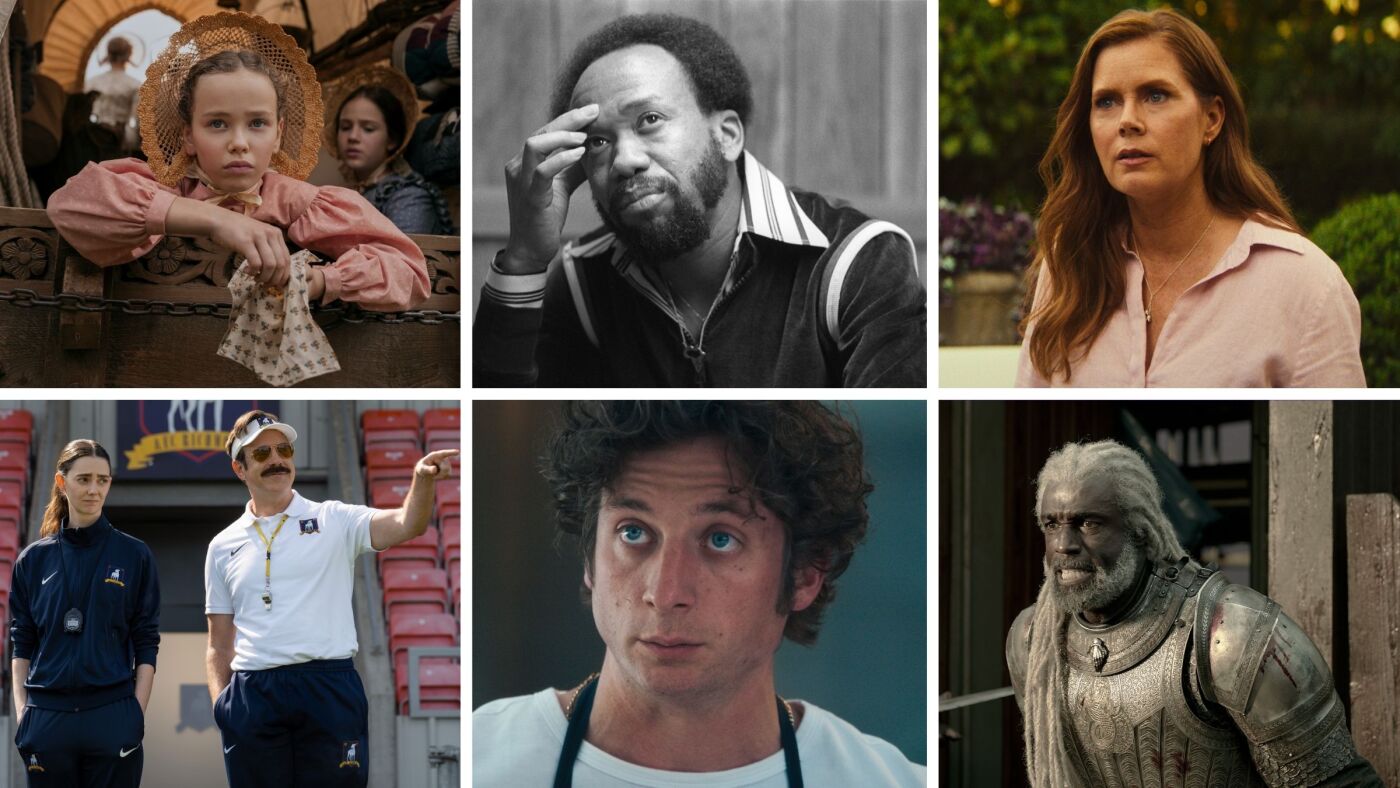
Clockwise from top left: Little House on the Prairie; Earth, Wind & Fire (To Be Celestial vs. That’s The Weight Of The World); Cape Fear; House of the Dragon; The Bear; Ted Lasso.
Netflix; HBO; Apple TV; HBO; FX; Apple TV
hide caption
toggle caption
Netflix; HBO; Apple TV; HBO; FX; Apple TV
Summer is when people are trying to get away from screens — headed outside to enjoy weather and time off.
But in the modern age, TV never sleeps, so streaming and premiere television outlets have lined up a slew of attention-getting new and returning shows competing with vacations and sunny days over the next few months to pull in viewers and attention.
Fans can choose from remakes of classic films and TV shows like Cape Fear and Little House on the Prairie, the final season of FX’s fading dramedy The Bear, Larry David’s intriguing new HBO project made with Barack and Michelle Obama’s Higher Ground productions and the return of a series many fans thought was over and done with — Apple TV’s hit comedy, Ted Lasso.
Here’s a look at what’s coming when, and why it matters:
Cape Fear, Apple TV, June 5
YouTube

It’s tough to imagine an actor who could bring a creepier vibe than Robert DeNiro in 1991’s film thriller Cape Fear — playing a wiry, pathological felon who blamed his public defender for purposefully tanking his case. But Javier Bardem is that actor, raising the stakes for Apple TV’s modern streaming series with a deliciously wily performance as Max Cady — a man exonerated after serving 17 years in prison for murder. Amy Adams is Anna Bowden, the former public defender who defended Cady, but wound up marrying the prosecutor that put him away, raising all kinds of suspicion over how she handled his case. Lots of it is preposterous and heavy-handed, but Bardem plays Cady with more intelligence and sophistication than DeNiro’s version, dismantling his former lawyer’s perfect life with horrifying glee. Toss in as executive producers Steven Spielberg and Martin Scorsese — who directed the 1991 version, itself a remake of a 1962 classic — and you’ve got a powerful combination.
Earth, Wind & Fire: (To Be Celestial vs That’s the Weight of the World), HBO and HBO Max, June 7
YouTube
R&B stars Earth, Wind & Fire provided the soundtrack for Black America in the late 1970s — a hit machine which cranked out classics like “Shining Star,” “That’s the Way of the World” and “September,” courtesy of driven bandleader Maurice White. Tonight Show bandleader Ahmir “Questlove” Thompson — who has made a name as a Oscar-winning documentarian with groundbreaking films on the 1969 Harlem Cultural Festival, the music of Saturday Night Live and Sly Stone — offers a relatively traditional look at the band’s story. He covers all the bases in the arc of White’s own story, from his roots as a drummer for jazz legend Ramsey Lewis, to his eventual death in 2016 due to complications from Parkinson’s disease. But with on camera sources ranging from Barack and Michelle Obama to Stevie Wonder — who reveals how “Shining Star” inspired the writing of his hit, “I Wish” — Thompson still manages an enlightening, compelling story.
House of the Dragon Season 3, HBO and HBO Max, June 21
YouTube
This feels like a make-or-break season for HBO’s Game of Thrones spinoff, following a lackluster collection of episodes last year which some critics — OK, me — lambasted for too little forward motion. Based on events in the Game of Thrones prequel novel Fire & Blood, this season focuses on a bloody civil war between two factions, the Blacks and the Greens, for rule over the fictional continent of Westeros. Early press indicates this season will feature lots of dragons and epic battle action, which seems necessary. It’s been two years since the second season, so that level of spectacle might be needed to remind viewers about this long-running franchise.
The Bear Season 5, Hulu, June 25

FX’s towering dramatic comedy will present its final season here, dropping its last eight episodes at once. It’s an opportune moment to conclude the story of driven chef Carmy Berzatto’s bruising efforts to build a Michelin starred restaurant from his family’s humble hole-in-the-wall Italian beef shack in Chicago. The show has a maddening habit of presenting standout episodes even during mediocre seasons. But critics have cooled on a show where the number of unspectacular episodes has grown and the latest plot twist — Jeremy Allen White’s Carmy deciding to leave the restaurant, forcing the family of workers he assembled to seek that Michelin star without him — feels perilously close to a Hail Mary pass thrown by writers running out of ideas.
Life, Larry and the Pursuit of Unhappiness: An Almost History of America, HBO and HBO Max, June 26
YouTube
Higher Ground, the production company founded by Barack and Michelle Obama (Rustin, Leave the World Behind), takes its biggest swing yet here — producing a sketch series from Curb Your Enthusiasm star Larry David. The show celebrates America’s 250th anniversary a little differently, offering seven episodes filled with sketches lampooning key historical moments, featuring David — whose history as a failed writer for Saturday Night Live might not inspire loads of confidence. Still, the Obamas have assembled an impressive track record as producers and David remains a quirky, effective comedic voice who could have easily sat back on his Curb laurels, rather than offering a bold counterpoint to the official celebrations of America’s history.
Little House on the Prairie, Netflix, July 9
YouTube
Gen Z viewers likely don’t know the original series which dominated ratings back in the mid-’70s and early ’80s, featuring Michael Landon as the patriarch of a family struggling to establish a home in Minnesota during the late 19th century. Netflix’s series returns to the largely autobiographical books written by novelist Laura Ingalls Wilder as inspiration, featuring the family struggling to stay together after moving to Kansas not long after the Civil War. The initial series debuted on NBC back in 1974, when family-oriented shows like The Waltons were still popular. But will today’s streaming audiences embrace a series which brings a modern lens to questions of slavery and white people moving into the American west?
Star Trek: Strange New Worlds Season 4, Paramount+, July 23
YouTube
It’s one of TV’s longest-running science fiction franchises, celebrating its 60th anniversary this year. But the future of Star Trek remains uncertain, as Paramount finishes production on two live action Trek series, with no new iterations yet planned for TV or film. This season of Strange New Worlds — centered on the adventures of the Starship Enterprise before the days of Captain Kirk depicted in the original series — is the second-to-last batch of episodes for the series, which will end with an abbreviated fifth season. Strange New Worlds has a bit to prove, coming off a third season largely considered a disappointment by many fans. Ultimately, producers have admitted the show will conclude with Kirk taking the captain’s chair — but it’s going to take a lot of attention-getting episodes to get there.
Ted Lasso Season 4, Apple TV, Aug. 5
YouTube
Many fans thought this series effectively ended after its third season back in 2023, when the show’s folksy lead character returned home to America after leading a British soccer team to success. But never underestimate TV’s urge to keep tapping into a hit — star and executive producer Jason Sudeikis found a new story to tell about Coach Lasso, who returns to lead a second division women’s football team in Britain. Over its first three seasons, the show emerged as one of Apple’s most successful series, with a slew of Emmy, Golden Globe and Critics Choice awards. This fourth season will have to answer a new question: Can lightning strike twice for the same series?
Lanterns, HBO and HBO Max, Aug. 16
YouTube
This series offers a chance to reinvent one of DC Comics most beloved superheroes for today’s TV scene, casting Friday Night Lights alum Kyle Chandler as Hal Jordan — a grizzled hero with a power ring capable of creating any construct from the energy of his will. Jordan is a Green Lantern, part of a corps of intergalactic space cops handed the rings by a powerful group of immortal beings. That all sounds like a lot for a streaming TV series; initial teasers for the show focus on Jordan’s work training/vetting new Lantern candidate John Stewart, played by Aaron Pierre. The two will work to investigate a murder on Earth in an uneasy alliance which feels an awful lot like the first season of HBO’s True Detective — balancing a gritty, authentic environment with a ring that allows flight, space travel and lots of superheroic adventures. This superhero nerd absolutely cannot wait to see where it all goes.


-

 North Dakota3 minutes ago
North Dakota Air National Guard’s 119th Wing to hold readiness exercise June 8-12 in Fargo – KVRR Local News
-

 Ohio10 minutes ago
Body found during search for missing kayaker
-

 Oklahoma13 minutes ago
Disaster emergency declared for multiple counties in eastern Oklahoma following floods
-

 Oregon18 minutes ago
4-star EDGE K.J. Green snubs Oregon, commits to LSU on official visit
-

 Pennsylvania25 minutes ago
Kathleen H. Anzalone, New Castle, PA
-

 Rhode Island28 minutes ago
Moses Brown showed up late, but it was still ready to win a title.
-

 South-Carolina33 minutes ago
Former South Carolina quarterback Stephen Garcia shares cancer treatment update
-

 South Dakota40 minutes ago
South Dakota Mines plans $6M geology field station in Nemo

